eBook - ePub
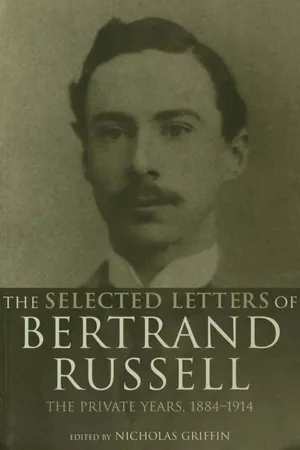
The Selected Letters of Bertrand Russell, Volume 1
The Private Years 1884-1914
- 584 pages
- English
- ePUB (mobile friendly)
- Available on iOS & Android
eBook - ePub
About this book
Those who knew the famous philosopher Bertrand Russell at the turn of the century referred to him as 'the Day of Judgement'. This acclaimed selection of his early letters, available in paperback for the first time, reveals the full scope of Russell's life and innermost thoughts up to the First World War. It includes letters to his first wife, Alys Pearsall Smith, reveals the background to his now famous work in philosophy and the foundations of mathematics and how his mind was stirred by socialism, free trade and votes for women. It also contains letters on his famous affair with Ottoline Morrell, providing yet another insight into one of the great intellectual figures of the twentieth century.
Information
1 CHILDHOOD AND YOUTH
(1884–93)
The earliest of Russell's letters to have survived are three to his brother, Frank, written in 1884, the third of which is printed below. It was written while Russell was staying near his Uncle Rollo's house, Dunrozel, at Hindhead on the Surrey–Sussex border. Each summer during Russell's childhood, he and other members of the Pembroke Lodge household would spend three months at Hindhead. Rollo Russell (1849–1914) was Lord John Russell's third son. ‘Auntie’, Lady Agatha Russell (1853–1933), was Lord John's youngest daughter. Her engagement, to which Russell refers, was broken off when she became subject to insane delusions. She lived at Pembroke Lodge, a victim of her mother's virtue according to Russell (Autobiography, vol. I, p. 26).
1
Oeborne, Fernhurst,
Sussex
14 September 1884
My dear Frank
Granny told me I'd better write to you whilst I was heare [sic] at Oeborne. I came here on Monday and I'm going home again today. What do you think of Auntie's engagement? I can't bear it of course. Auntie says one ought to think of it as one more person to love, but then Auntie will go away.
Last Saturday Uncle Rollo, M. Rochat1 and I went to the Isle of Wight; it was very nice indeed there. We started by the 10.49 from Haslemere, and got to Ryde, and from there we went to Bembridge, which is very pretty. We went to the sea-shore, where the tide was coming in very fast. Then we went to see the Roman Villa which was very interesting. There were big nails and beautiful mosaics and broken vases, and the skelletons [sic] of a Roman and a horse, found in an old well near there, and supposed to have been thrown in by the Britons when the Romans were leaving at the same time that they burnt the villa. Uncle Rollo has had all his potatoes dug up; there are a frightful lot. He's only going to keep two pigeons for the future, which is a great pity.
Goodbye
Your loving brother,
Bertie
Of all the members of his family it was Uncle Rollo for whom Russell as a child had the greatest affinity. Russell's biographer describes him as ‘an amiable and uncomplaining man’ (Clark, Russell, p. 34). Rollo lived mainly at Pembroke Lodge from 1886, after the death of his first wife, until he remarried in 1891. He had given up a career in the Foreign Office owing to poor eyesight, and thereafter spent his time as an amateur scientist. He published a number of books on meteorology and medical matters, as well as the book of poems, Break of Day, which Russell refers to in letter 6. Like that of many Victorian amateurs, his work was well respected and he had contacts with some of the leading scientists of his day. He took Bertie to meet the physicist John Tyndall, for example. Rollo Russell's encouragement during the years he lived at Pembroke Lodge helped shape his nephew's scientific interests.
Despite their closeness, Russell's letters to his uncle seem curiously stilted. In part this must have been due to his age and the Victorian rigidity of family relations at Pembroke Lodge. In part, however, it was the result of the excessive shyness of both correspondents. All his life, according to Russell, Rollo suffered from ‘a morbid shyness so intense as to prevent him from achieving anything that involved contact with other human beings’ (Autobiography, vol. I, p. 24). Bertie's shyness, by contrast, was overcome once he had left Pembroke Lodge.
Russell's first letter to his uncle was written shortly after his thirteenth birthday. Rollo was then living at Dunrozel with his first wife, Alice Sophia. It gives a brief glimpse of Russell's daily life at Pembroke Lodge with his tutors. Mr Quirke was attempting to teach Russell to play the violin.
2
Pembroke Lodge
7 June 1885
Dear Uncle Rollo
We got here all right on Thursday, in time for tea, and found that Mr Marshall, the new tutor, had already come. He seems very nice indeed. We had some lawn-tennis the day before yesterday, but yesterday it was so wet that the lines have almost entirely disappeared. He plays very well. I believe he's got about half a dozen silver cups which he got for matches. In three sets I didn't win a single game.
Have you seen any more adders? or found any lark's nests. The things in my kitchen garden are doing very well, the rain yesterday brought them forward immensely.
I hope Andrews will be able to catch the two hens soon, because otherwise I'm afraid they won't breed here at all this year.
Mr Quirke came yesterday, and he thinks I have fallen back seriously from not practising for so long.
There is not time to write any more as it's time to go to church. Please give my love to Aunt Alice.
Your loving nephew
Bertie
Russell's Christmas letter of 1886 introduces various members of his family for the first time. ‘Grandmamma Stanley’ was Russell's maternal grandmother, Henrietta Maria, Lady Stanley of Alderley (1807–95). She lived with her unmarried daughter, Maude, in a large house on Dover Street in London. She was a rather intimidating personage to the young Russell, who later described his desperate efforts to make a good impression on her. The only occasion on which they were successful was when he asked her for a copy of Tristram Shandy as a birthday present. On one occasion she sighed in despair, ‘I have no intelligent grandchildren’ (Autobiography, vol. I, pp. 32–3). ‘Granny’, Lady Frances Anna Maria Elliot, the dowager Countess Russell (1815–98), was Russell's other grandmother, Lord John Russell's second wife. She was mainly responsible for Russell's upbringing at Pembroke Lodge. Russell described her as ‘Liberal in politics and religion … but extremely strict in all matters of morality’ (Autobiography, vol. I, p. 20).
Rollo Russell's wife had died earlier in the year giving birth to a son, Arthur Russell (1886–1943). Rollo, together with his son, always referred to at this time as ‘Baby’, had moved back to live in Pembroke Lodge. At the time the letter was written, Rollo was evidently holidaying in Nice.
3
Pembroke Lodge
Christmas 1886
Dear Uncle Rollo
My letter will be too late to wish you a merry Christmas, but I will wish you a happy New Year. I am very sorry I never saw you to say goodbye; I did not know you were going till I was at Dover Street. I suppose it is very warm at Nice, isn't it? We have had skating here; to-day it is a splendid morning with a west wind and a hoar frost on the ground.
Jemmie1 has gone home to Yorkshire for his holidays, and Ernest2 stayed here a few days. Mr Ewen3 has gone to Plymouth for a fortnight's holiday, so I am alone in the schoolroom. Auntie has given me a splendid book, called A Child of the Revolution, by the author of the Atelier du Lys.1 Grandmamma Stanley gave me a Shakespeare, one in small volumes in a case; about as fine an edition as possible. Wasn't that a magnificent present?
Neither Granny nor Auntie has caught cold, in spite of the cold weather.
My examination finished on Friday,2 and I have holidays now till Mr Ewen comes home, which is a very pleasant change.
It is curious how few holly-berries there are this year; I don't think I have seen one about the place. There are very few decorations about the house this year; I haven't even decorated the schoolroom, I didn't think about doing it till this morning.
It is a pity they are so slow telling one about the result of the Exam; they don't let one know till March; by that time all the excitement is over. It is time to get ready for church now, so goodbye
Your loving
Bertrand Russell
P.S. Baby is very flourishing, and has learnt a lot of tricks, such as blowing the candle when he's told, clapping his hands, and a lot of things like that. I think blowing the candle is quite a new thing.
Aunt Agatha twice took Russell to visit Ireland, where he remembered going for walks with Michael Davitt, the nationalist leader who founded the Irish Land League. Russell's letter to his uncle from Ireland shows an entirely conventional interest in the scenery and a more unconventional interest in the politics of the country, then entering a phase of repression after the defeat of Gladstone's first Home Rule bill. It says much for the advanced political opinions of Pembroke Lodge that Auntie should want to play Irish revolutionary songs on the piano.
Powerscourt, in County Wicklow just south of Dublin, was a large estate, originally the site of a castle, but in 1887 occupied by a fine eighteenth-century mansion. The Dargle, a mountain stream that bounds the property, flows over a 400-ft cliff in the deer park to form one of the highest single-drop waterfalls in the British Isles.
4
Breslin's Hotel
7 August 1887
Dear Uncle Rollo
I have just got Granny's letter; please thank her very much for it. I think Auntie is going to write to her to-day.
We have had most lovely weather ever since we came, and it has never been too hot because of the sea.
Yesterday we drove to Powerscourt, which is a most lovely place. It began by a few drops of rain in the morning, but our usual driver wa...
Table of contents
- Front Cover
- Title Page
- Copyright
- CONTENTS
- List of Illustrations
- Preface
- Introduction: Some Family Background
- 1 Childhood and Youth (1884–93)
- 2 Engagement (1893–4)
- 3 ‘A Life of Intellect Tempered by Flippancy’ (1895–1901)
- 4 New Crises (1901–2)
- 5 ‘The Long Task of Thought’ (1903–11)
- 6 New Love (1911–14)
- Appendix: Granny to Bertie
- Bibliographical Notes
- Index
Trusted by 375,005 students
Access to over 1.5 million titles for a fair monthly price.
Study more efficiently using our study tools.
Frequently asked questions
Yes, you can cancel anytime from the Subscription tab in your account settings on the Perlego website. Your subscription will stay active until the end of your current billing period. Learn how to cancel your subscription
No, books cannot be downloaded as external files, such as PDFs, for use outside of Perlego. However, you can download books within the Perlego app for offline reading on mobile or tablet. Learn how to download books offline
We are an online textbook subscription service, where you can get access to an entire online library for less than the price of a single book per month. With over 1.5 million books across 990+ topics, we’ve got you covered! Learn about our mission
Look out for the read-aloud symbol on your next book to see if you can listen to it. The read-aloud tool reads text aloud for you, highlighting the text as it is being read. You can pause it, speed it up and slow it down. Learn more about Read Aloud
Yes! You can use the Perlego app on both iOS and Android devices to read anytime, anywhere — even offline. Perfect for commutes or when you’re on the go.
Please note we cannot support devices running on iOS 13 and Android 7 or earlier. Learn more about using the app
Please note we cannot support devices running on iOS 13 and Android 7 or earlier. Learn more about using the app
Yes, you can access The Selected Letters of Bertrand Russell, Volume 1 by Nicholas Griffin in PDF and/or ePUB format, as well as other popular books in Filosofía & Biografías filosóficas. We have over 1.5 million books available in our catalogue for you to explore.