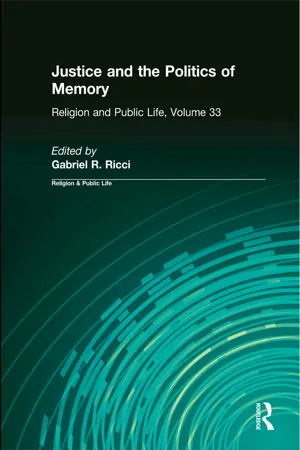
Memory is not a mere repository for past events. This was Henri Bergson's fundamental claim about consciousness. In distinguishing our psychic constitution by its sense of the past, Bergson differentiates our perception of time from a process in which one instant merely replaces another. While Bergson cast his ideas in terms of the biological sciences, his analysis did not neglect the moral impulse that accompanies the condensation of history with which we continuously live. Classifying human existence in this way bears on ethical and political questions. How such questions can plague the memory of a people and the entire human community is addressed in Justice and the Politics of Memory. The contributors explore the manner in which cultural and psychic violation undermine collective identity, and destroy traditions. They raise troubling questions on how recompense and reconciliation is possible after abominable wrongs have been systematically perpetrated against a community. Faced with the burden of memory, those committed to the righting of wrongs are faced with pursuing an elusive justice that sometimes includes levying reparations and memorializing horrific historical episodes. Guided by the muse of forgiveness, restoration and a more harmonious future are likely to be rooted in the sources of spirituality that had been previously eclipsed by the conquering and homogenizing historical processes. This volume includes Heribert Adam's "Collective Reckoning with a Criminal Regime," Jeffrey Olick's "Lessons from and for Germany," James Hatley's "Levinas, Witness and Politics," James E. Young's "Germany's Holocaust Memorial Problem--and Mine," Tim Giago's "Killing the Indian to Save the Child: The Near Death of Spirituality," Jordan B. Peterson's and Maja Djikic's "Running Ahead: You Can Neither Remember Nor Forget What You Do Not Understand," Derick Wilson's "Where Religion Confuses yet Faith Gives Hope: Conflict Resolution in Northern Ireland," and Leonard Kaplan's "Justice Perfected: Cinematic Exemplifications," and an introduction, "Morality and Memory," by the editor.
- 157 pages
- English
- ePUB (mobile friendly)
- Available on iOS & Android
eBook - ePub
Justice and the Politics of Memory
About this book
Trusted by 375,005 students
Access to over 1.5 million titles for a fair monthly price.
Study more efficiently using our study tools.
Information
Print ISBN
9781138526723
Subtopic
Holocaust HistoryYou can Neither Remember nor Forget what You do not Understand
Jordan B. Peterson and Maja Djikic
On June 28, 1914, a radical Serbian youth-group member, Gavrilo Princip, assassinated the Archduke Franz Ferdinand, heir to the Habsburg Empire, and plunged Europe into the First World War. Seventy-five years later to the day, the president of Serbia, Slobodan Milosevic, roused his people to combat in a speech before thousands of his supporters, gathered to commemorate the 600th anniversary of the Battle of Kosovo (1389) – an event that served as the focal point of a powerful collective Serbian sense of victimization and entitlement. “After six centuries,” Milosevic told the enthusiastic crowd, “we are again engaged in battles and quarrels. They are not armed battles, but this cannot be excluded yet” (Malcom, 1996). The memory Milosovic invoked, mystified and distorted through the intermediary centuries of “unjust hardship” suffered by the Serb people, served to justify Serbian attempts to regain territory they felt unfairly deprived of. Milosevic proved exceedingly successful in exploiting this memory to rouse the aggressive defensiveness of his people, and in manipulating them into pundering and murdering in Bosnia and Croatia in the following years.
Memory is vulnerable, easily distorted to fit beliefs and modes of action that are more expedient than accurate. When the process of remembering becomes collective, such distortion may be greatly increased. Collective memories are acquired and transmitted in a social context, and are therefore the modifiable property of many people (De La Ronde and Swann, 1998; Hardin and Higgins, 1996; Rosenthal and Rubin, 1978; Snyder, 1974). The tendency towards social modification, which can serve positively to unite the members of a group, has a very negative, dangerous, underground aspect. Individuals appear somewhat constrained in their willingness to inflict destruction (or at least in the power to do so). Groups of individuals are not. The dangers of self-deception about past events, far from trivial in the personal case, are tremendously magnified in the social arena. The careless use of memory can lead directly to the grave abuse of people.
Group identity, like individual identity, is shaped by the past. Shared concepts, experiences, and memories bind individuals together, and provide them with an implicit, collective frame of reference (Pennebaker et al., 1997; Peterson, 1999a). Such collective frames of reference help group members understand their individual fates, communicate easily with other group members, and lay out collectively acceptable future plans. However, the memories upon which collective identity is based are prone to distortion, and groups, like individuals, frequently modify their memories, in the attempt to keep their self-images morally apposite and pristine (Baumeister and Hastings, 1997). Each of the several steps involved in the essentially reconstructive process of memory (Bartlett, 1932) can serve as an occasion or opportunity to alter the original event (Igartua and Perez, 1997) – often, in a self-serving manner. The record of the event is first inevitably condensed. Inopportune details may be omitted or suppressed, while those that show the group in a positive light are stressed. Then the story is elaborated. Events are incorporated into the account that may not have even been associated with the original story or sequence of events. Finally, and most importantly, the modified memory may be utilized or applied in a context that most particularly justifies present strongly motivated beliefs and actions of the group. Representations of presumed events far removed in time are particularly prone to these forms of distortion, as the effects of reconstruction accrue across generations.
The collectively constructed memory of the Battle of Kosovo, for example – used by Milosevic and other Serb nationalists to justify attempts to take over parts of their neighboring countries – accentuated the victimization of the Serbian people, while omitting all reference to the somewhat equivocal actual outcome of the Kosovo battle. Nationalist Serbian leaders agitating for war also consistently implied that the Serbs faced great threat, and proposed that such threat could be confronted pre-emptively in armed battle (Malcom, 1996). Appeal to past or present victimization to rationalize current atrocity appears a far from uncommon and impressively effective technique for rousing hatred (Staub, 1997). Recently, for example, Hutu journalist Leon Mugesera applied the rhetoric of past and potential victimization while delivering a speech at a rally in Northern Rwanda. He told his Hutu audience that the Tutsis with whom they had lived for generations originally descended from Ethiopia (a conjecture introduced by the nineteenth century English explorer Speke) to heighten out-group bias and to incite rage against them as intruders from another country (Off, 2000). Mugesera also warned of potential threat to justify current attacks of Hutus on their Tutsi neighbors. “Know that the person whose throat you do not cut now will be the one who will cut yours,” said Mugesera (Off, 2000: 18). What he may have lacked in subtlety, Mugesera made up for in effectiveness. Within four years, 800,000 Tutsis were massacred.
Complete and accurate historical accounting might contribute to genuine reconciliation between individuals and groups previously or presently in conflict, at least in principle, and help to prevent outbreaks of future violence. But several obstacles, philosophical and practical, stand in the way of such completeness and accuracy. First, the only truly comprehensive representation of an event is the event itself. Any memory of an event must be, by contrast, incomplete, motivated and reconstructed. In consequence, there appears to be a fundamental conflict between the twin aims of coherence or comprehensibility of representation and correspondence with reality in memory construction. This conflict exists because of the necessarily paradoxical relationship that obtains between the tremendous complexity of remembered events, and the inevitably filtered and narrowed viewpoint of the limited individual observer. The very idea of historical truth has therefore has become subject to serious questioning. Furthermore, even if the existence of some transcendent and absolute historical truth is granted, provisionally, it is still very difficult, practically, to set up the circumstances so that the truth can be discovered – so that all the relevant participants in a given cultural or historical circumstance have the opportunity to tell their particular stories, and to have them incorporated into some coherent and accurate representation of the past.
It is, in consequence of these difficulties, a simple matter to deem all the participants in a given conflict as equally right, morally, equally pursuing their own valid historically determined visions of reality and justice. Since the Nuremberg trials, however, civilized societies have adopted the idea that certain modes of behavior are wrong – axiomatically wrong. This means that individuals and groups do not all necessarily stand equidistant from the truth, although they still retain some unspecified but implicit right to their own idiosyncratic views of a given event. So how might truth be conceptualized, in some manner useful to a discussion of truth and justice, given the troublesome problem of historical veridicality, the necessarily motivated stance of the observer, and the absolute impossibility of full “objective” representation?
The Frame and the Picture: Who Calls the Shots, and Why?
The presumption that the individual human mind operates like a videotape recorder, dispassionately observing the flow of ongoing events, and producing a permanent, objectively verifiable account of those events, appears natural, even self-evident. However, this intuitively appealing account – the “tape recorder fallacy” (Neisser, 1982) – is clearly inadequate, empirically and metaphorically. The sheer volume of information comprising any given sequence of events is so overwhelming that it cannot be comprehensively recorded, even in principle (Medin and Aguilar, 1999). The difficulty of coming to terms with such complexity is known, technically, as the frame problem. The frame problem, simply put, is this: how can a limited organism make realistic sense out of the unlimited information necessarily presented to it? Everything has to be simplified and modeled, without sacrificing “accuracy.” But how? The frame problem has presented a virtually insurmountable obstacle to the development of machines that can operate with even a modicum of independence in any real-world environment (Brooks, 1991a, 1991b), and forced a complete reconsideration of the idea of representation. It constitutes an equally immense barrier to the understanding of human perception and memory.
Every account of any event inevitably utilizes only a tiny fraction of the information that originally comprised that event. Even a video camera must have an operator – must have a motivated, active director who calls the shots. Calling the shots, in a particular situation, means continual determination of what processes and objects will be included in the record, and what elements will be ignored. “What to ignore” is precisely the most complex of cognitive problems, in the real world, since almost everything has to be ignored. This problem of “relevant object” and “irrelevant background” – and the problem of the biases any solution necessarily introduces – could apparently be solved by random sampling of the environment that is to undergo representation. However, the immense database that comprises the real world is so vast that a sample of appropriate representativeness would still be far too large to be manageable. How do you sample appropriately from a population of infinite size? Practically, therefore, randomness is of less than no value. Anyone who has switched a video-tape recorder on accidentally during a family event, for example, soon learns that the snippets of unfocused scenery and fragmented dialog thus registered manage to be simultaneously uninformative, uninteresting, incomplete, and incoherent.
The human solution to the problem of sampling is motivation. We are always engaged with the environment – are always “being-in-the-world” – and are never dispassionate observers. We are always pursuing the limited goals we construe as valuable, from our particular idiosyncratic perspectives. We pay attention to, and remember, those events we construe as relevant, with regards to those goals. We do not and cannot strive for comprehensive, “objective” coverage. This process of motivated engagement allows us to extract out and remember a world of productive predictability from the ongoing complex chaos of being.
In his book Searching for Memory (1996), Daniel Schacter goes to great lengths to demolish the long-standing myth of memory as literal recoding of reality (echoing Bartlett [1932] and Jung [1959]). Schacter portrays memory as an essentially paleontological exercise. We reconstruct our memories from fragments of experience, using our broader understanding to guide us, just as dinosaurs are reconstructed from scattered bone fragments, in keeping with the broad knowledge of those doing the reconstruction (Schacter, 1996: 40). The events we remember were originally registered, in accordance with our motivations at the time, and are further revised, in the present, in accordance with what we now feel, want, and believe. We are bound to ignore, suppress, distort or even entirely fabricate fundamental aspects of the transpiring stream of events (ibid., p.102) if our current desires and beliefs compel us to do so.
Ziva Kunda (1990) has proposed, analogously, that individuals generally posit truths they find desirable – although they remain somewhat constrained by the necessity of mustering up evidence that supports those truths. This means at least that a balance must be struck between motivation and accuracy. People who wish to draw a particular conclusion attempt to be rational, at least post-hoc, and are therefore driven to construct a justification of their conclusion that might persuade a dispassionate observer. This means that people draw upon memories for facts and experiences that might support their desired conclusion, and that they creatively combine aspects of what they already know to develop new and supportive evidence, in favor of the views they currently espouse. She reviews evidence suggesting that this process is far from objective, as individuals fail to realize (1) that their conclusions are biased by their goals; (2) that a small and delimited subset of their personal knowledge is being pulled into play; (3) that alternative goals might draw out different aspects of memory; and (4) that completely different or even opposing conclusions might be accepted under alternative circumstances (see also Kruglanski, 1980; Pyszczynski and Greenberg, 1987; Pyszczynski, Greenberg, and Holt, 1985).
Such problems of motivated memory and reasoning become even more complex when the issue is not so much what physically happened in the past as the meaning of what happened. We can make tentative steps, after all, towards an objective accounting for certain events and processes. We can calculate to the second when a solar eclipse occurred a century ago, and we can specify to the meter where it could be observed. We cannot describe the psychological impact of the eclipse, however, with equal certainty. Consider, first, the immense difficulty of acceptably reconstructing an interpersonal event, such as a currently unresolved argument between two people. Then consider the difficulties in determining an acceptable account of something as complex as a war. Every individual battle must not only be noted, objectively – and portrayed in relationship to an ever-expanding net of relevant contextual information – as well as described in terms of its meaning, its implications for action and interpretation. It is no wonder that history is written by the victor.
Memory is not, therefore, and cannot be, an objective record of the past. There can be no memory without a subjective observer, and there is no subjective viewer who lacks a motivated viewpoint. All interpretations are therefore motivated, biased, if not by outright ideological concerns, then at least by a series of implicit decisions about where limited attentional resources might best be utilized. What does “best” mean, in such a context? How can memory be discriminated from fiction, since it is by necessity ...
Table of contents
- Cover
- Half Title
- Title
- Copyright
- Contents
- Introduction
- Divided Memories: Reckoning with a Criminal Regime
- The Value of Regret: Lessons from and for Germany
- Nameless Memory: Levinas, Witness, and Politics
- Germany's Holocaust Memorial Problem—and Mine
- Killing the Indian to Save the Child: The Near-Death of Spirituality
- You Can Neither Remember nor Forget what You do not Understand
- Where Religion Confuses Yet Faith Gives Hope: Conflict Resolution in Northern Ireland
- Justice Perfected: Cinematic Exemplifications
- Contributors
Frequently asked questions
Yes, you can cancel anytime from the Subscription tab in your account settings on the Perlego website. Your subscription will stay active until the end of your current billing period. Learn how to cancel your subscription
No, books cannot be downloaded as external files, such as PDFs, for use outside of Perlego. However, you can download books within the Perlego app for offline reading on mobile or tablet. Learn how to download books offline
We are an online textbook subscription service, where you can get access to an entire online library for less than the price of a single book per month. With over 1.5 million books across 990+ topics, we’ve got you covered! Learn about our mission
Look out for the read-aloud symbol on your next book to see if you can listen to it. The read-aloud tool reads text aloud for you, highlighting the text as it is being read. You can pause it, speed it up and slow it down. Learn more about Read Aloud
Yes! You can use the Perlego app on both iOS and Android devices to read anytime, anywhere — even offline. Perfect for commutes or when you’re on the go.
Please note we cannot support devices running on iOS 13 and Android 7 or earlier. Learn more about using the app
Please note we cannot support devices running on iOS 13 and Android 7 or earlier. Learn more about using the app
Yes, you can access Justice and the Politics of Memory by Gabriel R. Ricci in PDF and/or ePUB format. We have over 1.5 million books available in our catalogue for you to explore.