Art, value, law - the links between these three terms mark a history of struggle in the cultural scene. Studies of contemporary culture have thus increasingly turned to the image as central to the production of legitimacy, aesthetics and order. Judging the Image extends the cultural turn in legal and criminological studies by interrogating our responses to the image. This book provides a space to think through problems of ethics, social authority and the legal imagination. Concepts of memory and interpretation, violence and aesthetic, authority and legitimacy are considered in a diverse range of sites, including:
* body, performance and regulation
* judgment, censorship and controversial artworks
* graffiti and the aesthetics of public space
* HIV and the art of the disappearing body
* witnessing, ethics and the performance of suffering
* memorial images - art in the wake of disaster.
- 208 pages
- English
- ePUB (mobile friendly)
- Available on iOS & Android
eBook - ePub
About this book
Information
1 The capture of the subject
That illusion, in the final analysis, determines the laws of society cannot and must not be seen.(Luce Irigaray, Marine Lover of Friedrich Nietzsche)
I think an enlightened culture is one that respects the body and doesn't consider it a crime or put a body in jail just because there's an artist working with the nude in public.(Spencer Tunick)
Becoming image
It's 10 a.m. on a sunny Wednesday morning, and I'm lying naked on a rock at the end of the North Wharf under the Bolte Bridge in Melbourne. I'm in the middle of discovering that, as bell hooks (1995: 136) says, ‘writing about art, making art, is not the same as being the subject of art’.
I am naked on this rock because I'm one of more than 200 women who are being photographed by Spencer Tunick, the New York-based artist whose work centres on documenting nude individuals (either solo or as mass groups) in public spaces with photography and video.1 Tunick is in Melbourne for the Melbourne Fringe Festival, and as part of his nudeadrift project, which involves travelling around all seven continents, photographing people naked in public. In the last week, he has already had one installation: he hoped to gather approximately 3,000 people at dawn on the banks of the Yarra River (in fact over 4,000 participants turned up).
Today's event is a closed-to-media, women-only event. I found out about it just this morning, when Tunick called me, in response to my emailed request to carry out an interview with him. He has invited me to interview him afterwards. I turned up at the location — ambitiously called the ‘Oriental Gardens’ but in reality a concreted stretch of disused wharf past a series of warehouses — intending simply to observe the installation and take notes on what was happening, but now here I am, surrounded by strangers, all of us naked, holding a pose while Tunick shoots the scene.
The participants constitute a formidably diverse group of women. It is supposed to be an event for women aged over 35; most of those present are in the 35–40 age range, a few look younger, and there's a sizeable proportion of older women. The sun is shining fiercely, a strong breeze gusts up from the water. It looks as though there are well over 200 women here.
Upon my arrival, I introduced myself to Tunick. He said, ‘Feel free to join in if you like’. I was startled, then transfixed by the idea of sliding from critic into participant. I try to imagine myself taking my clothes off here, in the sun, in this group. I'm apprehensive, but I decided that I would do it. I watched Tunick checking out different sites for him to stand while taking the photographs. Eventually it was decided; he told the group that there will be three locations. We are to take our clothes off and walk to the first; then walk naked to the second; then walk back to our clothes and dress. We will then walk a few hundred metres to the third location, undress again, and pose for a final time.
Everything's ready, his assistant calls out for us to undress. Some women whoop loudly, others are laughing, there's a buzzing noise of excitement as we strip, bundling clothes into bags, stuffing watches and jewellery into pockets. I feel intensely aware of every piece of clothing and every movement necessary to remove it. The T-shirt pulled over my head. The jeans unbuttoned and bundled up. The act of undressing was never so self-conscious for me, so freighted with significance. I look at some of the people undressing around me: there's a tall woman who carries a naked baby with her. A group of three older women remove their clothes to reveal — on their lower backs, hidden in everyday life — tattoos. And I feel as though I am both exposing and hiding something: I'm eight weeks pregnant, and standing completely unclothed in public seems like a display of my internally transformed body, although no-one looking at me would yet be able to tell from my body's exterior.
We walk to the first location — rocks by the river's edge, directly under the massive Bolte Bridge ferrying traffic over our heads. Every step I take feels as though I am moving in slow motion. I feel the scratch of gravel under the soft soles of my feet. A film crew, which is documenting Tunick's progress around the world, is filming us.2 They are standing on the edge of the flowing river of naked women. I walk past one cameraman. I manage not to look at the lens.
We have been told to lie on the rocks, leaning back. Tunick calls instruc-tions: legs to be bent, legs to lean away from the camera, faces to be turned away. He repeats over and over: do not look at the camera. (Tunick's mass photographs are characterized by facelessness, the subjects' heads averted from Tunick's camera.) There are so many of us that we are lying very close to and sometimes touching each other. I'm leaning back on a stranger's lower legs; another stranger's haunches are inches from my face. Women are still laughing and chatting, the buzzing still sounds as we settle into the pose, then silence takes over as Tunick takes the photographs. Tunick takes the photographs and our status as objects of art becomes subjectified. We are the objects of the image and we also become subjects by way of the immensity of the act of lying naked on a rock in public in a group of strangers. The experience of becoming image is a movement of subjectification that interrupts the everyday sense of ourselves as individuals separated from the public and its gaze and institutions. Participation in Tunick's installation has enfolded each of us into public space and has infused that space with unexpected intimacy: the shrugging off of clothes, the touch of skin on skin, the immobility of the pose. The silence surrounds us; our bodies could not be less objectified in this moment, the result of a sequence of movements beginning with the removal of clothing, continuing through the walk to the installation location, and held, now, in the sovereign moment of the pose.
It's so quiet while Tunick takes the photographs. I can hear the wind rushing over us, the river paddling at the rocks, the traffic trudging overhead. I can hear my breath. The sun and breeze on my naked skin are shocking. Two hundred naked strangers hold a pose for several minutes. Tunick takes the photographs. It's over; Tunick tells us we can move, there's an outburst of cheering and clapping.
We repeat this twice more. From the rocks, we walk, gingerly over the rough ground, to a disused jetty, and lie down in rows upon the wooden planks. The jetty is covered in gravel; tiny fragments of glass glint in the dirt. I unfold my naked body and lie on my back, head turned away from the camera, feeling the harsh wood, tiny stones and rubble engrave themselves upon my skin. This is not a critical writing about art; instead, this is art as the writing of bodies, of my body.
The third location requires a longer walk, through a throng of wharf workers, and so we dress hurriedly in the basics of clothing (jeans but no underwear, T-shirt but no bra) and move to an open space which backs on to the glistening blue harbour, with the prongs of the city's buildings jutting along the horizon. At each location, the same phenomenon: a buzz of excitement, then, as Tunick takes the photographs, the uncanny, beautiful silence, followed by cheers and laughter. People dress and depart, returning to everyday life. Some remain naked, posing for snapshots with Tunick. Many, many women want to hug him and thank him.
Finally, the crowd is gone; Tunick, his assistants, the documentary film crew, myself, and some women who are going to pose in individual installations later in the day remain. We return to Tunick's hotel to do the interview. The film crew wants to film me interviewing Tunick, for possible inclusion of the scene in their documentary. And so I ask him questions and he answers, generously, thoughtfully. I have a brief list of questions to ask, with my usual interview technique being to use them as improvisational tools, so that I can move the interview in particular directions that seem interesting once the conversation has begun. However, the presence of the camera, silently swivelling between myself and Tunick, oscillating with each question and each answer, inhibits my thinking and I can feel myself getting more and more mechanical with the format, mind blanking as the answer comes, unable to generate impromptu questions. Tunick remains completely composed, but when it's over, I'm sweating and pink-faced. As I say my goodbyes, he returns to discussing with a prospective model the locations for his next installation. I'm left with the enigma of the ground's roughness against my body, of the soft air and the sunlight touching my skin, of the sudden open secret of two hundred naked bodies in a public place. I am writing about art, and I have just made myself the object of art. In the shift from subject to object, what affective dislocation has been achieved? In a performance that reconfigures the anonymous public sphere as intimate, what judgment is involved?
Art as performance: participation/regulation
Subject/object. It is simpler to occupy one side or other of that dividing line than to waver between the two. Attempting to interview Tunick while being filmed doing so was a brief and uncomfortable experience of that oscillation; however, Tunick's great achievement as an artist is that his work is premised upon offering individuals the uncanny experience of being simultaneously the object of the image and the subject of a performance. Tunick remains in control of the event and of the resulting image: it is he who selects locations, who dictates poses, who sets the time of day for the event. It is he who develops the film, crops the image, discards some in favour of others. As photographer, of course, he is the subject of the artistic process; the individuals he photo-graphs, whether alone or in their thousands, are objects of the camera's gaze.3 And yet: Tunick's photo-sessions are distinguished from those of other photographers by their performative dimension.4 In electing to photograph people nude in public spaces, Tunick asks of his models a willingness to put themselves on display, in an event existing prior to and independent of the final image. The performance begins as people disrobe and ends as they reclothe themselves. In between those two temporal points (akin to the opening and closing of curtains on a stage), the participants have redefined their bodily relationship to urban space and to other individuals and have enacted a discrete role in a brief drama which problematizes skin, concrete, strangeness and intimacy.
The performative dimension is perhaps the most significant aspect of Tunick's work. The finished images certainly attract attention: when exhibited, they are reviewed in the usual way as completed artworks, without much dwelling on the process of their production.5 However, in focusing on the product, these responses ignore the effort, risk and effects of how these artworks came to be. In accounts given (such as mine above) of posing for Tunick, individuals tend not to speak of the excitement or interest of contributing to an art object that will be displayed in a gallery or book. Rather, it is the experience of performing as nude bodies in public space that is found to be meaningful, remarkable, memorable, transformative. Participants in the Melbourne events described their experience as ‘one of the singularly most inspiring things I've ever done’;6 ‘it was beautiful’;7 ‘we were part of something more beautiful than it was possible to imagine before the event’;8 and ‘it made me feel good about being a human being’.9 One recounted:
There is a feeling of ridiculous, extravagant joie-de-vivre, of fraternal grins and sheepish acknowledgment of complicity. People jump up and down and hug themselves or if they're fortunate, hug a friend, and there is a sweetness, an innocence in this instinctive desire to keep the goose-bumps at bay. Without the accoutrements of class and status, you start thinking about abstract nouns like liberation and democratization.10
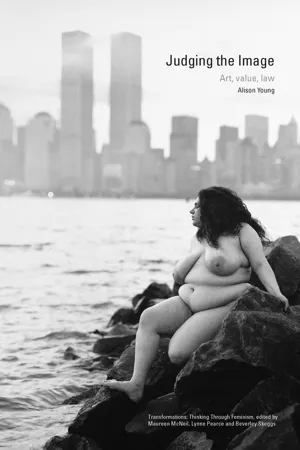
Participants in Tunick's massed events speak of their performance in terms of beauty, collectivity, personal affirmation and abstraction.11 Pleasure is found in the displacement of their individuality into the experience of belonging to a larger whole. In contrast, those who have posed for Tunick in his solo portraits describe the experience as a means of expressing something about themselves as individuals, often with a distinctly therapeutic component. The documentary film Naked States, which accompanied Tunick in his (successful) attempt to photograph individuals naked (alone or en masse) in every American state, features many models whose comments exemplify this: a woman in Boston states that posing for Tunick ‘was ninety per cent of [her] self-therapy’, after having been raped; an older man characterizes his decision to pose as a rejection of the conventions of ageing; and an obese woman, who has suffered constant public humiliation and physical assaults related to her bodily size, described posing naked for Tunick: ‘To be naked right before sunrise on the rocks at the Hudson River and the breeze was coming up — it was really wonderful’. Of the resulting photograph, she has stated:
For me, there is some privacy in the photograph … Not everyone is always poking at me and saying things to me and stopping me and grabbing me. So I think maybe I find a lot of pleasure in the sort of ‘public solitude’ of the photo.12
And these accounts would seem to confirm Tunick's objectives in undertaking this type of art practice; as he says, ‘I'm not trying to make spectacles. I'm trying to create art events that are spectacular for the participants’.13
For others, such as the police or municipal authorities, the performative dimension is also crucial, although in a far more troubling way than that experienced by the participants. For example, Tunick's attempts to take photographs in New York have repeatedly led to his being arrested.14 The first such occasion was in 1994, while Tunick was photographing a naked man posing on top of an 8-foot Christmas tree bauble alongside the famous Rockefeller Center Christmas tree. Another arrest came when Tunick was photographing two individuals in a snowstorm. The documentary Naked States depicts one of Tunick's mass installations (in Times Square) being interrupted as he is arrested by police officers, and also shows him facing charges of lewd behaviour and public exposure in court (which his lawyer succeeds in having dismissed). In all, Tunick had been arrested five times in New York, before a ruling was sought in the state courts as to whether Tunick's art practices were exempted from state laws banning public nudity. In 1999, however, police responses to Tunick's events were becoming more aggressive. On 25 April, Tunick was pulled away from his camera and handcuffed before he had even begun to photograph the dozens of people lying naked in Times Square.15 Charges on this occasion included unlawful assembly, creating a violent act, disorderly conduct, public exposure and reckless endangerment. And on 6 June, when Tunick and the participants arrived to begin the installation, police officers were already waiting for him, displaying handcuffs and an extensive line-up of police wagons, making it clear that if Tunick attempted to take photographs he, and perhaps the participants, would be arrested.
As a result, Tunick's lawyer, Ron Kuby, filed for an injunction preventing the New York Police Department and the City of New York from arresting him as he worked. The injunction was granted by the Federal District Court, and Tunick's next installation was scheduled for 18 July. The City of New York, however, obtained a stay of the injunction at an emergency court hearing on 17 July, and the event was thus prevented from taking place as planned, although Tunick photographed a hundred clothed participants and one naked baby. Police officers stood by i...
Table of contents
- Cover
- Half Title
- Full Title
- Copyright
- Contents
- List of figures
- Acknowledgements
- 1 The capture of the subject
- 2 Aesthetic vertigo: disgust and the illegitimate touchings of art
- 3 Written on the skin of the city
- 4 Disappearing images and the laws of appearance
- 5 The art of injury and the ethics of witnessing
- 6 All that remains: image in a place of ruin
- Notes
- Bibliography
- Index
Trusted by 375,005 students
Access to over 1.5 million titles for a fair monthly price.
Study more efficiently using our study tools.
Frequently asked questions
Yes, you can cancel anytime from the Subscription tab in your account settings on the Perlego website. Your subscription will stay active until the end of your current billing period. Learn how to cancel your subscription
No, books cannot be downloaded as external files, such as PDFs, for use outside of Perlego. However, you can download books within the Perlego app for offline reading on mobile or tablet. Learn how to download books offline
Perlego offers two plans: Essential and Complete
- Essential is ideal for learners and professionals who enjoy exploring a wide range of subjects. Access the Essential Library with 800,000+ trusted titles and best-sellers across business, personal growth, and the humanities. Includes unlimited reading time and Standard Read Aloud voice.
- Complete: Perfect for advanced learners and researchers needing full, unrestricted access. Unlock 1.5M+ books across hundreds of subjects, including academic and specialized titles. The Complete Plan also includes advanced features like Premium Read Aloud and Research Assistant.
We are an online textbook subscription service, where you can get access to an entire online library for less than the price of a single book per month. With over 1.5 million books across 990+ topics, we’ve got you covered! Learn about our mission
Look out for the read-aloud symbol on your next book to see if you can listen to it. The read-aloud tool reads text aloud for you, highlighting the text as it is being read. You can pause it, speed it up and slow it down. Learn more about Read Aloud
Yes! You can use the Perlego app on both iOS and Android devices to read anytime, anywhere — even offline. Perfect for commutes or when you’re on the go.
Please note we cannot support devices running on iOS 13 and Android 7 or earlier. Learn more about using the app
Please note we cannot support devices running on iOS 13 and Android 7 or earlier. Learn more about using the app
Yes, you can access Judging the Image by Alison Young in PDF and/or ePUB format, as well as other popular books in Art & Art Theory & Criticism. We have over 1.5 million books available in our catalogue for you to explore.