- 216 pages
- English
- ePUB (mobile friendly)
- Available on iOS & Android
eBook - ePub
About this book
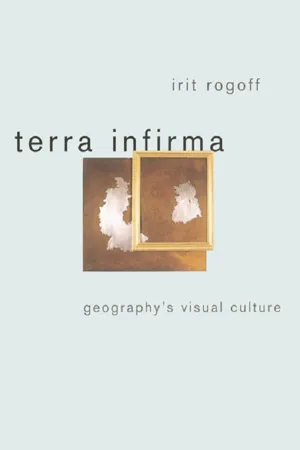
How have issues of place and identity, of belonging and exclusion, been represented in visual culture? Irit Rogoff uses the work of contemporary artists to explore how art in the twentieth century has confronted issues of identity and belonging.
Trusted by 375,005 students
Access to over 1.5 million titles for a fair monthly price.
Study more efficiently using our study tools.
Information
Chapter 1
Subjects/places/spaces
Wailing / positionality
‘WHERE DO I BELONG‘ seems to be the question that plagues so many of the discussions I participate in. As a constant lament it refers to dislocations felt by displaced subjects towards disrupted histories and to shifting and transient national identities. Equally, it refers to university departments and orders of knowledge, to exhibiting institutions and market places and, not least, to the ability to live out complex and reflexive identities which acknowledge language, knowledge, gender and race as modes of self-positioning.
It is one of those misguided questions which nevertheless serve a useful purpose, for while it may naively assume that there might conceivably be some coherent site of absolute belonging, it also floats the constant presence of a politics of location in the making. This very act of constant, plaintive articulation serves to alert to the processes by which identity comes into being and is permanently in flux. As a quest(ion) it brings to mind a memorable sentence from Salman Rushdie’s ‘Outside the Whale’ in which he advocates taking issue with George Orwell’s assumption that there is an inside in which to be passively swallowed up. ‘In place of Jonah’s womb, I am recommending the ancient tradition of making as big a fuss, as noisy a complaint about the world as is humanly possible. Where Orwell wished quietism, let there be rowdyism; in place of the Whale, the protesting wail.’16 Therefore the geography I am examining, so totally outside the whale, is the geography of keening and wailing, of trying to find both articulation and signification for that constant unease between efforts at self-positioning and the languages and knowledges available for us to write these into culture. It is an unease inscribed both with a sense of loss of that earlier seamless emplacement we might have thought we had and with the insecurity of not yet having a coherent alternative to inhabit.
My inquiry does not attempt to answer the question of a location for belonging; it is by no means prescriptive since I have no idea where anyone belongs, least of all myself. It is, however, an attempt to take issue with the very question of belonging, with its naturalization as a set of political realities, epistemic structures and signifying systems. Thus it views questions of belonging through the cultural and epistemic signifying processes which are their manifestations in language.
My choice of geography as a site which links together these relations between subjects and places and the grounding discourses that legitimate them is only partly metaphoric. I take it up in full knowledge that it has of late become an excessively overused metaphor which runs the danger of being evacuated of all meaning. This is most succinctly expressed by Neil Smith and Cindi Katz, whose criticism is that
The breadth of interest in space is matched by the breadth of spatial metaphors newly in vogue. In social theory and literary criticism, spatial metaphors have become a predominant means by which social life is understood. ‘Theoretical spaces’ have been ‘explored’, ‘mapped’, ‘charted’, ‘contested’, ‘de-colonized’ and everyone seems to be ‘traveling’. Perhaps surprisingly, there has been little attempt to examine the different implications of material and metaphorical space. Metaphorical concepts and uses of ‘space’ have evolved quite independently from materialist treatments of space, and many of the latter.17
In fact there is a considerable body of work that applies issues of mapping, displacement and location to the material conditions of their making, and some of the most interesting of it is by these very same authors. Metaphor is indeed a very limited and comfortable way of understanding sets of conditions and their articulations through the similar which is by definition also the familiar. It is far more in the relations between structures of metaphor and metonymy that a complexly elaboarated perception of ‘geography’ can be played out. The duality of relating both objectivities and subjectivities within one order of knowledge can be found in this twofold concept; to quote Kaja Silverman:
while metaphor … exploits relationships of similarity between things, not words … metonymy exploits relations of contiguity between things, not words; between a thing and its attributes, its environments and its adjuncts … Since things are only available to us cognitively, metaphor is in essence the exploitation of conceptual similarity, and metonymy the exploitation of conceptual contiguity.18
Surely concepts of ‘geography’ as metaphor, as an order of knowledge and as a narrative structure are not mutually exclusive and allow for a certain amount of interplay which extends beyond the binarism of material conditions versus psychic subjectivities as the determinants of place and its implications. In Silverman’s words
metaphor and metonymy assert neither the complete identity nor the irreducible difference of similar and contiguous terms but rather what Proust calls their ‘multiform unity’ … [thus] the primary and secondary processes find a kind of equilibrium, one which permits profound affinities and adjacencies to be discovered without differences being lost.19
Among much of the work that remains to be done, however, at the level of ‘geography’ as a metonymical structure, is that which mediates between the concrete and material and the psychic conditions and metaphorical articulations of relations between subjects, places and spaces. Geography, space and subjectivity at the level of narrative have long been explored in the arena of literary criticism. Edward Said’s essay ‘Narrative and Geography’ takes the examples of Joseph Conrad and Albert Camus to work out relations between texts and emplaced interpretative communities. In the case of Conrad, Said locates this as the effort to delineate the edges of ‘West’ and of ‘Empire’, the attempt to write a ‘Western Consciousness’ out of the unease of being positioned at the edge of a West, a knowledge of there being a non-West at that border. In Conrad’s work, Said finds a geographical project of ‘maps of English as world knowledge and of the penetration beyond the European frontier and into the heart of another geographical entity’.20 Alternatively in the work of Camus an entirely different moment of colonial history is made visible, a moment in which the very same subject is part both of a colonizing culture and of the turmoil and double consciousness of decolonization conflicts. While Conrad in Said’s reading is a subject in motion traveling through the territorialities articulated by colonialism, Camus is a geographical terrain of convergences in and of himself. Camus, like Frantz Fanon, is one of the canonical figures of histories of intellectuals displaced simultaneously through the legacies of colonialism, through the political radicalization of Right/Left politics in the 1940s and through the wars of decolonization and national liberation of the 1950s and 1960s. In both cases, their actual practices — writing and psychoanalysis respectively — provide another aspect of displacement away from bourgeois norms of professionalization. In the narrative of Camus the writer and the political man, as in that of Fanon, we find one of the early examples of the ability to broach a contradictory range of ‘belongings’ as well as to access opposite and even opposing interpretative communities. Shoshana Felman has argued most interestingly of Camus’s novel The Plague as both ‘The Project of Recording History’ and bearing witness to the Holocaust. This, argues Felman, is because
Camus … exemplifies the way in which traditional relationships of narrative and of history have changed through the historical necessity of involving literature in action, of creating new forms of narrative as testimony not merely to record, but to rethink and in the act of its rethinking, in effect transform history by bearing literary witness to the Holocaust.21
Although Felman admits that Camus’s text neither clearly refers to the Holocaust nor claims to deal with it, she charts out a very interesting journey by which Camus after 1945 leaves behind the underground oppositions and resistances to the German occupation in which he was involved during the Second World War for a set of external critical positions. Through the writing of The Plague in 1947 he shifted from an internal French paradigm of involvement with anti-German occupation to assume a series of highly critical positions against the very ‘France’ whose liberation he was so invested in during the war as a member of the French Resistance and as the editor of the underground newspaper Combat. Camus’s critical positions range from a ‘witnessing’ of collaboration in France and its active contribution to the genocide of European Jewry to a ‘witnessing’ of French colonialism of North Africa. I am not entirely sure what I think of Felman’s claim for Camus as witness of the Holocaust as such, but I am certainly convinced by the argument that to bear historical witness is to effect a shift in the very paradigms one is perceiving. However, given that Camus has traditionally been claimed either by Left-wing French intellectuals in the battle against fascism or by Algerian intellectuals in the struggle against French colonialism, this interpretation with its triple inscription of Europe, France and Algeria seems very welcome in the search for links between narrative and geographical subjectivities. In her reading of Camus the writer, Felman produces another model for a politics of ‘belonging’: here we find a contingency, a taking up of positions of belonging and unbelonging in relation to shifting political spectrums which write the writer as the author of self-determined relations to ‘place’. Not only does ‘belonging’ here become problematized but the writer who is its subject becomes ‘de-essentialized’ in the process — the ‘real’ Camus is neither Algerian colonial subject, French Left-wing mobilized intellectual nor Existentialist citizen of the Left Bank but rather the traveler between these positions who understands the need to ‘unbelong’ himself as the manifestation and signification of shifting political paradigms.
To ‘unbelong’ and to ‘not be at home’ is the very condition of critical theoretical activity — one in which as Homi Bhabha states
one is not homeless nor can the unhomely be easily accommodated into that familiar division of social life into public and private spheres. The unhomely moment creeps up on you stealthily as your own shadow and suddenly you find yourself with Henry James’ Isabel Archer ‘Taking the measure of your own dwelling in a state of incredulous horror’.22
Often this active form of ‘unbelonging’ is both the express purpose of journey and its unexpected consequence. A couple of years ago I was fortunate enough to come across Abraham Verghese’s account of his medical practice in rural Kentucky at the beginnings of the AIDS epidemic in the early 1980s. I had heard a tantalizing bit read on the radio and recognized immediately that this was an alternative and fascinating geographical charting. The subsequent hunt for the book itself, a chronicle of one doctor’s work among the dying in rural America, was an even greater lesson in how much work still needs to be done in producing new categories for emergent bodies of knowledge and for complex, unfamiliar identities. The book could not be found in the sections on Biography, Medicine, Non-Fiction or any other categories the staff at one of New York’s gigantic Barnes and Noble stores could think of — our search finally discovered it in a category called ‘Health and Fitness’.
The book contains two geographical narratives, two cartographies. The first is that of the journey made by the protagonist doctor:
I had arrived in America as a rookie doctor in 1980.I first came to America from Africa in 1973. War and political unrest had interrupted my medical education in Ethiopia, the land where I was born and where my parents had worked for 35 years as expatriate teachers. After a hiatus spent working as an orderly in a succession of hospitals and nursing homes in New Jersey during my first period of American citizenship, I had eventually completed medical school in India and by 1980 had passed all the necessary exams to come back to the United States as a doctor. I considered myself lucky.My father and mother were born in Kerala, the south of India, to Christian families that trace their religion back to the apostle Thomas. After Christ’s death, ‘Doubting’ Thomas travelled east and arrived on the Malabar coast of India. There, long before St. Peter arrived in Rome, long before Christianity had taken any sort of hold outside of Palestine, ‘Mar Thoma’ converted the South Indian Brahmins he encountered to Christianity. They named their children with Christian names. My surname, Verghese, has the same derivation as Georgios or George …… As I crisscrossed the country, in search of a residency slot, by way of Greyhound, sleeping on friends’ couches (or on their beds if they were on call), I was amazed by the number and variety of foreign interns and residents I met in these hospitals. I overheard snatches of Urdu, Tagalog, Hindi, Tamil, Spanish, Portuguese, Farsi and Arabic. Some hospitals were largely Indian in flavor, others largely Filipino. Still others were predominantly Latin or Eastern European …
Verghese describes US hospitals which recruit in India, are surrounded by Indian food stores, sari shops and bootleg videos outlets — all serving a hospital staff that could have been in Bombay.
Now that I had returned to America with my medical degree, a certain perverseness and contrariness made me want to bypass this system. What was the point in coming to America to train if I wound up in a little Bombay or a little Manila … Through a relative who was on the faculty I heard of a new medical school; East Tennessee University. It had started a residency program in internal medicine.23
This is one geography, a cartography of trying to find a residency in the US that will not replicate the culture he has just come from and which builds on a historical sweep of migrations from the beginning of the Christian era to the present and whose sources are routes of the ancient world from Palestine to India and to Africa culminating in the New World. The second cartography is the unexpected consequence of the first, the sharpness of vision regarding an ‘unbelonging’ whose viewing position can have been arrived at only through the preoccupation with journeys. This second cartography, following later in the book, is one which Verghese commences to chart once he has begun to treat HIV-positive patients in Tennessee, and through it he tries to understand how a small, largely rural area, with seemingly so little gay culture in the sense of urban encounters and social life, can be experiencing such a large number of cases of AIDS. He begins a map whose outset is in the present in Tennessee and which folds out to encompass the earlier movements of these same people, when they had left their home town for the big cities of the East and West coasts of the United States. Verghese discovers through his cartographic charting a movement back and forth that begins with the sexual liberation of young men moving away from the rural community to the big cities and their subsequent move back once they have reached the late stages of illness. I will return to Verghese’s detailed account of the process he underwent in plotting out his map, in Chapter 3. In this initial context what seems important and worth marking is the way in which a geographical exposition of a medical and social set of questions produced, in this case, an answer that had not been evident or available previously. Neither medical case studies nor rural histories had produced any form of explanation, while a geographic charting of journeys of sexual liberation and of medical insurance policies and care for terminally ill patients, neither of them the subject matter of traditional map-making, had been able to spatialize these relations and thus to provide a narrative in which they could be brought together.
My particular effort is to situate this discussion within the field of vision and of its articulation within the arena of visual culture. It might be useful at this point to elaborate briefly on some of these contexts of vision and the visual for the discussion of signs of identity, displacement and location or dislocation. The links between visuality and identity/location are of interest because they establish references to, and enable the inclusion of, far broader materials than those which could be categorized as visual arts or visual representations. Visual culture is a form neither of art history nor of art criticism — it designates an entire arena of visual representations which circulate in the field of vision establishing visibilities (and policing invisiblities), stereotypes, power relations, the ability to know and to ...
Table of contents
- Cover
- Terra Infirma
- Full Title
- Copyright
- Dedication
- Contents
- List of illustrations
- Acknowledgements
- Introduction: This is not …… unhomed geographies
- 1 Subjects / places / spaces
- 2 Luggage
- 3 Mapping
- 4 Borders
- 5 Bodies
- Notes
- Select bibliography
- Index
Frequently asked questions
Yes, you can cancel anytime from the Subscription tab in your account settings on the Perlego website. Your subscription will stay active until the end of your current billing period. Learn how to cancel your subscription
No, books cannot be downloaded as external files, such as PDFs, for use outside of Perlego. However, you can download books within the Perlego app for offline reading on mobile or tablet. Learn how to download books offline
We are an online textbook subscription service, where you can get access to an entire online library for less than the price of a single book per month. With over 1.5 million books across 990+ topics, we’ve got you covered! Learn about our mission
Look out for the read-aloud symbol on your next book to see if you can listen to it. The read-aloud tool reads text aloud for you, highlighting the text as it is being read. You can pause it, speed it up and slow it down. Learn more about Read Aloud
Yes! You can use the Perlego app on both iOS and Android devices to read anytime, anywhere — even offline. Perfect for commutes or when you’re on the go.
Please note we cannot support devices running on iOS 13 and Android 7 or earlier. Learn more about using the app
Please note we cannot support devices running on iOS 13 and Android 7 or earlier. Learn more about using the app
Yes, you can access Terra Infirma by Irit Rogoff in PDF and/or ePUB format, as well as other popular books in Art & Art Theory & Criticism. We have over 1.5 million books available in our catalogue for you to explore.