The surge of contemporary interest in Vygotsky's contribution to child psychology has focused largely on his developmental method and his claim that higher psychological functions in the individual emerge out of social processes, that is, his notion of the "zone of proximal development." Insufficient attention has been given to his claim that human social and psychological processes are shaped by cultural tools or mediational means. This book is one of the most important documents for understanding this claim.
Making a timely appearance, this volume speaks directly to the present crisis in education and the nature/nurture debate in psychology. It provides a greater understanding of an interdisciplinarian approach to the education of normal and exceptional children, the role of literacy in psychological development, the historical and cultural evolution of behavior, and other important issues in cognitive psychology, neurobiology, and cultural and social anthropology.
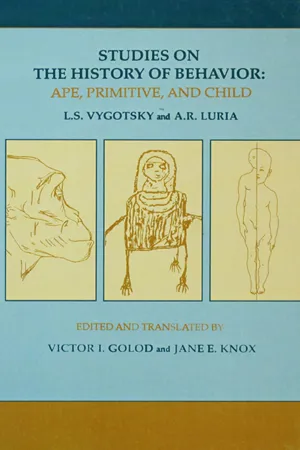
eBook - ePub
Studies on the History of Behavior
Ape, Primitive, and Child
- 262 pages
- English
- ePUB (mobile friendly)
- Available on iOS & Android
eBook - ePub
Studies on the History of Behavior
Ape, Primitive, and Child
About this book
Trusted by 375,005 students
Access to over 1.5 million titles for a fair monthly price.
Study more efficiently using our study tools.
Information
Publisher
Psychology PressYear
2013Print ISBN
9781138983311
9780805810141
Edition
1eBook ISBN
9781134766857
1
Behavior of the Anthropoid Ape
Nec manus nuda intellectus sibi permissus multum valet: instruments et auxiliis res perficitur.
—BACO
A bare hand and a mind by itself are worth not that much: everything is performed with the help of tools and auxiliary means.
—F. Bacon
Three Stages in the Development of Behavior
When analyzing the development of behavior from its simplest forms observed in the lower animals to the most complex and the highest observed in man, one can easily see that behavior taken as a whole goes through three main stages in its development.
The first stage in the development of behavior in all animals is represented by hereditary reactions or innate modes of behavior. These are usually called instincts. They serve mostly to satisfy the basic needs of an organism. Their biological function is that of self preservation and reproduction. The main distinctive feature of instinctive reactions is that they operate without being learned and are structurally inherent to the organism. Immediately after birth, a child moves his hands and legs, cries, sucks the breast, swallows milk.
But not all instincts mature as early as sucking, and not all of them are functional immediately after birth. Many of them, for example, the sexual instinct, mature much later, only when the organism itself reaches a high enough stage of maturation and development. However, even those instincts that mature later are still characterized by the same fundamental feature. This is the innate reserve of reactions at the animal’s disposal as a result of its hereditary structure.
The animal does not learn instinctive reactions in the course of its life; these [instinctive reactions—J. K.] do not appear as a result of trial-and-error or of successful and unsuccessful experiences; they are also not the result of imitation. This constitutes their main distinctive feature. The biological importance of instinctive reactions is that they are useful adaptations to the environment; they are developed in the course of struggle for survival and reinforced by natural choice in the process of biological evolution.
That is why their origin is explained in the same way as is the origin of “expedient” structures and functions of any organism, that is, according to Darwin’s laws of evolution. If we take the lower species, for example, insects or other invertebrates, we will easily see that their entire behavior is almost completely limited to this type of instinctive reactions. A spider weaving a web, a bee constructing a honeycomb, all such species use instinctive reactions as the main form of adaptation to the environment.
The second stage is built up and erected directly above the first and basic stage in the development of behavior. This is the so-called training stage or stage of conditional reflexes. The second class of reactions differs from the previous one in that it is not hereditary but arises from the animal’s individual experience. All the reactions in this category are the result of specific learning, specific training, and individually accumulated experience. The usual conditional reflex, which is well known and described in the works Pavlov and his school, may serve as the classic example of a reaction at the second stage.
It is now important for us to note only two aspects that characterize this second stage in the development of reactions. First we have in mind the connection existing between reactions of the second stage and instinctive or hereditary reactions. Studies of conditional reflexes have shown that any primary conditional reflex appears only on the basis of the unconditional reflex or instinctive hereditary reactions.
In essence, training does not create new reactions in the animal, but only serves to combine inherent reactions, giving rise to new conditional connections between the innate reactions and environmental stimuli. Thus, the new stage in the development of behavior arises directly on top of the foundation of the previous one. A conditional reaction is nothing more than an immediate reaction altered by the conditions under which it appeared.
The second aspect characteristic for this stage of behavioral development is the new biological function created by the conditional reflexes. Although instincts serve as a means of adaptating to more or less constant, stable, and fixed environmental situations, conditional reflexes constitute a much more flexible, subtle, and refined mechanism of adaptation; in essence, this (mechanism allows) hereditary, instinctive reactions to adapt to the individual conditions of a given animal’s existence. If Darwin has explained the origin of species, Pavlov has explained the origin of the individual, that is, the biology of the individual, particular experience of an animal.
Complete development of this second stage of behavior is found only in vertebrate animals, although some more primitive forms of conditional reactions may be seen already in ants, bees, and crabs. However, vertebrates are the first to demonstrate a shift in behavior. In spite of all the success achieved in training lower animals, the dominating, overpowering form of their behavior still remains the instinct. In contrast, in higher animals we note a shift toward the dominance of conditional reflexes in the overall system of reactions.
These animals are the first in which the plasticity of innate abilities is found; “childhood” in the proper sense of the word and, linked with it, “child” play emerge. Itself being a type of instinctive activity, play is also an exercise for other instincts, the young animal’s natural school, its self-instruction or training. According to Bühler,1 “Young dogs, cats, and the human child play, whereas beetles and insects, even the highly organized bees and ants, do not. This cannot be mere chance, but must rest upon an inner connection: play supplements the plastic dispositions” (Bühler, 1919/1930, p. 9).
Finally, it is necessary to also note that the second stage has a reverse influence on the first. Conditional reflexes, being overlaid on top of unconditional reflexes, change the latter profoundly, and very often in the individual experience of an animal we observe “a perversion of instincts,”2 that is, a new direction taken by an innate reaction due to the conditions in which it appeared.
The classic example of such a “perversion of instinct” is demonstrated by Pavlov’s experiment where a conditional reflex is developed in a dog by cauterizing its skin with an electric current. The animal’s first response to pain is a violent defensive reaction; it strains against its harness, it bites the device with its teeth, and it fights with all its might. But as a result of a long series of experiments, where pain stimulation was accompanied by food, the dog’s response to burns on the skin began to be that very same reaction with which it usually responded to food. The famous English psychologist Sherrington,3 who was present at these experiments, said, looking at the dog, “Now I understand the joy with which martyrs ascended the fire.” With these words he pointed out the enormous perspective revealed by this classic experiment. In this simple experiment he saw the prototype of those profound changes in our nature that are produced by enculturation (education)4 and by the environment’s influence on us.
Ukhtomskii (1945) stated:
Our nature is cultivatable, the foundation itself, though slowly, has to necessarily be altered in the course of the appearance of still newer and newer Pavlovian conditional connections. That is why instincts are not a stable and permanent stock, but an expanding and transforming property of man. The fact that under normal conditions higher achievements quite readily disintegrate, whereas the most primary instincts do not, means that the latter make up ‘the basis of man’s behavior,’ not the newer and higher ones.
The behavior of the modern normal human being can no more be explained by the most ancient animal instincts than it can by the characteristics of the ovum or the embryo. One can say that the entire scope of man’s pursuits and behavior boils down to the formation and cultivation of new instincts. I am convinced that the most important and inspiring idea of Pavlov’s doctrine is the notion that the reflex apparatus functions not by treading in place but by constantly transforming and pushing forward in time.
On top of this second stage in the development of behavior, there arises the third and, apparently for the animal kingdom, last stage, which is, however, not the last for man. The presence of this third stage has been established with undoubted scientific certainty only in the behavior of the higher anthropoid apes. Darwin’s theory stimulated precisely this search for and discovery of the third stage in these very animals.
According to data on comparative anatomy and comparative physiology, it has been established with absolute reliability that anthropoid apes appear to be our close relatives in the evolutionary progression. Until most recently, however, one link in this evolutionary chain that connects man with the animal world has remained missing, namely the psychological link. Up until now, psychologists have not succeeded in showing that the behavior of apes bears the same relationship to man as their anatomy does.
Köhler undertook the task of finding this missing psychological link in Darwin’s theory and of showing that, like biological development, psychological development also proceeded along the same evolutionary path—from the highest animals to man. To this end, Köhler (1921/1926) tried to find in the ape rudiments of those specifically human forms of behavior that are usually referred to by the general term rational behavior or the mind.
In doing so, Köhler proceeded along the same path, as did all the comparative sciences in their time. “The anatomy of man,” says Marx, “is the key to the anatomy of the ape. Traces of the higher forms (of behavior) present in the lower animal species can be understood only when these higher [forms—J. K.] are already known.” Köhler chose to use this very approach in his analysis of ape behavior. He considered the invention and use of tools to be the most essential and distinctive characteristics of human behavior. That is why he undertook the task of showing that the rudimants of these forms of behavior could already be found in anthropoid apes.
Köhler (1921/1926) conducted his experiments from 1912 to 1920 on the Island of Teneriffe at the anthropoid station that the Prussian Academy of Sciences specially organized for this purpose. Nine apes (chimpanzees) were under his observation and served as experimental subjects.
The importance of Köhler’s experiments is not limited to the discovery of the missing psychological link in the evolutionary chain. We will easily find in them yet other significance that is of our immediate interest. It is in these very experiments with anthropoid apes where intellectual reactions appeared in that simple, clear cut, transparent form that we have never been able to observe in the developed behavior of man. It is here where we see the advantage of primary and primitive forms over the later and more complex ones.
That is why all the characteristic features of this third developmental stage of behavior, all the specificity distinguishing it from the previous two, all the connections linking the third with the first two stages, are found here in the most clear cut form. It is as if we had a “pure culture” of intellectual reactions, experimentally created for the purpose of studying the qualities of this stage in development in all its purity. This explains the great significance of these experiments, which are important not only for understanding the upward development of behavior from ape to man, but also for correctly understanding behavioral development from the bottom up, that is, from the instinct to the conditional reflexes of the mind.
Köhler’s experiments basically involved three fundamental operations that an animal has to perform to solve a task. The first condition necessary for the solution of the task was that the animal had to find a roundabout way to reach the goal in situations where for some reason the direct solution was impossible; the second condition was linked to the need to bypass or eliminate an obstacle found on the path leading to the goal; and finally the third condition was the need to use, invent, or produce tools as a means for achieving an otherwise unachievable goal.
In the most complex experiments, two conditions, sometimes even all three, were combined together in one task. Sometimes these conditions appeared separately, but, in general, the experiments were all designed in such a way that the complexity increased so that the ability to solve a simpler task included in the previous experiment became a necessary prerequisite for each subsequent experiment.
Köhler’s Experiments
Now we dwell briefly on some of Köhler’s most important observations in order to delineate the characteristics of the third form of behavior. Even in the apes’ play, Köhler had numerous occasions to observe their ability to use tools. The play of these animals gives us a rough picture of their behavior in the wild (in the forest).
In play, one very easily finds a connection with the animal’s real-life experience. The animal quite easily carries over certain types and modes of behavior from play to nonplayful activities, and, vice versa—the animal immediately transfers to its play some new life experiences and some solved tasks.
According to Köhler (1921/1926): “If under the pressure of ‘necessity,’ in the special circumstances of an experimental test, some special method, say, of the use of tools, has been evolved—one can confidently expect to find this new knowledge shortly utilized in ‘play,’ where it can bring not the slightest immediate gain, but only an increased ‘joie de vivre’” (p. 71).
At Köhler’s station, it was found that the apes’ favorite toy, used for different aims, was the stick. While at the station, Sultan, the cleverest of the apes, invented the game of jumping from a stick; climbing as fast as possible up a stick set almost perpendicular to the floor, the animal jumped down to the ground or to some elevated spot once the stick started to fall, or even before. The other apes imitated this play and became surprisingly skillful at it.
This method, which first appeared in their play, was later used by the apes in those experiments where they had to get a hold of some fruit hung up high. Figure 1.1 (taken from Köhler, 19215) the apes, taking part in such an exp...
Table of contents
- Cover
- Half Title
- Title Page
- Copyright
- Dedication
- Contents
- Foreword
- Preface
- Translator’s Introduction
- Authors’ Introduction
- Chapter 1: Behavior of the Anthropoid Age
- Chapter 2: Primitive and His Behavior
- Chapter 3: The Child and Its Behavior
- References
- Author Index
- Subject Index
Frequently asked questions
Yes, you can cancel anytime from the Subscription tab in your account settings on the Perlego website. Your subscription will stay active until the end of your current billing period. Learn how to cancel your subscription
No, books cannot be downloaded as external files, such as PDFs, for use outside of Perlego. However, you can download books within the Perlego app for offline reading on mobile or tablet. Learn how to download books offline
We are an online textbook subscription service, where you can get access to an entire online library for less than the price of a single book per month. With over 1.5 million books across 990+ topics, we’ve got you covered! Learn about our mission
Look out for the read-aloud symbol on your next book to see if you can listen to it. The read-aloud tool reads text aloud for you, highlighting the text as it is being read. You can pause it, speed it up and slow it down. Learn more about Read Aloud
Yes! You can use the Perlego app on both iOS and Android devices to read anytime, anywhere — even offline. Perfect for commutes or when you’re on the go.
Please note we cannot support devices running on iOS 13 and Android 7 or earlier. Learn more about using the app
Please note we cannot support devices running on iOS 13 and Android 7 or earlier. Learn more about using the app
Yes, you can access Studies on the History of Behavior by L.S. Vygotsky,A.R. Luria,Jane E. Knox, Victor I. Golod,Victor I. Golod,Jane E. Knox, Victor I. Golod, Victor I. Golod, Jane E. Knox in PDF and/or ePUB format, as well as other popular books in Psychology & Developmental Psychology. We have over 1.5 million books available in our catalogue for you to explore.