eBook - ePub
Skills of Encouragement
Bringing Out the Best in Yourself and Others
- 248 pages
- English
- ePUB (mobile friendly)
- Available on iOS & Android
eBook - ePub
About this book
Most of us believe that every event has a cause and effect. We often feel there is someone or something we can put the blame onto besides ourselves. We may blame everyone from our parents to our bosses. Discouragement and unhappiness are ways of life for many of us.Now there is a book that addresses these realities.Skills of Encouragement provides opportunities for readers to improve their self-esteem and personal skills through practical exercises.Learn how to achieve a positive approach to living. Dynamic power is set free when you know how to focus on the positive potential within yourself. The authors have identified the process of encouragement that can produce an exciting, fulfilling and ultimately happy life.
Information
1
Encouragement
Is Positively
The Way Up!
The next time you are with a group of people, look for the encourager. He or she is the one whose arrival lights up the atmosphere, who circulates good news, who mobilizes the resources of each person, and who conveys that energy-giving optimism that raises the group “will” over the “won’t.” The encouraging person is buoyed up by the advantage of being positive, of being certain that life is worth living, that people would rather hope than despair, and that fear is the only enemy we face in life.
The antidote to fear is courage. And that courage is produced by encouragement.
Ultimately, the encouraging person’s gift is a positive attitude coupled with the skills to encourage others to believe in themselves. This is a book about how to become an encourager to yourself and others. Perhaps there is no greater gift in life. And perhaps self-encouragement is the only skill you will ever need to put yourself into a positive state for the rest of your life.
Encouragement is positively the way up!
Who Were The Encouragers And Discouragers In Your Life?
Think for a moment. Can you recall a specific time when, as a young child, you worked hard to achieve a certain goal? Do you remember the feeling of satisfaction you experienced when you finally reached your goal? Who was the first person you wanted to tell about your success?
Now think about a time when you had a problem and needed to talk to someone. Who was the person you usually sought out to discuss your feelings with? Why did you choose that person? What did he or she do to help you? When we are “down in the dumps,” some people always seem to have the talent to help us re-energize and move on to face our stresses, pressures, and the demands of life.
We call those positive people to whom we are attracted and with whom we share our interests encouragers. What makes encouragers so appealing to us? Are there common patterns that exist in most encouragers? To discover whether there are patterns in these effective people, we listened to many individuals, perhaps like you, talk about the encouraging people in their lives. Interestingly, encouragers exist in all walks of life. Some people chose parents, friends, teachers, supervisors, even hairdressers and police officers, as being the most encouraging to them. To better understand the specific skills of the encourager, we asked people to talk about the ingredients of their relationship with this influencing other person. Now let us ask you.
Take a moment to think about your relationship with your encouraging person. What was special about this relationship? How did you feel when you were with that person? Jot down your comments below.
We have listed some of what we feel are representative of the most frequently heard answers to this question. Do any of these observations match your response?
- “This person really listened and didn’t immediately tell me I was wrong.”
- “This person understood how I felt.”
- “In this relationship I felt like a winner. I think this person felt that I was special, unique.”
- “I could be honest with this person and wouldn’t have to be phony and didn’t fear the results. I was even willing to be responsible for what I did if it were wrong.”
- I could disagree with this person and wasn’t afraid of getting him or her angry.”
- “This person always had time for me.”
- “I felt safe with this person.”
- “This person always saw hope for me no matter how bad things seemed to be.”
- “This person had a good sense of humor.”
- “This person was enthusiastic about my experience.”
- “This person respected me for myself. The respect didn’t come just because I got an A in school or did well, but just because I was me.”
Are any of these comments similar to your response? If so, then your experience has been similar to that of many others, suggesting that perhaps there are common characteristics, or skills, that encouragers possess. We have heard many other answers to this same question, but the answers above were the most common.
Now, if you will, take a moment or two to think about the characteristics of the relationship between you and someone who was discouraging to you. Jot down your comments below.
Here are some of the comments people made concerning the characteristics of the most discouraging people in their lives:
- “This person never listened to me when I talked and was always too busy.”
- “Nothing I could ever do was right, no matter how hard I tried. This person always expected perfection from me.”
- “This person would embarrass me. I felt constantly put down.”
- “This person only noticed my bad points.”
- “I was always scared around this person. The person was unpredictable.”
Did any of your comments match the ingredients of these discouraging people? What additional responses would you add based on your own experiences?
By doing this simple exercise with people, it became clear to us that there were characteristics encouragers had that discouragers clearly lacked. An example is listening. Encouragers were described as people who listened without judging or condemning. Discouragers, contrarily, were described as people who were not effective listeners. From our information, then, we could theoretically range some behaviors of people from being totally discouraging to being totally encouraging to others. Let’s consider a few characteristics:
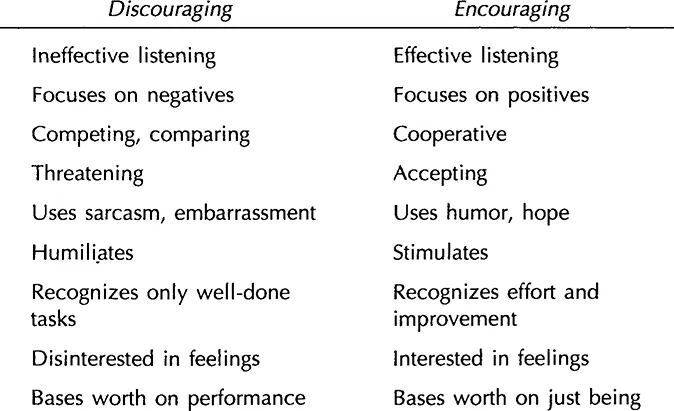
Of course, we could go on looking at the skills of the encourager in terms of this polarity. Obviously, the totally discouraging or encouraging person does not exist. All of us, being human, have days when we are more or less effective at encouraging ourselves and others. Yet all of us do have the ability to move toward the more encouraging side of this chart.
Every time two people come in contact, both individuals are influenced to move in either a more “turned on,” encouraged direction or in a “turned off,” discouraged direction. When we are discouraged, we tend to discourage. And when we discourage others, we become more discouraged ourselves. By the same token, when we encourage someone else, we are encouraged as we realize the positive contribution we can make in helping others develop their “inner courage.” This is contrary to the popular belief that the more we put other people down, the higher up we go. To contradict this belief in the seesaw effects of human relationships, many psychologists today even deal with depressed clients by recommending they do something to make someone else feel good. Apparently, when we extend ourselves in what Alfred Adler (1939) called “social interest,” we become personally fulfilled.
Encouragement is the key ingredient in all positive personal and professional relationships. Did you ever have a doctor, for example, who was quite knowledgeable about medicine but had a poor, impersonal bedside manner? This doctor may have been quite insensitive to your world and experiences, and perhaps this created anxiety or tension on your part. All the knowledge in the world is ineffective in the hands of an insensitive person who lacks understanding of people.
Did you ever have a teacher whose brilliance was obvious but who was miles above and beyond the students? Perhaps you felt discouraged or intimidated. The end product was that you probably did not learn much, despite the fact that the teacher knew a lot. If you were like many other people, perhaps you even developed a dislike for the particular subject! Imagine if this individual had developed encouragement skills. Through an understanding of encouragement, this teacher would have shifted the focus from spouting facts to thirty uninvolved bodies to getting them to understand and feel excited about the subject.
Perhaps you have many examples from your everyday life to show how encouragement is a key to positive personal and professional relationships. The following model demonstrates the significance of encouragement:
| Your Professional Skills (doctor, secretary, lawyer, teacher, nurse, etc.) | + | Your Encouragement Skills (communication, respect, attitude, etc.) | = | The Most Positive You |
This model is relevant whenever two or more people meet. It matters not whether an individual is a salesperson, supervisor, teacher, or waiter. The skills of encouragement are the key factors that provide positive influences on effective relationships.
One wonders why the positive effects of encouragement have been so ignored in the past. The major reason, we believe, is that encouragement challenges a tradition that emphasized the use of power, competition, intimidation, and autocracy as a means to human relationships. Take a few moments to compare the effects of encouragement with the effects of intimidation.
A Positive Person Has An Optimistic View Of Our Possibilities For Change
Recently, a great deal of interest and excitement has centered on ways of improving our skills in motivating ourselves and others to a fuller development of talents and resources. Pessimistic notions that people cannot change and are doomed by their childhood experiences are giving way to the more optimistic ideas as first advanced by Alfred Adler. Adler suggested that neither heredity nor environment is the ultimate determinant of personality, but that each only provides the basic building blocks out of which we construct the kind of person we want to be (Ansbacher and Ansbacher, 1956).
We agree with Adler that people have the capacity for constructive change in their lives. We also believe, as Adler did, that this change is more likely to occur in a relationship with a person who is encouraging.
This interest in helping people grow and reach a fuller development of their resources is visible everywhere today. Parents, for example, concerned about their discouraged or irresponsible child, frequently find themselves exhausted in trying to find ways to help their loved one. Educators, faced with vast underuse of student potential as reflected in declining test scores, poor attendance, disinterest, and boredom, seek ways of motivating the disinterested student in more positive directions. Business and industry personnel, aware of the effects of worker alienation, job apathy, and active and passive rebellion, spend millions annually to shift this costly trend. Very simply put, the world is looking for positive people who bring out the best in others—people who are encouraging.
Goals Of Encouragement
People who are unhappy, depressed, anxious, angry, or even unproductive are not disturbed; rather, they are discouraged. They lack courage in their ability to grow and take risks in more self-fulfilling directions. This immobilization, fear of failure, or negative goal seeking is reflected in a lifestyle overwhelmed with a theme of “I can’t change.”
Encouragement is the process of fac...
Table of contents
- Cover Page
- Half title
- Title Page
- Copyright Page
- Dedication
- Contents
- Authors
- 1 Encouragement Is Positively The Way Up!
- 2 The Psychology Of Encouragement
- 3 Getting High On Yourself Skills
- 4 Listening Builds Relationships
- 5 Responding With Understanding
- 6 Building Agreement Skills To Create A Bond
- 7 Believing Skills To Communicate Your Respect
- 8 Enthusiasm Skills To Create Energy
- 9 Focusing On Assets, Strengths & Resources
- 10 Perceptual Alternative Skills
- 11 Humor Skills To Lighten Things Up
- 12 Recognizing Discouraging Belief Skills
- 13 Focusing On Effort Skills
- 14 Rational Thinking Skills To Defeat Discouragement
- 15 Goal Commitment Skills To Define Your Destination
- 16 Optimism Skills To Find The Best Vantage Point
- 17 Positive Leadership Skills
- 18 Self-Encouragement Skills
- 19 Living As A Courageous, Positive Person
Trusted by 375,005 students
Access to over 1.5 million titles for a fair monthly price.
Study more efficiently using our study tools.
Frequently asked questions
Yes, you can cancel anytime from the Subscription tab in your account settings on the Perlego website. Your subscription will stay active until the end of your current billing period. Learn how to cancel your subscription
No, books cannot be downloaded as external files, such as PDFs, for use outside of Perlego. However, you can download books within the Perlego app for offline reading on mobile or tablet. Learn how to download books offline
Perlego offers two plans: Essential and Complete
- Essential is ideal for learners and professionals who enjoy exploring a wide range of subjects. Access the Essential Library with 800,000+ trusted titles and best-sellers across business, personal growth, and the humanities. Includes unlimited reading time and Standard Read Aloud voice.
- Complete: Perfect for advanced learners and researchers needing full, unrestricted access. Unlock 1.5M+ books across hundreds of subjects, including academic and specialized titles. The Complete Plan also includes advanced features like Premium Read Aloud and Research Assistant.
We are an online textbook subscription service, where you can get access to an entire online library for less than the price of a single book per month. With over 1.5 million books across 990+ topics, we’ve got you covered! Learn about our mission
Look out for the read-aloud symbol on your next book to see if you can listen to it. The read-aloud tool reads text aloud for you, highlighting the text as it is being read. You can pause it, speed it up and slow it down. Learn more about Read Aloud
Yes! You can use the Perlego app on both iOS and Android devices to read anytime, anywhere — even offline. Perfect for commutes or when you’re on the go.
Please note we cannot support devices running on iOS 13 and Android 7 or earlier. Learn more about using the app
Please note we cannot support devices running on iOS 13 and Android 7 or earlier. Learn more about using the app
Yes, you can access Skills of Encouragement by Don Dinkmeyer,Lewis Losoncy in PDF and/or ePUB format, as well as other popular books in Personal Development & Management. We have over 1.5 million books available in our catalogue for you to explore.