- 648 pages
- English
- ePUB (mobile friendly)
- Available on iOS & Android
eBook - ePub
About this book
Genomics, the mapping of the entire genetic complement of an organism, is the new frontier in biology. This handbook on the statistical issues of genomics covers current methods and the tried-and-true classical approaches.
Information
CHAPTER 1
INTRODUCTION
Twenty years ago, as an undergraduate student, I was fascinated by many courses in the physical, mathematical and biological sciences, but most of all, by genetics. How does one apply the laws of chemistry, physics and mathematics to biology? How does biological inheritance follow the laws of chemistry, physics and mathematics? These basic questions have been given intense attention since modern biology began about a century ago and will continue to be central questions for some time to come.
Genetics includes five well-structured branches: classical genetics, cytogenetics, population genetics, quantitative genetics and molecular genetics (Figure 1.1). Classical genetics began with the breeding studies of Gregor Mendel. Concepts such as genes, alleles, segregation and dominance were invented to describe the results of Mendel’s experiments and of similar ones that were carried out after the turn of the century (1901). However, the Mendelian concepts of genetics did not have a chemical or physical basis. These concepts of Mendelian genetics were physically defined later by cytogenetics and molecular genetics. In many cases, the products of genes that follow Mendelian inheritance are now well defined and have been studied extensively. In the human hemoglobins, the underlying molecular events are well understood and the consequences of these changes in metabolism and development have a plausible molecular basis. In many cases, particularly for complex quantitative traits, we do not yet understand their genetic basis in terms of Mendelian genes, and certainly not at the molecular level. Some individual genes and their effects on complex phenotypic traits are understood. Sometimes, we may be able to identify a particular gene, for example, one controlling grain yield of wheat, or a gene responsible for hypertension in humans. However, much less is known about the basis of the regulation and expression of coordinately and differentially controlled genes in metabolism and development. Modern molecular genetics, a combination of the classical genetics and biochemistry, began in 1953 when J. D. Watson and F. H. C. Crick deduced the double-helical structure of DNA. Their deduction made the conceptual connection between biological inheritance and fundamental chemistry and physics.
1.1 INTRODUCING GENOMICS
1.1.1 GENOMICS AND THIS BOOK
Quantitative and population genetics, cytogenetics and molecular genetics are being integrated rapidly with new advances in genome research, due to worldwide efforts in human, plant and animal genome research. This new frontier of genetics can be called genomics.
Genomics is a new science that studies genomes at a whole genome level by integrating the five traditional disciplines of genetics with new technology from informatics and automated systems. The purpose of genomic research is to learn about the structure, function and evolution of all genomes, past and present. The ability to fill the gaps between the laws of chemistry, physics and biology has been enhanced by the development of genomics (Figure 1.1). Genomics asks many fundamental biological questions, such as
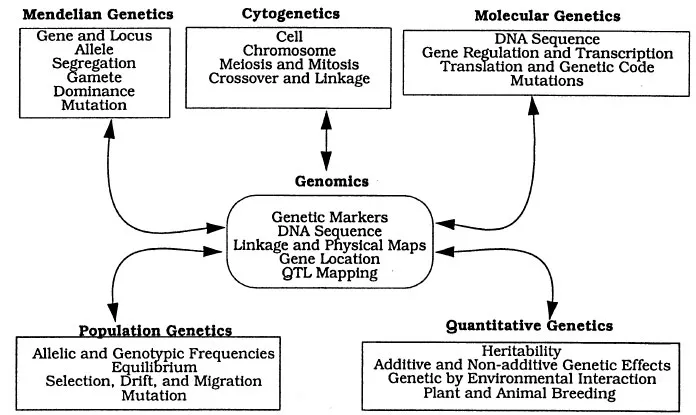
Figure 1.1 Genomics integrates five traditional areas of genetics.
• How many functional genes are necessary and sufficient in a biological system, such as an animal or plant species?
• How do these genes determine the total phenotype?
• How many different functional genes are present in the whole biosphere?
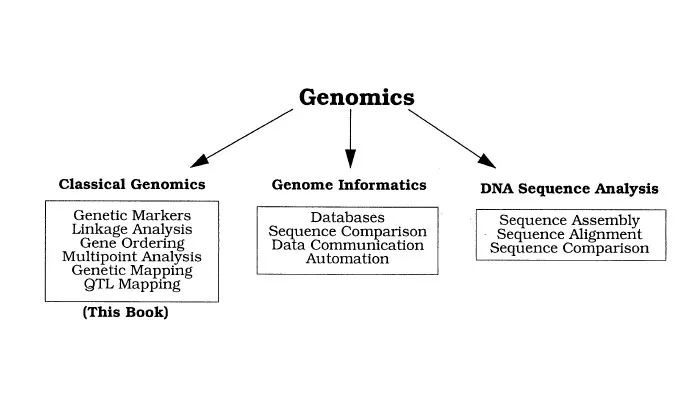
Figure 1.2 Relationships of genomics, informatics and DNA sequence
• What DNA sequences or structures are required for genes to perform their functions?
• What is the essential nature of genome structure?
Genomics can be divided into three major components: classical genomics, genome informatics and physical genomics. These are related to each other in many aspects (Figure 1.2).
The discovery of gene linkage (genes on the same chromosome) (Correns, Bateson, and Punnett 1905; Morgan 1912; Sturtevant 1913) led to the idea of making a linkage map. This classical technique was rejuvenated following the development of molecular marker technology in 1980 (Botstein et. al. 1980). Classical cytogenetics and genetic mapping bring together the physical and genetic structure of the chromosome. Today, genomics integrates DNA sequence studies with functional genetics and information sciences.
Genomic information is growing rapidly and computational sciences are needed to manage and analyze the massive amounts of information using improvements in computer technology, database design, networking, graphics and animation. Genomics also focuses on the physical composition of genomes, new methods for nucleotide sequencing and DNA cloning and includes physical map assembly and DNA sequence assembly for genome sequencing. To generate the large amounts of data for genomic studies, automated instruments are needed. To analyze the increasing amounts of data, knowledge of statistics and computers are essential. The statistical and computational knowledge essential to analyze genome data is the focus of this book.
1.1.2 GENOMICS AND MODERN BIOLOGY
In recent years, great progress has been made in both molecular and quantitative genetics. In molecular genetics, many specific genes and proteins have been identified and characterized affecting the growth, metabolism, development and behavior of plants, animals and microorganisms. Genomics will have a great impact on the future development of basic biology (Table 1.1 and Figure 1.3).
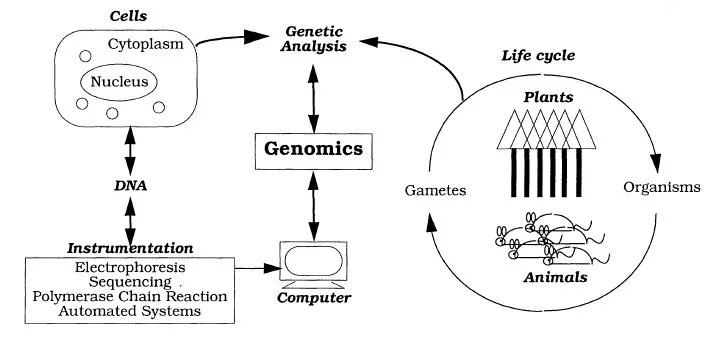
Figure 1.3 From cells to computers through genomics
Table 1.1 Potential impact of genomics on basic biology.
Basic science | Potential impact |
Basic biology | 1. Better understanding of developmental biology 2. Systematic study of genetic control systems, such as regulation of gene expression 3. An accurate definition of gene structure and function 4. Obtaining a better understanding of biochemical foundation of genetic effects |
Population and quantitative genetics | 1. Construction of multiple gene models of quantitative traits 2. Obtaining biological definitions of additive and dominant effects and epistatic interactions 3. Better understanding of genetic by environment interactions 4. Development of tools and databases for studying genome evolution |
1.1.3 GENOMICS AND ITS PRACTICAL APPLICATIONS
The Potential of Genome Research
It has been widely recognized that genomic research has great potential to benefit the biomedical industry, agriculture, forestry and forensic sciences. The technology and information from genome research should advance the diagnosis of human diseases. Forensic sciences would be improved by enabling more precise identification of human individuals. For agriculture and forestry, the technology and information can assist plant and animal breeding, disease management, genetic diversity assessment and variety protection. These applications should contribute to the development of more sustainable agriculture and forestry.
Population and Quantitative Genetics
New methods of quantitative genetics, which use the genetic dissection of quantitative traits, have identified genetic regions regulating important functions. Quantitative trait analysis has fundamentally changed the conventional view of polygenic inheritance and has led to the identification of loci with quantitative effects on complex traits. Such loci typically have important biological roles, but are usually lacking in molecular identification. Lander and Schork, in their 1994 paper on genetic dissection of complex traits, wrote
….. one can systematically discover the genes causing inherited diseases without any prior biological clue as to how they function. The method of genetic mapping, by which one compares the inheritance pattern of a trait with the inheritance patterns of chromosomal regions, allows one to find where a gene is without knowing what it is….
This example shows the importance of genomics to basic biology and and also the limitations of traditional approaches. Traditionally, characterizing one gene could span decades and represent a good career for a scientist. However, many traits require understanding the roles and interactions of many genes acting at the same time. Using new methods, it is now possible for a number of genes to be extensively characterized at the same time. In addition, the genomic approach has revolutionized the ways of finding genes by sequence comparison in very large databases. Genome programs (human, plant, animal and microbial) will greatly advance the technology for DNA analysis and generate a large amount of information for a better understanding of a broad spectrum of biological problems.
Additive, dominance and epistatic interactions are traditional quantitative genetic effects that have been defined in statistical terms. Although some studies have resulted in the biologic...
Table of contents
- Cover
- Title Page
- Copyright Page
- Table of Contents
- FOREWORD BY DR. RONALD R. SEDEROFF
- PREFACE
- CHAPTER LIST
- CHAPTER 1 INTRODUCTION
- CHAPTER 2 BIOLOGY IN GENOMICS
- CHAPTER 3 INTRODUCTION TO GENOMICS
- CHAPTER 4 STATISTICS IN GENOMICS
- CHAPTER 5 SINGLE-LOCUS MODELS
- CHAPTER 6 TWO-LOCUS MODELS: THE CONTROLLED CROSSES
- CHAPTER 7 TWO-LOCUS MODELS: NATURAL POPULATIONS
- CHAPTER 8 TWO-LOCUS MODELS: USING LINKAGE DISEQUILIBRIUM :
- CHAPTER 9 LINKAGE GROUPING AND LOCUS ORDERING
- CHAPTER 10 MULTI-LOCUS MODELS
- CHAPTER 11 LINKAGE MAP MERGING
- CHAPTER 12 QTL MAPPING: INTRODUCTION
- CHAPTER 13 QTL MAPPING: SINGLE-MARKER ANALYSIS
- CHAPTER 14 QTL MAPPING: INTERVAL MAPPING
- CHAPTER 15 QTL MAPPING: NATURAL POPULATIONS
- CHAPTER 16 QTL MAPPING: STATISTICAL POWER
- CHAPTER 17 QTL MAPPING: FUTURE CONSIDERATIONS
- CHAPTER 18 COMPUTER TOOLS
- CHAPTER 19 RESAMPLING AND SIMULATION IN GENOMICS
- GLOSSARY
- BIBLIOGRAPHY
- AUTHOR INDEX
- SUBJECT INDEX
Trusted by 375,005 students
Access to over 1.5 million titles for a fair monthly price.
Study more efficiently using our study tools.
Frequently asked questions
Yes, you can cancel anytime from the Subscription tab in your account settings on the Perlego website. Your subscription will stay active until the end of your current billing period. Learn how to cancel your subscription
No, books cannot be downloaded as external files, such as PDFs, for use outside of Perlego. However, you can download books within the Perlego app for offline reading on mobile or tablet. Learn how to download books offline
Perlego offers two plans: Essential and Complete
- Essential is ideal for learners and professionals who enjoy exploring a wide range of subjects. Access the Essential Library with 800,000+ trusted titles and best-sellers across business, personal growth, and the humanities. Includes unlimited reading time and Standard Read Aloud voice.
- Complete: Perfect for advanced learners and researchers needing full, unrestricted access. Unlock 1.5M+ books across hundreds of subjects, including academic and specialized titles. The Complete Plan also includes advanced features like Premium Read Aloud and Research Assistant.
We are an online textbook subscription service, where you can get access to an entire online library for less than the price of a single book per month. With over 1.5 million books across 990+ topics, we’ve got you covered! Learn about our mission
Look out for the read-aloud symbol on your next book to see if you can listen to it. The read-aloud tool reads text aloud for you, highlighting the text as it is being read. You can pause it, speed it up and slow it down. Learn more about Read Aloud
Yes! You can use the Perlego app on both iOS and Android devices to read anytime, anywhere — even offline. Perfect for commutes or when you’re on the go.
Please note we cannot support devices running on iOS 13 and Android 7 or earlier. Learn more about using the app
Please note we cannot support devices running on iOS 13 and Android 7 or earlier. Learn more about using the app
Yes, you can access Statistical Genomics by Ben Hui Liu in PDF and/or ePUB format, as well as other popular books in Biological Sciences & Probability & Statistics. We have over 1.5 million books available in our catalogue for you to explore.