![]()
ACADEMIC-PRACTICE PARTNERSHIP
MODELS AND OUTCOMES
Scholarship of Practice
in the United Kingdom:
An Occupational Therapy
Service Case Study
Kirsty Forsyth, PhD, OTR
Edward A. S. Duncan, PhD, BSc (Hons), Dip.CBT
Lynn Summerfield Mann, MSc, DipCOT
Kirsty Forsyth is Director, UK Centre for Outcomes Research and Education (UKCORE), London South Bank University, London, and Senior Lecturer, Queen Margaret University College, Edinburgh. Edward A. S. Duncan is Postdoctoral Research Fellow, Nursing Midwifery and Allied Health Professions Research Unit, The University of Stirling, Stirling, and Clinical Specialist Occupational Therapist, The State Hospital, Carstairs, Lanarkshire. Lynn Summerfield Mann is Principal Lecturer, Occupational Therapy Post Graduate Programme and Co-Director, UK Centre for Outcomes Research and Education (UKCORE), London South Bank University, London.
The authors would like to acknowledge the stakeholders involved in the UKCORE/TSH partnership. They would also like to acknowledge Susan Prior, Orchard Clinic, Royal Edinburgh Hospital for her support with Figure 2.
SUMMARY. Occupational therapy is required to deliver and generate evidence-based practice. This paper illustrates an approach to meeting these evidence-based expectations. Specifically, there is a description of the development of a partnership between the United Kingdom Centre for Outcomes Research and Education (UKCORE) and The State Hospital which is a forensic mental health service. This case study will illuminate (a) a rationale for partnership, (b) the process of building the partnership, and (c) outcomes of the partnership. Principles of scholarship of practice will be identified and ways of supporting services to integrate occupational therapy knowledge generation and utilisation will be outlined.
[Article copies available for a fee from The Haworth Document Delivery Sen’ice: 1–800-HAWORTH. E-mail address: <
[email protected]>
Website: <http://www.HaworthPress.com> ©
2005 by The Haworth Press, Inc. All rights reserved.]
KEYWORDS. Occupation, theory, evidence-based practice
BACKGROUND AND RA TIONALE
Introduction
Occupational therapy endorses the importance of research findings in shaping practice (Humphries et al., 2000; Metcalf et al., 2001; Bennett et al., 2003). An accessible evidence-base would support practitioners in their clinical decision-making, empowering occupational therapists to review the way in which they have traditionally carried out their practice. Furthermore, it has been argued, evidence-based practice can help clinicians influence service purchasers and managers to provide occupation-focused intervention as part of health care for clients.
However, there is a growing consensus that, many clinicians feel unable to use evidence to support practice. It has been argued that occupational therapy lacks the research capacity to respond systematically and existing research in the field tends to be sporadic rather than strategically planned (HEFCE, 2001; Creek & Ilott, 2002). Creek (2003:27) suggested that experienced occupational therapists use a wide range of techniques that“… appear to work rather than appraising the research evidence.” Metcalf et al. (2001:436) stated that only 5.8% of the occupational therapists in their study reported “… any interest in finding and reading research.” McCluskey and Cusick (2002) reported occupational therapists were aware they needed to change their practice but didn’t know how or where to start.
Identified barriers to building research capacity include workload pressures, lack of protected time, inadequate arrangements to provide cover whilst clinicians carry out research, lack of support for therapists, and the failure to develop research leaders and establish research career pathways (HEFEC, 2001; Creek & Ilott, 2002). Despite the challenges involved, research has the potential to generate recognition of the valuable contribution occupational therapy can make to improve health (Godfrey, 2000). Reasons for this apparent lack of research productivity needed to be explored and solutions identified. This paper will outline a scholarship of practice approach to supporting a mental health service tackle these challenging issues in order to embed evidence into practice while simultaneously generating evidence for practice.
The State Hospital
The State Hospital (TSH) is a high security hospital that caters for offenders with mental disorders. TSH is a national service for Scotland and Northern Ireland and receives referrals from the National Health Service, prisons and court. In 1991, TSH became the first high security hospital to employ state-registered occupational therapists. The service uses the Model of Human Occupation (MOHO) as its primary conceptual model, guiding clinicians’ formulation of a client's difficulties, assessment, and intervention. Occupational therapy services are provided to improve engagement in occupation within the hospital in preparation for clients’ future discharge.
The TSH occupational therapy service was experiencing some of the barriers to evidence based practice described in the broader literature. Despite a managerial commitment to delivering research outcomes, there were challenges to strategically building evidence. Research outcomes were developed in an ad hoc fashion and according to personal interest. Although occupational therapy managers were supportive of clinicians undertaking research, practitioners perceived it as an added extra to clinical work. As a result, little research was actually carried out within the service that had a significant impact on future service delivery (Duncan et al., 2004). Therefore, whilst there was verbal support for research in practice, the lack of a strategy to develop appropriate systems of data gathering within practice resulted in little research occurring. This appeared to frustrate staff. A review of the occupational therapy department commitment to research in practice came when the individual who had been supplying academic supervision for the staff was no longer able to continue in her role. The occupational therapy service realized that managerial support and quality academic supervision were not in themselves sufficient to enable clinicians to undertake sustainable research studies that have an effect on clinical practice. The department then’approached the staff of the UK Centre for Outcomes Research and Education (UKCORE), as they were gaining a positive reputation for overcoming exactly the types of challenges that were inhibiting the department from progressing with research in practice as they desired. This paper describes the process of the collaboration between TSH and UKCORE.
UKCORE
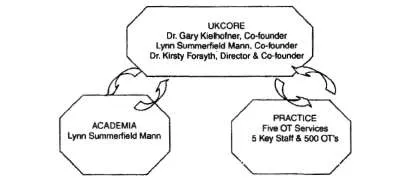
- The UKCORE was originally built in collaboration with and built on principles from the scholarship of practice (Kielhofner, 2005) Centre for Outcomes Research and Education at the University of Illinois at Chicago (Kielhofner et al., 2004). The UKCORE was built on a scholarship of practice philosophy and was viewed as an organizational structure to bring together academic departments and occupational therapy practice settings (see Figure 1). The centre began working with several occupational therapy services in the greater London area in England. The focus of such collaborations were to develop theory driven, evidence base practice through the collaboration of academics and clinicians, working in partnership. Amongst other aims, the centre strives to help practitioners integrate evidence into their work and to incorporate the generation of further evidence as a core part of their work.
The UKCORE is now based at London South Bank University, and involves ongoing relationships with occupational therapy services in London, Gloucestershire and Lanarkshire. The UKCORE works to integrate scholarship (i.e., research and theory development), education, and practice across each organizational settings.
PROCESS OF BUILDING SCHOLARSHIP OF PRACTICE
The State Hospital in Partnership with UKCORE
As previously discussed, practitioners at TSH tended to view research as something separate from their everyday work. This was not
FIGURE 1. UK Centre for Outcomes Research and Education (UKCORE)
due to a reluctance to participate in research, but rather because the predominant model of research was one in which the links between the clinicians role and theory development was not explicit. The first step, therefore, was to assess how best to introduce research into practice and to consider how to contribute to research in a way that would have a positive impact on the everyday practice and experience of the clinicians. This was a daunting challenge, as it required the clinicians to view research in a radically different way than they previously had. Their first goal of the new partnership between TSH and UKCORE was therefore to change the research-practice culture within the service. This required the service to reconsider how it perceived and used MOHO in practice; a re-evaluation of the focus of the services interventions to ensure that they were evidence-based and occupation-focused; and to commence the redevelopment of the service so that it enabled clinicians to gather data for research studies as a routine part of the clinicians’ practice. All of this has required a great deal of attention to be paid to supporting clinicians to change from established clinical routines to a more evidence-based culture.
(i) Initial Negotiations
The partnership between The State Hospital and UKCORE began with examining the possibility of generating new roles and structures. The work required a new system of relationships with people taking non-traditional roles and activities. Specifically, this means that academics (educators, researchers, and students) and practice (clinicians,clients, and administrators) all take on roles within this new system and with an appreciation of the different constituencies and how they relate to each other.
The goal was to have both academics and practitioners working together as “practice scholars” who are jointly involved in the development of the evidence-base for occupational therapy. Importantly, each staff group has had to learn how to do things differently. For the clinicians, there were new evidence-based assessments to consider and implement, as well as getting used to working in collaboration with academics and viewing the developments within the service as the focus of this new partnership. For the academics, it was important to understand how the clinicians worked within a secure environment. This was an important initial stage of outlining the working relationship that set the context within which the work was to be completed.
(ii) Building Structures to Support Delivering of Evidence-Based Practice
It is necessary to understand the perspectives of all stakeholders in the system before attempting to implement changes in practice (Grol, 1997). It is important to develop routine mechanisms by which individual and organisational change can occur (NHS Centre for Reviews and Dissemination, 1999; FoNS, 2001). Indeed, building research infrastructures and capacity are commonly identified as areas for urgent attention in the UK (Scottish Executive, 2002). UKCORE has, therefore, supported TSH to develop several structures to support the change process. These structures evolved from ongoing dialogues between stakeholders about what was required to deliver occupation focused, theory driven, evidence-based practice at TSH. They included (a) strategic planning, (b) managerial structures, and (c) evidence-based development groups for staff. These are briefly described below.
(a) Strategic Planning. Strategic planning is important to support any change process (Fitzgerald et al., 2003). This was specifically identified by TSH as a high priority. TSH staff felt their previous attempts at research had not been strategically planned and therefore was not cumulatively building research over time. Strategic plans could very clearly identify the priorities for TSH services and how resources should be focused. UKCORE and TSH worked together to identify and develop the parameters of the service and an R&D strategic document that would outline yearly targets.
Parameters of the service. The clinical team with UKCORE developed a plan of a patient's pathway through the hospital. It was then identified that the focus of the occupational therapy service was to support the clients’ engagement in occupation in order to promote health and reduce or manage risk and offending behaviour. This is achieved through the Model of Human Occupation (MoHO). The service was outlined in terms of when the occupational therapy service would be offered, where it would be offered, what the content of the service would be, how the intervention would be graded. This collaboration developed a theory driven framework for the occupational therapy service.
R&D Strategic Document. This documentation needed to take into account what TSH occupational therapists were being asked to deliver in terms of governmental, institutional and professional priorities. Collaborative working synthesized these priorities into a workable document to support the change process. The document outlined the focus of the service, the challenges that face occupational therapy in developing its research base and an action plan outlining specifically the developments that were planned for the next 12 months. This document is used as a communication mechanism both for the wider institution and for occupational therapists who are all charged in delivering the change. The document is presented at hospital meetings and becomes part of the overall hospitals’ strategic plans. Moreover, the strategic document allows for regular monitoring of progress through the change process.
(b) Managerial structures. Managerial structures were also identified as having important influence on change (Fitzgerald et ah, 2003; McCluskey & Cusick, 2002). TSH already worked with their human resource department to develop job descriptions that explicitly identified research as part of all clinical posts and thereby legitimised research as an integra...