Perhaps the foremost issue in the emerging area of inquiry known as lesbian and gay studies is the social constructionist controversy. Social constructionism is the view that the categories of sexual orientation are cultural constructs rather than naturally universal categories.
Forms of Desire brings together important essays by social constructionists and their critics, representing several disciplines and approaches to this debate about the history and science of sexuality.
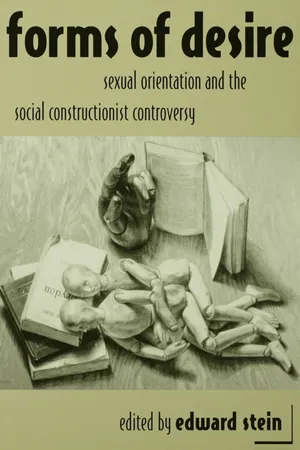
eBook - ePub
Forms of Desire
Sexual Orientation and the Social Constructionist Controversy
- 366 pages
- English
- ePUB (mobile friendly)
- Available on iOS & Android
eBook - ePub
About this book
Trusted by 375,005 students
Access to over 1.5 million titles for a fair monthly price.
Study more efficiently using our study tools.
Information
CHAPTER 1:
Edward Stein
Introduction
Sexual Behavior in the Human Male and Sexual Behavior in the Human Female, published respectively in 1948 and 1953 and collectively known as the Kinsey reports, revolutionized the way many North Americans think about sex. In particular, these books brought to light the significant number of people who engage in same-sex sexual activities— “only 50 percent of the [white male] population is exclusively heterosexual throughout its adult life.”1
The discovery of a surprisingly high frequency of same-sex sexual activities led Kinsey and his collaborators to examine the definition of the term ‘homosexual.’ They wrote:
For nearly a century the term homosexual in connection with human behavior has been applied to sexual relationships, either overt or psychic, between individuals of the same sex. … It would encourage clearer thinking on these matters if persons were not characterized as heterosexual or homosexual, but as individuals who have had certain amounts of heterosexual experience and certain amounts of homosexual experience. Instead of using these terms as substantives which stand for persons, or even as adjectives to describe persons, they may better be used to describe the nature of overt sexual relations, or of the stimuli to which an individual erotically responds.2
Kinsey's 1948 suggestion not to use the terms ‘heterosexual,’ ‘homosexual’ and ‘bisexual’3 as nouns or adjectives applying to human beings has been, for the most part, ignored. We quite commonly talk about people as being homosexual, heterosexual or bisexual. This is true not only in everyday talk, but in scholarly work as well. For example, scientists commonly ask what factors (e.g., genetic, hormonal) make some people into heterosexuals and other people into homosexuals, historians ask whether some historical figure (e.g., Walt Whitman, Joan of Arc) was a homosexual, and sociologists ask about the ways that homosexuals in a particular society (e.g., Ancient Greece, Native American cultures) are viewed. The central issue of this anthology is whether these sorts of questions are legitimate or whether Kinsey's forty-year-old exhortation against them was justified.
The issue to which this anthology is devoted is the debate between social constructionists and essentialists4 about sexual orientation. In simplest terms, essentialists think that the categories of sexual orientation5 (e.g., heterosexual, homosexual and bisexual) are appropriate categories to apply to individuals. According to essentialists, it is legitimate to inquire into the origin of heterosexuality or homosexuality, to ask whether some historical figure was a heterosexual or homosexual, etc. This follows from the essentialist tenet that there are objective, intrinsic, culture-independent facts about what a person's sexual orientation is. In contrast, the social constructionist denies that there are such facts about people's sexual orientation and would agree with the exhortation that it is mistaken to look at an individual as being of a particular sexual orientation in the absence of a cultural construction of that orientation. Thus, social constructionism, if true, has deep ramifications for the historical, scientific, sociological, philosophical, anthropological and psychological studies of sexuality because these studies often assume that the objects of their investigations are natural rather than cultural entities.
The debate about sexual orientation between the social constructionists and the essentialists started fairly recently. In 1968, Mary McIntosh wrote “The Homosexual Role” (reprinted as chapter three of this volume).6 In this essay, she uses the tools of labelling theory, a sociological approach, to defend social constructionism as applied to homosexuality. In 1976, Michel Foucault, a noted French philosopher, published the first volume of The History of Sexuality.7 This book has become, for many social constructionists, the locus classicus of their program. The section of this book in which Foucault lays out his version of the social constructionist thesis (part two, chapter 2, “The Perverse Implantation”) is reprinted as chapter two of this volume. From this double origin, social constructionism has developed as a serious challenge to essentialism.8
Social constructionists began by defining their view in contrast to essentialism, but more recently they have developed an independent account of same-sex behavior and desire as it exists today and as it has existed in the past. Some of the essays in this volume—in particular, Robert Padgug's “Sexual Matters: On Conceptualizing Sexuality in History”9 and Arnold Davidson's “Sex and the Emergence of Sexuality”10— have played a role in developing this positive picture. Padgug's essay argues that sexual orientation needs to be located as a construction within a certain social reality while Davidson's essay attempts to formalize and provide support for Foucault's thesis about the emergence of the homosexual as a type of person. Davidson focuses on the distinction between sex and sexuality. Davidson's essay complements Ian Hacking's essay “Making Up People”11 in which Hacking attempts to develop a general account of the development of new types of people.
Three of the remaining essays in this volume are in some way critical of social constructionism. John Boswell, in “Concepts, Experience and Sexuality” (chapter seven) tries to mediate between extreme versions of social constructionism and essentialism through his interpretation of some historical evidence. James Weinrich tries to do the same thing but his discussion is informed by a variety of scientific and theoretical considerations.12 He discusses a theory called “interactionism” which shares some features of both constructionism and essentialism. Wayne Dynes looks at social constructionism in terms of intellectual history and compares it to other methodological approaches in history.13
The remaining essays are by Steven Epstein, who focuses on the political ramifications of the social constructionist controversy,14 and Leonore Tiefer, who discusses how the social constructionist perspective has an impact on sexology and parts of psychology.15 Finally, in my conclusion (chapter twelve of this volume), I attempt to pull the various threads of the debate together, lay out what exactly is in dispute between essentialists and social constructionists, and suggest what sort of information would be needed to settle the matter.
Most people who have well-articulated views on the debate between social constructionists and essentialists think that it has been settled. Many scholars in the humanities working in lesbian and gay studies think that the debate is settled in favor of social constructionism while most scientists working on issues relating to sexual orientation as well as, for example, members of the national organization Parents and Friends of Lesbians and Gays (PFLAG) think it is settled in favor of essentialism. Most laypeople seem to have conflicting intuitions—they are essentialist in some ways and constructionist in some others.16
One of my aims in assembling this anthology is to show that the debate is far from settled. One of the reasons why it might appear to some of the disputants that it is settled is because the two sides are talking past each other, working with impoverished versions of their rivals' views and resorting to name-calling. By bringing together, for close comparison and scrutiny, essays from disparate journals and books as well as different disciplines and methodologies, I hope that it will become clearer what is really at issue between the social constructionists and essentialists and how to proceed if we are to get to the bottom of this controversy. I also hope to stimulate further discussion, perhaps from a slightly different perspective, of the questions that the essays in this volume raise.
In putting this anthology together, I have tried to represent a variety of viewpoints and disciplines. In doing so, I have left out many interesting and relevant essays that have been written on the topic, not to mention entire disciplines (for example, anthropology) that have addressed themselves to related questions. My selections have been guided by a desire to collect essays that fit together nicely, that are free of unnecessary jargon, and that are often difficult to locate.
With the exception of Dynes's essay which has been substantially rewritten by the author, the reprinted essays in this volume appear largely unaltered. Some stylistic changes have been made. First, the format of footnotes and references has been made relatively uniform. Doing so involved renumbering some of the notes. Second, typographical and other obvious errors have been eliminated. Third, single quotation marks are used around words to denote reference to the word itself, rather than the meaning of the word, as in: the word ‘homosexual’ has ten letters in it. In other contexts, double quotation marks are used.
The essays in this anthology may be read in any order as each is self-contained. All of the essays have appeared before in some form with the exception of Boswell's essay and my two essays. Those who wish to begin with a critical overview of the social constructionism/essentialism debate may want to begin with my concluding essay and then read the others.17
1 A.C. Kinsey, W.B. Pomeroy, and C.E. Martin, Sexual Behavior in the Human Male (Philadelphia: W.B. Saunders Company, 1948), p. 656.
2 Ibid., pp. 612, 617.
3 See Ibid., pp. 656–659 for the claim that ‘bisexual,’ like ‘homosexual’ and ‘heterosexual’ should not be applied to individuals.
4 John Boswell, “Revolutions, Universal and Sexual Categories,” Salmagundi 58–69, (1982–83), pp. 89–113, and James Weinrich, in his contribution to this volume (chapter eight), refer to essentialism with the word ‘realism.’ Since there are so many views about so many different questions which go by the name ‘realism,’ I prefer to use ‘essentialism.’ My preference, here, should be seen as stylistic rather than theoretical. The potential problem with this usage is that the term ‘essentialism’ may suggest that the view entails that there is an essence to sexual orientation. As I use ‘essentialism,’ no literal sense of ‘essence’ is implied. See also Boswell's contribution to this volume (chapter seven).
5 There has been some dispute within the scholarly community and the lesbian and gay community about whether it is correct or preferable to use the phrase ‘sexual orientation,’ the phrase ‘sexual preference’ or some other cognate. I wish to sidestep this dispute. ‘Sexual preference’ is ambiguous: on one reading, ‘sexual orientation’ and ‘sexual preference’ are synonyms; on the other, ‘sexual preference’ refers to more fine-grained erotic desires such as desires for sorts of people (e.g., large-breasted women or muscular men) or for sorts of activities (sadomasochism or being “passive”). For consi...
Table of contents
- Cover
- Half Title
- Full Title
- Copyright
- Dedication
- Contents
- Acknowledgements
- Preface to the Paperback Edition
- Chapter One: Introduction
- Chapter Two: The Perverse Implantation
- Chapter Three: The Homosexual Role
- Chapter Four: Sexual Matters: On Conceptualizing Sexuality in History
- Chapter Five: Making Up People
- Chapter Six: Sex and the Emergence of Sexuality
- Chapter Seven: Concepts, Experience, and Sexuality
- Chapter Eight: Reality or Social Construction?
- Chapter Nine: Wrestling with the Social Boa Constructor
- Chapter Ten: Gay Politics, Ethnic Identity: The Limits of Social Constructionism
- Chapter Eleven: Social Constructionism and the Study of Human Sexuality
- Chapter Twelve: Conclusion: The Essentials of Constructionism and the Construction of Essentialism
- Bibliography
Frequently asked questions
Yes, you can cancel anytime from the Subscription tab in your account settings on the Perlego website. Your subscription will stay active until the end of your current billing period. Learn how to cancel your subscription
No, books cannot be downloaded as external files, such as PDFs, for use outside of Perlego. However, you can download books within the Perlego app for offline reading on mobile or tablet. Learn how to download books offline
Perlego offers two plans: Essential and Complete
- Essential is ideal for learners and professionals who enjoy exploring a wide range of subjects. Access the Essential Library with 800,000+ trusted titles and best-sellers across business, personal growth, and the humanities. Includes unlimited reading time and Standard Read Aloud voice.
- Complete: Perfect for advanced learners and researchers needing full, unrestricted access. Unlock 1.5M+ books across hundreds of subjects, including academic and specialized titles. The Complete Plan also includes advanced features like Premium Read Aloud and Research Assistant.
We are an online textbook subscription service, where you can get access to an entire online library for less than the price of a single book per month. With over 1.5 million books across 990+ topics, we’ve got you covered! Learn about our mission
Look out for the read-aloud symbol on your next book to see if you can listen to it. The read-aloud tool reads text aloud for you, highlighting the text as it is being read. You can pause it, speed it up and slow it down. Learn more about Read Aloud
Yes! You can use the Perlego app on both iOS and Android devices to read anytime, anywhere — even offline. Perfect for commutes or when you’re on the go.
Please note we cannot support devices running on iOS 13 and Android 7 or earlier. Learn more about using the app
Please note we cannot support devices running on iOS 13 and Android 7 or earlier. Learn more about using the app
Yes, you can access Forms of Desire by Edward Stein in PDF and/or ePUB format, as well as other popular books in Social Sciences & Philosophy History & Theory. We have over 1.5 million books available in our catalogue for you to explore.