Human Rights and Development in the new Millennium
eBook - ePub

Human Rights and Development in the new Millennium

Towards a Theory of Change

  1. 320 pages
  2. English
  3. ePUB (mobile friendly)
  4. Available on iOS & Android
eBook - ePub

Human Rights and Development in the new Millennium

Towards a Theory of Change

About this book

In recent years human rights have assumed a central position in the discourse surrounding international development, while human rights agencies have begun to more systematically address economic and social rights. This edited volume brings together distinguished scholars to explore the merging of human rights and development agendas at local, national and international levels. They examine how this merging affects organisational change, operational change and the role of relevant actors in bringing about change. With a focus on practice and policy rather than pure theory, the volume also addresses broader questions such as what human rights and development can learn from one another, and whether the connections between the two fields are increasing or declining.

The book is structured in three sections:

  • Part I looks at approaches that combine human rights and development, including chapters on drivers of change; indicators; donor; and legal empowerment of the poor.
  • Part II focuses on organisational contexts and includes chapters on the UN at the country level; EU development cooperation; PLAN's children's rights-based approach; and ActionAid's human rights-based approach.
  • Part III examines country contexts, including chapters on the ILO in various settings; the Congo; Ethiopia; and South Africa.

Human Rights and Development in the new Millennium: Towards a Theory of Change will be of strong interest to students and scholars of human rights, development studies, political science and economics.

Trusted by 375,005 students

Access to over 1.5 million titles for a fair monthly price.

Study more efficiently using our study tools.

Information

1
What are We Trying to Change?

Theories of change in development and human rights
Paul Gready with Wouter Vandenhole

Introduction

Few human rights organisations, development non-governmental organisations (NGOs), or intergovernmental organisations (IGOs) work with an explicit theory or theories of change. The same can be said for many bilateral and multilateral donors. It is much more common for agencies to have an implicit, partially formed theory of change. Eyben et al. (2008: 202–3) place an ‘archetypes framework’ in this category – change is implicitly thought to come about through some taken-for-granted conventional wisdom (enlightened elites, people in the streets, a good example, a shock to the system, etc.). The objective of this introductory chapter, and of this volume, is to explore what might be gained by bringing to light these implicit, partially formed theories of change. Arguably, the potential advantage of rendering a theory of change explicit is that it provides a vantage point from which all aspects of organisational activity can be viewed, coordinated and, if necessary, reformed. Important components of practice, such as the design of interventions and their evaluation, can be aligned with the chosen theory or theories of change.
A theory of change links a goal or concept (the theory) and the mechanisms or methodologies that are designed to deliver on the promise of the goal or concept (the change). It encapsulates ‘our perceptions, assumptions or beliefs about the process or pathway through which social change can or will’ be achieved. Organisations develop theories of change when they start to ask questions such as ‘What change are we trying to achieve?’; ‘What change strategies are most effective?’; ‘What are the constraints on change?’; ‘Who are we trying to influence?’; ‘What is our role in achieving this change, and what else is happening that can affect the outcomes of our efforts?’ – rather than ‘How are we helping?’ (Eyben et al. 2008). It is important to note two further components of change: first, not all change is desirable, and what constitutes desirable change is often contested; second, change can be unexpected and unintended. Change also takes multiple forms. What we call outward-looking theories seek to understand how change occurs through policies, programmes, projects, campaigns and other operational activities. Inward-looking theories of change refer to the internal dynamics and priorities of organisations, and how they change over time and in relation to shifts in operational focus, external pressures, and so on.
This introductory chapter draws on the work of Jones (2011: 4-5) by placing theories of change in three broad categories. First, causal chain theories identify a ‘chain’ of elements and the proposed links or connections between them – if x happens, then y will follow. Human rights methodologies of naming and shaming, and some advocacy strategies, can fit into this category. A criticism of this theory is that change is rarely linear, unidirectional or simple. Second, dimensions of influence as a theory of change emphasise complexity and different elements or factors required to bring about change. The main critique of this approach is that difficult choices often have to be made in resource-constrained environments, and what we term multiple and complex methods require consideration of prioritisation, sequencing, the relationship between different kinds of intervention, and appropriate divisions of labour.1 In such settings attribution of influence and impact can also be challenging. Third, actor-centred theories focus on the actions and behaviour change required in individuals (elites, perpetrators, victims, members of the public) and coalitions or collectives (networks or partnerships). Critics argue that this approach can prioritise actor behaviour and relationships at the expense of tangible changes in the lived reality of stakeholders and target groups. More complex theories of change adapt these theories (e.g. multiple causal chains, Rogers 2008), combine elements from more than one of the theories, and try to adapt them to different contexts.2
This introduction compares human rights and development theories of change for a number of reasons. Theories of change in development are more advanced, often appearing in the literature on monitoring and evaluation. In human rights, theories of change are virtually non-existent. Will human rights feel the need to articulate theories of change? If so, will organisations simply borrow from neighbours such as development organisations, or generate their own theories of change? Whatever transferable lessons there may be, one would expect both similarities and differences between the two fields to be reflected in their theories of change. There has been considerable recent convergence brought about by more serious work on economic and social rights, human rights-based approaches to development, and the right to development (Uvin 2004; Gready and Ensor 2005; Gauri and Brinks 2008; Langford 2008). There are also certain sectors where approaches such as participation and capacity building are largely shared, such as children’s rights or labour rights. Both share approaches that are more top-down, bottom-up and some combination of the two – thus the direction of change becomes a key issue. One would expect each sector, and its approaches to change, to be affected by the encounter with the other. That said, important differences remain between development and human rights. Development work is essentially evidence based, for example (working forward from concrete problems and dilemmas), whereas human rights activism is more usually governed by laws and norms (working backwards from such norms and laws). Such differences will surely inform theories of change.
The first part of this introductory chapter is divided into five sections, each of which looks at a key entry point to theories of change: 1) the state; 2) the law; 3) transnational and international collaboration; 4) localism and bottom-up approaches; and 5) multiple and complex methods. The final part of the chapter explores inward-looking or organisational theories of change for human rights and development organisations. In this introduction we address two main questions: what is gained by making theories of change explicit rather than implicit? And what are the similarities and differences between human rights and development theories of change, and why is such an analysis useful?

Operational theories of change

The state

Three important issues are addressed in this discussion about the state and theories of change:
  • the role of the state with regard to change
  • optimal relations between various actors – other states, IGOs, NGOs, etc. – and a given state to facilitate desirable change
  • links between roles and relationships, and how relationships can modify roles– for example, should NGOs deliver services only when also building the capacity of the state to assume its responsibilities?
In development discourse, official debates about the role of the state have historically been highly political, with those in the capitalist camp advocating a small, non-interventionist state while others in the social democratic or socialist camp advocate a larger, more interventionist state. Different political persuasions have informed and contested particular development eras. In the 1980s and early 1990s, for example, the ‘Washington consensus’ dominated government thinking in the North, and from this perspective the role of the neoliberal state was essentially to keep out of the way and allow the market to be the engine of growth and change. The neoliberal state privatised and outsourced many basic services such as health care and water, with communities and civil society expected to become self-reliant and/or pay for their own basic needs. After the rise of the East Asian economies, built on strong interventionist states, much official development thinking adopted the discourse of good governance during the 1990s. Good governance agendas advocated better government and not just less government, addressed the institutional context of development, and in some cases championed broader measures of change, for example human development rather than growth. Within good governance discourse, the role of the state was defined in narrow managerial terms, to stimulate the market and growth, but also in broader terms, addressing issues such as human rights, judicial reform and corruption (Weiss 2000; van Reisen and Mekonnen, chapter 7 in this volume). More recently, the ‘developmental state’ (Woo-Cumings 1999) and the ongoing global economic crisis (Saiz 2009) have provided new rationales for revisiting these debates about the role of the state in development.3
Perhaps the main tension between development and human rights theories of change is whether there a development–human rights trade off, especially at the early stages of development. To frame the tension more provocatively, is it necessary to exercise certain authoritarian tendencies and suppress certain human rights to address early stage development challenges such as the need for long-term planning rather than the short-termism that can characterise democracies? The rise of East Asian economies is one point of reference for this dilemma. Recent work on development patrimonialism, which advocates a kind of centralised and disciplined neo-patrimonialism, lauds the development record of strong, interventionist regimes with poor human rights records, such as those in Ethiopia and Rwanda (Kelsall 2011). Leftwich (2000) has addressed the related question of whether dominant party democracies are better for development than coalition democracies or democracies where political parties alternate in power. From a human rights perspective the ends do not justify any means, and an indivisibility argument has been made that civil and political rights facilitate true development (Sen 1999). However, some development thinking advocates a more sequentialist approach, in which civil and political rights are internally advocated for and realised at a particular point in the development process, usually once a substantial middle class is formed.
The most relevant human rights articulation of the ideal role of the state is the respect (non-interference)–protect (oversight)–fulfil (delivery) continuum outlining government obligations regarding human rights. The duty to fulfil is broken down into an obligation to facilitate (provide an enabling environment), an obligation to promote, and an obligation to be the provider, in certain limited circumstances. These categories broadly map onto the development continuum outlined above: the neoliberal state, the good governance state, and the developmental state. Recent scholarship, jurisprudence and decisions by adjudicatory bodies have fleshed out the meanings of these human rights categories. Langford (2008: 16), for example, outlines four kinds of state ‘interference’: interference with self-organisation (community schools, trade unions); arbitrary or discriminatory denial of access to existing government programmes; removal of legislative protections required to protect rights; and removal of government programmes that enable individuals or groups to realise rights.
Proponents of the idea that states have positive, as well as negative, duties for all rights argue that the duty of the state extends to ‘a positive duty to secure the possibility of rights being exercised’ (Fredman 2008: 3) – ‘freedoms to’ are as important as the classic liberal ‘freedoms from’ – and that such obligations build a bridge between human rights as ideal and an ability to actually exercise rights.
Attempts to define the human rights obligations of the state are linked to theories of change in two important ways. First, with regard to the role of the state, human rights is clearer than development discourse that a state holds the obligations to respect, protect and fulfil simultaneously, and as such it acknowledges that the state is neither homogeneous nor one-dimensional with regard to its functions.4 Second, the human rights obligations discourse, unlike development, lacks coherent theories of the state or the economy – it also remains silent on the politics of the state or economy.5 General Comment 3 on Article 2 paragraph 1 of the International Covenant on Economic, Social and Cultural Rights (ICESCR) (Committee on Economic, Social and Cultural Rights, 1990), addressing the nature of states’ obligations, argues that it ‘neither requires nor precludes any particular form of government or economic system … provided only that it is democratic and that all human rights are thereby respected’. It argues that the Covenant is ‘neutral’ in terms of political and economic systems. Thus human rights runs the danger of simply working within the system as it is rather than providing alternatives (De Feyter and Lumbika, chapter 11 in this volume). For example, a recent assessment of rights-based work in Ghana argues that three decades of neoliberal policies and privatisation has created a limited and hollowed-out state that is unresponsive and unaccountable to citizens (Ako et al. 2013: 69). Efforts to position the state as the primary duty-bearer for human rights struggle in the face of this historical and political reality. The authors argue:
If rights-based approaches are to be progressive, then a vigorous opposition to prevailing neoliberal ideology is required. Such opposition will need to reconceptualise the role of the state, inclusive of its ability to take the necessary interventionist and redistributive measures to secure rights for its citizens.
We are currently in an era in which it is clear that all-or-nothing prescriptions for the role of the state in development are redundant. Optimal progressive change requires a complex and contextualised state, with the capacity to know when to do nothing, when to regulate and when to provide.
A second set of debates concern relationships between various other actors and a given state. Novel arrangements and alliances including states characterise some established organisations (see Stokke on the tripartism of the International Labour Organisation, chapter 10 in this volume) and many recent global campaigns (blood diamonds, landmines, etc.; Gready 2004). That said, one tension dominates in the domain of relationships. Human rights organisations often have an adversarial relationship with governments, viewing the state as occupying the ambiguous position of being both the main potential protector of human rights and their primary violator. Development actors, in part because they are much more dependent on governments as donors, and in part because of the less politically contentious nature of their work, more usually work in partnership with governments (see Vandenhole on the disconnect between UN development and human rights actors on these grounds, chapter 6 in this volume). The classic human rights NGO approach is the adversarial methodology of naming and shaming. Based on an ability to investigate and expose, it seeks to identify a violation, violator and remedy (Roth 2004). The methodology assumes that states can be embarrassed by public pressure, and that they care enough about their public image and about ‘belonging’ to a particular camp, such as the community of rights-respecting democratic states, to modify their behaviour. The approach works best with states that already partially belong – that have one foot inside the camp; it works least well with states that are completely outside the camp, have powerful allies, or are themselves powerful enough to set up their own camp with different criteria for belonging. Naming and shaming is usually event- and actor-focused rather than addressing systems and struc...
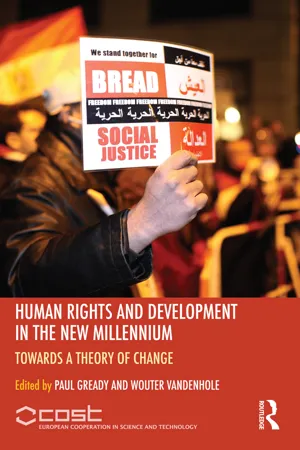
Table of contents

  1. Cover Page
  2. Half Title Page
  3. Title Page
  4. Copyright Page
  5. Contents
  6. Contributors’ biographies
  7. 1 What are We Trying to Change? Theories of change in development and human rights
  8. Part I Approaches
  9. Part II Organisational contexts
  10. Part III Country contexts
  11. Index

Frequently asked questions

Yes, you can cancel anytime from the Subscription tab in your account settings on the Perlego website. Your subscription will stay active until the end of your current billing period. Learn how to cancel your subscription
No, books cannot be downloaded as external files, such as PDFs, for use outside of Perlego. However, you can download books within the Perlego app for offline reading on mobile or tablet. Learn how to download books offline
Perlego offers two plans: Essential and Complete
  • Essential is ideal for learners and professionals who enjoy exploring a wide range of subjects. Access the Essential Library with 800,000+ trusted titles and best-sellers across business, personal growth, and the humanities. Includes unlimited reading time and Standard Read Aloud voice.
  • Complete: Perfect for advanced learners and researchers needing full, unrestricted access. Unlock 1.5M+ books across hundreds of subjects, including academic and specialized titles. The Complete Plan also includes advanced features like Premium Read Aloud and Research Assistant.
Both plans are available with monthly, semester, or annual billing cycles.
We are an online textbook subscription service, where you can get access to an entire online library for less than the price of a single book per month. With over 1.5 million books across 990+ topics, we’ve got you covered! Learn about our mission
Look out for the read-aloud symbol on your next book to see if you can listen to it. The read-aloud tool reads text aloud for you, highlighting the text as it is being read. You can pause it, speed it up and slow it down. Learn more about Read Aloud
Yes! You can use the Perlego app on both iOS and Android devices to read anytime, anywhere — even offline. Perfect for commutes or when you’re on the go.
Please note we cannot support devices running on iOS 13 and Android 7 or earlier. Learn more about using the app
Yes, you can access Human Rights and Development in the new Millennium by Paul Gready,Wouter Vandenhole in PDF and/or ePUB format, as well as other popular books in Politics & International Relations & Politics. We have over 1.5 million books available in our catalogue for you to explore.