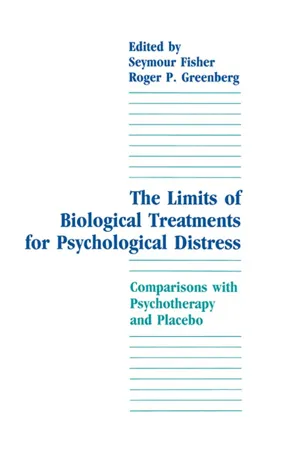
Broadly scanning the biologically oriented treatments for psychological disorders in 20th century psychiatry, the authors raise serious questions about the efficacy of the somatic treatments for psychological distress and challenge the widespread preference for biologically based treatments as the treatments of choice. For graduate and undergraduate courses in clinical, social, and health psychology, behavioral medicine, psychotherapy and psychoanalysis. psychopharmacology, psychiatry, and clinical social work.
eBook - ePub
The Limits of Biological Treatments for Psychological Distress
Comparisons With Psychotherapy and Placebo
- 382 pages
- English
- ePUB (mobile friendly)
- Available on iOS & Android
eBook - ePub
The Limits of Biological Treatments for Psychological Distress
Comparisons With Psychotherapy and Placebo
About this book
Trusted by 375,005 students
Access to over 1.5 million titles for a fair monthly price.
Study more efficiently using our study tools.
Information
1
Examining Antidepressant Effectiveness: Findings, Ambiguities, and Some Vexing Puzzles
Since Kuhn (1958) detected an apparent antidepressant effect for imipramine, many studies have explored this phenomenon. Despite some past skeptical opinions (Jenner, 1977; Porter, 1970; Wechsler, Grosser, & Greenblatt, 1965), it is now widely accepted that the therapeutic effectiveness of the antidepressants, especially the tricyclics, has been indubitably demonstrated. However, although this chapter does not question that antidepressants are therapeutic, it does question the magnitude of the effect and some of its underlying causes. As we surveyed the literature dealing with antidepressants, we detected some inconsistences and methodological gaps in current claims and clinical practices. The history of treatment modes for psychological disturbance bristles with examples (e.g., insulin therapy, lobotomy) that were widely accepted and ultimately proved to fall short of early claims. This is, of course, also true in other areas of treatment (Benson & McCallie, 1979). A cautious attitude about treatment claims is dictated by what has gone before. Among other things, this chapter focuses on the way in which the double- blind design has typically been used to evaluate the therapeutic value of the antidepressants and suggests that it has not been applied satisfactorily. More specifically, our intent is the following:
1. To appraise the effectiveness of the antidepressants across multiple reviews and studies. It should be noted, however, that the appraisal restricts itself to the effectiveness for relieving depression and does not deal with other symptom categories to which antidepressants have been applied.
2. To examine the stability of findings involving the antidepressants, with a special focus on whether reported levels of effectiveness have changed in more recent appraisals.
3. To compare the effectiveness of antidepressants to the outcomes for psychotherapies specifically designed to treat depression.
4. To probe the objectivity of the typical double-blind design employed to evaluate antidepressants, especially in relation to the issue of using placebos that are inactive.
5. To offer suggestions of possible ways of balancing deficiencies in current approaches to measuring the effectiveness of antidepressants and other therapeutic agents.
Past Reviews of Antidepressant Drug Efficacy
Since the introduction of antidepressant drugs, many studies have attempted to assess their effectiveness, and a variety of reviewers have tried their hand at summarizing the reports that have appeared in the literature. The reviewers have focused on the antidepressant effects of tricyclic compounds and monoamine oxidase inhibitors (MAOIs). Obviously there is overlap in the studies summarized by different authors. However, there is occasional disagreement among reviewers in categorizing the same investigation as showing evidence for or against drug use. Results have generally been compressed into either box scores comparing the number of studies showing drugs to be superior to placebos versus those showing no difference in outcome or compilations of the percentage of patients significantly improving on drugs as opposed to placebos. A search of the literature revealed 15 such reviews. Six assessed the drug effects as relatively positive and superior to placebos and 7 suggested more modest, cautious, or equivocal conclusions about drug effects. Two reviews took a somewhat different tack and attempted to measure the degree to which groups treated with antidepressant drugs have exceeded non-drug control groups. Note that these 15 reviews were largely written in the 1960s.
Perhaps a presentation of the positive reviews should begin with the work of Cole (1964) who, in providing an early impressionistic discussion of drug treatments, noted that two thirds of 15 placebo-controlled studies of depressed inpatients showed imipramine to be superior. Three placebo-controlled studies of outpatients also declared imipramine to be the more effective treatment. Similarly, Davis (1965) detailed a box score account of 47 antidepressant drug studies. Most of these reports were placebo controlled and double-blind. The drug was declared superior to placebos in 68% of the studies. At a later date, Davis, Klerman, and Schildkraut (1968) tabulated box scores for 52 double- blind placebo-controlled studies of tricyclics and 28 similarly controlled investigations of MAOIs. Drugs were declared superior to placebos in 79% of the tricyclic studies and in 54% of the MAOI studies.
Klerman and Cole (1965) found 23 studies comparing imipramine to placebo. Eighteen of these studies (78%) indicated that the drug outcome was better. However, the authors of 3 of these 18 positive papers felt that their investigations as a whole did not present really convincing evidence of imipramine’s general superiority to the controls. Overall, the authors of the studies felt that the drug was convincingly superior 15 times in the 23 trials (65%). Incidentally, even this figure may be an overestimation of the number of trials in which imipramine exceeded placebo. Thus, a commentary (Beck, 1967) on this review indicated that many studies were counted by Klerman and Cole as showing positive results even though the superiority of the drug was slight and short of statistical significance on a number of indices.
Klerman and Cole also combined the data across all the studies, permitting an overall judgment as to whether the patients had or had not improved. They concluded that 65% of the 550 imipramine-treated patients improved, whereas 31% of the 459 controls evidenced similar improvement. They went on to suggest that this improvement difference between drugs and placebo might not be as large as the percentages indicated because some of the improved patients were not improved enough to satisfy either themselves or their physicians. Therefore, imipramine was deemed “not entirely satisfactory treatment in many of the depressed patients to whom it was given” (p. 282).
Klein and Davis (1969) reviewed 65 studies comparing tricyclics with placebo and indicated that 50 showed the drug to be superior (77%). They found no striking overall outcome differences among the tricyclics. Although there were differences in diagnostic groupings and types of measurement among studies, it was felt that combining samples might give an approximate summary statement of the efficacy of antidepressants. Therefore, the percentages of improvement reported by the various studies were pooled. The number of patients rated at least moderately improved was combined within the drug and placebo groups respectively and compared with the number found to be slightly improved, unchanged, or worse. In this way the reviewers derived a figure of 70% as the rate of improvement on imipramine and 39% as the placebo improvement rate. Overall it was concluded that imipramine was superior to a placebo, although “not overwhelmingly so,” with a treatment superiority of about 30% more improvement for the active drug than for the placebo. Similarly, in fewer studies, amitriptyline was found to be more beneficial than placebo (62% vs. 24%).
In a more recent, widely cited review, Morris and Beck (1974) looked at 146 double-blind studies on antidepressant drugs utilized in the United States in 1972. Two thirds of the 93 studies of tricyclics indicated that the drug was superior to a placebo, whereas one third of the reports found no difference. The box score outcome for the MAOIs revealed somewhat less success, with an overall superiority over placebo in only 33% of the papers. When MAOI results were limited to only FDA approved drugs, the success rate rose to 61% in favor of the drugs, but Morris and Beck cautioned that this average value could be misleading in view of the considerable variability in efficacy among the MAOIs.
Although the tone of the six reviews cited to this point indicates a superiority of the antidepressant drugs over placebos, seven other reviews indicate more cautious or equivocal conclusions. Brady, in a 1963 review of placebo- controlled studies of imipramine, found that 52% (13 of 25 studies) of these comparisons yielded no significant difference in outcome (cited in Beck, 1967). Atkinson and Ditman (1965) examined 16 reports where the patients were given similar depressive diagnoses and in which an MAOI (tranylcypromine) was used as the sole treatment. Ten of the 16 studies employed a prepost design without control groups. Study outcomes were divided into three groups: favorable, equivocal, or unfavorable. Of the comparisons, 68% were deemed equivocal or unfavorable.
Friedman, Granick, Cohen, and Cowitz (1966) located 21 reports appearing between 1957 and 1964 of double-blind controlled studies comparing imipramine with placebo on hospitalized endogenous or psychotic depressed patients. Eleven of the 21 studies claimed that imipramine was superior to a placebo. However, Friedman et al. stated that on close inspection even the 11 studies reporting positive effects for the drug with psychotic depressives were inconclusive. Only 2 of the 11 studies claimed the results were statistically significant and patients in the “positive” studies turned out to be a mixed sample of endogenous and nonendogenous depressives. In short, Friedman et al. could not find a single double-blind controlled study that demonstrated clearly favorable results with a sample of hospitalized psychotic depressives. Overall, Friedman and his colleagues concluded that the matter of treating endogenous or psychotic depression with imipramine is “unsettled.” Their investigation of this question in an additional carefully done study presented in the same paper indicated that if all outcome indices were considered, there was equivalent relief from depression when hospitalized psychotic depressives were treated with either imipramine or an active placebo.
McNair (1974), in studying how frequently different self-rating scales indicate antidepressant effectiveness, analyzed the results of 72 research publications reporting on 75 largely antidepressant drug trials (almost all double- blind) published between 1955 and 1972. The studies produced an average of six comparisons per trial by utilizing a variety of measures with various subscores and sometimes having more than one evaluation period. Significant treatment effects were found in only 21% of the 451 comparisons. Although this represents a greater number of significant effects than would be expected by chance, the results are modest. Another overview suggesting conservative conclusions was presented by Rogers and Clay (1975), who examined 30 trials comparing imipramine to placebo. They used the global ratings of improvement in each of the studies and submitted each to Fisher’s Exact Test. Although the authors attempted to report results in a sympathetic manner, they found drugs superior to placebo in only 10 of 30 comparisons (33%).
Wechsler et al. (1965), in a review of 103 publications that appeared over a 5-year period, raised questions about the actual magnitude of the antidepressant drug effect. They found the size of the effect to be related to the type of research design. Treatments were found to be more effective when placebo controls were not employed. The association between improvement rates and research design is highlighted by viewing the work on imipramine, the treatment studied most frequently. Imipramine was found to be at least 65% effective in only 1 of the 9 studies comparing it to a placebo, as opposed to 7 out of 9 studies without a control group and 11 out of 17 reports comparing it to another active treatment.
A. Smith, Traganza, and Harrison (1969) presented a “comprehensive overview of antidepressant literature published in the English language.” More than 2,000 articles were screened resulting in a distillation of 490 trials of the efficacy of one or more drugs used in the treatment of depression. The authors discovered, as had Wechsler et al. (1965), that the sophistication of the research design was a dominant factor in determining the level of reported improvement. The more stringently controlled the study, the lower the reported drug improvement rate. Improvement rates for drugs were significantly lowered by either the presence of a control group or the use of blind techniques. Interestingly, increasing study sophistication had the opposite effect on placebo response. The more stringent the controls, the more improvement noted for placebo. Overall, the authors suggested that the methodology of antidepressant research is more significant than the drug being studied in determining the outcome of a clinical trial. They concluded that “the differences between the effectiveness of antidepressant drugs and placebo are not impressive” (p. 19). When studies were restricted to those having placebo controls and blind techniques, active medications had only about a 15% improvement advantage over placebo (with respective median improvement rates of 61.1% vs. 46.3%). Skepticism about the conclusions reached by most authors was raised by the finding that only 18% of the studies in the literature up to that time used statistical tests to decide whether the active drugs were effective. Most frequently (in 67% of the studies) authors simply used global improvement judgments (without statistical comparisons) to reach conclusions about efficacy. The literature review did not indicate what percentage of the time a statistically significant difference was found between drugs and placebos in studies that tested for a difference.
M. L. Smith, Glass, and Miller (1980), utilizing an effect size statistic, determined the degree to which drug treatment groups exceeded control groups on outcome measures drawn from a representative sample of published studies. Their analysis of 75 antidepressant drug effect sizes indicated that the average antidepressant drug effect size is .40. This means that the average person treated with antidepressants is at the 66th percentile of the placebo control group or, conversely, that the average person treated with placebos will do better than 34% of those treated with antidepressants. The typical patient’s standing on outcome variables was bettered by 16 percentile points because of taking drugs rather than a placebo. The fact that this is a relatively modest drug effect is underlined by the finding that of the three major types of psychotropic medications (antipsychotic, antidepressant, and antianxiety), antidepressants produced the smallest effects.
Another meta-analysis, reported by a group from Australia and New Zealand (Quality Assurance Project 1983), also analyzed the results for controlled trials of drug treatments for depression. Results were separately assessed for neurotic (69 studies) and endogenous depressions (54 studies) treated with tricyclics (or other approaches). The effect size (ES) for the treatment of neurotic depression with tricyclics (ES = .52) was slightly higher than the effect size obtained by Smith et al. (1980). A larger effect size was obtained for tricyclic treatment of endogenous depressions (ES = .79). However, the data indicated that the largest effect size for treating neurotic depression occurred with psychotherapy (ES = 1.00) and the largest effect size for dealing with endogenous depressions (where no comparisons with psychotherapy were made) occurred in studies of Electroconvulsive Therapy (ECT) (ES = .93). There were differences in criteria for including studies, handling data, and measuring outcome between the Australian and American meta-analyses, which may account for differential results. Oddly, the Australian/New Zealand analysis found no relationship between research design characteristics and effect size, whereas the M. L. Smith et al. (1980) project discovered—consistent with other researchers—that effect size was related to such design characteristics as degree of blindness in assessing outcome and randomness of assignment to treatment and control groups.
Commentary on the Reviews
After looking at modern textbooks in psychiatry, a reading of the antidepressant drug literature may come as something of a surprise. Although textbooks frequently proclaim that drugs are a significant solution to the problem of depression, research findings help to place this conclusion in perspective. Even the most positive reviews indicate that 30% to 40% of the studies show no difference in response to drugs and placebos (M. L. Smith et al., 1980). In terms of the percentage of improvement, supporters of medication use suggest that about one third of patients do not improve with antidepressant treatment, one third improve with placebos, and an additional one third show a response to medication that they would not have achieved with placebos. Thus, with the most positive outlook, about two thirds of the cases—placebo responders and those who do not respond to anything—would do as well or better with placebo treatment as they would do if treated by an active medication. Furthermore, as we have already note...
Table of contents
- Cover
- Half Title
- Title Page
- Copyright
- Dedication
- Contributors
- Contents
- Preface
- 1. Examining Antidepressant Effectiveness: Findings, Ambiguities, and Some Vexing Puzzles
- 2. Measurement Issues in the Evaluation of Psychopharmacological Therapy
- 3. Pharmacotherapy of the Anxiety Disorders
- 4. Psychotherapy Versus Medication for Schizophrenia: Empirical Comparisons
- 5. Attention Deficit Disorder: The Emperor’s Clothes, Animal “Pharm,” and Other Fiction
- 6. The Clinical Impact of the Side Effects of Psychotropic Drugs
- 7. Personality Factors in the Mediation of Drug Response
- 8. Analysis of Statistical Procedures and Designs Commonly used in Drug Research Studies
- 9. The Efficacy of Electroconvulsive Therapy in the Treatment of Major Depressive Disorder
- 10. A Second Opinion: Rethinking the Claims of Biological Psychiatry
- Author Index
- Subject Index
Frequently asked questions
Yes, you can cancel anytime from the Subscription tab in your account settings on the Perlego website. Your subscription will stay active until the end of your current billing period. Learn how to cancel your subscription
No, books cannot be downloaded as external files, such as PDFs, for use outside of Perlego. However, you can download books within the Perlego app for offline reading on mobile or tablet. Learn how to download books offline
Perlego offers two plans: Essential and Complete
- Essential is ideal for learners and professionals who enjoy exploring a wide range of subjects. Access the Essential Library with 800,000+ trusted titles and best-sellers across business, personal growth, and the humanities. Includes unlimited reading time and Standard Read Aloud voice.
- Complete: Perfect for advanced learners and researchers needing full, unrestricted access. Unlock 1.5M+ books across hundreds of subjects, including academic and specialized titles. The Complete Plan also includes advanced features like Premium Read Aloud and Research Assistant.
We are an online textbook subscription service, where you can get access to an entire online library for less than the price of a single book per month. With over 1.5 million books across 990+ topics, we’ve got you covered! Learn about our mission
Look out for the read-aloud symbol on your next book to see if you can listen to it. The read-aloud tool reads text aloud for you, highlighting the text as it is being read. You can pause it, speed it up and slow it down. Learn more about Read Aloud
Yes! You can use the Perlego app on both iOS and Android devices to read anytime, anywhere — even offline. Perfect for commutes or when you’re on the go.
Please note we cannot support devices running on iOS 13 and Android 7 or earlier. Learn more about using the app
Please note we cannot support devices running on iOS 13 and Android 7 or earlier. Learn more about using the app
Yes, you can access The Limits of Biological Treatments for Psychological Distress by Seymour Fisher, Roger P. Greenberg, Seymour Fisher,Roger P. Greenberg in PDF and/or ePUB format, as well as other popular books in Psychology & Clinical Psychology. We have over 1.5 million books available in our catalogue for you to explore.