eBook - ePub
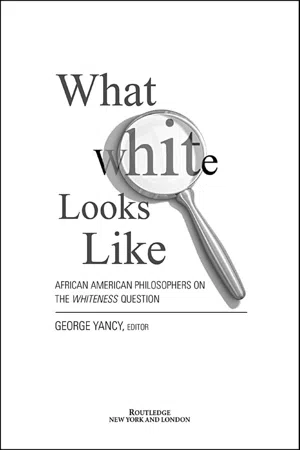
What White Looks Like
African-American Philosophers on the Whiteness Question
- 296 pages
- English
- ePUB (mobile friendly)
- Available on iOS & Android
eBook - ePub
About this book
In the burgeoning field of whiteness studies, What White Looks Like takes a unique approach to the subject by collecting the ideas of African-American philosophers. George Yancy has brought together a group of thinkers who address the problematic issues of whiteness as a category requiring serious analysis. What does white look like when viewed through philosophical training and African-American experience? In this volume, Robert Birt asks if whites can live whiteness authentically. Janine Jones examines what it means to be a goodwill white. Joy James tells of beating her addiction to white supremacy, while Arnold Farr writes on making whiteness visible in Western philosophy. What White Looks Like brings a badly needed critique and philosophically sophisticated perspective to central issue of contemporary society.
Information
1
RACIAL EXPLOITATION AND THE WAGES OF WHITENESS
Charles W. Mills
DISCUSSIONS in the academy in general, and in philosophy in particular, of racial injustice have come a long way over the past decade or two.1 African-American philosophers such as Bernard Boxill and Howard McGary can testify far better than I concerning how little interest there was in these matters only a few years ago, and how the torch was kept burning by a few figures, mostly blacks such as themselves, but with a scattering of white progressives.2 From being a strictly fringe concern, the issue of reparations has become sufficiently mainstream for city councils across the country to take a position on the question, and for “white” universities to debate the matter. Unfortunately, very little of the credit for this development can go to mainstream white philosophy, despite the fact that philosophers are by their calling supposed to be the group professionally concerned about justice as a concept and an ideal; indeed, the book regarded by many as the fountainhead of the Western tradition, Plato’s Republic, is focused single-mindedly on that very subject. Instead, it is black intellectuals, black activists such as Randall Robinson, and community groups such as the National Coalition of Blacks for Reparations in America (N’COBRA) who deserve the credit. Yet there is certainly enough blame to go around—one would not want to pick just on one’s own profession. The indictment for (relative) historic silence on the question of racial justice can be extended to American social and political theory in general, not merely social and political philosophy, but mainstream American sociology and mainstream American political science. (Depending on how one defines “mainstream”—and from the racial margins, pretty much everything else looks mainstream—this judgment also holds true for a lot of orthodox left theory in these fields, not just liberalism, since Marxists have tended to dissolve the specificities of these racial problems into the general oppression of capital, with socialism then being plugged as the universal panacea.)
How do we correct this situation? In this chapter, extrapolating the line of argument I have articulated elsewhere in my work,3 I want to make some suggestions toward the development of a possible long-term theoretical strategy for remedying this deficiency. My recommendation is that we (1) retrieve and elaborate, as an alternative, a more accurate global sociopolitical paradigm, the concept of white supremacy; (2) develop an analysis of a specifically racial form of exploitation, in its manifold dimensions; (3) uncover and follow the trail of what W.E.B. Du Bois famously called the “wages of whiteness”; and then (4) locate normative demands for racial justice within this improved descriptive conceptual framework.
“WHITE SUPREMACY” AS ALTERNATIVE PARADIGM
At least since Marx’s time, if not long before, it has been a cliché that major political battles are ideological battles also, struggles over rival understandings of the sociopolitical order and conflicting framings of the crucial issues. Normative debates about right and wrong, justice and injustice, typically involve not merely axiological clashes but rival pictures of the factual: competing narratives of what happened in the past and what is happening right now, alternative descriptive frameworks and interpretations. The ignoring of race as a global issue in American sociopolitical theory—I distinguish “global” from, say, “local” discussions of race in subsections of a field such as the sociology of race relations, urban politics, or affirmative action debates in applied ethics—is made possible by a certain conception of the American polity and social order. With appropriate disciplinary adjustments for the particular subject in question (whether sociology, or political science, or political philosophy), this picture provides the common overarching framework of debate in the field: the United States is conceptualized as basically an egalitarian (if a bit flawed) liberal democracy free of the hierarchical social structures of the Old World. This profoundly misleading picture is Eurocentric in at least two interesting ways: (i) it focuses on the Euro-American population, those we call “whites,” and takes their experience as representative, as the raw material from which to construct theoretical generalizations; (ii) it draws on a set of theoretical paradigms drawn from European sociopolitical theory—the classic writings of the great figures in European sociology and modern political thought, centered on class as the primary social division, and either not recognizing race as an emergent structure in its own right or biologizing it. The New World is being intellectually grasped with the tools of the Old World, and with reference to the Old World’s transplanted population, an operation thus doubly blinded to the possibility that the experience of expropriated reds, enslaved blacks, annexed browns, and excluded yellows may be sufficiently different as to warrant the development of a new tool kit and, accordingly, a new paradigm. To the extent that race is not ignored altogether, it is naturalized or marginalized, and the nonwhite non-nation is assimilated in theory to the white nation.
The results can be seen in the typical silences and evasions of these disciplines. In an article giving a historical overview of American sociology, for example, Stanford Lyman argues that from the very start the discipline had a “resistance to a civil rights orientation”:
Race relations has been conceived of as a social problem within the domain of sociology ever since that discipline gained prominence in the United States; however, the self-proclaimed science of society did not focus its attention on the problem of how the civil rights of racial minorities might be recognized, legitimated, and enforced…. Indeed, tracing the history of the race problem in sociology is tantamount to tracing the history and the central problem of the discipline itself—namely, its avoidance of the issue of the significance of civil rights for a democratic society…. The reformist solution to social problems … rests upon a rational approach to modifying the structures of a society that is regarded a priori as fundamentally sound with respect to its basic values and norms…. Sociology, in this respect, has been part of the problem and not part of the solution.4
In political science, similarly, Rogers Smith’s recent important and prizewinning book, Civic Ideals, outlines the various ways in which the most important theorists of American political culture, Alexis de Tocqueville, Gunnar Myrdal, and Louis Hartz, have managed to represent racism as an “anomaly” within a polity conceived of as basically egalitarian:
[W]hen restrictions on voting rights, naturalization, and immigration are taken into account, it turns out that for over 80 percent of U.S. history, American laws declared most people in the world legally ineligible to become full U.S. citizens solely because of their race, original nationality, or gender. For at least two-thirds of American history, the majority of the domestic adult population was also ineligible for full citizenship for the same reasons…. Although such facts are hardly unknown, they have been ignored, minimized, or dismissed in several major interpretations of American civic identity that have massively influenced modern scholarship. … All these Tocquevillian accounts falter because they center on relationships among a minority of Americans—white men, largely of northern European ancestry—analyzed in terms of categories derived from the hierarchy of political and economic status such men held in Europe…. [Writers in the Tocquevillian tradition] believe … that the cause of human equality is best served by reading egalitarian principles as America’s true principles, while treating the massive inequalities in American life as products of prejudice, not rival principles.5
Finally, in our own discipline, philosophy, it is notorious—at least among black philosophers—that racial justice has been a major theme or subtheme of hardly a single one of the numerous books on justice by white philosophers written in the three decades since the revival of political philosophy following John Rawls’s work.6 One must conclude either that racial justice is of no concern to them or that they think it has already been achieved.
How are such evasions possible in a country built on Native American expropriation and hundreds of years of African slavery, followed by 140 years of first de jure, and now de facto, segregation? An interesting essay, or even a whole book, in the sociology of knowledge (or here, more accurately, the sociology of ignorance) could certainly be written on this question, but briefly, one would need to highlight the role of historical amnesia (the suppression, or the downplaying of the significance, of certain facts), the group interests and nonrepresentative experience of the privileged race (what cognitive psychologists would identify respectively as hot and cold factors of cognitive distortion), and, crucially, a conceptual apparatus inherited, as I said, from European sociopolitical theory, for which race is marginal. Though the problem is by no means confined to philosophy, in philosophy (for home-team reasons, I want to make sure that we get the credit for something) it is worst of all, because of the much greater possibilities for abstracting away from reality provided by the nonempirical nature of the subject.
Consider our own discipline, then. In philosophy it becomes possible for what some see as the most important work in Anglo-American political philosophy of the twentieth century, or even the most important work in twentieth-century political theory period, A Theory of Justice, to be written by an American, John Rawls, and yet make next to no mention of the centrality of racial injustice to the American polity. Defenders will, of course, tell me—I have had these debates before—that that is because Rawls expressly set out to do a book in ideal theory. My response would be to ask why he chose to do this, considering that the role of normative inquiry is presumably ultimately to intervene in our own, manifestly nonideal world. I would also suggest, though I suppose this verges on the ad hominem, that only those whose experience is one of privilege would find it so natural to deal purely with “ideal” theory in the first place. After all, having mapped out the ideal theory, should not the natural next move be to apply this theory to social reality so as to generate concrete prescriptions for making it more just? Moreover, in the three decades since the publication of Rawls’s book, why have so many white philosophers followed his lead? As my colleague Tony Laden has pointed out to me, having done an Ethics review essay on a five-volume collection of articles on Rawls’s work that includes no less than 88 papers from the past three decades, only one of these essays—by the African-American philosopher Laurence Thomas—deals with race.7 Why has nobody done for race what Susan Moller Okin did with Rawls’s apparatus for gender8 and imagined what kind of social structure you would prescribe from behind the veil if you knew how people of color were disadvantaged by white supremacy? For that matter, why are European imperialism, African slavery, Native American expropriation, Jim Crow, and so on not part of the “general facts” about society and history, knowledge of which you are supposed to take with you behind the veil? How is it that in a book that appeared in 1971 and whose chapters were being written and circulated in the 1960s, a time of national civil rights protest from the mainstream NAACP to the more radical Black Panthers, we get no whiff of these struggles, no consideration—over the span of 600 pages—of what the implications might be if the “basic structure” is itself unjust?
And from a black point of view, of course, Rawls’s later work is even less helpful in that the focus has shifted from the distributive concerns that at least provided some opening for philosophers of color to what I think most of us feel to be a largely irrelevant, profoundly nonurgent and sleep-inducing debate about whether a just and stable society is possible when citizens are divided by their adherence to reasonable but incompatible doctrines.9 In a post-Cold War United States where liberalism (in the broad, antifeudal sense) is obviously hegemonic, this is hardly a pressing matter. Of far greater importance from the point of view of justice, one would think, are the growing divisions between rich and poor of all colors, and the decades’ long retreat from whatever weak corrective measures had been implemented in the ‘70s and ‘80s to address the legacy of de jure racial domination, which many black intellectuals have seen as the betrayal of the “Second Reconstruction.”
So there has been a debilitating “whiteness” to mainstream political philosophy in terms of its crucial assumptions, the issues it has typically taken up, and the mapping of what it has deemed to be appropriate and important subject matter. And my claim is that the transdisciplinary framing of the United States as an if-not-quite-ideal-then-pretty-damn-close-to-it liberal democracy, particularly in the exacerbatedly abstract form typical of philosophy, has facilitated and underwritten these massive evasions on the issue of racial injustice. Accordingly, I have suggested in my own work that to counter this framing we need to revive “white supremacy” (which is already being used by many people in critical race theory and critical white studies) as a descriptive concept.10 Normative questions, as pointed out above, hinge not merely on clashes of values, but on rival factual claims, both with respect to specific incidents and events and with respect to determining and constraining social structures. And particularly when challenges are coming from the perspective of radical political theory (e.g., Marxism, feminism, critical race theory), it may well be the case that most or all of the work in claims about injustice is being done by the divergent factual picture put forward rather than different values. Marxism is famously associated with antimoralism, but for those Marxists who have sought to make a normative case for the superiority of socialism, the appeal has often been made with reference to standard liberal norms of equality and well-being. (Indeed, some Marxist theorists have argued that there are no distinctively socialist values—that insofar as Marxism has a normative critique of capitalism, it is basically parasitic on liberal-democratic values.) And while there are numerous varieties of feminism, the most important kind historically has obviously been mainstream liberal feminism, which has simply sought to extend liberal values across the gender divide. So the point is that one can utilize mainstream values to advance quite radical demands: the key thing is to contest the factual picture with which mainstream theorists are operating. With the feminist concept of patriarchy and the Marxist concept of class society, women and the left have been better able to intervene in mainstream discussions of justice, because they have also contested the factual picture that has framed these discussions.
My claim is, then, that African-American and other philosophers working on race, and critical race theorists more generally, should make a comparable theoretical move: challenge the mainstream liberal “anomaly” framing of race by developing the concept of white supremacy. Doing so would have several advantages.
- To begin with, just on the terminological level, this is the term that was traditionally used to denote white domination, so one would be drawing on a vocabulary already established and familiar.11 Feminists appropriated an existing term (“patriarchy”) but had to shift its meaning; Marx had to provide an analysis of class society not merely in terms of rich and poor but, more rigorously, in terms of ownership of the means of production. So both are being employed as terms of art. But in the case of race in the United States, “white supremacy” was the term standardly used. What would now be necessary, of course, would be to give it a more detailed theoretical specification than it has hitherto had, to map in detail its various dimensions, and to try to work out its typical dynamic.
- More important, the term carries with it the connotation of systematicity. Unlike the currently more fashionable “white privilege,” white supremacy implies the existence of a system that not only privileges whites but is run by whites, for white benefit. As such it is a global conception, including not just the socioeconomic, but also the juridical, political, cultural, and ideational realms. Thus it contests—paradigm versus paradigm—the liberal individualist framework of analysis that has played and continues to play such an important and pernicious role in obfuscating the real centrality of race and racial subordination to the polity’s history.
- Finally, by shifting the focus from the individual and attitudinal (the discourse of “racism”) to the realm of structures and power, it helps highlight the most important thing from the perspective of justice, which is how the white population benefits illicitly from its social location. Current debates about “racism” are hindered by the fact that the term is used in such a confusingly diverse range of ways that it is difficult to find a stable semantic core. Moreover, the dominant interpretation of white racism in the white population is probably individual belief...
Table of contents
- COVER PAGE
- TITLE PAGE
- COPYRIGHT PAGE
- ACKNOWLEDGMENTS
- CONTRIBUTORS
- 1: RACIAL EXPLOITATION AND THE WAGES OF WHITENESS
- 2: THE BAD FAITH OF WHITENESS
- 3: THE IMPAIRMENT OF EMPATHY IN GOODWILL WHITES FOR AFRICAN AMERICANS
- 4: DELEGITIMIZING THE NORMATIVITY OF “WHITENESS”: A CRITICAL AFRICANA PHILOSOPHICAL STUDY OF THE METAPHORICITY OF “ WHITENESS”
- 5: A FOUCAULDIAN (GENEALOGICAL) READING OF WHITENESS: THE PRODUCTION OF THE BLACK BODY/SELF AND THE RACIAL DEFORMATION OF PECOLA BREEDLOVE IN TONI MORRISON’S THE BLUEST EYE
- 6: WHITENESS VISIBLE: ENLIGHTENMENT RACISM AND THE STRUCTURE OF RACIALIZED CONSCIOUSNESS
- 7: REHABILITATE RACIAL WHITENESS
- 8: CRITICAL REFLECTIONS ON THREE POPULAR TROPES IN THE STUDY OF WHITENESS
- 9: WHITENESS AND AFRICANA PHENOMENOLOGY
- 10: ON THE NATURE OF WHITENESS AND THE ONTOLOGY OF RACE: TOWARD A DIALECTICAL MATERIALIST ANALYSIS
- 11: SILENCE AND SYMPATHY: DEWEY’S WHITENESS
- 12: WHITENESS AND FEMINISM: DÉJÀ VU DISCOURSES, WHAT’S NEXT?
- 13: THE ACADEMIC ADDICT: MAINLINING (& KICKING) WHITE SUPREMACY (WS)
Trusted by 375,005 students
Access to over 1.5 million titles for a fair monthly price.
Study more efficiently using our study tools.
Frequently asked questions
Yes, you can cancel anytime from the Subscription tab in your account settings on the Perlego website. Your subscription will stay active until the end of your current billing period. Learn how to cancel your subscription
No, books cannot be downloaded as external files, such as PDFs, for use outside of Perlego. However, you can download books within the Perlego app for offline reading on mobile or tablet. Learn how to download books offline
Perlego offers two plans: Essential and Complete
- Essential is ideal for learners and professionals who enjoy exploring a wide range of subjects. Access the Essential Library with 800,000+ trusted titles and best-sellers across business, personal growth, and the humanities. Includes unlimited reading time and Standard Read Aloud voice.
- Complete: Perfect for advanced learners and researchers needing full, unrestricted access. Unlock 1.5M+ books across hundreds of subjects, including academic and specialized titles. The Complete Plan also includes advanced features like Premium Read Aloud and Research Assistant.
We are an online textbook subscription service, where you can get access to an entire online library for less than the price of a single book per month. With over 1.5 million books across 990+ topics, we’ve got you covered! Learn about our mission
Look out for the read-aloud symbol on your next book to see if you can listen to it. The read-aloud tool reads text aloud for you, highlighting the text as it is being read. You can pause it, speed it up and slow it down. Learn more about Read Aloud
Yes! You can use the Perlego app on both iOS and Android devices to read anytime, anywhere — even offline. Perfect for commutes or when you’re on the go.
Please note we cannot support devices running on iOS 13 and Android 7 or earlier. Learn more about using the app
Please note we cannot support devices running on iOS 13 and Android 7 or earlier. Learn more about using the app
Yes, you can access What White Looks Like by George Yancy in PDF and/or ePUB format, as well as other popular books in Philosophy & Philosophy History & Theory. We have over 1.5 million books available in our catalogue for you to explore.