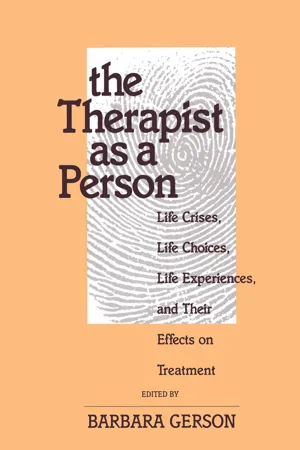
In this collection of powerfully illuminating and often poignant essays, contributors candidly discuss the impact of central life crises and identity concerns on their work as therapists. With chapters focusing on identity concerns associated with the body-self (body size, ethnicity, sexual orientation, and age), urgent life crises, and defining life circumstances, The Therapist as a Person exemplifies the myriad ways in which the therapist's subjectivity shapes his or her interaction with patients. Included in the collection are life events rarely if ever dealt with in the literature: the death of family members, late pregnancy loss, divorce, the failure of the therapist's own therapy, infertility and childlessness, the decision to adopt a child, and the parenting of a profoundly deaf child.
eBook - ePub
The Therapist as a Person
Life Crises, Life Choices, Life Experiences, and Their Effects on Treatment
- 326 pages
- English
- ePUB (mobile friendly)
- Available on iOS & Android
eBook - ePub
The Therapist as a Person
Life Crises, Life Choices, Life Experiences, and Their Effects on Treatment
About this book
Trusted by 375,005 students
Access to over 1.5 million titles for a fair monthly price.
Study more efficiently using our study tools.
Information
I
Current Life Crises of Therapists
1
Death of a Psychoanalyst’s Child
I only know that summer
sang in me
a little while, that in me
sings no more.
sang in me
a little while, that in me
sings no more.
Edna St. Vincent Millay
Let me comfort you, let me weep with you in your bottomless sorrow, let me sob, let me grieve for you in your endless mourning, let me wail, let me clasp you in my arms, let me rock wordlessly back and forth in your dreadful pain.
A patient’s sympathy note
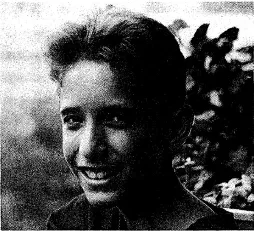
The unutterably unthinkable has happened. My twelve-year-old son, my only child, whom I had longed for for years, was killed. We were walking on a country road after a concert, he behind me, when he was struck by a car driven by a sixteen-year-old who had been driving six weeks. It was September 5, 1993, Labor Day weekend. We were looking forward to returning home to New York City the next day, after a five-week vacation in our country house in the Berkshires. Shaun had just been proudly graduated from the Rodeph Sholom Day School and was accepted for seventh grade at Dalton. He had a new girlfriend, Debbie, eleven, whom he had met that July at Camp Eisner. He was singing in the Metropolitan Opera Children’s Chorus, and I had had the joy of seeing him in six operas, one with Pavarotti himself, on the stage of the great Metropolitan Opera. He had just earned his yellow belt in Karate. His artwork was exceptional. His comic collection was extraordinary. He wanted to be a surgeon and would have been. He was handsome, smart as can be, and full of life.
Yet, in one minute he was dead, and my life was totally shattered. In the hospital when they told me he was brain dead, I realized with horror that, instead of his Bar Mitzvah, I would be arranging his funeral. Now, three and a half months since that tragic, that unspeakable day, I weep every day. I cannot believe he is dead. I cannot accept he is dead. It cannot be that I will never see him again, won’t ever touch him again, or watch him grow, or have grandchildren. The fact that he is not here to live his life, to love and be loved, to achieve, to enjoy, to give—for him—is too painful to even speak about. I think about death a great deal. It comforts me to think that I could be near him in the earth.
Called to the hospital by the local Rabbi,1 the Associate Rabbi2 of our New York City temple and Shaun’s school happened to be in the Berkshires that fateful Labor Day weekend. They were with me for hours after Shaun was killed. There was no time to contact a psychology colleague, so my Rabbi was the one I asked to call my patients, whom I had been planning to resume seeing in two days. He told them there was a “death in the family” and that I would contact them as soon as I could.. I had debated whether to tell my patients that it was my son but decided that it was more humane not to shock them without being available to them. Most of my patients sent cordial sympathy cards, but it was obvious that early on they did not know specifically who had died. When the obituary notice appeared and some patients realized it was my child, several of them sent much more deeply felt cards.
Hundreds of people, many of them colleagues from the NYU Postdoctoral Program and the NYU School Psychology Program, came to the funeral. Parents themselves, they were traumatized by what had happened; they told me it was their worst nightmare. During Shiva (the traditional Jewish week of mourning), my colleagues visited and gently suggested going back to work as soon as possible, saying it would help. By the Monday following the week of Shiva, counting my five-week vacation, I had been gone from my patients seven weeks.
THOUGHTS ABOUT RETURNING TO WORK
I planned to resume seeing my patients exactly two weeks after Shaun was killed. Taking medication, it was going to be an experiment, as I could not imagine how I would be able to function. Visions of going on disability appeared. Yet, on a practical level, there were bills to pay. Also, now that I no longer had my son to care for, I could not imagine what I would do all day long without work. Even with work, there seemed to be endless time for crying and grief. I do not think I thought about my patients’ needs for me, and if I did, I am sure I felt that I did not have much, if anything, to give.
Yet amazingly, amazingly, I was able to concentrate. Traditionally in my work, I am not particularly self-revealing, preferring a more “neutral” analytic stance. But I had decided that, if asked who had died, given the enormity of the trauma for me, I would not respond with, “What is your fantasy?” I knew I would answer each patient, though I felt I would not tell those who did not ask. Several of my patients were astute enough to realize that the mourning period had extended two weeks instead of one and, suspecting the worst, asked me outright who had died. My office is in my home; over the years, some patients had occasionally seen my young son in the elevator or going to his room, they had smelled dinner being cooked for him by the housekeeper, or they had heard the TV. They knew I had a child. They were devasted when I told them it was my son and cried for me, for him, admitting it was what they feared. As I write this now, it has been three and a half months, and there are still a number of patients who do not know. Where the work is perhaps less in-depth, their not knowing does not seem to feel critical. There are, however, several patients who do not yet know, but I would like them to because our work is more intense, and it feels as if I have a big, bad secret. I dread others’ finding out; one wants to get pregnant, one is trying to adopt—how will this affect them?
FIRST DAY BACK AT WORK (SEPTEMBER 20, 1993)
The first patient I saw, precisely two weeks after my son was killed, was a 39-year-old married woman, with a five-year-old child, who has been trying to get pregnant for two years. Other than knowing someone had died, she had no idea what happened to me nor did she ask. She started talking about how desperately she wanted this second child and about the fertility problems she was having. Despite, or perhaps because of, my tragic loss and my own fantasies of another child, I felt extremely sympathetic to her longing for a second child. I was relieved she did not know about Shaun’s death because I felt it would have inhibited her rightful need to grieve for what she had not been able to achieve. She told me that she found it very reassuring when a friend recently told her, “At least you have one child.” I was, however, unable to help her with that perspective. I was glad someone else had; it would have felt like “sour grapes” coming from me. I fear if she finds out that I lost my child, she will be ashamed. She shouldn’t be. I care about her, and her pain is so palpable.
By contrast, that day, another long-term patient asked me who had died. She had feared it was my son and was devastated when I confirmed it. She cried bitterly for me and for Shaun. I felt strangely grateful that she hurt, too, and to know that Shaun’s death had so affected her. She is 39, just out of a divorce, and also desperately wants a child. She has had to struggle with the dual issues of finding a man and having a child. This patient, however, has accomplished what she set out to do. She recently fell in love with a man, older and handicapped, but willing and able to afford to have a child with her or to adopt. I marvel at the recoverability of the human soul. She was distraught and despairing after the breakup of her marriage, yet one year later she is embarking on a new life. Could this be possible for me? I cannot imagine it. This patient is most dear to me, and I enjoy every moment that she conquers fate. She asked what she could do to help, and I told her to let me keep doing my work. I worry that this truly sensitive person could fear that I might be jealous, but I am not. She must know how much I want her to be happy.
Grief is such a difficult emotion. A funeral director/social worker went so far as to say that
Jacqueline Kennedy Onassis, with her magnificent public stoicism at the funeral of the assassinated president, set grieving back a hundred years. She created an example of dignity for the world that people emulated. … The only harm in emulating this brave woman arose when people did not stop to think that in private she cried and probably screamed just as we all do. Bereaved parents actually are ashamed of their own comparative “lack of control” as this attitude filtered down to the general population.
Harriette Sarnoff Schiff, author of The Bereaved Parent (1977, p. 16), questioned what kind of control should have to be maintained by the parent of a dead child at such a catastrophic time. I questioned what kind of control to maintain as an analyst with a dead child.
It was not until this first day, when I saw I could function, that I realized I would be continuing with work.
ABRUPT TERMINATION (SEPTEMBER 23, 1993—2 WEEKS)
That first week, a patient who had happened to read my son’s obituary wrote to me:
Even though we have a professional relationship, we also have a very personal relationship, albeit one way. The news of your personal loss—tragedy—makes me want to reciprocate to you all the attention, caring, and advice you’ve given me. Of course, I feel close to you as you are the only one I have confided in about so many things.
The patient came for this one session and quit treatment that day. She cried bitterly for my loss and told me she could not bear talking about herself, that all she wanted to do was to comfort and hug me. We embraced; we did hug and cry—actually, I don’t remember if I cried. She is a 35-year-old married woman who is having difficulty conceiving. I asked if she felt that she could not talk to me about wanting a child or having a child because of my loss. She denied it but quit nonetheless, with assurances that she would contact me should she need me. The assurances sounded strangely hollow, yet I understood her need to flee from my terrible situation, as if the death of my child could be “catching.” (Interestingly, almost ten months later, this patient referred a relative of hers.)
The rest of my patients remained. Freud was right about the nature of productive work: at least for the time that I was in session, I could escape a little from the horror of what my life had become.
OTHER WAYS PATIENTS FOUND OUT (DECEMBER 15, 1993—3 MONTHS)
This week, New York Magazine published my Letter to the Editor where I discussed Shaun’s death. The letter was in response to an article they had published about a couple whose seven-year-old son had died of a brain tumor and who subsequently adopted two daughters. This same couple had heard about Shaun’s death and contacted me, and, as the first family I knew who had also lost a child, helped me to feel less alone in my tragedy. The husband introduced and accompanied me to several meetings of Compassionate Friends (a bereavement group for parents who have lost children). I wrote too because part of me wanted the world to know about Shaun’s death. I also suspected some patients who did not know might read the letter.
One did. She described how, when she originally received the call from the Rabbi, she had no idea it was my son who had died and had thought (wished) it was some distant relative. She herself had lost her father within the past year. She told me she read the letter three times to be sure it was really me. She then volunteered to contribute to a Memorial Fund I had set up in Shaun’s name at his school. She talked about how guilty she felt having talked about her problems, which by comparison to my son’s death, now seemed unimportant. I told her that my work with her and my other patients was, in fact, very important and was helping me to survive and that she should go right on doing what she was doing, namely letting our work continue. She seemed relieved by this reassurance.
Feeling guilty about being preoccupied with their own problems, which they felt were insignificant by comparison, was a dominant theme for patients once they found out it was my child who had died.
When Shaun was dead three and a half months, I received a written response to my published letter from a current patient:
Dear Dr. Chasen—
After reading your letter in this week’s New York Magazine, I was very sad to hear of your son’s tragic death. I actually had the gut feeling all along that this is what had happened to you, but was hoping it wasn’t what I thought, and was also afraid to put you in a difficult position by your having to tell me.
But in this card I wanted to reach out and send to you a little emotional support for a change. You are a very strong woman to be able to go on with your sessions so quickly, but I suppose it is also therapeutic for you. You are a very special person—a great therapist. I truly feel that I respect your words and your way in guiding me, or at least pushing me into the right direction when necessary.
Thank you again. Take care (and see you soon!)
When I talked with her about this note, she said she had asked me who died at the end of our second session but then never brought it up again. I know I would not have told her at the end of a session, and somehow I too did not bring it up at the next session. She said, “It reminded me of my first therapist—some guy called to say the therapist was unavailable, and I never went to sessions again. When this happened to you, I thought maybe I wouldn’t see you again. I was really anxious at the beginning. If it was bad as I thought, how could you go on as a therapist? I was scared you’d get upset—afraid I wouldn’t know what to say or do. I know there are no real rules. I thought you’d say what happened when you were ready to.” She cried, saying, “I can’t believe it happened. I feel really bad. I keep thinking what a tragedy it is—the worst thing that happens to a parent. It’s close to home. It makes me think about what the future holds.”
She then started talking about the traumas in her own life: her parents’ divorce, her father’s remarriage, and the birth of a half-brother. “Part of me is thinking about the similarity of my half-brother’s age (eleven), part of me is relieved to know about Shaun’s death. I was always wondering, but scared to bring it up. I didn’t want to be pushy. Maybe partly I didn’t want to know. I cared so much I couldn’t bring it up. I thought about it all the time. I get really nervous about bringing up things that are difficult.” I asked “Why?” “My father taught me to hold things in. If it’s bad, he broods for months or years. We don’t deal with things. I had that same bad gut feeling when my parents told me about their divorce. Then when my stepmother was pregnant, we saw her gaining weight, but my sister and I said, “No, she’s not pregnant, she’s older [38].” She had returned to her issues, through my loss, perhaps with a different perspective. I said, “Maybe I wanted my patients who didn’t know, to read the letter.” She said, “I’m glad you wrote.” I responded, “I’m glad you wrote.”
MY SUICIDAL WISH (JANUARY, 1994—4 MONTHS)
We thank with brief thanksgiving
Whatever Gods may be
that no life lives forever;
that dead men rise up never;
That even the weariest river
winds somewhere safe to sea.
Whatever Gods may be
that no life lives forever;
that dead men rise up never;
That even the weariest river
winds somewhere safe to sea.
A. C. Swinburne
Now I fully understand how the thought of suicide is so very comforting. Last year, a young patient came to see me after a suicide attempt. He told me that he had had suicidal ideation since he was a child and brought me a poem, written when he was eight, about how he would one day attempt suicide by taking aspirin. This is, in fact, what he attempted at nineteen. During the course of our brief treatment, he described how whenever anything would go wrong, he soothed himself with the fantasy that since he could always kill himself, “it really didn’t matter.” I was horrified that so young and so talented a child would have carried the burden of this fantasy for so long. Now I have the same fantasy myself. I worry, however, what impact my suicide would have on my patients, particularly him. I especially worry about a failed suicide attempt and bought Final Exit (Humphry, 1991) to learn how to do it successfully.
That first week, this same young patient decided to stop treatment. He did not know that my son had died. Our work was far from finished, and I tried to persuade him to continue treatment, but he was determined to “go it on his own.” Previously, during the summer, he had told me that he might quit because he didn’t want to become “dependent” (though he had only been in one-time-a-week treatment for less than a year). While I wanted to continue work with him for his sake, I was relieved he quit, for my sake. He was the patient I worried about most should I decide to commit suicide. Not a very good role model. I was now relieved of that particular constraint.
One of the century’s most famous intellectual pronouncements comes at the beginning of The Myth of Sisyphus. “There is but one truly serious philosophical problem, and that is suicide. Judging whether life is or is not worth living amounts to answering the fundamental question of philosophy” [Styron, 1990, p. 23].
My patients’ relief that I am working and their need for me has given me strength. I feel I would betray their trust if I killed myself. They would have to truly understand that to lose a child is a blow from which one might not want to recover. There is a constant longing to see Shaun and hold him and touch him: as Anna Quindlen put it, “the constant presence of an absence.” Shaun’s death leaves me feeling unneeded and useless. The feeling of being needed, wanted, and useful by my patients counteracts the uselessness for a time, but when I am alone, suicidal thoughts soothe.
VARIOUS PATIENT REACTIONS (JANUARY, 1994—4 MONTHS)
Another patient who knew Shaun casually through passing each other in the hallway, and of his death, has been with me for many years and has been talking of terminating this June. One session she talked of feeling trapped in the treatment. We analyzed a dream where she saw me as forcing her to remain in treatment. She then told me of a recent slip; when she was asked how long she had been in treatment with me, she told the person, “I’m treating her,” instead of “She’s treating me.” In part, she feels that she cannot leave me because my son died. She was right, though I did not confirm her perceptions. So I challenged her and asked her how she would feel about leaving even sooner, perhaps in February or March instead of June. She immediately responded that she would not want to and astutely told me, “You just got upset.” Defensively I said, “I merely wanted to ask you.” I will miss her and did not ...
Table of contents
- Cover Page
- Half Title page
- Series page
- Title Page
- Copyright Page
- Dedication
- Contents
- Contributors
- Acknowledgments
- Introduction
- Current Life Crises of Therapists
- 1 Death of a Psychoanalyst's Child
- 2 More Human Than Otherwise Working Through a Time of Preoccupation and Mourning
- 3 Trauma and Disruption in the Life of the Analyst Enforced Disclosure and Disequilibrium in “The Analytic Instrument”
- 4 An Analyst's Pregnancy Loss and Its Effects on Treatment Disruption and Growth
- 5 Reflections of a Childless Analyst
- 6 Chloë by the Afternoon Relational Configurations, Identificatory Processes, and the Organization of Clinical Experiences in Unusual Circumstances
- 7 The Ongoing, Mostly Happy “Crisis” of Parenthood and Its Effect on the Therapist's Clinical Work
- 8 Thank You for Jenny
- 9 When the Therapist Divorces
- 10 The Impact of Negative Experiences as a Patient on My Work as a Therapist
- Childhood Life Crises and Identity Concerns of Therapists
- 11 The Effects of Sexual Trauma on the Self in Clinical Work
- 12 The Loss of My Father in Adolescence Its Impact on My Work as a Psychoanalyst
- 13 Psychoanalysis In and Out of the Closet
- 14 Different Strokes, Different Folks Meanings of Difference, Meaningful Differences
- 15 The Therapist's Body in Reality and Fantasy A Perspective from an Overweight Therapist
- 16 Working as an Elder Analyst
- Afterword
- Index
Frequently asked questions
Yes, you can cancel anytime from the Subscription tab in your account settings on the Perlego website. Your subscription will stay active until the end of your current billing period. Learn how to cancel your subscription
No, books cannot be downloaded as external files, such as PDFs, for use outside of Perlego. However, you can download books within the Perlego app for offline reading on mobile or tablet. Learn how to download books offline
Perlego offers two plans: Essential and Complete
- Essential is ideal for learners and professionals who enjoy exploring a wide range of subjects. Access the Essential Library with 800,000+ trusted titles and best-sellers across business, personal growth, and the humanities. Includes unlimited reading time and Standard Read Aloud voice.
- Complete: Perfect for advanced learners and researchers needing full, unrestricted access. Unlock 1.5M+ books across hundreds of subjects, including academic and specialized titles. The Complete Plan also includes advanced features like Premium Read Aloud and Research Assistant.
We are an online textbook subscription service, where you can get access to an entire online library for less than the price of a single book per month. With over 1.5 million books across 990+ topics, we’ve got you covered! Learn about our mission
Look out for the read-aloud symbol on your next book to see if you can listen to it. The read-aloud tool reads text aloud for you, highlighting the text as it is being read. You can pause it, speed it up and slow it down. Learn more about Read Aloud
Yes! You can use the Perlego app on both iOS and Android devices to read anytime, anywhere — even offline. Perfect for commutes or when you’re on the go.
Please note we cannot support devices running on iOS 13 and Android 7 or earlier. Learn more about using the app
Please note we cannot support devices running on iOS 13 and Android 7 or earlier. Learn more about using the app
Yes, you can access The Therapist as a Person by Barbara Gerson in PDF and/or ePUB format, as well as other popular books in Psychology & Applied Psychology. We have over 1.5 million books available in our catalogue for you to explore.