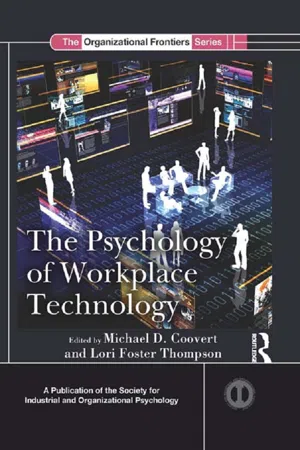
- 336 pages
- English
- ePUB (mobile friendly)
- Available on iOS & Android
eBook - ePub
The Psychology of Workplace Technology
About this book
Recent advances in technology have dramatically altered the manner in which organizations function, transforming the way people think about and perform their work. The implications of these trends continue to evolve as emerging innovations adapt to and are adapted by organizations, workers, and other components of the socio-technical systems in which they are embedded. A rigorous consideration of these implications is needed to understand, manage, and drive the reciprocal interplay between technology and the workplace. This edited volume brings together top scholars within and outside of the field of industrial and organizational (I-O) psychology to explore the psychological and organizational effects of contemporary workplace technologies. A special section is included at the end of the book by four experts in the field entitled Reflections and Future Directions.
Trusted by 375,005 students
Access to over 1.5 million titles for a fair monthly price.
Study more efficiently using our study tools.
Information
Subtopic
ManagementIndex
Business1 Toward a Synergistic Relationship between Psychology and Technology
DOI: 10.4324/9780203735565-1
The world in which we live and work is truly a magnificent one. Technology's presence has grown at a most rapid rate, and technology itself is ubiquitous. Many readers of this volume will be familiar with Moore's Law, which describes the rate and cost of the number of semi — conductors on a chip (indicative of the chip's power). The law predicts semiconductors doubling every 18 months while the cost halves during the same period. But what does this mean in terms of helping us understand how far technology has come? Diamandis and Kotler (2012) provide a useful frame of reference, noting: “Right now a Masai warrior with a cell phone has better mobile phone capabilities than the president of the United States did twenty-five years ago. And if he's on a smart phone with access to Google, then he has better access to information than the president did just fifteen years ago” (p. 9).
If we've come so far in such a short period of time, what lies ahead? Futurist Ray Kurzweil claims that by 2029 computers will be able to deal with the full range of human intelligence and emotions and will thus be indistinguishable from people (Murray, 2012). Computational develop — ments of this scale enable exciting possibilities, but also raise new questions and concerns. While many believe that technology enhances our quality of life, both in and out of the workplace, others worry about its detrimental effects. Is technology necessarily good?
As discussed in this chapter, workplace technology can enable or oppress. I-O psychology research, theory, and practice have the potential to facilitate the former and prevent the latter, much to the benefit of workers and employers. Psychological research and theory are essential to predicting and managing the direct influence as well as the second- and third-order effects of technology, enabling workers and employers to capitalize on technology's potential while avoiding its perils. As workplace technology progresses, its effectiveness will only increase to the extent that its development and integration into the workplace are driven by a clear understanding of human behavior.
Technology's Perils, Potential, and the Role of Psychology
As children, many of us were taught that there can be more than one outcome when using any tool. Fire can be good, cooking our food and keeping us warm; but fire can also be harmful, such as when it burns us or gets out of control and destroys property. Similarly, we need to mindfully employ technology so it benefits and does not oppress us. As discussed below, electronic monitoring systems (Alge & Hansen, this volume) provide a good example of technology's coexisting promise and perils. Another example pertains to online recruitment and selection systems. On the upside, such systems greatly increase the ability to screen large numbers of applicants based on key words or other descriptors. But they can also cause viable applicants to be overlooked, a problem with very real implications for people's lives. Unfortunately, there have been no comprehensive studies examining the false negatives that are slipping through the system because they do not have the correct format or key words in their online résumé. Smart, mobile devices as a conduit for “24/7” access to information, work, and co-workers provide yet another illustration of technology's positive and negative effects. Although constant, instantaneous access to technology and expertise has benefits, it can quickly wreak havoc with work—life balance.
Forward thinking organizations use technology to enable their workforce, while others use it in a more oppressive fashion. The problem of oppressive technological interventions, however, is not as simple as a blatant disregard for workers' well-being by organizational leaders seeking to maximize profit and productivity at any cost. At times, leaders inadvertently adopt or implement technology in a manner that undermines workers' motivation and well-being. Psychological research and theory are needed to inform solutions to this problem. Many applicable theories exist. To provide but one example, consider the implementation of workplace technology through the lens of self-determination theory. Self-determination theory posits that workers' self-motivation and well-being will be enhanced when innate needs for autonomy, competence, and relatedness are satisfied, and diminished when these needs are thwarted (Ryan & Deci, 2000). Autonomy refers to the need to exercise control over one's actions—to be a causal agent in one's own life. Competence is the need to experience mastery and affect one's outcomes and surroundings. Relatedness is the need to feel interpersonally connected with others (Greguras & Diefendorff, 2009).
Technology can arguably threaten or help to satisfy these three core needs, thereby affecting workers' motivation, functioning, well-being, and 1011 growth. Electronic monitoring provides a good example. Monitoring can be beneficial, as self-initiated systems demonstrate. Systems that enable people to track their activities at work have led to increases in productivity by helping people to better understand how they are allocating their time (Osman, 2010). This understanding allows workers to reapportion their time, tasks, and activities to better accomplish work goals. Note, however, that the effectiveness of such monitoring depends on how it is implemented. It appears most effective when it is initiated and controlled by the worker as opposed to the organization (Alge & Hansen, this volume), with the latter approach arguably threatening one's freedom of action and hence a fundamental need for autonomy. In short, even a single technological intervention can negatively or positively affect people's satisfaction, motivation, well-being, and productivity, depending on how it is designed and implemented. This underscores the need to attend to the psychology of workplace technology when innovations are adopted in organizations.
At present, one fact is clear: Technology's influence—both enabling and oppressive—is pervasive in the modern workplace. Technology's presence will only increase as it continues to provide a competitive advantage. As noted earlier, its effectiveness will only increase to the extent that its development and integration into the workplace are driven by a clear understanding of human behavior. These two considerations—tech — nological development and integration—are worth elaborating on in turn. With regard to technology's development, psychologists specializing in cognition, human factors, and ergonomics have a history of contributing meaningfully to technology design through science and practice designed to improve the usability and naturalness of the hardware and software solutions that workers are asked to use. But what about the second point—the one pertaining to the integration of technology, once it is developed, into jobs, work processes, and social systems? What perspectives are necessary to ensure that piece of the puzzle is adequately informed by psychological research and theory? Industrial-organizational (I-O) psychology needs to play a role. Effective implementation of workplace technology necessitates careful attention to a host of issues ranging from “I-side” matters such as work analysis, selection, and training, to more “O-side” phenomena such as job stress and work teams.
Effective implementation also generally requires the ability to understand and predict how workers react to new technologies as they are introduced. Are they “natural” and “easy to use” (Coovert, 1995; Hancock, this volume; Gillan & Bias, this volume)? Self-efficacy should also be considered, as people who feel competent to use (or learn to use) the new technology are likely to experience less anxiety when it is introduced. There is also an economic consideration: Does the technology provide users a competitive advantage in their business or personal lives? If so, the odds of it being embraced increase. Finally, one mustn't overlook or undervalue the social component of technology acceptance. If friends, co-workers, or family members are using a technology and feel we should be doing the same, the likelihood that we too will adopt it increases, although sometimes we may feel coerced into doing so. Thus, many considerations, including economic, usability, psychological, and social factors will influence the adoption of workplace technologies. Existing theories, such as the United Theory of Acceptance and Use of Technology (Venkatesh et al., 2003), can be used and further developed to help organizations understand and optimize technology's integration into the workplace.
As noted, human factors and other areas of psychology are needed to inform technology's design, and I-O psychology is needed to inform its implementation. As technology continues to evolve, however, I-O psychology's perspective will be increasingly needed in the design of workplace technology as well. Why? Because the increasingly autonomous, “smart” technologies are resulting in a paradigm shift, whereby computers are not only embedded into organizational social systems, but they are becoming “social” actors in those systems. Consider, for example, the terms “co-worker” and “teammate.” Historically, these terms implied other humans. But this may no longer be the case as co-bots (co-worker robots) are entering the workplace as team members with greater and greater frequency (Redden, Elliott, & Barnes, this volume). As many readers well know, robots started in industry as heavy lifters and still play a significant role in that capacity. But more recently they have been taking on additional work requiring greater agility and interdependence with humans, such as assembling consumer electronics and finding trapped survivors after the collapse of a manmade structure (Burke et al., 2004). As robots evolve, they are likely to become more adaptable to the work environment, with multimodal interfaces enabling them to communicate more efficiently and effectively with human teammates both receiving and transmitting information (Shindev et al., 2012). In effect, they will become increasingly social actors, with the potential to work with humans in a truly collaborative fashion. Research and theory in areas such as work analysis, teams, selection, training, motivation, and criterion development can aid their successful design and integration into work teams and organizations. Participation by the field of I-O psychology sooner rather than later can maximize the probability that “smart” innovations such as organizational robotics evolve in a way that promotes job satisfaction, motivation, commitment, organizational citizenship, and productivity on the part of human workers, rather than triggering undesirable effects such as stress, demotivation, and counterproductive work behaviors.
Future Directions
Given the need for a more synergistic relationship between technology and psychology, we now consider a few specific areas where I-O psychologists might turn their attention. Although this list of future directions is by no means exhaustive, it offers examples of topics that appear especially promising and/or in need of further emphasis at the time of this writing.
Digitalization
Much has been written about how technology has fundamentally changed some jobs (Howard, 1995; this volume). Today's factory worker is often engaged in assembly tasks employing high-tech equipment. The low-paid cashier is more likely to swipe a product's barcode over a laser reader than to enter a price by hand. RFID tags and readers are increasingly replacing the toll collector. The cash register has become a multi-functional device, not only receiving cash but also interfacing with banks for credit and debit transactions and supplying sales information to warehouse, supply chain, and manufacturing systems. For the commuter, technology decreases commute time, saves energy, decreases pollution, and eases frustration.
The digitalization of work has led to the increased abstraction of the job (Zuboff, 1988) while also allowing workers to visualize otherwise abstract information in entirely new ways. Consider weather forecasters who can now see rain, frontal zones, storms, and hurricanes as never before. Pilots have access to weather radars in the cockpit and can visualize routes around threatening storms. Chemists visualize molecules. NASA brings all sorts of digital information to life through simulations and images of star clusters, nebulae, and the like, forever changing the job of the physicist, astronomer, and cosmologist as well as the public's understanding of their work. In a similar way, physicians use technology to educate and inform patients and receive real-time updates from patient monitoring systems and lab results (Coovert et al., 2012; Ducey et al., 2011).
Interfaces
We see certain themes in the area of interfaces that are also worth considering. One is termed organic, environmental, or ecological interfaces (c.f. Vicente, 2002). This trend entails developing interfaces so they fit seamlessly into the entire sociotechnical system of the users. Focusing on the technology itself is not enough; we must also attend to the social system in which the technology is intended for it to be wholly successful in aiding the worker.
Multimodal interfaces (Coovert et al., 2008; Prewett et al., 2012) will be found in the workplace with greater and greater frequency. This is due to the ever-increasing need to develop interaction modes between the user and technology that are both natural and maximally effective, thereby reducing operator workload, improving attention allocation, and elimin -ating or mitigating human error. The goal is to understand and expand the availability of technological displays by including three modalities: visual, haptic, and auditory. By leveraging the ability to use more than one modality (e.g., exclusively visual for information conveyance), auditory and tactile devices are being developed with ever-increasing frequency, as they are deemed superior especially in situations where the visual channel is overloaded. For example, both 3-D audio and a tactile belt have been used effectively for directional cueing. It is especially important to quantify the advantages of displays and controls so they can be compared to the benefits of decreasing the physical and cognitive burden on the operator.
Another theme worth noting involves bringing the interface closer to the body. Wearable computing glasses and earpieces are examples of this trend. These are now in their early stage of development, but the potential is clearly there as they provide a direct link to the rich digital world of information without removing the user from the physical world. Workers in aviation have utilized these displays for quite some time with the HUD (heads-up d...
Table of contents
- Cover Page
- Half Title Page
- Title Page
- Copyright Page
- Dedication
- Table of Contents
- Series Foreword
- Preface
- About the Editors
- About the Contributors
- Chapter 1 Toward a Synergistic Relationship between Psychology and Technology
- Section I Traditional Topics
- Section II Human Factors
- Section III Emerging Areas
- Section IV Reflections and Future Directions
- Author Index
- Subject Index
Frequently asked questions
Yes, you can cancel anytime from the Subscription tab in your account settings on the Perlego website. Your subscription will stay active until the end of your current billing period. Learn how to cancel your subscription
No, books cannot be downloaded as external files, such as PDFs, for use outside of Perlego. However, you can download books within the Perlego app for offline reading on mobile or tablet. Learn how to download books offline
We are an online textbook subscription service, where you can get access to an entire online library for less than the price of a single book per month. With over 1.5 million books across 990+ topics, we’ve got you covered! Learn about our mission
Look out for the read-aloud symbol on your next book to see if you can listen to it. The read-aloud tool reads text aloud for you, highlighting the text as it is being read. You can pause it, speed it up and slow it down. Learn more about Read Aloud
Yes! You can use the Perlego app on both iOS and Android devices to read anytime, anywhere — even offline. Perfect for commutes or when you’re on the go.
Please note we cannot support devices running on iOS 13 and Android 7 or earlier. Learn more about using the app
Please note we cannot support devices running on iOS 13 and Android 7 or earlier. Learn more about using the app
Yes, you can access The Psychology of Workplace Technology by Michael D. Coovert,Lori Foster Thompson in PDF and/or ePUB format, as well as other popular books in Business & Management. We have over 1.5 million books available in our catalogue for you to explore.