- 186 pages
- English
- ePUB (mobile friendly)
- Available on iOS & Android
eBook - ePub
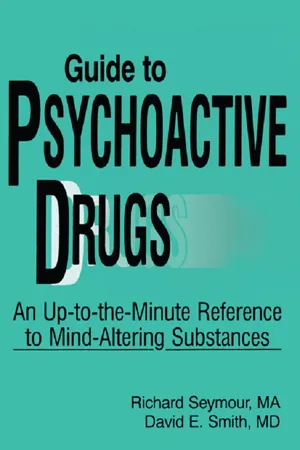
Guide to Psychoactive Drugs
About this book
Invaluable clinical and treatment information on the most powerful mind-altering drugs in use today. Compiled by two leading professionals from the renowned Haight Ashbury Clinic, the information is based on national and international studies undertaken at the clinic, as well as from 600,000 patient visits, a thorough review of practice and background as reported in the literature, and from their own private practices. An up-to-date reference source, this important guide includes information on the trademark, generic, and popular names of drugs; the use and abuse of drugs; and their acute and chronic effects. An innovative index and cross reference system provide quick, easy access for the physician who must act quickly in an emergency.
Information
SECTION ONE: THE NATURE OF PSYCHOACTIVE DRUGS
Narcotics/Analgesics
HISTORICAL PERSPECTIVE
The term “narcotic” is derived from the Greek narkotikos, which means numbness or stupor. In general, it means any drug that produces sleep, lethargy, and the relief of pain. Originally, the term referred to opium and to any drug derived from opium, such as heroin, morphine, or codeine.
Some confusion is created by the enforcement community’s practice of referring to any potent illegal drug as a narcotic, including the stimulant cocaine. Although federal law classifies the coca leaf and cocaine as narcotics, we will follow the medical definitions and place these drugs among the central nervous system stimulants where they belong.
These drugs are also called analgesics because of their ability to suppress pain. The overall class of drugs includes opiates (drugs derived from opium) and opiodes (synthetic drugs that have similar effects).
Natural opiates are all derived from preparations extracted from the opium poppy bulb. The crudest of these is opium itself, which is boiled down from the sap bled from the poppy seed bulbs in much the way that maple syrup and maple sugar are produced from the sap of the maple tree. In this process, the bulbs are cut and bled soon after the poppy petals have matured and fallen away. The boiled raw opium is dark, resinous, and often tarlike in appearance, and it may give off a flowery odor.
In eastern countries, this resin itself is often smoked for its sedative, euphoriant, and hallucinogenic qualities. In the West, more refined forms are usually used, both as pharmaceuticals and as street drugs.
Although some other drugs have similar antiquity of use for religious purposes, opium and its products are among the oldest drugs still in use in the practice of medicine. The history of this drug is extensive.
The opium poppy, Papaver somniferum, originated in Asia Minor. It is referred to in a six-thousand-year-old Sumerian tablet as the “joy plant,” and it appears in a sculpture from the same period as well as in Egyptian pictography. Both Virgil and Ovid refer to its properties. Representations of the Greek and Roman gods of sleep, Hypnos and Somnos, show them either wearing or carrying poppies.
Opium was well known to Classical Greek physicians, who ground the entire plant or used opium extract. The Greek physician Galen listed the medical indications of this drug in his practice, saying it:
… resists poison and venomous bites, cures chronic headache, vertigo, deafness, epilepsy, apoplexy, dimness of sight, loss of voice, asthma, coughs of all kinds, spitting of blood, tightness of breath, colic, the lilac poison, jaundice, hardness of the spleen stone, urinary complaints, fever, dropsies, leprosies, the trouble to which women are subject, melancholy and all pestilences. (Smith and Gay, 1972)
Although the use of opium in medicine was lost to the West after the fall of Rome, the Arab world retained knowledge of it. In fact, owing to the Muslim injunctions against the use of alcohol, opium was used extensively in the Arab world as a recreational drug. Its medical use was regained in Europe during the Renaissance when the works of Galen and the Moorish physician Avicenna became the standard texts for medical education.
Many people have a mistaken notion that opium originated in China. Actually, the spread of opium abuse in China did not occur until the latter part of the 18th century. At that time, Portuguese, English, and American traders, with government backing, established a lucrative trade in the drug. The Chinese government resisted, and a series of engagements were fought with the British that came to be known as the Opium Wars. The British won, and the settlement resulted in the establishment of Hong Kong as a British Crown Colony and the payment of twenty-one million dollars by China as reparation for destroyed opium.
In medicine, opiates are used primarily for their analgesic (pain-killing) and constipating effects. The effects of these drugs vary both by the dosage and by the degree of refinement and purity of the particular preparation. Because they are constipating, low-grade opiates are used to treat diarrhea.
As street drugs, opiates are prized for their production of euphoria and feelings of well-being. The “rush” that usually comes on when the drug is injected has been compared by some users to a total-body sexual orgasm. These drugs also have antipsychotic, sedative, and relaxant qualities and are often used in a drug cycle to counter the more unpleasant effects of long-term stimulant abuse.
The drug group includes natural opium alkaloids; synthetic derivatives of opiates, synthetic opiatelike drugs, and synthetic opiatelike drugs of low addiction liability and low potency. Sometimes narcotic antagonists are included on the list because they bind to similar sites in the brain even though they have no narcotic effects. All these drugs act by attaching to receptor sites in the central nervous system and producing chemical changes within the brain itself. Research in the past decade has shown that under normal conditions, and when stimulated by such diverse means as acupuncture and aerobic exercise such as running, the body produces its own internal opiatelike substances. These substances are called endorphins. They attach to many of the same receptor sites as narcotics and have similar effects. It is these endorphins that cause euphoric feelings after exercise, cessation of pain following minor injuries, and shock symptoms in trauma. Pain, of course, is the prime stimulant for the production of endorphins.
Several occurrences in the 19th century contributed both to the medical usefulness of opiates and to their abuse potential. In 1806, Frederich Seturner isolated morphine, the primary active ingredient in opium. Development of the hypodermic syringe in 1853 made it possible to deliver this purer drug form quickly into the body for rapid relief of pain or onset of euphoria with a rush. Finally, in 1874, C. R. Wright synthesized diacety morphine using refined morphine and acetic anhydride. This substance was first marketed by Bayer Pharmaceutical Products of Elberfeld, Germany, in 1898 under the trade name Heroin.
Morphine was used extensively as a painkiller for wounded troops during the American Civil War. After that war, morphine addiction among veterans was a national health problem. Opiates in general were often a prime ingredient in a variety of tonics and elixirs used mainly by women. At the turn of the century, it could be said that the average opiate abuser was a middle-aged, middle-class white housewife and mother.
Two opiate preparations in common use at the turn of the century were favored by many artists and writers. These were paregoric, a dilute tincture of opium combined with camphor and used medically for diarrhea, and laudanum, a simple tincture of opium in alcohol. Both are still on the market.
The natural opiate in most general use today is codeine, combined with a variety of other ingredients. Codeine preparations usually come in pill form and are often prescribed for dental postoperative pain and other moderate pain.
There are currently several hundred natural or synthetic narcotic analgesics on the market or being used illicitly. The following list, compiled by Kenneth Blum (1984), indicates the most prevalent of these by category:
- Natural opium alkaloids MorphineCodeine
- Synthetic derivatives of opiates Dihydromorphinone (Dilaudid®)Diacetylmorphine (heroin)Methyldihydromorphinone (metopon)Hydrocodone (Hycodan®)
- Synthetic opiatelike drugsPhenazocine (Prinadol®)Meperidine (Demerol®)Alphaprodine (Nisentil®)Anileridine (Leritine®)Piminodine (Alvodine®)Diphenoxylate (with atropine, as Lomotil®)Methadone (Dolophine®)Levorphanol (Levo-Dromoran®)
- Synthetic opiatelike drugs of low addiction liability and potencyPropoxyphene (Darvon®)Ethoheptamine (Zactane®)Pentazocine (Talwin®)
NOTE: Not included in the list of opiatelike synthetics is fentanyl (with droperidol as Innovar), a narcotic analgesic that has given rise to a series of street-abused, high-potency analogues.
Public opinion regarding chemical dependency or addiction to narcotics was quite different in the 19th century from what it is today. There was no connotation of criminality or underworld connections. These drugs were readily available. Dependence on them tended to be viewed as a vice or as a personal misfortune but not as a crime.
The first law pertaining to opiates is thought to have been both racist and political in its motivation. It was an ordinance passed in the city of San Francisco in 1875 banning the smoking of opium by the city’s Chinese. Several tax acts followed, but the national statute that criminalized recreational use of these drugs was the Harrison Narcotic Act of 1914.
Narcotic drugs can be ingested, injected either intravenously or intramuscularly, snorted, sipped, taken in pill or tablet form, or smoked. A method of use called “chasing the dragon” involves vaporizing the substance and then inhaling the vapor.
ACUTE AND CHRONIC TOXICITY
Narcotics mainly affect the brain and bowel. In the brain, they cause relief of pain, relaxation, and drowsiness; suppression of the cough center; and stimulation of the vomiting center. They can also cause mental clouding and inability to concentrate.
The desired effects in narcotic abuse include a rush that has been compared to sexual orgasm; it occurs when potent narcotic preparations are injected intravenously. Users cite feelings of euphoria, a melting of troubles — feelings that everything is all right and the user is in control.
These drugs are not reliable for sleep induction. Some people become anxious, restless, and wakeful after taking them, while others fall into a twilight sleep marked by vivid dreams.
Opiates cause the pupils of the eyes to contract, sometimes to pinpoints. They can cause profuse and uncomfortable sweating. With large dosages, nausea, vomiting, and depression of breathing can take place.
Most postoperative and other patients who must take these drugs for pain find the experience singularly unpleasant and are relieved when their pain has subsided to where they no longer need to be used. For some, however, the narcotics produce a compulsion to continue use, even before the onset of physical dependence.
Sufferers from chronic pain may also develop a dependence on opiates as the only means of dealing with their pain. One unfortunate aspect of this situation is that in many areas chronic pain victims are lumped in with opiate addicts and considered to be drug abusers. Chronic pain is perhaps one of the more troublesome medical problems we have today from a philosophic and treatment standpoint.
In our culture, the drug of choice for the majority of opiate street abusers is heroin. Most of these heroin abusers started out as recreational users, not as postoperative patients or chronic pain victims. The heroin used tends to be of a low purity, 4% to 6%, and is injected.
Acute toxicity is usually the result of an overdose. The user either takes too much of the drug or inadvertently buys an unusually potent formulation. In either case, the patient becomes comatose and cyanotic, with slow respiration and pinpointed pupils.
Chronic toxicity is associated with opiate or opioid dependence. Dependence can occur with any opium derivative or synthetic narcotic, as can an overdose. Prolonged use of these drugs usually results in physical dependence, marked by withdrawal symptomatology if use is terminated, and in tolerance, wherein the victim needs an ever increasing amount of the drug to achieve any desired effects.
Trreatment of Acute Toxicity: Overdose
Fortunately, overdose with either an opiate or an opioid can be reversed by administration of the narcotic antagonist naloxone (Narcan®). This is usually done in the emergency unit. The antagonist should be injected intravenously, with 0.2 to 0.8 mg given initially. If the patient is in shock and has low blood pressure, 1.0 mg of the antagonist can be injected sublingually at the beginning and the injection repeated sublingually or intravenously to gain a response. The sublingual injection site must be carefull...
Table of contents
- Cover
- Half Title
- About the Authors
- Full Title
- Copyright
- Contents
- Introduction
- SECTION ONE: THE NATURE OF PSYCHOACTIVE DRUGS
- SECTION TWO: ASPECTS OF ABUSE AND TREATMENT
- Bibliography
- Index
Trusted by 375,005 students
Access to over 1.5 million titles for a fair monthly price.
Study more efficiently using our study tools.
Frequently asked questions
Yes, you can cancel anytime from the Subscription tab in your account settings on the Perlego website. Your subscription will stay active until the end of your current billing period. Learn how to cancel your subscription
No, books cannot be downloaded as external files, such as PDFs, for use outside of Perlego. However, you can download books within the Perlego app for offline reading on mobile or tablet. Learn how to download books offline
Perlego offers two plans: Essential and Complete
- Essential is ideal for learners and professionals who enjoy exploring a wide range of subjects. Access the Essential Library with 800,000+ trusted titles and best-sellers across business, personal growth, and the humanities. Includes unlimited reading time and Standard Read Aloud voice.
- Complete: Perfect for advanced learners and researchers needing full, unrestricted access. Unlock 1.5M+ books across hundreds of subjects, including academic and specialized titles. The Complete Plan also includes advanced features like Premium Read Aloud and Research Assistant.
We are an online textbook subscription service, where you can get access to an entire online library for less than the price of a single book per month. With over 1.5 million books across 990+ topics, we’ve got you covered! Learn about our mission
Look out for the read-aloud symbol on your next book to see if you can listen to it. The read-aloud tool reads text aloud for you, highlighting the text as it is being read. You can pause it, speed it up and slow it down. Learn more about Read Aloud
Yes! You can use the Perlego app on both iOS and Android devices to read anytime, anywhere — even offline. Perfect for commutes or when you’re on the go.
Please note we cannot support devices running on iOS 13 and Android 7 or earlier. Learn more about using the app
Please note we cannot support devices running on iOS 13 and Android 7 or earlier. Learn more about using the app
Yes, you can access Guide to Psychoactive Drugs by Richard B Seymour,David E Smith in PDF and/or ePUB format, as well as other popular books in Medicine & Medical Theory, Practice & Reference. We have over 1.5 million books available in our catalogue for you to explore.