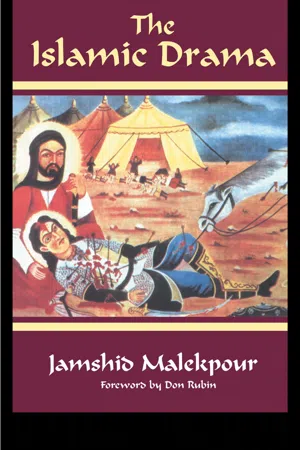
Described by the distinguished theatre director Peter Brook as 'a very powerful form of theatre', the Ta'ziyeh is the Islamic drama of Iran. This work examines the evolution of the Ta'ziyeh, which involved elements drawn from Zoroastrianaism, Mithraism, mythology, folklore and traditional forms of Iranian entertainment. In its final form, most of its elements - plot, character, thought, spectacle and song - derive from the Shi'a branch of Islam. Its main plot concerns the suffering and death of Imam Hussein, grandson of the Prophet of Islam.
A special issue of the journal Israel Affairs.
- 256 pages
- English
- ePUB (mobile friendly)
- Available on iOS & Android
eBook - ePub
The Islamic Drama
About this book
Information
CHAPTER 1
Iran, the Birthplace of the Taʹ ziyeh
FOR THOUSANDS OF years Iran, the land of the Aryans, has been a crossroads of cultures. Although its civilization has an Indo-European origin, it has been a meeting place and a melting pot throughout the ages for various civilizations and cultures drawn from the Far East and the Middle East, as well as from India, China and Greece.1
To study Iran’s history and culture it is necessary to keep in mind that the present boundaries of the country are the result of the political and military invasions of the past two centuries. In particular, Iranian history and culture were deeply affected by what took place during the rule of the Qajar dynasty in the eighteenth and nineteenth centuries.
The Iranian plateau is bordered on the south by the Persian Gulf and the Sea of Oman, and on the north by the Caspian Sea. The plateau acts as a bridge linking Central and Western Asia to the plateau of Asia Minor and to Europe. Even though Iranian civilization began with the arrival of Aryans around 4000 BC, it was only in the ninth century BC that the first Iranian state was established by the Medes dynasty. The founder of the dynasty was Dayaku, who built a palace in Hagmatana, the present city of Hamedan, with seven walls symbolizing the solar system with the sun at its centre and other planets around it. This symbol later played a significant role in Iranian religions and arts.
The Medes had to fight continuously with the Assyrian kings to protect their territory. The dynasty was finally overthrown in about 550 BC, by Cyrus the Great, of the Achaemenian family and the tribe of Pars.2 Cyrus was a great military leader and social reformer. According to R.Girshman:
Few kings have left behind so noble a reputation as that which attaches to the memory of Cyrus… He had no thought of forcing conquered countries into a single mould, but had the wisdom to leave unchanged the institutions of each kingdom he attached to his crown… A new wind blew across the world, carrying away the cries of murdered victims, extinguishing the fires of sacked cities and liberating nations from slavery.3
The Achaemenian Empire ruled over vast areas of land that reached from the Indus river, the Punjab and the foothills of the Pamir mountains to Greece and Carthage. For 220 years, from the middle of the sixth century to the end of the fourth century BC, the civilized world was under Achaemenian control or influence. In addition to establishing a glorious era of power and justice, the Achaemenian Empire also had a share in the development of a unique religion, Zoroastrianism.
Zoroastrianism, sometimes called Mazdaism, is the most ancient religion of Iran, and was founded around 600 BC by Zoroaster.4 Seyyed Hossein Nasr has pointed out just how important was the effect of Zoroastrianism in shaping Persian society:
The extent of the influence of Zoroastrianism in the molding of Persia in its social as well as intellectual and religious aspects for some fourteen centuries is so profound that no discussion of Persian history from the Achaemenian period to the rise of Islam can overlook it. Zoroastrianism provided the basis for the hierarchic structure of Achaemenian as well as Sassanid society. During these eras it was the basis for individual and collective ethics and it was the fountainhead of the world view of the majority of Persians and the origin of their beliefs concerning the beginning and end of things as well as the nature of the Universe.5
The holy book of Avesta is a collection of sacred writings of the Zoroastrian religion. The oldest parts of the Avesta, known as gathas, are songs written by the Prophet Zoroaster himself and are thought to date from a period between the eleventh and sixth centuries BC. Apart from their religious importance, gathas are also important from a dramatic point of view. They were written in a question-answer style and were chanted by two groups of priests (magi) before the sacred fire:
Stanza 11:
When, O Wise One, shall Devotion come with Righteousness?
When with the Dominion the good dwelling rich in pastures?
Who are they that will give safety from the bloodthirsty wicked?
When with the Dominion the good dwelling rich in pastures?
Who are they that will give safety from the bloodthirsty wicked?
Who are they to whom the doctrine of Good Mind will come?
Stanza 12:
Those are the future saviours of the peoples
Who through Good Mind strive in their deeds
To carry out the judgment which thou has decreed,
O Wise One, as Righteousness.
For they were created the foes of Fury.6
Who through Good Mind strive in their deeds
To carry out the judgment which thou has decreed,
O Wise One, as Righteousness.
For they were created the foes of Fury.6
While these early materials may not have been written in a fully developed theatrical form, their readiness for turning into dramatic form is attested to by the fact that Mahin Tajadod based her play Orghast on Avesta writings. This play was directed by Peter Brook in 1971 and presented at the Shiraz Arts Festival. Orghast was an attempt to show how these religious texts underpinned Iranian religious drama.
Zoroastrianism is based on a dualism: the presence in the universe of two conflicting forces, Ahura Mazda, the source of goodness and light, and Ahriman, the symbol of evil. According to Zoroastrianism, man participates in the struggle between Ahura Mazda and Ahriman, which ends with the disappearance of evil. Ahura Mazda embodies the virtues of goodness and truth and is symbolized by light and fire, while Ahriman, the devil force, is symbolized by darkness. Thus the world is the scene of a spiritual battle between these two forces, and man has to choose between Ahura Mazda and Ahriman. This conflict formed the theme and the plot of Orghast. In most Avesta writings, we can identify easily the presence of such ‘dramatic’ elements as a plot, a few characters, some dialogue and monologues. These elements were easily moulded into full-fledged dramatic form.
A good example of how this transformation of Avesta writings took place is provided by the gatha of The Ox-Soul. We can consider the work to be one of the first attempts to create ‘religious ritual drama’ by Iranians. In this dramatic scene, the Ox is pleading with Ahura Mazda to provide protection. Ahura Mazda gives Zoroaster the task of protecting the Ox. But Zoroaster has no temporal power and the Ox remains defenceless:
The Ox:
For whom did you create me? Who made me?
Fury and violence oppress me, and cruelty and tyranny.
I have no shepherd other than you: then obtain good pastures
for me.
Fury and violence oppress me, and cruelty and tyranny.
I have no shepherd other than you: then obtain good pastures
for me.
The Maker of the Ox (Ahura Mazda):
Hast thou a judge for the ox,
That you may give him, with the pasture, the care for the
raising of the cattle?
Whom did you appoint his master who shall put to flight
Fury together with the wicked?
That you may give him, with the pasture, the care for the
raising of the cattle?
Whom did you appoint his master who shall put to flight
Fury together with the wicked?
Righteousness (Zoroaster):
No companion is there for the ox
That is free from hatred. Men do not understand
How the great deal with the lowly.
Of all beings he is the strongest
To whose aid I come at his call.
The Wise One it is who best remembers
The plans carried out of yore by false gods and men
Or that will be carried out in the future.
He, the Lord, will decide, it shall be according to his will.
That is free from hatred. Men do not understand
How the great deal with the lowly.
Of all beings he is the strongest
To whose aid I come at his call.
The Wise One it is who best remembers
The plans carried out of yore by false gods and men
Or that will be carried out in the future.
He, the Lord, will decide, it shall be according to his will.
Zoroaster and the Ox:
With hands outstretched we pray to the Lord,
We two, my soul and the soul of the mother-cow,
Urging the Wise One to command that no harm shall come to the honest man,
We two, my soul and the soul of the mother-cow,
Urging the Wise One to command that no harm shall come to the honest man,
To the herdsman, in the midst of the wicked who surround him.
Ahura Mazda:
No master has been found, no judge according to Righteousness:
For the breeder and the herdsman has the creator fashioned thee.
The ordinance of sprinkling the water for the cattle, for the welfare of the ox,
And the milk for the welfare of men desiring food,
This has the Wise Lord, the Holy One,
Fashioned by his decree, in accord with Righteousness.7
For the breeder and the herdsman has the creator fashioned thee.
The ordinance of sprinkling the water for the cattle, for the welfare of the ox,
And the milk for the welfare of men desiring food,
This has the Wise Lord, the Holy One,
Fashioned by his decree, in accord with Righteousness.7
Today we are unable to prove that this pre-Islamic religious drama in ancient Iran existed, and that it had a major influence on the development of the Taʹziyeh. This lack of any absolute proof results mainly from the fact that much of the hard evidence has been destroyed by invaders or by Iranians themselves. For example, Alexander the Great invaded Iran in 330 BC, overthrew the Achaemenian Empire and brought with him the influence of Greek civilization, which disrupted the development of the indigenous drama. However, Greek domination lasted no longer than seventy years and immediately after the death of Alexander in 256 BC, Arsaces I rose against the Greeks in a war for independence and established the Parthian Empire. This empire soon extended its borders as far as Syria and Palestine.
During the Parthian period, Iranian culture, which had declined in the face of Hellenism, particularly in the area of architecture, ceased to be threatened. The Parthians’ most important service to Iran, after driving out the Greeks and restoring the country’s independence, was their brave defence of the western front against the Romans invaders, who became a new and powerful enemy threatening the whole area of Mesopotamia.
In the third century BC another religion, Mithraism, made its appearance in Iran. This religion was based on the worship of a Persian God, Mithra or the Sun. He was the god of light and justice, a guardian of the crops and an enemy of evil spirits. Many of these characteristics of Mithra were transferred to the legendary character of Siavush, and through him to the religious character of Imam Hussein, the central character of the Taʹ ziyeh plays, an issue that will be discussed in Chapter 3.
Mithraism spread throughout the Roman Empire in the second century AD, and many of its characteristics influenced Christianity. The connection between Mithraism and Christianity has been widely discussed. David Ulansey, one of the scholars who discusses such a connection, claims that Mithraism and Christianity arose at the same time. According to Hasham Razi, a well-known Iranian scholar of Mithraism, this religion was already well established in the second century BC throughout Mesopotamia and Asia Minor.8 But David Ulansey puts it this way: ‘Mithraism and Christianity were in many respects sister religions. Arising at the same time and spreading in roughly the same geographical area, Mithraism and Christianity embodied two responses to the same set of cultural forces.’9
The decline of Mithraism in the third century was coincident with the fall of the Parthian Empire in 224 AD. As a result of this change, power transferred from the eastern tribes to the people of the province of Pars in the centre of the plateau. This transfer of power resulted in a change from a feudal and non-religiously oriented government to a centralized and religious one.
The Sassanids, who ruled the Persian Empire from 224 to 652, defended their eastern and western frontiers and, by virtue of their well-organized government and military institutions, expanded their territory until it approached the magnitude achieved by the Achaemenian Empire.
It is generally agreed that it was during the Sassanid period that the civilization of ancient Iran reached its highest degree of cultural development, producing several great religious and non-religious works in prose and poetry. Yadegar-e-Zariran in particular has had great significance as far as the development of the religious drama of Iran is concerned, and can claim to be the first religious story produced in Iran.
It concerns the religious wars of Zarirr, a general of the Iranian army, against the enemies of Zoroaster. Originally, the story was handed down as part of Iran’s oral tradition. During the Parthian period it was recited by story-tellers and used both music and song. Those story-tellers or minstrels were called gusan. The Gusanic oral story was finally written down by the Zoroastrian priests during the Sassanid era (224–652) and preserved for future generations. Apart from its story-telling technique, which utilizes several dramatic devices, this religious story is significant as far as the development of the Taʹziyeh is concerned because it depicts the mourning rituals and processions that, years later, were to become the central events dramatized by the Islamic religious drama. The mourning scene in which Bastor, a seven-year-old boy, laments over the corpse of his father, Zarirr, who has been martyred for the sake of Zoroaster and his religion, is a powerful scene that foreshadows the passion of the Taʹziyeh, dealing with the martyrdom of Imam Hussein and his children in the plain of Karbala:
My celebrated father/Who has shed your blood/Who has taken your bird-like horse/Your joy was all to fight/But now you have dropped dead here/Like a man with no crown/And this hair and beard of yours/Are disarrayed by the wind/Your pure body is exhausted/And dust has covered your neck/Now what can I do/If I descend from my horse and kneel down beside you/And take your head into my arms/And clean the dust from your head /Then it won’t be easy for me to remount my horse.*10
It is difficult to explain why the powerful Sassanid Empire, which produced such magnificent social and cultural institutions, was so easily overthrown by Muslim Arabs in 652. Ghirshman explains that extraordinary shift in power as follows:
The splendid and gigantic edifice of Sassanian Iran, which had functioned with such magnificence and precision, crumbled to pieces in the space of a few years. But the Arabs did not owe their success...
Table of contents
- COVER PAGE
- TITLE PAGE
- COPYRIGHT PAGE
- FOREWORD
- ACKNOWLEDGEMENTS
- LIST OF ILLUSTRATIONS
- INTRODUCTION
- CHAPTER 1: IRAN, THE BIRTHPLACE OF THE TA’ZIYEH
- CHAPTER 2: ISLAM AND THE TA’ZIYEH
- CHAPTER 3: THE ORIGIN AND DEVELOPMENT OF THE TA’ZIYEH
- CHAPTER 4: TA’ZIYEH PLAYS
- CHAPTER 5: THE TA’ZIYEH IN PERFORMANCE
- CHAPTER 6: THE TA’ZIYEH IN THE ISLAMIC WORLD
- CHAPTER 7: THE TA’ZIYEH YESTERDAY, TODAY AND TOMORROW
- APPENDIX: COLLECTIONS OF THE TA’ZIYEH
- GLOSSARY
- BIBLIOGRAPHY
Trusted by 375,005 students
Access to over 1.5 million titles for a fair monthly price.
Study more efficiently using our study tools.
Frequently asked questions
Yes, you can cancel anytime from the Subscription tab in your account settings on the Perlego website. Your subscription will stay active until the end of your current billing period. Learn how to cancel your subscription
No, books cannot be downloaded as external files, such as PDFs, for use outside of Perlego. However, you can download books within the Perlego app for offline reading on mobile or tablet. Learn how to download books offline
Perlego offers two plans: Essential and Complete
- Essential is ideal for learners and professionals who enjoy exploring a wide range of subjects. Access the Essential Library with 800,000+ trusted titles and best-sellers across business, personal growth, and the humanities. Includes unlimited reading time and Standard Read Aloud voice.
- Complete: Perfect for advanced learners and researchers needing full, unrestricted access. Unlock 1.5M+ books across hundreds of subjects, including academic and specialized titles. The Complete Plan also includes advanced features like Premium Read Aloud and Research Assistant.
We are an online textbook subscription service, where you can get access to an entire online library for less than the price of a single book per month. With over 1.5 million books across 990+ topics, we’ve got you covered! Learn about our mission
Look out for the read-aloud symbol on your next book to see if you can listen to it. The read-aloud tool reads text aloud for you, highlighting the text as it is being read. You can pause it, speed it up and slow it down. Learn more about Read Aloud
Yes! You can use the Perlego app on both iOS and Android devices to read anytime, anywhere — even offline. Perfect for commutes or when you’re on the go.
Please note we cannot support devices running on iOS 13 and Android 7 or earlier. Learn more about using the app
Please note we cannot support devices running on iOS 13 and Android 7 or earlier. Learn more about using the app
Yes, you can access The Islamic Drama by Jamshid Malekpour in PDF and/or ePUB format, as well as other popular books in Media & Performing Arts & Middle Eastern History. We have over 1.5 million books available in our catalogue for you to explore.