- 128 pages
- English
- ePUB (mobile friendly)
- Available on iOS & Android
eBook - ePub
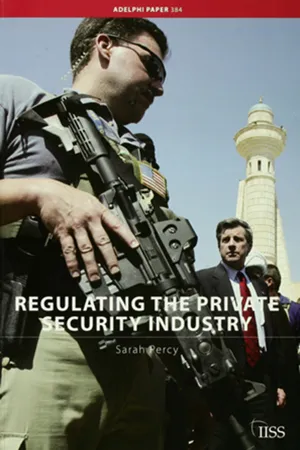
Regulating the Private Security Industry
About this book
The under-regulation of the private security industry has increasingly become a topic of media and academic interest. This Adelphi Paper enters the debate by explaining why the industry requires further regulation, and what is wrong with the current system. It begins by briefly defining the industry and explaining the need for more effective regulation, before analysing three types of regulation: domestic, international and informal (including self-regulation).
Chapter One
An Overview of the Industry and the Need for Regulation
The private security industry is complex: it performs a variety of tasks for a wide range of clients in war zones, in peaceful nations and during post-conflict reconstruction. Analysis of the industry has also tended to be complicated, as authors seek to distinguish PSCs from other types of private actor. With as many as 200 companies operating around the world,1 and working on every continent except Antarctica,2 an exhaustive analysis of the industry is impossible. There is no attempt here to provide a definitive overview of the industry,3 the nature and nationality of the companies that compose it,4 or to discuss in detail where PSCs fit into an overall spectrum of private force.5 In discussing the challenge of regulation, what is most necessary is to provide an overview of the kinds of contracts PSCs undertake, highlighting some of the difficulties involved in defining what PSCs do, and in differentiating them from other types of actors.
Overview of the industry
PSCs provide four main types of service: logistical support; operational or tactical support; military advice and training; and policing or security. Logistical support entails tasks such as the preparation and delivery of food, laundry and maintenance at military bases. The American company KBR (formerly Kellogg, Brown and Root) is a good example of a logistical support company.6 These sorts of companies do not pose important regulatory challenges.
PSCs also provide operational or tactical support;7 this type of support can best be explained as the provision of services normally considered the sole purview of national armed forces (in contrast to logistical support, which has a long history of privatisation). These services may include military interrogation, and even the operation and support of weapons systems. During Operation Enduring Freedom in Iraq in 2003, AH-64 Apache helicopters and B-2 bombers were supported by contractors,8 and contractors were used to operate missile guidance systems on US ships, as well as the computer systems for unmanned aerial vehicles (UAVs).9
In the 1990s, tactical and operational support included the planning and implementation of combat missions. Executive Outcomes (EO) and Sandline, both now defunct, offered combat services in Sierra Leone, Angola and Papua New Guinea. No PSC operating openly today offers combat services, although in 2006 the American company Blackwater suggested that it would be able to provide a battalion-sized group of peacekeepers for crises like the one in Darfur if authorised by the United Nations.10
PSCs also provide security and policing. These services are particularly widespread in Iraq and Afghanistan, where PSCs have provided security for military and political assets, including installations, individuals and convoys.11 Paul Bremer, head of the Coalition Provisional Authority (CPA) in Iraq, and Afghan President Hamid Karzai have been protected by Blackwater and DynCorp respectively. In some cases PSCs act as police themselves: DynCorp routinely provides the military police that make up American contributions to international missions,12 including in East Timor and Kosovo. PSCs have also been used to develop and run police and security services. The South Africa-based company Erinys trained, managed and equipped the 16,000-strong Iraq Oil Protection Force.13 Security services can also be sold to the private sector and to NGOs. In war zones such as Iraq and Afghanistan, virtually all private companies, from the media to telecommunications to extractive industries, require security to do their jobs, and this is usually provided by PSCs.14 James Cockayne of the International Peace Academy identifies four roles for private security in the NGO and humanitarian sector: guarding installations; providing mobile security escorts; guarding third parties (such as refugee populations); and, less commonly, security analysis and intelligence provision.15 Deborah Avant of the Elliott School of International Affairs at George Washington University has provided extensive analysis of the use of private security by the World Wildlife Fund.16
Providing military advice and training constitutes a significant portion of PSC business. PSCs train armed forces, police forces and auxiliary forces. The American company Military Professional Resources Incorporated (MPRI) provided training for Croatian forces that was so effective that its protégés had striking success during Operation Storm, the offensive to take back Serb-held territory in the Krajina during the summer of 1995. The Croatian victory showed such remarkable operational improvement that MPRI has been dogged by accusations that its personnel must have accompanied their trainees during the mission itself,17 an accusation that persists despite the absence of evidence. PSCs also provide training as part of post-war reconstruction efforts: DynCorp has trained both the Iraqi and Afghan police forces.
Problems of definition and differentiation
While it is easy to provide an overview of the sort of tasks performed by the private security industry, defining the industry and differentiating it from other private actors is not so simple. First, there are difficulties with assessing the place of PSCs within the spectrum of private force. Second, the placement of PSCs within that spectrum tends to influence the labels used to describe the industry, which vary considerably (and often confusingly).
The role of today's private security industry may be clarified by discussing it in relation to other manifestations of private force, including combat companies like EO and Sandline, modern mercenaries such as those active in Africa in the 1960s and 1970s, and the many pre-twentieth-century manifestations of mercenaries. One way to differentiate actors who use private force is to organise them into categories on the basis of what they do, and for whom they do it. Singer uses a 'tip of the spear' approach, in which he classifies companies on the basis of the lethality of the services they provide, ranging from the lethal combat capacity of companies like EO and Sandline to the relatively non-lethal capacity associated with training and advising.18 Christopher Kinsey, an academic expert on PSCs, uses a typology that attempts to organise companies into four quadrants on the basis of whether or not they employ lethal force and whether the object they attempt to secure is private (an installation, for example) or public (which he defines as state authority).
There are, however, noticeable difficulties with these sorts of categorisations. As Kinsey notes, it is hard to organise PSCs into tidy categories, because they provide such a wide range of services.19 Sometimes the same PSC might provide a non-lethal service (such as land-mine clearance), as well as one with significantly greater potential for lethality (such as close protection for an important political figure). The 'lethality' distinction is often made in terms of offensive or defensive capacity, or in terms of whether or not a company engages in active combat or passive defensive action. Most PSCs assert that they will only use force in self-defence and that they do not actively engage in combat.20 However, the distinction between offense and defence, or combat and non-combat, is also a blunt instrument when used to differentiate between companies. Caroline Holmqvist, of the Stockholm Institute for Peace Research, argues that 'what is perceived as "defensive" under one set of circumstances may well turn out to have "offensive" repercussions in another' and that 'the ability of companies to provide many different services simultaneously makes the 'offensive-defensive' or 'active-passive' distinctions irrelevant at best or misleading at worst'.21 Advice and training, which are technically neutral and do not constitute actual combat, can nonetheless have a lethal impact as the trainee force becomes more effective.22 The Blackwater employees providing Paul Bremer's security in Iraq had their own weapons and their own helicopters, and 'fought off insurgents in ways that were hard to distinguish from combat'.23 Differentiating between actors who use force on the basis of lethality and the nature of the force deployed is clearly challenging.
There are further difficulties with the labels applied to the private security industry. The term 'mercenary' inevitably creeps into discussions about private force, and it has become so pejorative that Avant suggests avoiding it entirely.24 There is no real question that PSCs and mercenaries differ considerably. PSCs are organised entities with a permanent presence, and are capable of taking on complex and long-term projects. They claim to be discriminating with regard to their clients, and seek to avoid direct combat. Mercenaries, on the other hand, work either individually or in loosely organised groups. They are not particular about their employers and will provide a wide range of services, including engagement in combat. There are also questions about whether or not PSCs can be differentiated from the combat companies of the 1990s, like EO and Sandline. It seems that they can, as no company operating today openly provides the sorts of services (including planning missions and fighting them) that these two companies offered. There are other clear lines of continuity between all three types of actor, however. All three exchange force for financial reward, and PSCs and combat companies differ only in the degree of combat they will provide.
The confusion that results from organising the industry into categories and differentiating it from other types of private force is further compounded by the variety of labels used to describe it. Sometimes the term 'private military company' (PMC) is used; confusingly sometimes authors take the term to include all types of companies, including combat companies, and sometimes PMC is used to refer exclusively to combat companies.25 PSCs themselves make this latter distinction and avoid the term PMC. Singer opts for a totally different term, PMF, or private military firm.26
The question, then, is how to find the way out of the maze of acronyms that refer to the industry and how to differentiate PSCs from other actors. The term PSC is used here to refer to the type of company operating today in Iraq and Afghanistan: companies that provide a wide range of military and security services but avoid combat. This also reflects the terminology used by the industry itself.
Differentiating PSCs from each other and from PMCs may be achieved by focusing on specific contracts rather than on the nature of the actors themselves.27 Reiving on contracts as the tool of differentiation is also useful because it helps to distinguish PSCs from mercenaries: the latter are unlikely to have official or formal contracts, and if they do, they might include combat or even illegal activity, such as organising coups d'état. Contracts explicitly calling for combat services and informal agreements to hire mercenary groups are not examined here, as they pose different sets of problems requiring specific regulation.
The five main reasons for regulation
Better regulation of the private security industry is vital. While domestic, international and informal regulation exists, there is a strong case that the current system is deficient and contains significant gaps. Regulation is necessary for five main reasons: because PSCs challenge both political and military control; because the rules governing PSCs are unclear; because the industry suffers from a lack of transparency; because PSCs are insufficiently accountable for their actions; and because the industry's future growth ought to be monitored to protect the public interest. The problems outlined stem essentially from a lack of state-directed regulation rather than from problems inherent in the nature of PSCs.
Control
The privatisation of military functions, particularly those formerly associated with the state, has a significant impact on the way states control military force. Avant points out that the use of PSCs affects three different types of state control over force: functional (the effectiveness of the military); political (which actors, organisations or individuals control force); and social (the degree to which the use ot torce is congruent with broader social values, including democracy, international law, human rights and the protection of civilians in warfare). In addition, the privatisation of security can affect how well these types of control fit together. A good fit holds the 'key to stable, legitimate, and effective civil—military relations — the situation we recognize as effective control'.28 She concludes that although the privatisation of security has different effects in weak and strong states, and that the type of company hired will also make a difference to the degree of change, all three types of control are transformed by privatisation, as is the way they fit together.29
Indeed, it is easy to find examples where privatisation undermines control, particularly political and military control (which Avant defines as functional control). The undermining effects of privatisation on political and military control should prompt two types of regulatory debate: one on how regulation can ameliorate some of these changes, and another on the general advisability of privatising some aspects of state security.
The traditional political controls placed on the use of force change with the privatisation of security. In particular, many of the institutional constraints that surround the decision to send state military forces into action can be circumvented by the use of private force.
In the United States, the privatisation of torce affects the mechanics of governmental decisions to use fo...
Table of contents
- Cover
- Title
- Copyright
- Contents
- Glossary
- Introduction
- Chapter One An Overview of the Industry and the Need for Regulation
- Chapter Two Domestic Regulation
- Chapter Three International Regulation
- Chapter Four Informal Regulation
- Conclusion
- Notes
Trusted by 375,005 students
Access to over 1.5 million titles for a fair monthly price.
Study more efficiently using our study tools.
Frequently asked questions
Yes, you can cancel anytime from the Subscription tab in your account settings on the Perlego website. Your subscription will stay active until the end of your current billing period. Learn how to cancel your subscription
No, books cannot be downloaded as external files, such as PDFs, for use outside of Perlego. However, you can download books within the Perlego app for offline reading on mobile or tablet. Learn how to download books offline
Perlego offers two plans: Essential and Complete
- Essential is ideal for learners and professionals who enjoy exploring a wide range of subjects. Access the Essential Library with 800,000+ trusted titles and best-sellers across business, personal growth, and the humanities. Includes unlimited reading time and Standard Read Aloud voice.
- Complete: Perfect for advanced learners and researchers needing full, unrestricted access. Unlock 1.5M+ books across hundreds of subjects, including academic and specialized titles. The Complete Plan also includes advanced features like Premium Read Aloud and Research Assistant.
We are an online textbook subscription service, where you can get access to an entire online library for less than the price of a single book per month. With over 1.5 million books across 990+ topics, we’ve got you covered! Learn about our mission
Look out for the read-aloud symbol on your next book to see if you can listen to it. The read-aloud tool reads text aloud for you, highlighting the text as it is being read. You can pause it, speed it up and slow it down. Learn more about Read Aloud
Yes! You can use the Perlego app on both iOS and Android devices to read anytime, anywhere — even offline. Perfect for commutes or when you’re on the go.
Please note we cannot support devices running on iOS 13 and Android 7 or earlier. Learn more about using the app
Please note we cannot support devices running on iOS 13 and Android 7 or earlier. Learn more about using the app
Yes, you can access Regulating the Private Security Industry by Sarah Percy in PDF and/or ePUB format, as well as other popular books in Law & Military & Maritime History. We have over 1.5 million books available in our catalogue for you to explore.