What is a dream?
Dreams are universal, but their perceived significance and conceptual framework change over time. This book provides new perspectives on the history of dreams and dream interpretation in western culture and thought.
Dreams and History contains important new scholarship on Freud's Interpretation of Dreams (1900) and subsequent psychoanalytical approaches from distinguished historians, psychoanalysts, historians of science and anthropologists. This collection celebrates and evaluates Freud's landmark intellectual production, whilst placing it in historical context. A modern view of psychoanalysis, it also discusses the controversial idea of the role of the external world on the shaping of unconscious mental contents.
In highly accessible language it proceeds through a series of richly illustrated case studies, providing new source materials and debates about the causes, meanings and consequences of dreams, past and present: from Victorian anthropological exploration of ancient Greek dream sources to peasant interpretation of dream-life in communist Russia; from concepts of the dream in sixteenth-century England to visual images in nineteenth-century symbolist painting in France.
Dreams and History will fascinate those interested not only in psychoanalysis and history, but also arts, culture, humanities and literature.
eBook - ePub
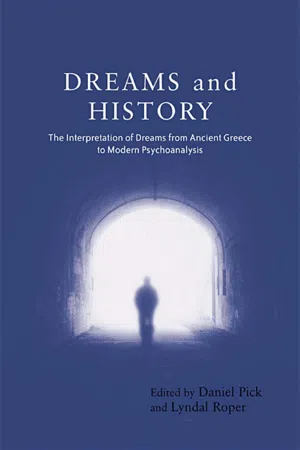
Dreams and History
The Interpretation of Dreams from Ancient Greece to Modern Psychoanalysis
- 288 pages
- English
- ePUB (mobile friendly)
- Available on iOS & Android
eBook - ePub
Dreams and History
The Interpretation of Dreams from Ancient Greece to Modern Psychoanalysis
About this book
Trusted by 375,005 students
Access to over 1.5 million titles for a fair monthly price.
Study more efficiently using our study tools.
Information
Chapter 1
Introduction
Daniel Pick and Lyndal Roper
In the famous book that launched psychoanalysis in 1900, Freud set out a novel thesis about the scientific potential of dreams. Controversially and brilliantly, The Interpretation of Dreams drew upon – even as it profoundly recast – elements of folk-wisdom: belief in the psychic significance and the symbolic weight of even our most bizarre nocturnal visions. Freud observed differences in the way dreams had been understood across the ages – referring, for instance, to certain Victorian researches into ancient ideas – but he had other fish to fry, and thus declared that he would reluctantly have to leave these arcane matters aside.1 His interest here was not primarily historical. This was not to be an archaeology of forgotten cultural beliefs but, rather, the foundation for a new psychology based on the concept of repression. Psychoanalysis was to be centred on the exploration of the unconscious: a domain of the mind, he later wrote, in which the dictates of time did not operate.2 So much for history. Through the interpretation of dreams, Freud proposed to expose a fundamental psychic mystery and to reveal the dynamic nature of mental life itself, a dynamic that was itself partly unconscious.
Somewhat to the chagrin of historically minded readers, the dry tone of the early ‘review’ sections of The Interpretation of Dreams incline one to press ‘fast-forward’ (perhaps too fast) towards Freud’s own lively material and arguments. His survey of all those time-bound Victorian predecessors has its points of interest – and its potential for arousing polemical debate as to principles of selection and exclusion – but it was clearly a preamble, presaging the cornucopia of ideas and examples that followed. The rich account of the author’s process of dream analysis, the descriptions of condensation and displacement, the absorbing examples and remarkable theory of the mind offered in chapter seven of the book are generally remembered, whether appreciatively or critically; but what of the rest?
However captivating and universally significant Freud’s psychological undertaking is judged to be, a myriad of historical questions soon reappear. Whilst some of these questions concern the genealogy of ideas, there are also many other varieties of historical speculation to which the text can give rise. The ramifications and implications of the dream book cannot be confined to its moment of historical composition; nor can its theses be seen as the predictable reflection of the career path or intellectual background of its author, yet nonetheless the personal, cultural, social and political contexts in which it was produced are all loudly present in the text itself.
Elements in Freud’s dreams were drawn from and identifiable within nineteenth-century German culture and history, sometimes specifically within fin-de-siècle Vienna. In a particularly compressed sequence, for example, Freud finds references in his dream to an eminent and reactionary Austrian politician, Count Thun, a contemporary student-leader, Fischhof, and another ‘leader of men’, almost certainly the Austrian social democrat, Victor Adler. One scene seems to derive from the author’s early student days and a heated political discussion in a German students’ club on the relation of philosophy to the natural sciences, where the young Freud takes up a militantly materialist view. These recognizable contemporary political and autobiographical references are interspersed with allusions to Henry VIII, Zola’s novels, Tennyson’s poetry, and much besides.3 But it is not simply the content of the dream book that reflects the culture and politics of the age. The whole approach itself is reminiscent of other methodologies and genres of writing evident at around the same time. As the historian Carlo Ginzburg has shown, it was not by chance that Freud was to compare his enterprise with that of a sleuth; for in the genre of the detective story, the emerging techniques of fingerprinting, the connoisseur’s new methods of detecting fake paintings (via the scientific analysis of the minutiae of the work, for instance the ‘signature’ brushstrokes evident in the smallest physiognomic details of portraiture) and even the dream tradition of psychoanalysis itself, the pursuit of apparently small and easily overlooked ‘clues’ became the royal road to the uncovering of large truths about identity. Uncannily, such leads were being assiduously followed up in a variety of discreet disciplines at just this time: it was the age of ‘Morelli, Freud and Sherlock Holmes’.4
As this suggests, our bill of fare includes the pre-history, the legacy and the methodological implications of Freud’s dream book. The accounts by the psychoanalysts Susan Budd, Edna O’Shaugnessy and Hanna Segal all show how much the understanding of dreams in the consulting room has changed since 1900. Many psychoanalysts since Freud have pointed out that whereas the original focus was on the meaning of dreams, this was often at the expense of considering the process and function of its telling within the analytic session. Some now attribute as much, if not more, significance to the unconscious ways the dream is mobilized than to the symbolic content itself. As the French psychoanalyst J. B. Pontalis put it: ‘It is not the dream’s contents but the subject’s “use” of it that reveals his true pathology.’5
At the same time as we explore this legacy, we insist that the earlier historical literature must not be seen either as leading ineluctably to our own psychoanalytically informed views, or as some mere preface we skim before arriving at Freud’s own fascinating text. Freud famously remarked that ‘Insight such as this falls to one’s lot but once in a lifetime’.6 More than a century since its publication, how far does historical research still support that view of the significance of this text within Freud’s body of work and the wider claim by his biographer, Ernest Jones, that the main conclusions were ‘entirely novel and unexpected’?7 Contributions here ponder afresh the nature of dream theories in the period before and during Freud’s career. Whilst not directly challenging Jones’s assertion, Maureen Perkins’s account of Victorian dream books, for instance, illuminates popular conceptions in the nineteenth century, exploring a tradition of dream interpretation that had so often been the special preserve of women.
Readers will discover in several of the essays how different was the role accorded to the supernatural in understandings of dreams before the twentieth century. Indeed, Freud’s title itself echoes the long tradition of dream interpretation stretching back to the Greeks; for Traumdeutung is a possible translation of Oneirocritica, Artemidorus’s famous second-century Christian era (CE) text on dreaming, which remained authoritative right up to the early modern period.8 People in the medieval and early modern period often saw dreams as communications from God – or from the Devil. For the ancients, dreams were perhaps more like visitations. Dreams might predict the future or carry messages. So important was this apprehension that one group of sixteenth-century religious radicals from the region around Erlangen in Germany were known as the Dreamers: they believed that God might communicate with them directly through voices and visions. Disconcertingly, He advised them to enter new spiritual marriages and leave their old spouses, advice that was to set them at odds with their society. Because they conferred authority outside the structures of the church, dreams remained important for many Anabaptists and Protestant would-be prophets, just as they had been for medieval mystics, women in particular.9 In times of religious and social upheaval, comprehension of dreams too has characteristically been ‘on the move’. Dreams might point to other worlds of political possibility, conferring special authority on forces outside the established institutions and providing a visionary apprehension of how things might come to be.
Thinking our way backwards, then, allows us to ponder a cosmology in which spirituality played a central role and where the sphere of dreams was also the realm where the divine might intervene. Yet as Charles Stewart, Hans-Jürgen Bachorski and Patricia Crawford all show, the evidence of a secular approach to dream-interpretation in the modern age should not lead us to assume that men and women in the distant past only ever conceived of dreams as direct messages from supernatural powers. Some dreams were perceived to result from imbalances in the humours, or derived from what one took into the body, for instance, from the food one ate. This did not mean they were insignificant, for they could be used diagnostically to discover which humours predominated in the body, and where the cause of a physical disturbance might lie. These understandings of dreams were not purely physiological. Humoral medicine systematically linked the somatic and the psychological, and so reflecting on dreams involved thinking about an individual’s character and disposition.
Catch-all theses about ‘then’ and ‘now’ fall foul of the evidence, and the reader of these pieces may well oscillate between perceptions of continuity and change in the history of the conception of the dream. In a survey of some seventeenth-century Englishmen’s dreams, the historian Peter Burke observed that their manifest content concerned public life and religion, not sex, suggesting that early modern people’s psychic lives were driven by very different forces than those of the Freudian epoch. The historian’s role, then, might be to develop the possibilities of a cultural history of dream contents and of repression.10 There is certainly much important work still to be done here, and historians have yet, for the most part, to take up Burke’s challenge. But Crawford’s discussion of dilemmas of womanhood in seventeenthcentury England, for example, shows that there may be other uses of dreams for the historian too – a window, perhaps, through which to glimpse some of the private perceptions and deep conflicts of men and women in other epochs.
Catch-all theses about ‘then’ and ‘now’ fall foul of the evidence, and the reader of these pieces may well oscillate between perceptions of continuity and change in the history of the conception of the dream. In a survey of some seventeenth-century Englishmen’s dreams, the historian Peter Burke observed that their manifest content concerned public life and religion, not sex, suggesting that early modern people’s psychic lives were driven by very different forces than those of the Freudian epoch. The historian’s role, then, might be to develop the possibilities of a cultural history of dream contents and of repression.10 There is certainly much important work still to be done here, and historians have yet, for the most part, to take up Burke’s challenge.But Crawford’s discussion of dilemmas of womanhood in seventeenthcentury England, for example, shows that there may be other uses of dreamsfor the historian too – a window, perhaps, through which to glimpse some of the private perceptions and deep conflicts of men and women inother epochs.
Hans-Jürgen Bachorski alerts us to the special status of dreams within medieval narratives. Moreover, in his close reading, we can see striking differences in psychological self-understanding emerging in each of the texts he considers. On occasion, dreams were indeed perceived to reflect the dreamer’s inner conflicts, providing a potential route for insight. To this extent there may be more of a commonality between their view of dreams and our own than is often supposed. The seventeenth-century author Sir Thomas Browne commented on how ‘consolations or discouragements may bee drawne from dreams, which intimately tell us ourselves’. While it may be true that even self-revelatory dreams were interpreted in the framework of the individual’s path to salvation, such remarks show how dreams were also a way of reflecting upon one’s own subjectivity.
Dreams may, Crawford suggests, offer a way into the psychic as well as the spiritual dilemmas of people in the past. They also force us to ponder the relation between reality, fantasy, and dream, because the boundaries between these categories of experience could be extremely fluid. Consider a Swiss journeyman who in 1667 attempted to commit suicide – a capital offence – on the incitement of the Devil. He told how Satan had appeared to him when he was alone in a trance-like state in the cold January snows, telling him to climb a nearby tree and hang himself with his trousers belt. Yet later in his interrogation he described a similar encounter as a dream; and gradually his entire narrative became an account of his dream, not of reality. Persuaded that he suffered from disturbances of fantasy, the authorities sent him off unpunished for convalescence.11 Sometimes the ambiguity of dreams could be resolved the other way. One woman accused of witchcraft in the 1590s in Noördlingen in Southern Germany described a dream in which she split the skull of a newborn child from its head to its nose. We might see this as a terrifying vision of the potential for aggression a mother may feel towards her infant. But how was it seen at the time? Under the pressure of interrogation she transformed the dream into a ‘real’ encounter with the Devil and confessed to digging up, cooking and eating the bodies of dead children. Now she conceded she was a witch. The content of the dream and the witchcraft narrative were at core identical – perverted motherhood and unbearable destructiveness towards children.12
Dreams may, Crawford suggests, offer a way into the psychic as well as the spiritual dilemmas of people in the past. They also force us to ponder the relation between reality, fantasy, and dream, because the boundaries between these categories of experience could be extremely fluid. Consider a Swiss journeyman who in 1667 attempted to commit suicide – a capital offence – on the incitement of the Devil. He told how Satan had appeared to him when he was alone in a trance-like state in the cold January snows, telling him to climb a nearby tree and hang himself with his trousers belt. Yet later in his interrogation he described a similar encounter as a dream; and gradually his entire narrative became an account of his dream, not of reality. Persuaded that he suffered from disturbances of fantasy, the authorities sent him off unpunished for convalescence.11 Sometimes the ambiguity of dreams could be resolved the other way. One woman accused of witchcraft in the 1590s in Noördlingen in Southern Germany described a dream in which she split the skull of a newborn child from its head to its nose. We might see this as a terrifying vision of the potential for aggression a mother may feel towards her infant. But how was it seen at the time? Under the pressure of interrogation she transformed the dream into a ‘real’ encounter with the Devil and confessed to digging up, cooking and eating the bodies of dead children. Now she conceded she was a witch. The content of the dream and the witchcraft narrative were at core identical – perverted motherhood and unbearable destructiveness towards children.12
Even if either God or the Devil might send dreams, writers about dreaming were soon drawn to reflect on the nature of fantasy itself. After all, the Devil, as master of illusion, could always trick the senses; and from this apprehension, these writers moved to explore the particular character of dreaming. Jean Bodin, the famous sixteenth-century political theorist, also wrote a colloquium that debates the nature of dreams. His work on witchcraft, De la démonomanie des sorciers, includes an extraordinary passage of analysis, supposedly of the dream of a friend of his, but quite possibly his own.13 Interestingly, Bodin, with a lively sense of the uncertainties of truth and the ambiguities of reality, demonstrated that he was also aware of the heavy responsibility judges bore for determining good and evil, and sentencing the guilty. He describes how his ‘friend’ is advised by an angel who visits him nightly and guides his actions, distinguishing right from wrong. This follows a passage where Bodin has been comparing the hierarchies of angels and devils. It is as if his friend’s ‘angel’ provides him with the moral certainty that a judge condemning witches to death would need, and offers a parallel to the relation of the witch to the Devil. As with the Devil, so with angels; the medium of communication is the dream.
Attitudes to dreams were part of a whole package of conceptions of the body, the soul, morals and the nature of God; and they underwent a major tr...
Table of contents
- Cover Page
- Title Page
- Copyright Page
- List of figures
- Contributors
- Acknowledgements
- Chapter 1
- Chapter 2
- Chapter 3
- Chapter 4
- Chapter 5
- Chapter 6
- Chapter 7
- Chapter 8
- Chapter 9
- Chapter 10
- Chapter 11
- Chapter 12
- Chapter 13
- Chapter 14
Frequently asked questions
Yes, you can cancel anytime from the Subscription tab in your account settings on the Perlego website. Your subscription will stay active until the end of your current billing period. Learn how to cancel your subscription
No, books cannot be downloaded as external files, such as PDFs, for use outside of Perlego. However, you can download books within the Perlego app for offline reading on mobile or tablet. Learn how to download books offline
Perlego offers two plans: Essential and Complete
- Essential is ideal for learners and professionals who enjoy exploring a wide range of subjects. Access the Essential Library with 800,000+ trusted titles and best-sellers across business, personal growth, and the humanities. Includes unlimited reading time and Standard Read Aloud voice.
- Complete: Perfect for advanced learners and researchers needing full, unrestricted access. Unlock 1.5M+ books across hundreds of subjects, including academic and specialized titles. The Complete Plan also includes advanced features like Premium Read Aloud and Research Assistant.
We are an online textbook subscription service, where you can get access to an entire online library for less than the price of a single book per month. With over 1.5 million books across 990+ topics, we’ve got you covered! Learn about our mission
Look out for the read-aloud symbol on your next book to see if you can listen to it. The read-aloud tool reads text aloud for you, highlighting the text as it is being read. You can pause it, speed it up and slow it down. Learn more about Read Aloud
Yes! You can use the Perlego app on both iOS and Android devices to read anytime, anywhere — even offline. Perfect for commutes or when you’re on the go.
Please note we cannot support devices running on iOS 13 and Android 7 or earlier. Learn more about using the app
Please note we cannot support devices running on iOS 13 and Android 7 or earlier. Learn more about using the app
Yes, you can access Dreams and History by Daniel Pick, Lyndal Roper, Daniel Pick,Lyndal Roper in PDF and/or ePUB format, as well as other popular books in Psychology & History & Theory in Psychology. We have over 1.5 million books available in our catalogue for you to explore.