This invaluable interpretive tool, first published in 1937, is now available for the first time in a paperback edition specially aimed at students of Chinese Buddhism.
Those who have endeavoured to read Chinese texts apart from the apprehension of a Sanskrit background have generally made a fallacious interpretation, for the Buddhist canon is basically translation, or analogous to translation. In consequence, a large number of terms existing are employed approximately to connote imported ideas, as the various Chinese translators understood those ideas. Various translators invented different terms; and, even when the same term was finally adopted, its connotation varied, sometimes widely, from the Chinese term of phrase as normally used by the Chinese.
For instance, klésa undoubtedly has a meaning in Sanskrit similar to that of, i.e. affliction, distress, trouble. In Buddhism affliction (or, as it may be understood from Chinese, the afflicters, distressers, troublers) means passions and illusions; and consequently fan-nao in Buddhist phraseology has acquired this technical connotation of the passions and illusions. Many terms of a similar character are noted in the body of this work. Consequent partly on this use of ordinary terms, even a well-educated Chinese without a knowledge of the technical equivalents finds himself unable to understand their implications.
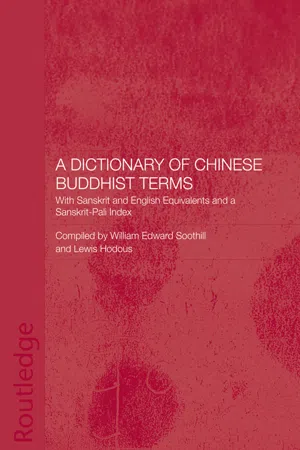
eBook - ePub
A Dictionary of Chinese Buddhist Terms
With Sanskrit and English Equivalents and a Sanskrit-Pali Index
- 536 pages
- English
- ePUB (mobile friendly)
- Available on iOS & Android
eBook - ePub
A Dictionary of Chinese Buddhist Terms
With Sanskrit and English Equivalents and a Sanskrit-Pali Index
About this book
Information
SANSKRIT AND PALI INDEX
The page numbers are followed by “ a ” indicating the left-hand column and “ b ” the right-hand column. Words sometimes occur more than once in the column indicated.
A, 3b, 211b, 285a, 362a, 377a, 426b
Ababa, 252a
Ābhāsvara, 85b, 179a, 202b, 220b, 289a, 403a
Ābhāsvara-vimāna, 202b, 289a
Abhāva, 295a
Abhaya, 68b, 381a
Abhayadāna, 303b
Abhayagiri, 292b, 381a
Abhayagiri-vāsinaḥ, 56a, 166a
Abhayaṁkara, 286b
Abhayandada, 303b
Abhayapradāna, 381a
Abhicāra(ka), 123b, 288b, 317b
Abhidhāna, 428b
Abhidharma, 44b, 84b, 288b, 306a, 315b, 386b, 395a, 423b, 444a, 467b
Abhidharma-hṛdaya-śāstra, 256a
Abbidharma-jñāna-prasthāna-śāstra, 315b
Abhidharma-kośa-śāstra, 256a
Abhidharma-mahāvibhāṣā-śāstra, 122b
Abhidharmāmṛta-śāstra, 466a
Abhidharma-piṭaka, 221b, 305b, 330a, 434a, 444a
Abhidharma-prakaraṇa-pāda-śāstra, 384b
Abhidheya, 410a
Abhijit, 22b, 288b
Abhijñā, 138b
Abhimāna, 238b
Abhimukham, 288b
Abhimukhī, 47b, 288b
Abhimukti, 288b
Abhirati, 104b, 290a, 293b, 378a, 394b, 487a
Abhisamaya, 359b
Abhisaṁbodha, 288b
Abhisaṁbuddha, 288b, 473b
Abhiṣecana, 125a, 413b,...
Table of contents
- Cover
- Half Title
- Title Page
- Copyright Page
- Table of Contents
- PREFACES
- METHOD AND NOTES
- INDEX OF CLASSIFICATION BY STROKES
- LIST OF THE CHINESE RADICALS
- CHINESE CHARACTERS WITH RADICALS NOT EASILY IDENTIFIED
- CORRIGENDA
- A DICTIONARY OF CHINESE BUDDHIST TERMS, ARRANGED ACCORDING TO THE NUMBER OF STROKES: CHINESE—SANSKRIT—ENGLISH
- INDEXES :—
Trusted by 375,005 students
Access to over 1.5 million titles for a fair monthly price.
Study more efficiently using our study tools.
Frequently asked questions
Yes, you can cancel anytime from the Subscription tab in your account settings on the Perlego website. Your subscription will stay active until the end of your current billing period. Learn how to cancel your subscription
No, books cannot be downloaded as external files, such as PDFs, for use outside of Perlego. However, you can download books within the Perlego app for offline reading on mobile or tablet. Learn how to download books offline
Perlego offers two plans: Essential and Complete
- Essential is ideal for learners and professionals who enjoy exploring a wide range of subjects. Access the Essential Library with 800,000+ trusted titles and best-sellers across business, personal growth, and the humanities. Includes unlimited reading time and Standard Read Aloud voice.
- Complete: Perfect for advanced learners and researchers needing full, unrestricted access. Unlock 1.5M+ books across hundreds of subjects, including academic and specialized titles. The Complete Plan also includes advanced features like Premium Read Aloud and Research Assistant.
We are an online textbook subscription service, where you can get access to an entire online library for less than the price of a single book per month. With over 1.5 million books across 990+ topics, we’ve got you covered! Learn about our mission
Look out for the read-aloud symbol on your next book to see if you can listen to it. The read-aloud tool reads text aloud for you, highlighting the text as it is being read. You can pause it, speed it up and slow it down. Learn more about Read Aloud
Yes! You can use the Perlego app on both iOS and Android devices to read anytime, anywhere — even offline. Perfect for commutes or when you’re on the go.
Please note we cannot support devices running on iOS 13 and Android 7 or earlier. Learn more about using the app
Please note we cannot support devices running on iOS 13 and Android 7 or earlier. Learn more about using the app
Yes, you can access A Dictionary of Chinese Buddhist Terms by Lewis Hodous,William E. Soothill in PDF and/or ePUB format, as well as other popular books in Languages & Linguistics & Buddhism. We have over 1.5 million books available in our catalogue for you to explore.