eBook - ePub
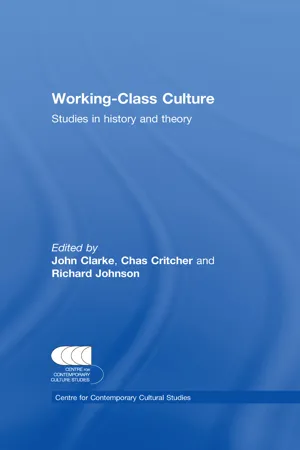
Working Class Culture
Studies in History and Theory
- 304 pages
- English
- ePUB (mobile friendly)
- Available on iOS & Android
eBook - ePub
About this book
First published in 2013. How can we define working class culture? Since the late 1950s, the term has become more complex, because of both social changes and intense debates about the meaning of 'culture'. Through this collection of original case studies and theoretical essays, the authors explore some central problems in the field. The first part of the book provides a unique critical review of existing literature, focusing on two main traditions of writing about the working class. Examining the empirical sociology tradition, the authors analyse a group of books from the post-war debate about affluence and its immediate aftermath. In looking at the related tradition of working class historiography, they examine the origins of social and labour history from the 1880s up to the 1960s, and conclude by discussing some of the dilemmas of history writing in the 1970s. Part two is a series of case studies which span the whole period that a working class has existed, with emphasis on the late nineteenth and twentieth centuries, and which examine the most important spheres of working class life: politics, education, youth, recreation, waged and domestic labour. Part three returns to some of the problems raised in part one, considering three main ways in which working class culture can be understood, through the problematics of 'consciousness', 'culture' or 'ideology', and examining the strengths and weaknesses of each approach. The authors argue for a more fruitful and developed way of thinking about working class culture, and suggest some guidelines for a history of the post-war working class.
Trusted by 375,005 students
Access to over 1.5 million titles for a fair monthly price.
Study more efficiently using our study tools.
Part 1
Traditions and approaches
1 Sociology, cultural studies and the post-war working class
Chas Critcher
Introduction
There is no self-consciously interrelated tradition of sociological writing on working-class culture. In a sense, we have to construct a genre of working-class cultural studies. The following selective list, in which bracketed works are relevant but not ‘sociological’, indicates the possibility of this, and the types of work with which this essay will deal. It is presented, for reasons that will become obvious, in chronological order.
1956 Dennis et al., Coal is Our Life
1957 Bott, Family and Social Network
Young and Wilmott, Family and Kinship in East London Hoggart, The Uses of Literacy
Young and Wilmott, Family and Kinship in East London Hoggart, The Uses of Literacy
(1958 Williams, Culture and Society)
Titmuss, Essays on the Welfare State
Titmuss, Essays on the Welfare State
1960 Abrams and Rose, Must Labour Lose?
Stacey, Tradition and Change
Stacey, Tradition and Change
1961 Williams, The Long Revolution
Zweig, The British Worker in An Affluent Society
Zweig, The British Worker in An Affluent Society
1962 Jackson and Marsden, Education and the Working Class
Titmuss, Income Distribution and Social Change
Titmuss, Income Distribution and Social Change
(1963 Thompson, The Making of the English Working Class)
1965 Klein, Samples From English Cultures
(New Left Review, Towards Socialism)
(New Left Review, Towards Socialism)
1966 Frankenberg, Communities in Britain
Runciman, Relative Deprivation and Social Justice
Runciman, Relative Deprivation and Social Justice
1967 Douglas, The Home and the School
1968 Goldthorpe and Lockwood, The Affluent Worker in the Class Structure
Jackson, Working Class Community
McKenzie and Silver, Angels in Marble
Jackson, Working Class Community
McKenzie and Silver, Angels in Marble
1970 Coates and Silburn, Poverty: The Forgotten Englishmen
1971 (Roberts, The Classic Slum)
Parkin, Class Inequality and Political Order
Parkin, Class Inequality and Political Order
Most of these studies have in common a concern with the effects of social change on the working class. The passivity of the class is a key feature: the sociologies present people to whom things happen. There is little sense of the working class an agent of change or even as a conservative force. The approach is through policy or through the social problems with which policy should deal. One associated tendency is to fragment a broader social pattern, to present a thin, abstracted element of working-class life, often dissociated from what determines it. These concerns are not merely the conclusions of such studies; they also form the initial impetus. An example may illustrate. Young and Wilmott's study of Bethnal Green is often taken to be the classic study of a working-class community. In fact, it is nothing of the sort. It is par excellence an example of how to appropriate working-class culture in terms of a discrete sociological variable: in this case, the family. Jackson and Marsden are later to adopt this ‘variable’ approach for education, and Titmuss's concern throughout the 1950s and 1960s is with the twin variables of income and welfare. The immediate project of these texts, then, reflects the empirical problem-oriented and atheoretical stance of British sociology, and its increasing post-war connection with public policy and it is only within this perspective that the situation of the working class is examined. Thus Young and Wilmott manage just twelve pages on the local economy of Bethnal Green: it is for them only important in so far as it ‘affects’ the nature of the family. The whole problem of redevelopment is not interpreted in terms of housing and job markets, much less the complex interrelationships between them which shape the changing face of Britain's cities. We are thus presented with a conclusion which, for all its liberal humaneness, is accepting a doubly limited definition, both of the nature of a working-class neighbourhood (seen through the family) and of the process of redevelopment (ignoring the structural determinants of redevelopment policies). The planners are blamed for their destruction of ‘community spirit’, but we have no sense of the reasons for this real transformation, save the ‘physical size of reconstruction’ and the planners’ oversights.1 *
One feature of this orientation is to divert political and theoretical questions into policy recommendations, through defining a particular aspect of working-class life as problematic. Hoggart, untypical in other ways, is concerned to identify the undermining of traditional working-class values by the influence of the mass media; Titmuss with the persistence of structural inequality; Jackson with the tendency for education to act as a channel of improvement for individuals rather than the class as a whole; Runciman with the quietism of the deprived; Abrams and Rose with the erosion of Labour support. Thompson and Williams are the exceptions which prove the rule: it may be significant that they are most outside the British sociological tradition. Generally we can identify a whole list of ‘problems’ about the working class; its vulnerability to cultural penetration; the failure of the welfare state to alter its position of economic and educational disadvantage; its apparent political and cultural identification with the status quo.
Attention to these problems always operates on two levels: the writers argue with dominant definitions of post-war change and make prescriptions in relation to the programme of the Labour Party. The crisis to which these texts belong is essentially that of a group of social-democratic intellectuals faced with the contention that capitalism works. We need to look more closely at the context of these arguments.
The notion of capitalist success was based on a limited but powerful reading of post-war capitalist societies, especially of America and Britain. The era of ‘high mass consumption’ was held to have produced the ‘affluent society’; the existence and the very idea of a working class was held to have become dated in a society of an overwhelmingly middle-class character. As Goldthorpe and Lockwood have argued, three kinds of propositions underwrote the twin theses of the affluent society and the working class rendered bourgeois. Firstly, the economic propositions emphasized the convergence of incomes and the spread of the ownership of consumer durables throughout the society. Secondly, technological and managerial changes were alleged to have inverted the traditional working-class situation of heavy manual work and low wages: the trend was towards white or blue collar jobs. Thirdly, changes in the structure of urban ecology were leading to the decline of the traditional ‘urban village’ with its restricted geographical mobility and limited cultural horizons. The authors go on to note that these propositions were not challenged in themselves. Their existence was conceded, but their significance debated:
The argument between the two camps in some part concerns the rate and extent of such changes. But, essentially, it is about the ways in which the changes in question are being experienced and given meaning by the individuals and groups upon whom they impinge and, consequently, about the nature of the latter's responses. The debate is one that centres not on questions of income standards of living, conditions of work or patterns of residence but on questions of social value, social relationships and social consciousness.2
This may stand as something of an epitaph for working-class cultural studies (and it makes all the more remarkable Goldthorpe and Lockwood's insistence on compounding the error). It is part of the purpose of this book to restore to the centre of the debate the relation between such changes in material life and the forms of working-class consciousness and culture.
The whole affluence-embourgeoisement thesis seems wilfully misconceived when viewed from the 1970s with its manifest conflicts. But the debate had a contemporary rationality: there were important changes in the nature of British society in the post-war period, the proper significance of which has never been adequately assessed. Mr Gaitskell's list - ‘the changing character of labour, full employment, new housing, the way of life based on the telly, the fridge and the motor-car and the glossy magazines - have all affected our strength’3 - did point to something real. Changes were often misrepresented, but they were real enough, especially in comparison with the immediate past. The comparison with society before the war not only gave empirical verification for the apostles of progress; it was also a lived experience of improvement for a whole generation of working people. A situation of full employment, whatever inequalities persisted, was eminently preferable to mass unemployment; the extension of ‘welfare’, however skeletal, promised some right to security compared with the degradations of prewar poor relief (even if the means test remained at the heart of the system); the pulling-down of slums and the substitution of houses with decent living space and bathrooms was a measure of improvement even if rents began to spiral and new estates seemed ‘unfriendly’; the ownership of a car, a fridge and vacuum cleaner provided partial relief from domestic drudgery and access to new enjoyments, even though each one would need replacing almost before it was paid for.
The sense of change had a real material basis. Later in this book we shall attempt to sketch some of the transformations involved. The elements of improvement were partial and uneven and always affected sections of the class (split by age and sex as well as region) somewhat differently. But social democratic politicians and intellectuals were often paralysed by the apparent transformation of the capitalist demon. As Patrick Gordon-Walker put it ‘the Tories identified themselves with the new working classes rather better than we did’.4 The response was often to abandon socialist terminology and join the chorus pronouncing the end of capitalism, referring, like Crosland, to ‘present-day, as opposed to capitalist society’.5 Underlying this dilemma, however, was the inability to conceptualize class or capitalism except in terms provided by the experience of inter-war life. If capitalism was synonymous with rampant profiteering, mass unemployment, international crises, and a world of war, fear and fascism, had not capitalism disappeared when the state controlled the economy, the economy was expanding, there was a shortage of labour and the main ‘threat to world peace’ came from a ‘communist’ power? The political theory of social democracy could not break through these ideas; nor could the students of working-class culture conceive of a working class without the extended family, back-to-backs, or mild beer. Both kinds of thought were profoundly empiricist and oblivious to their own historical specificity: they sought to explain only that which was immediately observable against some stereotypical past.
It is only an apparent paradox that the serious study of working-class culture should emerge just at the moment when it was being loudly proclaimed that the working class had ceased to exist. The discovery of working class culture was a response to this argument. The timing and many of the features of the genre can be explained in these terms. The studies typically took the form of finding out who the working classes were, where they lived, and what was happening to them and their way of life - an investigation uninformed by any theoretical discussion. They concentrated first on the nature of traditional working-class life (Dennis et al., Hoggart and Wilmott): then on changes in life-style and attitudes (Abrams, Zweig, Jackson and Marsden); returned hesitantly to problems of inequality (Runciman, Titmuss, Douglas); and commenced, somewhat gingerly, an encounter with theory (most evident in Goldthorpe and, in a different vein altogether, in Williams). There are of course other ways of reading this pattern. It has partly to do with the emergence of a whole generation of scholarship boys and girls whose relationship to the working class and the Labour Party was crucial to their own identity. These books could also be read as a logical outcome of the development of social science. Though it is true that all these works were produced from within higher education, this explanation does not account for the form of social inquiry, very different from that on the continent or in the USA. Neither would it explain the fact that these works are, sometimes quite self-consciously, related to a tradition of social investigation going back to Edwardian and Victorian times, which predated departments of sociology. Indeed the kinds of connections which can be made with this tradition are revealing in themselves, most obviously that in both cases the examination of the lives of the working class depends for its impetus on defining them as a problem. If the problem is no longer that of the deviant urban dangerous classes, but that of conventionalized suburban quietist citizens, that alters the nature of the problem, but does not diminish the distortion such a perspective may imply.
We have argued at length, then, that the ‘genre’ of working-class studies does not exist of itself; indeed, these books are frequently written without reference to each other. Nevertheless, we have sought to identify common elements which bind them together. These precisely do not exist at the levels of theory and methodology; as we shall see, the first is almost universally absent, and the second only present in an implicit form. Rather the common focus is the crisis in British social democratic thought in the post-war period, occasioned by changes at the level of appearance in working-class cultural formations. Our next step is to examine critically the genre through some of its main texts. This involves us in an assessment of their relative significance. In selecting texts for closer study, we have chosen works that come nearest to representing working-class culture as a whole.
‘The Uses of Literacy’
The Uses of Literacy was published in 1957. In the following year it went into paperback and was reprinted four times in the next seven years. Widely reviewed, it soon appeared on more ‘progressive’ syllabuses in institutions of higher education. It seemed to have special resonance among left-wing intellectuals in and around the Labour Party. It offered not only affirmation of their own experience as scholarship boys and girls ambivalent about the class they had left, but also a wholly new kind of critique of capitalism. If ‘affluence’ had made it more difficult to criticize contemporary capitalism as an economic system, Hoggart's work opened up the question of the quality of cultural life. The price of material progress seemed to be a new kind of cultural exploitation. This analysis, and the political programme inherent in it, becomes most explicit in Hoggart's concluding appeal to the working-class movement. Different in kind and tone from Young and Wilmott's exhortations over redevelopment policy, it nevertheless shares the attempt to rewrite the agenda of the social democratic left: ‘If the active minority continue to allow themselves too exclusively to think of immediate political and economic objectives, the past will be sold, culturally, behind their backs.’6 We can get from Hoggart's opening formulation how such a position evolves from his immediate concerns:
It is often said that there are no working-classes in England now, that a ‘bloodless revolution’ has taken place, which has so reduced social differences that already most of us inhabit an almost flat plain, the plain of the lower middle- to middle- classes. I can see the truth in such a statement, within its proper contexts, and do not wish to under-estimate the extent or the value of many recent social changes. To appreciate afresh the scope of these changes as they affect working-class people in particular, we need only read again a social survey or a few novels from, say, the turn of the century. We are likely to be struck by the extent to which working-class people have improved their lot, acquired more power and more possessions; we are likely to be even more impressed by the degree to which they no longer feel themselves members of ‘the lower orders’ with a sense of other classes, each above them and each superior in the way the world judges. Some of this remains, but it has been greatly reduced.
In spite of these changes, attitudes alter more slowly than we always realize, as the first half of this book seeks to show. Attitudes alter slowly, but obviously a great number of complex forces are bringing about changes here too: the second half of the book discusses some ways in which a change towards a culturally ‘classless’ society, is being brought about.7
Such a passage can be analysed in different ways. Hoggart's su...
Table of contents
- Front Cover
- Working-Class Culture
- Centre for Contemporary Cultural Studies
- Title Page
- Copyright
- Contents
- Preface
- Part 1 Traditions and approaches
- Part 2 Studies
- Part 3 Theories
- Notes and references
- Index
Frequently asked questions
Yes, you can cancel anytime from the Subscription tab in your account settings on the Perlego website. Your subscription will stay active until the end of your current billing period. Learn how to cancel your subscription
No, books cannot be downloaded as external files, such as PDFs, for use outside of Perlego. However, you can download books within the Perlego app for offline reading on mobile or tablet. Learn how to download books offline
Perlego offers two plans: Essential and Complete
- Essential is ideal for learners and professionals who enjoy exploring a wide range of subjects. Access the Essential Library with 800,000+ trusted titles and best-sellers across business, personal growth, and the humanities. Includes unlimited reading time and Standard Read Aloud voice.
- Complete: Perfect for advanced learners and researchers needing full, unrestricted access. Unlock 1.5M+ books across hundreds of subjects, including academic and specialized titles. The Complete Plan also includes advanced features like Premium Read Aloud and Research Assistant.
We are an online textbook subscription service, where you can get access to an entire online library for less than the price of a single book per month. With over 1.5 million books across 990+ topics, we’ve got you covered! Learn about our mission
Look out for the read-aloud symbol on your next book to see if you can listen to it. The read-aloud tool reads text aloud for you, highlighting the text as it is being read. You can pause it, speed it up and slow it down. Learn more about Read Aloud
Yes! You can use the Perlego app on both iOS and Android devices to read anytime, anywhere — even offline. Perfect for commutes or when you’re on the go.
Please note we cannot support devices running on iOS 13 and Android 7 or earlier. Learn more about using the app
Please note we cannot support devices running on iOS 13 and Android 7 or earlier. Learn more about using the app
Yes, you can access Working Class Culture by Centre for Contemporary Cultural Studies,CCCS in PDF and/or ePUB format, as well as other popular books in History & Social History. We have over 1.5 million books available in our catalogue for you to explore.