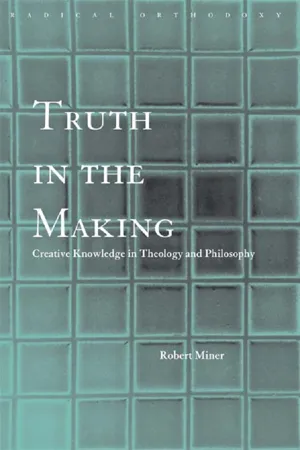
Is knowing a purely passive reception of something concrete outside the mind, or when we know something, are we creating something too?
Spanning more than 500 years of philosophical enquiry from the Middle Ages to the present day, Robert Miner clarifies modern philosophical conceptions of knowing as making or constructing, and contrasts this view with the theological understanding of knowing as a participation in divine creation.
This study demonstrates how 'creative knowledge' has its roots in the theologies of Thomas Aquinas and Nicholas Cusanus. It explores the multiple ways in which this idea influenced the architects of modern philosophy, most notably Francis Bacon, René Descartes and Thomas Hobbes, despite their secular stance. Miner contends that, well in advance of Kant, one of these thinkers, Gaimbattista Vico provided a remarkably succinct formulation of the metaphysical and epistemological core of modernity in his principle verum et factum convertuntur: 'the true and the made are convertible'.
In Truth in the Making, Robert Miner challenges the standard assumption that Kant was the first thinker to conceive of knowing as constructive activity, and shows how contemporary theology can reclaim a concept of knowing that is both creative and participant in divine wisdom.
- 192 pages
- English
- ePUB (mobile friendly)
- Available on iOS & Android
eBook - ePub
About this book
Trusted by 375,005 students
Access to over 1.5 million titles for a fair monthly price.
Study more efficiently using our study tools.
Information
1
THOMAS AQUINAS
For the classical tradition, knowing is first and foremost a seeing. The demiurge of Plato's Timaeus looks to forms or ideas, and molds raw material on the basis of what he sees, with the aim of embodying these forms in matter. Human craftsmen, insofar as they are craftsmen, do the same. Following the analysis of R.G. Collingwood, we may summarize the primary features of craft, or technical making:1
1. Craft involves a distinction between means and end.
2. Craft involves a distinction between planning and execution, where “planning” means precise foreknowledge of what is to be made, before the making is executed. In the order of planning, the end is prior to the means; in the order of execution, the means come before the end.
3. Craft involves a distinction between raw material and finished product or artifact. “A craft is always exercised upon something, and aims at the transformation of this into something different. That upon which it works begins as raw material and ends as finished product. The raw material is found ready made before the special work of the craft begins.”2
4. Craft involves a distinction between matter and form. “The matter is what is identical in the raw material and the finished product; the form is what is different, what the exercise of the craft changes.”3
5. Crafts are hierarchically related; the finished product of one is the raw material of another. (This also holds for means and parts.)
Is there a type of making that is not an exercise in craft? There is—the making of the incompetent pseudo-craftsman. Collingwood imagines a person who sets out to make a table, but conceives the table vaguely, “as somewhere between two by four feet and three by six, and between two and three feet high.”4 Such a person may produce something resembling a table, but he is no craftsman. He lacks the precise, explicit foreknowledge of what he wants to make, a knowledge whose possession is the hallmark of the person with the intellectual virtue of techne (ars). It is this knowledge of the formal cause of an artifact, together with the ability to impose the form onto matter, that defines the craftsman.
The paradigm of craft entails a particular conception of the relation between knowing and making. The relationship is one of dependence: making (understood as the execution of the means through the transformation of matter) depends upon an antecedent knowledge of the form. The activity of making does not provide knowledge of the formal cause of the artifact, but presupposes this knowledge. Is there another conception of the relation between knowing and making, according to which the activity of making does not merely devise means for the sake of giving material embodiment to what is already known, but actually contributes to our knowledge? A positive answer to this question requires a concept of making other than either the incompetent bungling of the pseudo-craftsman or the proficient fabrication of the technical maker. The name for this alternative concept of making is “creation.” Creation is a type of making, but it is not technical making. Aquinas's significance for the present inquiry is that he is among the first theologians to have a clear grasp of how creation differs from technical making. A proper appreciation of this point will cast doubt on any treatment of Aquinas that would interpret his theology of creation as little more than the application of a technicist paradigm to God's making.5 It will question the value of histories of philosophy according to which Western metaphysics construes all knowing, even divine knowing, as a kind of technical manipulation. It will, finally, raise the question of the relation between divine creation and the human activities of knowing and making.
Scientia Dei and creation
Aquinas himself seems to invite the charge that he reduces divine creation to technical making, in precisely the sense described by Collingwood. But this cannot be because (1) creation involves a distinction between means and end. It is impossible to identify any implements or instruments that God uses to create the world. The apparent affinity between divine creation and human craft would derive from the fact that (2) craft involves a distinction between planning and execution, where “planning” means precise fore-knowledge of what is to be made. When Aquinas argues that scientia Dei est causa rerum, he introduces an analogy to technical making. “For the scientia Dei is to all res creata as the knowledge of the craftsman (artifex) is to artificial things (artificiata).”6 Both God and the craftsman make works per intellectum. In both cases, there is a distinction between ideas in the intellect and works that embody those ideas. To bring about such works involves the action of will. God's knowledge is the cause of things, Aquinas concludes, insofar as the operation of the will is joined to it.
Aquinas uses the analogy to human art not because he wants to downgrade divine creation by reducing it to technical making, but because he wants to emphasize that, like the competent craftsman, God knows what he wants to make. This becomes important in the discussion of how God knows singular things (singularia). God cannot know singulars merely as instances of a type, as an astronomer might be able to predict all future eclipses on the basis of universal knowledge. To know “singulars in their singularity” (singularia in sua singularitate)7, God's knowledge must be more than the application of universal principles to particular effects. Thomas holds that his exhaustive knowledge of particulars is related to the fact that he produces them. “Since God is the cause of things by His knowledge, as said above, His knowledge extends as far as His causality extends.”8 If the “active power of God” (virtus activa Dei) extends not only to forms, but also to matter, then the knowledge of God must also extend to singular things. It cannot be confined to universals.
The analogy between the knowledge of the human craftsman and the knowledge of the divine creator thus gives way to a disanalogy. The house-builder knows the form of a house, and works to embody that form in matter. But he does not create the entire form/matter composite, since he does not create the matter out of which he makes the house. Thus, whereas God's knowledge of singulars is “productive of the whole thing, and not only of the form,”9 human knowledge of singulars must always stop short of knowing a thing in its full particularity. It is limited to a knowledge of form in matter, since it can only produce a house through the transformation of matter. This means that although God possesses a precise knowledge of what he makes, his creation cannot involve (3) a distinction between raw material and finished product or artifact. There is no raw material that creation transforms. Aquinas makes this clear in the prima pars of the Summa theologiae: creation is the emanation of all being from the not-being which is nothing.10 Even if it is correct (and in fact necessary) to describe creation as a product which exists separately from its producer, this product has not been made from a raw material, and so cannot be a product of craft. As Collingwood observes, “a craft is always exercised upon something, and aims at the transformation of this into something different.”11 In the case of creation, there is no “something” upon which divine will is exercised. The craftsman works from natural things such as wood and brass, “which are caused not by the action of art, but by the action of nature.”12 Divine creation, by contrast, presupposes no raw materials from which to work. The notion of a natura creatrix (as in Lucretius) would be a contradiction in terms, since “nature itself causes natural things as regards their form, but presupposes matter.”13 Because creation presupposes no matter, it cannot essentially (4) involve a distinction between matter and form. Aquinas's insistence that both matter and form are created ensures the impossibility of collapsing creation into the technical transformation of matter. It is, finally, impossible that creation should participate in (5) the hierarchical relations among crafts. Creation is not a member of the hierarchy among crafts, whether with respect to materials, to means, or to parts. As the cause of the most universal of effects, being itself, it is what makes the hierarchical relations among crafts possible.
That creation should possess only one of the characteristics of craft as enumerated by Collingwood seems to support the view that Aquinas's view of creation is a genuine alternative to technical making. One might object, however, that the possession of precise foreknowledge of what one wants to make is the essential characteristic of craft, and to the extent that Aquinas's theory of creation insists that God makes from ideas, he is beholden to the paradigm of techne. In response to this objection, one may begin by observing that Aquinas's use of the analogy to the craftsman does not so much reduce divine creation to technical making, as it elevates the gnoseological value of human art. Both God and the artifex have a superior knowledge of what they make; they have scientia practica and not merely scientia speculativa of things they make. With respect to natural things, Aquinas holds that humans are limited to speculative knowledge, which is determined and measured by things. But with respect to res artificiales, humans possess both practical and speculative knowledge. Aquinas contrasts the knowledge of the craftsman who builds a house with that of the person who is forced to take (capit) his knowledge “from a thing already made” (ex ipsa iam facta).14 The latter has only speculative knowledge; the former has both practical and speculative knowledge, in the same way that God has both practical and speculative knowledge of res creata. Aquinas thus provides a muted but unmistakable formulation of the thesis that we know better what we make than what we do not make. When we make something, we know not only the effect, but also the cause by which it is made. With regard to natural things, however, we are restricted to contemplating them from without and conjecturing about their causes.
It remains, however, that Aquinas's use of the analogy between God and the craftsman confirms the sense that all competent human making is an instance of craft. Our claim, however, is that despite his apparent construal of all human making as craft, Aquinas does possess a genuine alternative to craft because he thinks of divine making—creation—as something radically other than craft. The view that Aquinas's notion of creation is not radically other than techne, but a hyperbolic instance of it, seems to derive from the sense that any God who creates according to archetypes is nothing but a variation on the Platonic demiurge, who is only “half a god.” The fear is that Aquinas's affirmation of archetypes to which God looks compromise his divinity, and makes him into a kind of super-technician. This fear seems to be motivated by the notion that any analogy between human craftsmanship and divine creation will collapse the latter into the former. But this inference is arbitrary: one can equally argue, as Aquinas would, that the ability of the craftsman to make artifacts with intelligence, is the precise point at which human making bears an analogy with divine art. But it does not follow from this that divine making is essentially technical. Creation involves no distinction between means and end, no distinction between raw material and finished product and artifact, no distinction between matter and form. Although it does involve a knowledge of forms, it is not the case, as for craft, that this knowledge temporally precedes making. This is because creation is not a temporal process or motion. There are no discrete stages, no “before” and “after” in creation. Creation involves a harmony between God's knowledge and God's will, but this does not entail that God knows the form of a created being, and then wills it to be. The “joining” of the will to practical knowledge (necesse est quod scientia sit causa rerum, secundum quod habet voluntatem coniunctam15) does not involve a temporal succession.
Another reason for rejecting the suggestion that God's use of ideas makes him into a divine super-technician is that the process whereby God knows ideas is entirely different from the way in which a human craftsman knows a form. More precisely, there is no “process” by which God knows ideas. The ideas are part of God's non-discursive self-knowledge. When God knows the ideas, he knows the multiple ways in which His essence can be imitated by creatures. This knowledge, in the first instance, is a speculative knowledge. Divine self-knowledge is necessarily speculative, because God does not make or cause himself. But this knowledge, although speculative, is not sterile. It gives rise to divine practical knowledge, which is distinct but not separate from God's speculative knowledge of Himself. Aquinas considers that knowledge of the ideas is speculative if it considers the form without it directing it to operation, and practical if it is used to make something. Thus God's knowledge of ideas may be either entirely speculative, or both speculative and practical. When they are known speculatively, as principles of knowledge, they are “types” (rationes).16 When they are not only known speculatively, but also directed to the making of something, they attain the status of an exemplar, that is, the “principle of the making of things” (principium factionis rerum).17 A distinction between speculative and practical knowledge of ideas is necessary, because Aquinas allows that God knows some types of created things but chooses not to actualize them. But he does not sever practical knowledge of exemplars from speculative self-knowledge. “In speculative knowledge of Himself, He possesses both speculative and practical knowledge of all other things,” Aquinas concludes the final article of Question 14.18 Thus God's knowledge of exemplars is essentially different from the craftsman's knowledge of forms, because the former is a function of perfect self-knowledge, and the latter is not: “whatever we know speculatively in things by defining and dividing, God knows all this much more perfectly.”19 Yet even here there may...
Table of contents
- Front Cover
- Half Title
- Radical Orthodoxy Series
- Title Page
- Copyright
- Dedication
- CONTENTS
- Acknowledgments
- Prologue
- 1 Thomas Aquinas
- 2 Nicolaus Cusanus
- 3 Francis Bacon
- 4 René Descartes
- 5 Thomas Hobbes
- 6 Giambattista Vico
- Epilogue
- Notes
- Bibliography
- Index
Frequently asked questions
Yes, you can cancel anytime from the Subscription tab in your account settings on the Perlego website. Your subscription will stay active until the end of your current billing period. Learn how to cancel your subscription
No, books cannot be downloaded as external files, such as PDFs, for use outside of Perlego. However, you can download books within the Perlego app for offline reading on mobile or tablet. Learn how to download books offline
Perlego offers two plans: Essential and Complete
- Essential is ideal for learners and professionals who enjoy exploring a wide range of subjects. Access the Essential Library with 800,000+ trusted titles and best-sellers across business, personal growth, and the humanities. Includes unlimited reading time and Standard Read Aloud voice.
- Complete: Perfect for advanced learners and researchers needing full, unrestricted access. Unlock 1.5M+ books across hundreds of subjects, including academic and specialized titles. The Complete Plan also includes advanced features like Premium Read Aloud and Research Assistant.
We are an online textbook subscription service, where you can get access to an entire online library for less than the price of a single book per month. With over 1.5 million books across 990+ topics, we’ve got you covered! Learn about our mission
Look out for the read-aloud symbol on your next book to see if you can listen to it. The read-aloud tool reads text aloud for you, highlighting the text as it is being read. You can pause it, speed it up and slow it down. Learn more about Read Aloud
Yes! You can use the Perlego app on both iOS and Android devices to read anytime, anywhere — even offline. Perfect for commutes or when you’re on the go.
Please note we cannot support devices running on iOS 13 and Android 7 or earlier. Learn more about using the app
Please note we cannot support devices running on iOS 13 and Android 7 or earlier. Learn more about using the app
Yes, you can access Truth in the Making by Robert C. Miner in PDF and/or ePUB format, as well as other popular books in Philosophy & Epistemology in Philosophy. We have over 1.5 million books available in our catalogue for you to explore.