- 333 pages
- English
- ePUB (mobile friendly)
- Available on iOS & Android
eBook - ePub
Drugs and Politics
About this book
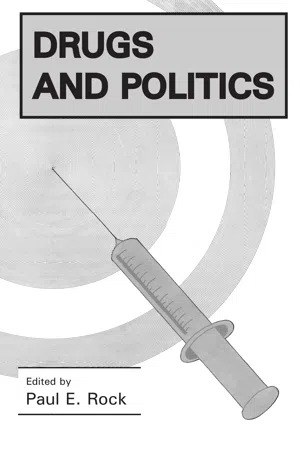
This collection examines the ambiguous relationship be-tween the politically mute, average drug user and the small number, socially distant from the common user, who started the work of undermining official definitions of drug use. The drug users' identification with the issues of power, freedom, oppression, and libertarianism, triggered by the experience of police and penal regulations, is discussed, as is the influence of the growth in the collective competence of users and the changes in the using population on the shifting image of drugs.
Trusted by 375,005 students
Access to over 1.5 million titles for a fair monthly price.
Study more efficiently using our study tools.
Information
Subtopic
Politica1
Early History of Narcotics Use and Narcotics Legislation in the United States*
John A. Clausen
The opium poppy has been the source of sleep-inducing drugs and soothing beverages since antiquity.1 Eventually it was learned that the ingredients responsible for the soporific properties were contained in the juice that exudes from the ripe poppy head when it is lanced. This juice, collected and dried, is opium. The opium itself contains two major components (alkaloids) that are distinct though related in drug action: morphine and codeine. They were first identified early in the nineteenth century.
Opium and its derivatives were inexpensive drugs and were used for a wide variety of human ills with almost no limitation until the early twentieth century. Indeed, the bold use of opium appears to have been the basis for the reputations of a number of famous physicians of earlier times. Not confined to use by physicians, however, opium and its derivatives were included in almost every patent medicine for the relief of painful conditions, in “soothing syrups” for babies, and in a variety of confections. Not all users received a sufficiently large or regular dosage to become addicted to these drugs, but many did. As one writer has commented:
Addicted persons have enjoyed the appellation “dope fiend” for only some forty years, while the pusher of pre-World War I society was usually the local pharmacist, grocer, confectioner, or general store keeper. In fact, until the turn of the twentieth century, the use of opium and its derivatives was generally less offensive to Anglo-American public morals than the smoking of cigarettes. 2
Some physicians had begun to warn against the dangers of the opiates as early as the 1830s, but by and large during the nineteenth century the problem of dependency was simply dealt with by continued consumption of the drug. The discomforts of abstinence were then just another set of aches and pains that could be alleviated by this panacea for all ills.
As an increasing number of physicians became aware of the dangers of habitual use of opium and its derivatives, there was a search for ways of using the drugs so as to avoid an “opium appetite.” The introduction of the hypodermic needle was thought to afford such a means. It was only after the habitual hypodermic use of morphine to relieve pain by Civil War veterans that the dangers of addiction through this channel were recognized. So widespread was morphine use among ex-soldiers that it was known for a time as “army disease.”
No sooner had awareness of this danger been achieved than a new one appeared. A new opiate, heroin, was produced in Germany in 1898. It was widely heralded as being free from addiction-producing properties, possessing all of the virtues but none of the dangers of morphine. It took several years’ use of heroin to disprove these erroneous beliefs. Terry and Pellens observe that the widespread use of heroin as a substitute for morphine and as a more stimulating narcotic took place “first in the underworld, . . . long before the average physician had become aware of the dangers of the drug.” 3 Heroin was especially convenient for underworld use, in that it was both highly potent and easy to adulterate with sugar and milk (lactose). While these characteristics were useful even before heroin could no longer be purchased freely, they became especially important after federal control of narcotics had been established.
Use of opium primarily for the sake of psychological effects achieved a vogue in some circles as a consequence of De Quincey’s famous Confessions of an English Opium-Eater, which had appeared in 1821. Later in the century, the Chinese pattern of opium smoking was introduced to “sporting circles” in San Francisco. It spread especially among gamblers, prostitutes, and other frequenters of the demimonde. Although local ordinances were passed forbidding the practice, imports of smoking opium increased sharply and exceeded 100,000 pounds per year for every year from 1890 to 1909, when legal importation was terminated. Interestingly enough, prior to the passage of federal legislation in 1909, the only measure employed for the control of this importation of opium for nonmedicinal use was the imposition of import duties. When these became heavy, legal importation diminished and smuggling increased.
The Harrison Act
The first significant federal legislation to deal with the problems posed by narcotics addiction was an outgrowth of concern about opium smoking in Far Eastern territories. Theodore Roosevelt established a commission that met in Shanghai in 1908 to discuss the abuse of drugs and recommend possible solutions. This in turn led to the first international drug conference. The Hague Opium Convention of 1912 constituted an agreement among nations to control the traffic of opium and other addicting drugs. As an expression of our adherence to that convention, Congress in 1914 passed the Harrison Act to control the domestic sale, use, and transfer of opium and coca products. The act provided at the same time for an excise tax and for registration of, and maintenance of exact records by, persons handling drugs; and prohibited possession of the drugs, except for “legitimate medical purposes,” on the part of persons not registered under the provisions of the act.
The primary purpose of the act, then, appeared to be to bring the drug traffic into observable and controllable channels. The lack of adequate control and the earlier indiscriminate use of opiates by physicians had resulted in a large number of addicted persons. Estimates vary, but almost certainly there were more than 100,000 addicts in the United States in 1914, many of whom were highly respected members of society. Prior to passage of the Harrison Act, these persons could apply to any member of the medical profession for treatment, including gradual drug withdrawal, or they could purchase drugs at moderate prices direct from any supplier. At a stroke, the Harrison Act cut off the latter source of supply and left the question of medical dosage for addicts to legal interpretation. That is, the direct dispensing of drugs by a physician was permitted only “for legitimate medical purposes” but it was not clear whether a physician could provide drugs to prevent the abstinence syndrome in persons previously addicted. World War I intervened before this issue was resolved. It would appear that many addicts did receive drugs through physicians, but that the short supply of opiates during the war led to some diminution of the number of addicted persons.
Since the Harrison Act was a revenue act, enforcement of its provisions was vested in a special police unit, the Narcotics Division of the Treasury Department. In 1919, after Treasury Department officials had charged that the drug menace had greatly increased, the government brought action against a number of physicians who had prescribed opiates for addicted persons. Several of these physicians had written prescriptions for addicts on a wholesale scale, without regard for medical responsibility. They were convicted; and, on appeal, the convictions were sustained by the Supreme Court. Unfortunately, these convictions were interpreted as denying to physicians the right to prescribe narcotics to relieve suffering due to addiction. Justices Holmes, Brandeis, and McReynolds vigorously dissented from this interpretation. Overnight, the government’s action, put into effect by the Treasury Department, created a new dimension of the problem of drug addiction. The former chairman of the Committee on Narcotics and Alcohol of the American Bar Association presents one view of the consequences:
Armed with what came to be known as the Behrman indictment, the Narcotics Divison launched a reign of terror. Doctors were bullied and threatened, and those who were adamant went to prison. Any prescribing for an addict, unless he had some other ailment that called for narcotization, was likely to mean trouble with the Treasury agents. The addict-patient vanished; the addict-criminal emerged in his place. Instead of policing a small domain of petty stamp-tax chiselers, the Narcotics Division expanded its activities until it was swelling our prison population with thousands of felony convictions each year. Many of those who were caught had been respected members of their communities until the T-men packed them off.
Simultaneously with its campaign to cut the addict off from the recourse to medical help, the Narcotics Division launched an attack on him along another line as well. He was portrayed as a moral degenerate, a criminal type, and the public was told that he could only be dealt with by being isolated from all normal contacts with society; if left at large, one of his main preoccupations was allegedly contriving ways to induce others to share his misery by becoming addicted themselves. In short, he should be caught and locked up.4
The consequences of the interpretation and implementation of the Harrison Act was, then, to discourage the medical professional from dealing with a legitimate medical problem, to define the addict as a criminal rather than as an afflicted person, and, by branding them ‘‘dope fiends,” degenerates, enemies of society, greatly to increase the difficulty of rehabilitating addicts and assimilating them into normal society. In 1925 the Supreme Court unequivocally rejected the interpretation that physicians were prohibited by the Harrison Act from treating addicts by prescribing drugs. In a unanimous decision, the Court disclaimed that the previous rulings could be:
accepted as authority for holding that a physician who acts bona fide and according to fair medical standards, may never give an addict moderate amounts of drugs for self-administration in order to relieve conditions incident to addiction. Enforcement of the tax demands no such drastic rule, and if the act had such scope it would certainly encounter grave Constitutional difficulties.5
Unfortunately, by the time this ruling was handed down, the medical profession had withdrawn from attempting to treat addicts; the field was left to the illicit drug peddler.
There were occasional waves of public concern about drug addiction between the early 1920s and World War II, even though the available evidence suggests that there was a gradual decrease in the number of addicts during this period. World War II brought about a further decline, as the channels of illegal drug distribution were disrupted by the war. It is not clear whether any substantial number of addicts were thereby freed from the drug habit or whether they became merely quiescent for a time. It does appear, however, that relatively fewer new addicts were being created during the decade before World War II and during the war itself. Within five years of the end of World War II, however, there was unmistakable evidence of a substantial increase in narcotics use. Increasing proportions of young delinquents and criminals either had on their persons the characteristic bent spoon and hypodermic needle that are the addict’s standard equipment for preparing and injecting heroin, or manifested the abstinence syndrome when jailed. Increasing numbers of parents appealed to police, to hospitals, and to social agencies for help in dealing with older adolescents and young adults who had become addicted to heroin. There were reports that heroin was being peddled to high school and even junior high school students and that addiction was rife in many parts of major cities. These reports were grossly exaggerated. There can be no question, however, that within relatively limited areas a major epidemic of drug use was in process. By 1960 the rate of new cases of addiction seems to have diminished, but the population of relatively young, recent addicts remains a threat to new outbreaks.
NOTES
* From “Drug Addiction” by John A. Clausen, in Contemporary Social Problems, edited by Robert K. Merton and Robert A. Nisbet, © 1961 by Harcourt Brace Jovanovich, Inc., and reprinted with their permission.
1. Based largely on Charles E. Terry and Mildred Pellens, The Opium Problem (New York: The Committee on Drug Addiction, 1928), ch. 2.
2. Rufus King, “Narcotic Drug Laws and Enforcement Policies,” Law and Contemporary Problems 22 (Winter 1957): 113.
3. Terry and Pellens, p. 84.
4. King, pp. 122-23.
5. Ibid., p. 123, quoted from the Supreme Court ruling in Linder vs United States, 268 U.S. 5 (1925).
2
Bureaucracy and Morality: An Organizational Perspective on a Moral Crusade*
Donald T. Dickson
The occurrence of a moral commitment within a bureaucratic setting is not an uncommon phenomenon, especially in our federal bureaucratic system. Examples abound, including the Federal Bureau of Investigation, the Bureau of Narcotics, the Selective Service System, the Central Intelligence Agency, the Internal Revenue Service, and—-on a different scale—the Departments of State and Justice. In fact, one could argue that some sort of moral commitment is necessary for the effective functioning of any bureaucratic body. Usually this moral commitment is termed an ideology and is translated into goals for the bureaucracy. Anthony Downs suggests four uses for an ideology: 1) to influence outsiders to support the bureau or at least not attack it; 2) to develop a goal consensus among the bureau members; 3) to facilitate a selective recruitment of staff, that is, to attract those who will support and further the goals of the bureau and repel those who would detract from those goals; and 4) to provide an alternative in decision making where other choice criteria are impractical or ambiguous.1
While most if not all bureaucracies attempt to maintain this moral commitment or ideology for the above mentioned reasons, some go further and initiate moral crusades, whereby they attempt to instill this commitment into groups and individuals outside their bureaus. The Narcotics Bureau in its efforts to mold public and congressional opinion against drug use is one bureaucratic example, the F.B.I. in its antisubversive and anticommunist crusades another.2 The question then becomes, under what conditions does this transference of ideology from the bureaucracy to its environment or specific groups within its environment take place? Howard S. Becker supplies one answer to this, suggesting that this is the work of a “moral entrepreneur,” either in the role of a crusading reformer or a rule enforcer.3 In either role, the moral entrepreneur as an individual takes the initiative and generates a “moral enterprise.”
This explanation has appeal. It is reminiscent of Weber’s charismatic leader, and can be used to account for the genesis of most moral crusades and entire social movements. Further, it is very difficult to refute. A complete refutation would not only have to indicate an alternative, but also demonstrate that the bureaucratic leader is not a “moral entrepreneur”—is not a major factor in this transference of ideology. The purpose of this chapter is to accomplish the former only—to provide an equally if not more persuasive...
Table of contents
- Cover
- Title Page
- Copyright
- Table of Contents
- Introduction
- 1 Early History of Narcotics Use and Narcotics Legislation in the United States
- 2 Bureaucracy and Morality: An Organizational Perspective on a Moral Crusade
- 3 The Marihuana Tax Act
- 4 On Capturing an Opium King: The Politics of Law Sik Han’s Arrest
- 5 The Drug Addict as a Folk Devil
- 6 The Police as Amplifiers of Deviancy
- 7 Methadone’s Rise and Fall
- 8 The Politics of Drugs
- 9 Knowledge, Power, and Drug Effects
- 10 Playing a Cold Game: Phases of a Ghetto Career
- 11 Street Status and Drug Use
- 12 Drug Pushers: A Collective Portrait
- 13 The Culture of Civility
- 14 Scapegoating “Military Addicts”: The Helping Hand Strikes Again
- 15 The Politics of Drugs
- 16 Cannabis, Alcohol, and the Management of Intoxication
- 17 Invitational Edges of Corruption: Some Consequences of Narcotic Law Enforcement
- Contributors
- Index
Frequently asked questions
Yes, you can cancel anytime from the Subscription tab in your account settings on the Perlego website. Your subscription will stay active until the end of your current billing period. Learn how to cancel your subscription
No, books cannot be downloaded as external files, such as PDFs, for use outside of Perlego. However, you can download books within the Perlego app for offline reading on mobile or tablet. Learn how to download books offline
We are an online textbook subscription service, where you can get access to an entire online library for less than the price of a single book per month. With over 1.5 million books across 990+ topics, we’ve got you covered! Learn about our mission
Look out for the read-aloud symbol on your next book to see if you can listen to it. The read-aloud tool reads text aloud for you, highlighting the text as it is being read. You can pause it, speed it up and slow it down. Learn more about Read Aloud
Yes! You can use the Perlego app on both iOS and Android devices to read anytime, anywhere — even offline. Perfect for commutes or when you’re on the go.
Please note we cannot support devices running on iOS 13 and Android 7 or earlier. Learn more about using the app
Please note we cannot support devices running on iOS 13 and Android 7 or earlier. Learn more about using the app
Yes, you can access Drugs and Politics by Paul E. Rock in PDF and/or ePUB format, as well as other popular books in Politica e relazioni internazionali & Politica. We have over 1.5 million books available in our catalogue for you to explore.