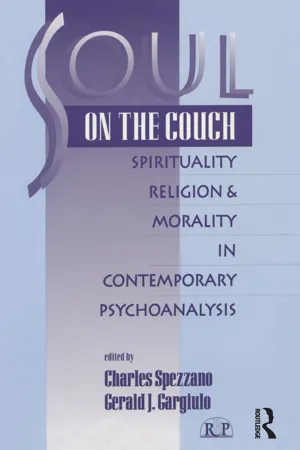
Ever since Freud put religion on the couch in "The Future of an Illusion," there has been an uneasy peace, with occasional skirmishes, between these two great disciplines of subjectivity. As prime meaning givers, God and the unconscious have vied for supremacy in our thinking about ourselves, especially our thinking about our human nature, our moral stature, and our destiny. Freud, in his bold manner, found projection, fear, and denial to be the wellspring of religion's domination over man. In analogous fashion, those giving primacy to the soul over the unconscious have long dismissed psychoanalysis as mechanistic, reductionistic, and hence inadequate to the examination of spirituality. Soul on the Couch is premised on the belief that discourse about the soul and discourse from the couch can inform, and not simply ignore, one another. It brings together scholars and psychoanalysts at the forefront of an interdisciplinary dialogue that is vitally important to the growth of both disciplines. Their essays are not only models of reflective inquiry; they also illuminate the syntheses that emerge when analysts and scholars of religion bridge the gap that has long separated them and speak to one another.
eBook - ePub
Soul on the Couch
Spirituality, Religion, and Morality in Contemporary Psychoanalysis
- 256 pages
- English
- ePUB (mobile friendly)
- Available on iOS & Android
eBook - ePub
Soul on the Couch
Spirituality, Religion, and Morality in Contemporary Psychoanalysis
About this book
Information
1
Inner Mind/Outer Mind and the Quest for the "I"
Spirituality Revisited
GERALD J. GARGIULO
In this essay I suggest that some of the fundamental concerns of traditional Western spirituality can be understood as addressing not only the search for the "hidden God," but the need to experience, as well as to delimit, the autonomous "I." Psychoanalysis, it can be argued, stands in the tradition of Western spirituality in its inquiry into personal meaning and in its efforts to achieve reconciliation.1 Although analysis does not hold the promise of salvation in a distant heaven, it does offer a more present, if less comprehensive, form of salvation, one that psychoanalysts have been slow to talk about since it entails a redefinition of mind, culture, and the notion of the "I."
Long before psychoanalysis spoke of the need for an object, or of object constancy, Meister Eckhart, the 13th- and 14th-century theologian mystic, spoke of internality as externality (Fox, 1980, p. 2), meaning that individuals are not separate monads, figuratively speaking, but are interconnected by our very nature to all that is. His idea was that to know oneself is to know the world, and to know the world is to know oneself. Speaking in the Christian religious symbols of his day, Eckhart went on to indicate that the self was destined to incarnate God. He taught that the Christian belief of God's incarnation in Jesus was not meant as a singular event to be worshipped, but rather as an exemplar event to learn from—an educational event, so to speak. What this "learning" might mean will be the subject of this chapter. Eckhart's theology, in the tradition of what is categorized as negative theology, was one of a radical immanence; that is, he eschewed a God over against man, a God who is spoken of as utterly transcendent. He was impatient with any "dogmatic" that attempted to capture the "holy" awe of life within human language. Thus he could write, in the 13th century, "God, rid me of God" (Fox, 1980, p. 217). That there is a bridge between Eckhart's theology and Buddhist thought is, as Suzuki (1957, p. 221) has observed, rather clear. Today, reflecting Western categories, we might speak of the fact that all life is to be valued, a manifestation, in Alfred North Whitehead's thought (in Jordan, 1968), of an overriding creative life principle. Further, to speak of our individual capacity to be alive, to be the breath of life, as it were, is to speak of man's soul. And, as Bruno Bettelheim (1983) has reminded us, Freud himself had no difficulty in speaking of man's soul.
Actually, psychoanalysis, in its commitment to resolving projection(s) and in its desire to help people live in the present, free of the troubling past and the elusive future, would have little difficulty in embracing many of Eckhart's thoughts. Admittedly his optimism about finding the "living God" within us and the world would have to be read on more than a linear, fundamentalist level. Historically, following the work of the 20th-century theologian and scriptural scholar Rudolph Bultmann (1971), we would have to "demythologize" this concept in order, paradoxically, to find a truer (i.e., latent) meaning. But this is not as foreign as it might at first appear, since any translator is, ultimately, a demythologizer, and psychoanalysts are translators—midwives of meaning. It is also in this sense that I spoke of them as heirs to Western spiritual traditions. That is, at their best they are Virgilian guides to wandering Dantes, ferreting out what is true from what is no longer true, what is real from what is no longer real, and what is realizable from what is no longer so. They are physicians, not of the body, but of culture and mind, of word and symbol. Although such psychoanalytic interpretative readings of man's meanings and values are clearly culture-bound and intellect-limited, they reflect both scientific and spiritual pursuits. They are scientific in limiting the range of inquiry, with an openness to alternate viewpoints and formulations; they are spiritual in the desire to know the truth of a given life beyond the recurrent distortions and reactions that cloud such knowing.
In order to explore what Eckhart's thoughts entail when he speaks of imitating God rather than worshipping him, we have to understand the "problem" of the autonomous "I." That is, we have to rethink some of our basic concepts about the psyche.
One such reconceptualization entails broadening our understanding of the concept of mind. In Winnicott's (1949) seminal article on mind he writes "I do not think that mind really exists as an entity" (p. 243) but that it is no more than a special case of the functioning of psyche-soma (p. 244). While he describes in this essay how mind can be pathologically split off, his generic thoughts about mind can, I believe, be applied to his notions of culture and transitional space. And in doing so we are able to speak, I believe, of mind as a special function of psyche/soma/culture. For example, when we speak of culture we mean, among other information conduits, the experience of language. Language which, paradoxically, both forms us and which we, collectively, create. Winnicott provides the foundation for our conceptualizing the cultural dimensions of mind when he elaborates on the transitional space of childhood as the seedbed of culture. In writing of the child's developmental stages of the me-not me experiences, with the early mother-other-environment, Winnicott grounds man's capacity to play with, and therefore to both find and create, the world. Such is the birthplace of culture. Mind, then, is clearly an achievement, it is not a given; consciousness is a prerequisite for the experience of mind, but it is not simply coequal. Consequently, we can say that to speak of culture is to speak of mind, and to speak of culture is necessarily to speak of a gestalt; there is no culture without different people, and implicit in that, no notion of self except within a particular social context. If mind comes to be in the works of our hands, so also does our sense of self. In our culture, our "I" experience reflects a collective presumption.
Just as Winnicott could write, now rather obviously, that there is no such thing as a baby (without a mothering environment), so we can say that the self does not exist in itself. The "I" is a cultural-imaginative construct. It is a way in which our culture attempts to organize experience into meaningful patterns. Lewis Thomas (1974), struggling with similar thoughts, uses the image of looking down on a giant ant hill as an analogue of human cultural activity. The self, seen from enough distance, is understandable more as a process within a context than as autonomously individuated. Such a perspective is not easily accepted, particularly in Western political and social experience, named as we are as separate "I's." What our culture conveys and what psychoanalysis has augmented is that self-experience and interiority are synonymous. Thus, interiority being experienced as radically distinctive, it is no wonder that Western culture gave birth to Descartes—no wonder that "I think therefore I am." We have been taught to experience ourselves more as individual, separate human beings than as structurally interrelated and interdependent members of humanity. Obviously, I am arguing for a more relational, structurally interdependent understanding of the "I" self than has been operative in traditional psychoanalytic drive theory, or for that matter, in political economic theory.
One of the factors that complicates our rethinking the experience of "I" and of "mind" is the fact that psychoanalysis, particularly in America, has spoken of the integration and the resolution of neurotic conflicts in terms of achieving an adequate level of "separation-individuation." With few exceptions, most notably in the philosophical work The Self in Transformation by Herbert Fingarette (1963), as well as Love's Body by Norman O. Brown (1966), psychoanalytic theory has unreflectedly presumed that an "individuated" autonomous "I" was not merely an intellectual possibility but a therapeutic ideal. Psychoanalytic clinical practice followed this belief, not only in its everyday therapeutic goals, but most notably in accenting, and consequently aggravating, the "postulated" difference(s) between patient and analyst. Had we listened more, perhaps, to Sandor Ferenczi (Dupont, 1988), when he spoke of the actual as well as the therapeutically necessary interdependence of analyst and patient, we might have taken a different route.
Today those demarcations are lessened, and with good reasons. For if the goal of psychoanalysis is to be able to love and to work, we are immediately in the arena of "the other." Despite all of Freud's mapping of the inner terrain, his model(s) of mental agencies, his postulating an arcane unconscious and the ego's hidden defenses, when he speaks of the goal of analysis he is relational and communal. In the case of "love," the other is experienced as more desired than the self, as its fulfillment. Actually, were one not capable of loving, neither the world nor oneself would have emotional reality. In such a scenario, one would merely exist, one would not be alive. This is certainly the thrust of Winnicott's (1960) thought when he observes that therapy can go on for many years under the false assumption that the patient is alive. In the stability of love, the individual has an experience that Winnicott characterizes as "an-ongoing-in-being"—an essential prerequisite for being alive. "Work," for its part, enables us to interact with the environmental world on many levels. Work supplies an essential "process" identity because it mediates a community's recognition of personal competence. Love and work are made possible only in community. The overemphasis on intrapsychic phenomena, as if there is a separate self, independent of the self's self-revelation, has been misleading and dangerous in its consequences, as has the exaggerated notion of personal autonomy. And this is true without our discussing how we are culturally molded, from our very beginnings, by language—the exact opposite of any solipsistic notion of individuality.
Psychoanalysts name and give voice to the meanings of a self, their own and their patients', and in doing so, they situate an individual within a particular cultural framework. The analytic place mirrors the family, just as the family mirrors society, in its defining functions for the individual. Twentieth-century philosophy has helped us to understand that language forms consciousness, just as consciousness forms language. We are formed by the language that is spoken to us—a language that we had no power in creating. We repeatedly have to be called by a name; we repeatedly have to be told we are an "I" for us to be able to organize our experience in these terms. And how we are called by and within our culture commits us to what we are allowed to hear about ourselves and about our world. Nor do we have a choice. This process is neither good nor bad—it is simply the way we pass on our cultural patterning. But a society, in all its various components, does have an obligation to examine the contact lenses, as it were, that it gives its members so that their vision may become more expansive, not less so. The fact that our particular cultural conditioning makes individuals prone to be experienced as if they are individual products, that is, as essentially unrelated to each other, should not be lost sight of, particularly since such consequences serve a capitalistic economic system rather well. (In most spiritual traditions, by way of contrast, a life of poverty is not a repudiation of work or a masochistic disdain of matter, but a desire not to be stuck in "thing" consciousness.)
Psychoanalysis looks for the hidden in the obvious, for an alternate meaning behind the manifest meaning. From such a perspective, one would have expected psychoanalysis to be a radical critique, following Fenichel and some of the early analysts, of society's identifying processes. Why this did not occur has been discussed by Russell Jacoby (1983) in The Repression of Psychoanalysis and need not detain us here; but the question of whether psychoanalysis should address the cultural product of the "I" should concern us, even in a preliminary way.
One of the difficulties in the task of correcting the distortions of the overemphasis on the autonomous "I" is related to Freud's theoretical conceptualizations of the early vicissitudes of narcissism. As a point of reference and reflection, Freud speaks of the individual child as possessing both primary and secondary narcissism. Primary narcissism, as a postulate for the life force, holding together and fostering growth, is understandable. Secondary narcissism, as the capacity of a young infant to withdraw "libido" from the other and invest it in the self, is more than misleading. It is misleading because there is no "self" except in context of another. Freud assumes what he is trying to prove, namely that the self is "self-contained," as if there is a separate operational "I" directing the flow of libidinal investment(s). But libidinal investments are always a context experience, that is, child-mothering-environment. The child can imaginatively pretend that he/she has withdrawn interest from the world, but this results in what Winnicott refers to as "split off intellect," that is, mind thought of as located in a thing we call the brain. Without an adequate parental environment supporting the young infant, he or she starts on the road of splitting from that environment with the concurrent illusion of being a separate entity—an "I" unto him/herself.
It is at this important point of discussion that Winnicott's and many of the English object-relational theorists' observations are particularly applicable. The mothering person is defined by his/her caring for the child's developing physical needs and concurrent language-social-emotional needs. And if that individual mix-up of mutual needs and services goes well enough, both the caretaker and cared-for have an experience of being alive in their bodies, without experiencing themselves as locked in their heads. Within a positive environmental framework, the cultural transmission of the self as an "I" can be experienced as primarily relational and interdependent, not as separate and autonomous. One of the indications that a relational and interdependent self is present is a person's capacity to experience cross-identification—that ability to put ourselves in another's shoes. Is such a capacity what Winnicott (1963) has in mind when he reflects that were we able to raise children with good enough environmental provision, there would be no need to teach them morality—they would have a natural ethics? We are, to repeat, only an "I" in context. Without this context, our drives cease to be human drives and become merely physical sensations. To love and to work, as Freud knew, means infinitely more than negotiation of physical sensations. In this sense, we can note that instincts do not have vicissitudes, people do.
Another difficulty in the path of analysts fully appreciating the import of an interdependent and totally relational "I" is the traditional model of the unconscious. With Freud's introduction of the structural model, the unconscious went, so to speak, from being a noun to being an adjective; it was, however, still thought of as "located" in a person—individually. Although this is an exceptionally complex topic, I will offer...
Table of contents
- Cover
- Title
- Copyright
- Contents
- Dedication
- Contributors
- Foreword
- Introduction
- 1 Inner Mind/Outer Mind and the Quest for the "I": Spirituality Revisited
- 2 Self-Reparation in Religious Experience and Creativity
- 3 The Patient Who Was Touched By and Knew Nothing About God
- 4 Formulation, Psychic Space, and Time: New Dimensions in Psychoanalysis and Jewish Spirituality
- 5 Psychoanalysis Is Self-Centered
- 6 Coming to Life: The Creative Intercourse of Psychoanalysis and Zen Buddhism
- 7 The Confluence of Psychoanalysis and Religion: A Personal View
- 8 Transcendence and Intersubjectivity: The Patient's Experience of the Analyst's Spirituality
- 9 On the Horizon of Authenticity: Toward a Moral Account of Psychoanalytic Therapy
- Afterword
- Index
Trusted by 375,005 students
Access to over 1.5 million titles for a fair monthly price.
Study more efficiently using our study tools.
Frequently asked questions
Yes, you can cancel anytime from the Subscription tab in your account settings on the Perlego website. Your subscription will stay active until the end of your current billing period. Learn how to cancel your subscription
No, books cannot be downloaded as external files, such as PDFs, for use outside of Perlego. However, you can download books within the Perlego app for offline reading on mobile or tablet. Learn how to download books offline
Perlego offers two plans: Essential and Complete
- Essential is ideal for learners and professionals who enjoy exploring a wide range of subjects. Access the Essential Library with 800,000+ trusted titles and best-sellers across business, personal growth, and the humanities. Includes unlimited reading time and Standard Read Aloud voice.
- Complete: Perfect for advanced learners and researchers needing full, unrestricted access. Unlock 1.5M+ books across hundreds of subjects, including academic and specialized titles. The Complete Plan also includes advanced features like Premium Read Aloud and Research Assistant.
We are an online textbook subscription service, where you can get access to an entire online library for less than the price of a single book per month. With over 1.5 million books across 990+ topics, we’ve got you covered! Learn about our mission
Look out for the read-aloud symbol on your next book to see if you can listen to it. The read-aloud tool reads text aloud for you, highlighting the text as it is being read. You can pause it, speed it up and slow it down. Learn more about Read Aloud
Yes! You can use the Perlego app on both iOS and Android devices to read anytime, anywhere — even offline. Perfect for commutes or when you’re on the go.
Please note we cannot support devices running on iOS 13 and Android 7 or earlier. Learn more about using the app
Please note we cannot support devices running on iOS 13 and Android 7 or earlier. Learn more about using the app
Yes, you can access Soul on the Couch by Charles Spezzano, Gerald J. Gargiulo, Charles Spezzano,Gerald J. Gargiulo in PDF and/or ePUB format, as well as other popular books in Psychology & History & Theory in Psychology. We have over 1.5 million books available in our catalogue for you to explore.