- 256 pages
- English
- ePUB (mobile friendly)
- Available on iOS & Android
eBook - ePub
About this book
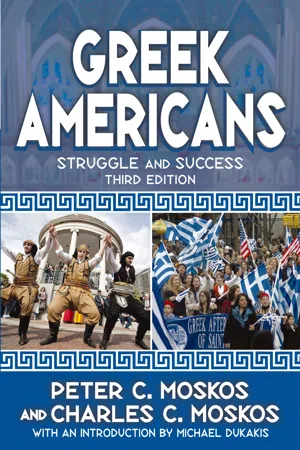
This is an engrossing account of Greek Americans their history, strengths, conflicts, aspirations, and contributions. Blending sociological insight with historical detail, Peter C. and Charles C. Moskos trace the Greek-American experience from the wave of mass immigration in the early 1900s to today. This is the story of immigrants, most of whom worked hard to secure middle-class status. It is also the story of their children and grandchildren, many of whom maintain an attachment to Greek ethnic identity even as they have become one of America's most successful ethnic groups.As the authors rightly note, the true measure of Greek-Americans is the immigrants themselves who came to America without knowing the language and without education. They raised solid families in the new country and shouldered responsibilities for those in the old. They laid the basis for an enduring Greek-American community.Included in this completely revised edition is an introduction by Michael Dukakis and chapters relating to the early struggles of Greeks in America, the Greek Orthodox Church, success in America, and the survival and expansion of Greek identity despite intermarriage. This work will be of value to scholars of ethnic studies, those interested in Greek culture and communities, and sociologists and historians.
Information
1
Early Struggles: The Greek Comes to America
The first Greek to set foot on these shores was Christopher Columbus. Such at least is the belief of many Greek immigrants in America. Columbus’s purported Greek lineage was to be given credence in a full-length treatise—Christopher Columbus: A Greek Nobleman—by Seraphim G. Canoutas, a major figure in Greek American letters during the early years of the twentieth century.1 Canoutas, himself an immigrant, devoted the last years of his life to prove that Columbus was a member of a distinguished Greek family that had gone to Italy from Byzantium. Whatever the ancestry of the Great Discoverer—and one is obliged to admit that Columbus’s Greek background is not accepted by non-Greek historians—the belief in his Greekness does reveal two enduring qualities of Greek immigrants: their overweening pride in their Hellenic background, and their striving to assert some psychic precedence over the dominant groups in American society.
The Greek experience in the United States has been a blend of ethnic pride and resourceful contribution to and participation in American society. In the early years of massive Greek influx, mostly between 1890 and 1920, the Greek experience was a story of immigrant men from Greece and the Ottoman Empire who suffered incredible hardships in the United States. But these Greeks, most of them at least, managed to become secure members of the American middle class. The Greek experience is also the story of later waves of immigrants from Greece in the 1960s and 1970s, more educated and Western than their com-patriot predecessors, that however kept the Hellenic flame burning bright in the United States.
This is also the story of the children, grandchildren, and great grandchildren of these immigrants in the twenty-first century. These Greek Americans have enjoyed levels of education and income surpassing the American average; and many of them have been outstandingly successful in the country of their birth. But as migration of Greeks to the United States has slowed to a trickle (and perhaps even reversed, notwithstanding a recent uptick), the future of Greek America remains precarious. Assimilation, intermarriage, and increased secularization contribute to a Greek American identity far more American than Greek. At the same time, the otherness of Greek American life has been destigmatized by prominent Greek names and the adaptation of Greek cultural and culinary life into the American mainstream. Ethnicity among Greek Americans has become much more symbolic than irrefutable. On the other hand the number of Americans claiming Greek ancestry has grown substantially over the past three decades— far more than demographic trends would predict—indicating that the Greek American experience has successfully shifted from a culture of immigrants to the contributions of fully assimilated Greek Americans. The most recent data, however, indicate that voluntary Greek American identity may have peaked in 2009, perhaps related to the recent economic crisis and unrest in Greece.
The Greek experience in the United States also had a darker side: immigrants whose lives drained away in poverty and loneliness after serving the demands of an expanding industrial economy; exploitation of Greek by Greek; conflicts across generations; and misunderstandings between older and newer immigrants. Yet in its broad outlines, the sociological and historical portrait of what are today more than 1.2 million Americans of Greek descent is one of an ethnic group that has maintained a remarkable degree of communal and family cohesion while also accommodating itself to and succeeding in larger society. This self-congratulatory best-of-both-worlds adaptation from a relatively small group—there are more Welsh Americans than Greek Americans, for example—that has had a disproportionately large impact on American life may well be the distinguishing quality of Greek Americans.
The Eighteenth Century: Beginnings and False Starts
Leaving aside the possibility that Columbus descended from Byzantine nobility, one may ask: Who was the first Greek to arrive in America? This distinction goes to Don Teodoro or Theodoros, a sailor and ship caulker serving aboard the expedition of the Spanish explorer Pánfilo de Narváez. In October 1528, Narváez anchored off what is now Pensacola, Florida, to secure fresh water. An agreement was reached with the Indians on the land who, however, insisted on keeping a hostage while the water was to be procured. Don Teodoro volunteered himself as the hostage, went ashore, and never returned. Presumably he was killed by the Indians. The life of the first known Greek to set foot on what is now American soil ended tragically.2
Two centuries later, Greeks again tried to colonize Florida. This involved a trans-Atlantic odyssey that started with high hopes and was to end in privation and misery. The story of the ill-fated New Smyrna colony began in 1763, when Florida passed from Spanish into British hands.3 Several influential people in Great Britain became intrigued with the idea of establishing plantations in the newly acquired territory by bringing in Greek settlers. Among these was Andrew Turnbull, a Scottish doctor, who was married to Maria Gracia Rubini, the daughter of a Greek merchant in London. Maria Rubini had been born in Smyrna, Asia Minor (present-day Izmir, Turkey). Turnbull secured a royal grant of twenty thousand acres (eventually to grow into a land area of more than one hundred thousand acres) about seventy-five miles south of St. Augustine, Florida. He named this land New Smyrna to honor the birthplace of his wife.
Funded by a generous subsidy from the Board of Trade in London, Turnbull sailed to the Mediterranean in April 1767 to recruit his colonists. These were to be indentured laborers, the terms of whose contracts specified that after completion of their service—between five and eight years—they would acquire a certain amount of land in their own right. Turnbull first stopped at the island of Minorca to arrange an assembly point for his settlers. There he found willing volunteers for his venture, Italians from nearby Leghorn as well as Minorcans. By the following year, Turnbull had recruited a total of 1,403 people for his Florida colony, about 400 to 500 of whom were Greeks—principally from the Mani peninsula on the southernmost tip of the Peloponnese, which was then still part of the Ottoman Empire. Turnbull and the colonists left for Florida with eight ships. The first ship arrived at St. Augustine on June 26, 1768, and the others caught up soon afterward. From St. Augustine the colonists continued southward to the site of New Smyrna. A contemporary report stated this to be the “largest importation of white inhabitants that was ever brought into America at a time.”4
The conditions the settlers confronted were dire. More than half of the colonists died within two years of their arrival. Not only was food scarce, but the New Smyrna colonists were put to brutally heavy labor to clear the wilderness under the supervision of former noncommissioned officers of the British army. Flogging was common. On August 19, 1768, the colony exploded in revolt. A riot started, overseers were attacked, and a ship was seized and readied to set sail for Havana and freedom. A British frigate was quickly dispatched and prevented the colonists’ escape. A detachment of soldiers landed and suppressed the rebellion.
Three of the leaders of the rebellion—two Italians and a Greek from Corsica, Elia Medici—were sentenced to death. The court however, in what seems to have been an obvious attempt to create divisiveness among the colonists, promised the Greek his life on condition that he execute the two Italians personally. A Dutch surveyor who witnessed the event wrote the following description:
On this occasion I saw one of the most moving scenes I ever experienced. Long and obstinate was the struggle of this man’s mind, who repeatedly called out that he chose to die rather than to be executioner of his friends in distress. This not a little perplexed Mr. Woolridge, the sheriff, till at last the entreaties of the victims themselves put an end to the conflict in his heart by encouraging him to act. Now we beheld a man, thus compelled to mount the ladder, take leave of his friends in the most moving manner, kissing them the moment before he committed them to an ignominious death.5
After the suppression of the rebellion, the colony resumed working operations. But things were going badly for the landowners. When colonists applied for discharges after serving their work time, they were turned down and a few were thrown into confinement. Finally, in the late spring of 1777, the several hundred surviving colonists simply picked up and moved to St. Augustine. Because of their repeated petitions seeking freedom, the conditions of the colonists had become an open scandal within British circles. The British courts formally freed the colonists from their indenture on July 17, 1777. By that time New Smyrna had already been abandoned.
The Greek remnant from New Smyrna—probably around one hundred residents—found new life in St. Augustine. A census in 1783 reports that most of the Greeks in St. Augustine were prospering. Some had established themselves as merchants, and a few even owned slaves. John Giannopoulos left a deep imprint in the educational history of St. Augustine by establishing a school in his house. Now restored, it stands as the oldest school building in the United States.
Without their own Greek Orthodox priest, the Greek settlers of New Smyrna took refuge in the Roman Catholic Church, a practice that continued in St. Augustine. With Catholic forbearance a small Greek chapel was established in St. Augustine in November 1777, where Greeks could pray with their own rights. Almost two hundred years later this building was designated the St. Photios Greek Orthodox Shrine by the Greek Orthodox Church to commemorate the trials of the first Greeks who came to this country. These first Greeks in the New World all but disappeared by the middle of the nineteenth century. Some Greeks left Florida for other places; the majority were absorbed into the general population. During the nine years of New Smyrna’s existence, Greek intermarriage with fellow Minorcan and Italian colonists had already become the rule.
Other firsts in early Greek American history can be noted.6 Records show that a Greek, Michael Dry (Youris), became a naturalized citizen by act of the General Assembly of Maryland in 1725.7 This makes Dry the first Greek positively known to reside permanently in what is today the United States. The first noted Greek American scholar was John Paradise.8 He was persuaded to come to this country by Benjamin Franklin and Thomas Jefferson, whom he met in Europe. Paradise married into the Ludwell family, one of Virginia’s most distinguished, in 1787. (The Ludwell-Paradise home was the first to be restored in Williamsburg, Virginia.) Coming to America by the back door, so to speak, of the Bering Strait, was Eustrate Delarof, a native of the Peloponnesus.9 From 1783 until 1791, Delarof was in charge of all Russian trading operations in the Aleutians and Alaska and is considered by some reckoning to have been the first de facto governor of Alaska.
The first known marriage between Greeks in America occurred in 1799 New Orleans, then under Spanish control. Andrea Dimitry, a native of the Greek island of Hydra, married Marianne Celeste Dracos, the daughter of Michael Dracos, a well-to-do merchant who had come to New Orleans from Athens around 1766. Marianne Celeste—with indisputable Greek lineage from her father’s side (her mother was of mixed French Acadian and American Indian ancestry)—was born in Louisiana on March 1, 1777, thus qualifying her as the Greek Virginia Dare (the first child born in the Americas to English parents). The children and grandchildren of Andrea and Marianne Dimitry were leading professionals and business figures in the antebellum South. One of their sons, Alexander, became the first superintendent of education in the...
Table of contents
- Cover Page
- Half title
- Title Page
- Copyright Page
- Contents
- Illustrations
- Foreword by Michael Dukakis
- Preface to the Third Edition by Peter C. Moskos
- Preface to the Second Edition by Charles C. Moskos
- Acknowledgments
- 1 Early Struggles: The Greek Comes to America
- 2 From Brawn to Brains
- 3 The Greek Orthodox Church in the New Secular World
- 4 Greek American Ideology and Politics
- 5 Success in America
- 6 Maintaining a Greek American Identity—Present and Future
- Afterword Becoming Greek American: A Family and Personal Memoir
- Bibliography
- Index
Trusted by 375,005 students
Access to over 1.5 million titles for a fair monthly price.
Study more efficiently using our study tools.
Frequently asked questions
Yes, you can cancel anytime from the Subscription tab in your account settings on the Perlego website. Your subscription will stay active until the end of your current billing period. Learn how to cancel your subscription
No, books cannot be downloaded as external files, such as PDFs, for use outside of Perlego. However, you can download books within the Perlego app for offline reading on mobile or tablet. Learn how to download books offline
Perlego offers two plans: Essential and Complete
- Essential is ideal for learners and professionals who enjoy exploring a wide range of subjects. Access the Essential Library with 800,000+ trusted titles and best-sellers across business, personal growth, and the humanities. Includes unlimited reading time and Standard Read Aloud voice.
- Complete: Perfect for advanced learners and researchers needing full, unrestricted access. Unlock 1.5M+ books across hundreds of subjects, including academic and specialized titles. The Complete Plan also includes advanced features like Premium Read Aloud and Research Assistant.
We are an online textbook subscription service, where you can get access to an entire online library for less than the price of a single book per month. With over 1.5 million books across 990+ topics, we’ve got you covered! Learn about our mission
Look out for the read-aloud symbol on your next book to see if you can listen to it. The read-aloud tool reads text aloud for you, highlighting the text as it is being read. You can pause it, speed it up and slow it down. Learn more about Read Aloud
Yes! You can use the Perlego app on both iOS and Android devices to read anytime, anywhere — even offline. Perfect for commutes or when you’re on the go.
Please note we cannot support devices running on iOS 13 and Android 7 or earlier. Learn more about using the app
Please note we cannot support devices running on iOS 13 and Android 7 or earlier. Learn more about using the app
Yes, you can access Greek Americans by Peter C. Moskos,Peter Moskos in PDF and/or ePUB format, as well as other popular books in Social Sciences & Social History. We have over 1.5 million books available in our catalogue for you to explore.