eBook - ePub
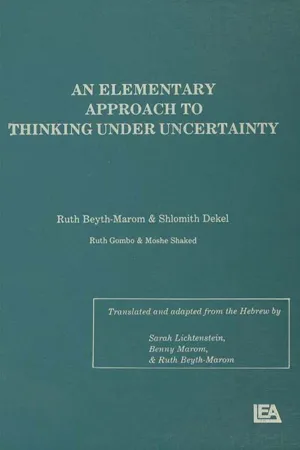
An Elementary Approach To Thinking Under Uncertainty
- 154 pages
- English
- ePUB (mobile friendly)
- Available on iOS & Android
eBook - ePub
An Elementary Approach To Thinking Under Uncertainty
About this book
Published in the year 1985, An Elementary Approach To Thinking Under Uncertainty is a valuable contribution to the field of Cognitive Psychology.
Information
I A GENERAL FRAMEWORK
1 Certainty and Uncertainty
1.1 FEELINGS OF CERTAINTY AND UNCERTAINTY
We often hear, as part of the answer to a question, phrases like “I'm sure that…,” “I've no doubt that…,” or “I'm positive that.…” People using these phrases really believe that they have the answer to the question and feel no doubt in its truthfulness.
—Question: What are you doing right now?Answer: I am reading.Nobody would ask, “Are you sure about that?”—Question: David, what gender are you?Answer: I'm sure I'm a man.—Question: Elizabeth, what will you do this afternoon?Answer: No doubt about it, I'll go to the movies.—Question: John, whose picture is that?Answer: I'm confident that's my sister.—Question: Dan, what kind of sandwich did you eat for lunch today?Answer: I know for certain I had a cheese sandwich.
In all these examples, the question asked relates to a fact or to an event in the past, present, or future. The person answering feels very certain, very confident, with no doubt at all. David is sure; Elizabeth has no doubt; John is confident; and Dan knows for certain.
We experience certainty about a specific question when we have a feeling of complete belief or complete confidence in a single answer to the question.
Certainty feelings originate from the confidence we have in our knowledge, in the experiences we have accumulated through the years (Dan has seen and tasted cheese many times and he knows what it looks like and how it tastes), and in the confidence we have in the functioning of our senses (Dan relied on his eyesight and taste).
This confidence may sometimes fail us. Elizabeth, who is so sure what her plans are for the afternoon, may find such a long line at the theater that she has no chance to get in. She just didn't think about such a possibility beforehand.
Knowledge and experience generally fail us when we face radically new developments. Until the 15th century, people were certain that the sun revolved around the earth. But some of those who heard of Copernicus's new ideas about planetary motion replaced their previous certainty with doubt.
Our senses can also fail us. Have you ever sat in a standing train as another train began to move? Sometimes you get the strong sensation that it is your own train that is moving. Only after the moving train has passed your window do you realize that your train is still standing in the same place. Novice mountain climbers often misjudge the summit, believing they are on the final approach when in fact they are still far away. As with our experiences, we cannot always rely on our senses. They can fail us in many situations.
In spite of these occasional failures, we do rely on our senses and the knowledge and experience that we have accumulated, because most of the time, they work. Moreover, if we had to make the effort to think about each step we take each time we take it, we wouldn't be able to function at all. Should we stop eating just because there is a small chance that the food in front of us is not the food we think it is? We prefer assuming that our knowledge and our senses are good enough.
In contrast to the feelings of certainty we experience with some questions, there are other questions that lead us to feel uncertain.
Will it rain next Saturday?Are there intelligent creatures in outer space?Will the strike be settled within a week?Where have I met this person before?How many traffic accidents were there last year?
Concerning such questions, some of us, and sometimes all of us, feel uncertainty. To some questions, we can't offer even one plausible answer. Who ruled Italy in 1563? Most people will be unable to suggest even one possible answer.
For other questions, many answers come to mind; some seem more suitable than others, but we do not feel completely confident about any one answer. How many members are there in the U.S. House of Representatives? I think it may be 435, but it might be 235, or 436, and so on. My confidence is spread over a large number of possible answers.
Consider an archeologist digging a site in the Great Plains of North America who wants to determine the date at which people lived at the site. While digging, she finds a leaf-shaped flint implement that she uses as a clue for deciding about the date of the site. She knows that such flints are prehistoric. Furthermore, its shape rules out some periods in prehistory but leaves two possibilities: (1) the present implement is most typical of the “Clovis” type of projectile point, which was used between 9000 and 8000 B.C.; therefore, it is highly probable that the site dates to that period. (2) However, the point has some characteristics of the “Folsom” type, which was in use later, between 8000 and 7000 B.C.; thus, it may be from that period. Moreover, such prehistoric points are highly valued by collectors and a ready market for modern fakes has developed. This point might be a fake. Thus, (3) perhaps the site is modern.
The archeologist is sure that these three possibilities cover the range of possibilities. Other possibilities do not seem plausible. She has three possible answers to the question. She feels a partial belief in each of the three answers. This partial belief is expressed in the words “highly probable,” “may be,” and “perhaps.” At that moment, there is no one answer about which she feels complete confidence. Therefore, we say that the archeologist feels uncertain about the question “How old is the site?”
To summarize: We experience uncertainty concerning a specific question when we have a partial belief in each of a number of possible answers to the question.
But what about when we can't think of even one plausible answer to a question, as in the example of the ruler of Italy in 1563? Although we don't have a partial belief in a number of answers (because we can't think of any answers), we do feel uncertainty. If someone were to present us with a number of possible answers, we wouldn't feel complete confidence in any of them. In order to include this last case, in which we can't think of even one answer, in the definition of uncertainty, we define the feeling of uncertainty negatively:
We experience uncertainty about a specific question when we can't give a single answer with complete confidence.
Exercises for Section 1.1
1. Sometimes in hindsight, we find out that our certainty feelings were not justified. Think about ways in which one's certainty feelings could be unjustified, for each of the following situations:
(a) I attended a concert yesterday.(b) I've been here before.(c) The store I'm looking for is right around the corner.(d) My watch indicates that it's eight o'clock.(e) It is now eight p.m.(f) I am standing in front of my house.(g) I will write a letter after the guests leave.
2. Think of at least three times when you were sure about something, but turned out to be wrong.
1.2 CHARACTERISTICS OF UNCERTAINTY FEELINGS
Personal and general uncertainty. There are some questions for which we feel that uncertainty is currently unavoidable. These are questions towards which we feel that nobody now knows the right answer.
Is there any sort of life on other stars?Is there a monster in Lake Ness in Scotland?I am about to toss a coin. Will it come up heads or tails?How did Shubert intend to finish his “Unfinished Symphony”?
For some of these questions, we expect that a certain answer will be known in the future. As soon as I toss the coin, I'll know whether it came up heads or tails. Other questions may be unresolved forever. Since Shubert died before he finished his last symphony (and left no notes), we'll never know his intentions for it.
In contrast to questions about which uncertainty feelings are unavoidable, there are questions that, in principle, somebody can answer with certainty. In which hand am I hiding a coin? You feel uncertainty but I don't. I'm not sure how many Representatives there are in Congress, but I recognize that other people know the answer with certainty.
When a person feels that, in principle, there is now no certain answer to a question, then that person feels general uncertainty.
When a person feels uncertainty concerning the question but realizes that, in principle, one could feel certainty, that person feels personal uncertainty.
Sometimes we may be more comfortable with general uncertainty, because we can't blame it on our own ignorance. On the other hand, with personal uncertainty we have the hope that we can resolve the uncertainty by consulting a more knowledgeable source.
Amounts of uncertainty. Paul was asked, “What is the longest river in the U.S.? He answered with complete confidence, “the Mississippi.”1 Next he was asked, “What is the longest river in the world?” This time, he felt uncertain. He was then given a hint: The answer is one of the four rivers: Mississippi, Yangtze, Amazon, or Nile.2 Let us now consider four possible states of mind Paul might be in after receiving the hint.
A. Paul thinks all the answers are equally likely.
B. Now that Paul sees the ...
Table of contents
- Cover
- Half Title
- Full Title
- Copyright
- Contents
- Preface
- Introduction
- I. A GENERAL FRAMEWORK
- II. SOME TOOLS
- III. PROBABILITY ASSESSMENT
- Bibliography and Background Reading
- Subject Index
Trusted by 375,005 students
Access to over 1.5 million titles for a fair monthly price.
Study more efficiently using our study tools.
Frequently asked questions
Yes, you can cancel anytime from the Subscription tab in your account settings on the Perlego website. Your subscription will stay active until the end of your current billing period. Learn how to cancel your subscription
No, books cannot be downloaded as external files, such as PDFs, for use outside of Perlego. However, you can download books within the Perlego app for offline reading on mobile or tablet. Learn how to download books offline
Perlego offers two plans: Essential and Complete
- Essential is ideal for learners and professionals who enjoy exploring a wide range of subjects. Access the Essential Library with 800,000+ trusted titles and best-sellers across business, personal growth, and the humanities. Includes unlimited reading time and Standard Read Aloud voice.
- Complete: Perfect for advanced learners and researchers needing full, unrestricted access. Unlock 1.5M+ books across hundreds of subjects, including academic and specialized titles. The Complete Plan also includes advanced features like Premium Read Aloud and Research Assistant.
We are an online textbook subscription service, where you can get access to an entire online library for less than the price of a single book per month. With over 1.5 million books across 990+ topics, we’ve got you covered! Learn about our mission
Look out for the read-aloud symbol on your next book to see if you can listen to it. The read-aloud tool reads text aloud for you, highlighting the text as it is being read. You can pause it, speed it up and slow it down. Learn more about Read Aloud
Yes! You can use the Perlego app on both iOS and Android devices to read anytime, anywhere — even offline. Perfect for commutes or when you’re on the go.
Please note we cannot support devices running on iOS 13 and Android 7 or earlier. Learn more about using the app
Please note we cannot support devices running on iOS 13 and Android 7 or earlier. Learn more about using the app
Yes, you can access An Elementary Approach To Thinking Under Uncertainty by Ruth Beyth-Marom,Shlomith Dekel,Ruth Gombo,Moshe Shaked, Sarah Lichtenstein in PDF and/or ePUB format, as well as other popular books in Pedagogía & Educación general. We have over 1.5 million books available in our catalogue for you to explore.