eBook - ePub
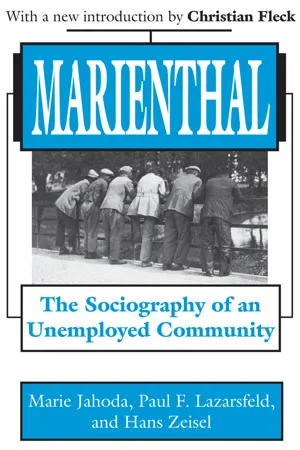
Marienthal
The Sociography of an Unemployed Community
- 176 pages
- English
- ePUB (mobile friendly)
- Available on iOS & Android
eBook - ePub
About this book
"One of the main theses of the Marienthal study was that prolonged unemployment leads to a state of apathy in which the victims do not utilize any longer even the few opportunities left to them. The vicious cycle between reduced opportunities and reduced level of aspiration has remained the focus of all subsequent discussions." So begin the opening remarks to the English-language edition of what has become a major classic in the literature of social stratification.
Information
CHAPTER 1
Introduction
HOW MUCH DO WE KNOW about the effects of unemployment? There are some statistics available on the extent of unemployment and the amount of relief provided; occasionally these data are given in some detail by age, sex, occupation, and local conditions. There is also a literature on social problems: newspapermen and other writers have most effectively portrayed the life of the unemployed, bringing home their condition through example and description to those as yet unaffected. But there is a gap between the bare figures of official statistics and the literary accounts, open as they invariably are to all kinds of accidental impressions. The purpose of our study of the Austrian village, Marienthal, is to bridge this gap.
Our idea was to find procedures which would combine the use of numerical data with immersion (sich einlcben) into the situation. To this end it was necessary to gain such close contact with the population of Marienthal that we could learn the smallest details of their daily life. At the same time we had to perceive each day so that it was possible to reconstruct it objectively; finally, a structure had to be developed for the whole that would allow all the details to be seen as expressions of a minimum number of basic syndromes.
As this report proceeds, it will become clear how we have tried to build up a comprehensive picture of life in Marienthal, while at the same time accommodating complex psychological situations within, an objective framework that is supported by relevant statistics. Every path that could bring us closer to our objective was explored. The testimony of the unemployed themselves brought us face to face with the living experience of unemployment: their casual remarks, their detailed response to our questions, the accounts of local officials, the diaries and letters that we came across by chance. We found some of the data already in usable form: the records of the Co-operative Store, of the various clubs, and of City Hall. For the most part, however, we ourselves had to collect the needed data in the form of meal records, time sheets, and observations of many kinds.
In the end, the detailed data were arranged so as to fit the overall impressions we had gained during our stay in Marienthal and our subsequent study of the accumulated data. We tried to reduce the subjective element that is inherent in any description of social phenomena to a minimum by discarding all impressions for which we had no objective support. In this fashion, our basic insights into the effects of unemployment eventually emerged: a diminution of expectation and activity, a disrupted sense of time, and a steady decline into apathy through a variety of stages and attitudes. It is around this thesis that we have grouped both the characteristic main results as well as occasional deviating details.
Our approach was not meant to deal with the problem of unemployment in its entirety. The object of this investigation was the unemployed community, not the unemployed individual. Character traits were given little attention, the whole field of psychopathology was omitted, and only where definite causal links could be traced between past and present did our study touch upon the case history of individuals. Nor will one find broad generalizations. Our concern was the unemployed manual laborer in a particular industry, in a particular village, at a particular time of the year. Such an investigation of a particular community has both its advantages and disadvantages.
We want to draw special attention to one limitation of our study because it led to interesting consequences. We were dealing with a community that was totally unemployed. In the absence of comparable studies of partially unemployed communities, it cannot be said with certainty to what extent the unemployed individual in the midst of an otherwise working community—say, in a big town—differs from the unemployed individual who lives in a place where everybody is out of work. However, a careful examination of our data leads to this conclusion: In Marienthal we found no extreme symptoms of mass neurosis, such as have been observed among German vagrants. This might suggest that for various reasons a closed rural community finds it easier to keep functioning over an extended period of time.
On the other hand, the more subtle psychological effects arising from idleness and the hopelessness of the situation were brought home to us, as it were, magnified and in slow motion. This research advantage clearly emerged from interviews and discussions with those concerned with the problem of unemployment, such as social workers, officials, and politicians. A casual observer is apt to see only what is most conspicuous, namely the occasional revolutionary effects of unemployment, or particularly heartrending outbreaks of despair. Our detailed inquiry has led us to see more clearly the paralyzing effects of unemployment, an aspect that might easily elude less systematic observation. Once perceived, however, evidence of these effects found ample support in the experience of the social workers. We repeatedly observed that when we reported our findings, they at first met with a certain degree of hostility but eventually led even the experts to reassess the facts as they had first seen them.
In order to relieve the report itself of its methodological burden, we now give a resume of the kind of data eventually at our disposal and the means by which they were obtained:
Family Files: A lengthy record was compiled for each of the 478 families of Marienthal. Each member had a separate file with his personal data, form of unemployment relief, etc. The file also contained all information relating to housing conditions, family life, domestic arrangements, and so forth. In addition, one family diary was kept for us.
Life Histories: We recorded detailed life histories of thirty-two men and thirty women. The importance of these histories lies primarily in their coverage of the individual's entire life. When these people came to speak of the period of unemployment, their narrative was already under way. They found it, therefore, easier to give expression to the experience of being unemployed, since by then they had reported on that part of their life that offered a basis for comparison. Had we inquired directly about their present condition the result would probably have been embarrassed silence or empty phrases.
Time Sheets: Eighty persons filled out a questionnaire outlining the way they spent their time during a given day.
Reports and Complaints: We studied those made over the past few years to the Industrial Commission of the district of Wiener Neustadt, of which Marienthal is a part.
School Essays: Some primary and secondary school children wrote on the subjects: "What I want most of all," "What I want to be," "What I want for Christmas."
A Prize Essay Competition: Some adolescents wrote on the subject: "How I see my future."
Meal Records: Forty families kept records of their meals for one week; records were also kept of the school children's packed lunches on the day before and the day after relief money was paid.
Miscellaneous Reports: We collected reports on the Christmas presents received by eighty small children; conversation topics and activities in public bars; parents' problems in bringing up their children (from the notes taken in the doctor's consulting room); medical tests; information from teachers on the performance of their pupils; general welfare work undertaken by welfare authorities, the factory, the parish priest, etc; the money spent at the tavern, the barber, the butcher, the horsemeat butcher, the shoemaker, the tailor, the confectioner; and reports from the various political clubs and other organizations.
Statistical Data: These consisted of the account hooks of the Co-operative Store; loans from the public library; subscriptions to various newspapers; membership figures of clubs; election results; age distribution, births, deaths, marriages, and migration figures.
Housekeeping Statistics: An official from the Chamber of Commerce came to Marienthal for the special purpose of collecting household statistics, but because of technical difficulties he was able to obtain them only for a few families.
To obtain all this data was not enough. If we were to succeed we had to adopt a very special approach: we made it a consistent point of policy that none of our researchers should be in Marienthal as a mere reporter or outside observer. Everyone was to fit naturally into the communal life by participating in some activity generally useful to the community. This proved most difficult in the case of the researcher who actually lived in Marienthal. However, even this problem was solved surprisingly well with the help of all kinds of special projects we launched, such as the following:
Clothing Project: Through private collections in Vienna we managed to procure some two hundred pieces of clothing, After being cleaned and repaired, they were distributed to the population by our research team in cooperation with the official Winter Aid of the Grammat-Neusiedi district. Since children's shoes and warm socks were in particular demand, we supplemented the collection with purchases of some new socks and shoes from our own funds. Previously, one of our researchers had visited one hundred families and asked which pieces of clothing were most urgently needed. These visits gave us unobtrusive access to the home, and enabled us to ascertain the particular needs of the family and discover which member received special attention.
While issuing the clothes we made detailed records of the behavior of the recipients, their reactions to this kind of assistance in particular and to their own predicament in general. Finally, contact with the population was facilitated by Dr. Lotte Danziger's preparatory work in connection with the clothing project; she inspired the confidence to which we owe the copious biographical material the workers confided to us.
Our other projects worked in much the same way. We have listed them below, indicating the information they helped to collect. The members of our research team were active in various functions; their reports appear throughout the study in their original form as they had been received from the inhabitants of Marienthal.
Political Activity: We knew that the active elements of the population were politically organized and, consequently, we sought to establish political contact with them. Since all shades of political opinion were represented in our research team, we were allowed access to practically all organizations. This ubiquity made it possible for us to check the numerous criticisms of local conditions that reached us from different quarters.
Pattern Design Course: Twice a week for two months we gave a course in pattern design. It was open to everyone and in fact some fifty women attended. The significance of the course lay in the fact that it satisfied the desire common to all unemployed for some kind of activity, and that during these sessions we learned much about the attitude of the people of Marienthal toward the idleness to which unemployment had condemned them. We obtained the relevant data in the following manner: during the course we told the women we intended to arrange similar courses elsewhere and asked each participant what exactly she had gained from the sessions and what suggestions she had for improving the course, in case it were to be repeated. The course was so popular that eventually it was decided to extend it beyond its original schedule.
Medical Treatment: Each Saturday afternoon two women doctors—one obstetrician and one pediatrician— gave free medical consultation. In urgent cases they also provided free drugs and medicines. Notes were kept of the conversations in the examination room. These medical consultations provided our best opportunity to learn about the medical and economic circumstances of a family, since the very success of the examinations depended on the patient's truthful reporting. Here we also had an opportunity to check on some of the statements made to the welfare worker, which were at times not quite truthful.
Girls Gymnastics Course: In order to establish contact with the young girls, we arranged a gymnastics course, As most of the boys were active in one organization or other, we could gradually reach the majority of the male adolescents through these organizations. The girls had stopped belonging to any organization since unemployment began, and reaching them was more difficult. Eventually, the gymnastics course proved a way of stimulating their interest and bringing them into contact with one of our female researchers.
Parent Guidance: Partly in connection with the medical examinations, partly after lectures, we gave the mothers an opportunity to come to us with the problems they encountered in bringing up their children. Occasionally they took advantage of this opportunity to consult us on other domestic problems as well.
Finally, we reproduce here part of the instructions with which we briefed our research team, to provide them with guide lines for planning their work.
MAIN QUESTIONS OF OUR STUDY
A. Attitude toward unemployment
What was the first reaction to unemployment?
What efforts has the man made to find work?
Who has found work outside the district, and by what means?
What work has been substituted for previous employment (e.g., rabbit breeding, farm work, etc.)?
What is the attitude to temporary employment and particularly to the possibility of emigration?
What are the types and phases of attitudes?
What plans do people still have? Are there differences between adults and adolescents?
What are the differences between those at work and those out of work?
What are the attitudes toward the Assistance Board?
What "superfluous" activities are still pursued?
B. Effects of unemployment
What are the effects on the physical condition of the population?
What are the effects on the children's performance at school?
What are the effects on criminality?
Are the older or the younger children more affected by their parents' unemployment?
Where work has been resumed, have any difficulties emerged?
Have political differences increased or decreased?
Have attitudes toward religion changed?
Is there a general shift of interests?
What changes have appeared in people's sense of time?
Have the relationships of people toward each other changed?
Is there more evidence of competition or of co-operation?
Are there changes within the family?
Preliminary work and discussions began in the autumn of 1931. Dr. Danziger lived in Marienthal from the beginning of December 1931 until the middle of January 1932. M...
Table of contents
- Cover
- Half Title
- Title
- Copyright
- Contents
- INTRODUCTION TO THE TRANSACTION EDITION
- FOREWORD TO THE AMERICAN EDITION Forty Years Later
- 1. Introduction
- 2. The Industrial Village
- 3. The Living Standard
- 4. Menus and Budgets
- 5. A Weary Community
- 6. Response to Deprivation
- 7. The Meaning of Time
- 8. Fading Resilience
- AFTERWORD Toward a History of Sociography
- Index
Trusted by 375,005 students
Access to over 1.5 million titles for a fair monthly price.
Study more efficiently using our study tools.
Frequently asked questions
Yes, you can cancel anytime from the Subscription tab in your account settings on the Perlego website. Your subscription will stay active until the end of your current billing period. Learn how to cancel your subscription
No, books cannot be downloaded as external files, such as PDFs, for use outside of Perlego. However, you can download books within the Perlego app for offline reading on mobile or tablet. Learn how to download books offline
Perlego offers two plans: Essential and Complete
- Essential is ideal for learners and professionals who enjoy exploring a wide range of subjects. Access the Essential Library with 800,000+ trusted titles and best-sellers across business, personal growth, and the humanities. Includes unlimited reading time and Standard Read Aloud voice.
- Complete: Perfect for advanced learners and researchers needing full, unrestricted access. Unlock 1.5M+ books across hundreds of subjects, including academic and specialized titles. The Complete Plan also includes advanced features like Premium Read Aloud and Research Assistant.
We are an online textbook subscription service, where you can get access to an entire online library for less than the price of a single book per month. With over 1.5 million books across 990+ topics, we’ve got you covered! Learn about our mission
Look out for the read-aloud symbol on your next book to see if you can listen to it. The read-aloud tool reads text aloud for you, highlighting the text as it is being read. You can pause it, speed it up and slow it down. Learn more about Read Aloud
Yes! You can use the Perlego app on both iOS and Android devices to read anytime, anywhere — even offline. Perfect for commutes or when you’re on the go.
Please note we cannot support devices running on iOS 13 and Android 7 or earlier. Learn more about using the app
Please note we cannot support devices running on iOS 13 and Android 7 or earlier. Learn more about using the app
Yes, you can access Marienthal by Marie Jahoda,Paul F. Lazarsfeld,Hans Zeisel in PDF and/or ePUB format, as well as other popular books in Social Sciences & Social Classes & Economic Disparity. We have over 1.5 million books available in our catalogue for you to explore.