- 184 pages
- English
- ePUB (mobile friendly)
- Available on iOS & Android
eBook - ePub
About this book
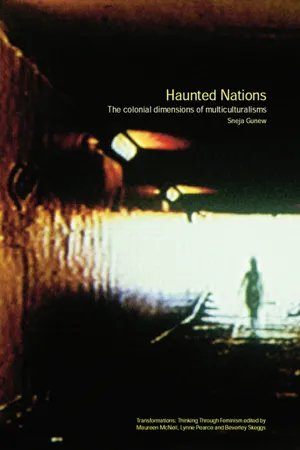
Postcolonialism has attracted a large amount of interest in cultural theory, but the adjacent area of multiculturalism has not been scrutinised to quite the same extent. In this innovative new book, Sneja Gunew sets out to interrogate the ways in which the transnational discourse of multiculturalism may be related to the politics of race and indigeneity, grounding her discussion in a variety of national settings and a variety of literary, autobiographical and theoretical texts. Using examples from marginal sites - the "settler societies" of Australia and Canada - to cast light on the globally dominant discourses of the US and the UK, Gunew analyses the political ambiguities and the pitfalls involved in a discourse of multiculturalism haunted by the opposing spectres of anarchy and assimilation.
Information
1 The terms of (multi)cultural difference
The relationship between multiculturalism and postcolonialism is an uneasy one. Multiculturalism deals with theories of difference but unlike post-colonialism, which to a great extent is perceived to be defined retroactively by specific historic legacies, multiculturalism deals with the often compromised management of contemporary geopolitical diversity in former imperial centres as well as in their ex-colonies. It is also increasingly a global discourse since it takes into account the dynamics of diasporas and their relations with nation states and other entities (such as transnational corporations), and the flow of migrants and refugees. The reason for continuing to focus on critical multiculturalism is precisely because multiculturalism is so intimately bound up in many parts of the world with those practices and discourses which manage (often in the sense of police and control) ‘diversity’. Within critical theory it was an embarrassing term to invoke partly because it was perceived as automatically aligned with and hopelessly co–opted by the state in its role of certain types of exclusionary nation building. As a result, for example, it was consistently rejected by anti-racist groups in Great Britain (Hall 1995). In theoretical debates it was often associated with an identity politics based on essentialism and claims for authenticity which automatically reinstate a version of the sovereign subject and a concern with reified notions of origins. Thus it became difficult to mention multiculturalism and socially progressive critical theory in the same breath. But because it is a contested term it is crucial to continue to scrutinize the discourses and practices mobilized in the name of multiculturalism. This chapter will briefly consider some of the different interpretations of multiculturalism in various parts of the world and will then consider the ambiguous function of the key terms ‘race’ and ‘ethnicity’ within its deployment. Consideration for the most part will be given to debates within Australia, Canada, the United States, and the United Kingdom.
Multiculturalism means different things in different contexts and in Canada, the United States and the United Kingdom, the term is intertwined with questions of racialized differences that have so far not been given sufficient prominence, for example, in Australia. While there have always been migrations and disaporas, after two world wars and many other conflicts last century, the mix of people within borders increasingly rendered traditional national models anachronistic. Multiculturalism has been developed as a concept by nations and other aspirants to geopolitical cohesiveness who are trying to represent themselves as transcendently homogeneous in spite of their heterogeneity. For cultural analysts the politics of representation are at its heart while for sociologists the specificities of legislation, public policies and their often arbitrary implementation are major concerns. Multiculturalism may also be invoked as a way of signalling divergence from a notional mono-culturalism often too glibly identified with the ‘West’ or ‘Europe’ and here it overlaps significantly with postcolonial concepts and debates.
Multiculturalism purports to deal with minorities and thus implies a relation with a majority, but how these two categories are defined and wielded in relation to each other is highly contested and further complicated by differences in articulation between advanced capitalist countries and the so-called Third World; between ‘settler societies’ and, for example, the European Union. In general, the organizing factor for the minorities are such terms as ‘race’, ‘ethnicity’ and ‘indigeneity’ while their origins are causally linked to migration, to colonization and various forms of subjugation. With respect to ‘race’ it would be more accurate to refer to the processes of racialization involved in representing minorities than to the existence of unproblematic racial categories. ‘Ethnicity’ as a defining category was initially employed as a differential term to avoid ‘race’ and its implications of a discredited ‘scientific’ racism. Ethnicity was more easily attached to the European migrations which proliferated around the two world wars. In Canada, phrases such as ‘visible minorities’ were developed to categorize non-European immigrants who formed part of mass diasporas and neatly encapsulated as well the indigenous groups and those descendants of African slaves who had been an uneasily acknowledged part of the ‘nation’ for many centuries.1 Hence multiculturalism is often perceived as a coded way to indicate racialized differences. The need to deconstruct the ‘natural’ facade of racialization is clear when one notes that groups such as Ukrainians in Canada and Greeks and Italians in Australia were designated ‘black’ at various historical stages (Kostash 1994; Gunew 1994a). Further difficulties encountered by indigenous groups are highlighted in Australia, for example, where the Aborigines prefer not to be included in multicultural discourses on the grounds that these refer only to cultures of migration, whereas in New Zealand ‘biculturalism’ is the preferred official term because multiculturalism is seen as a diversion from the Maori sovereignty movement (Greif 1995). In Canada, ‘First Nations’ (as they are known) are occasionally included in multicultural discourses and practices and are also consistently trapped between the French–English divide.2 These factors have complicated continuing debates on cultural appropriation (Crosby 1994).
Discussions must also distinguish between state multiculturalism, dealing with the management of diversity, and critical multiculturalism used by minorities as leverage to argue for participation, grounded in their differ ences, in the public sphere. Minorities use a variety of strategies to overcome the assimilationist presumptions of most state multiculturalisms. Crucial to both areas is the notion of ‘community’ and here women, for example, are particularly affected. State multiculturalism followed ‘assimilation’ (a term deriving from digestion and indicating ‘becoming the same as’) and ‘integration’ (separatism in association with some common values) and represents a kind of liberal pluralism which implies both a hidden norm from which minority groups diverge while failing to recognize prevailing power differentials (Goldberg 1994). State multiculturalism operates most clearly in the discourses and practices of education, sociology, the law and immigration and is always contradictory in its application and assumptions. In educational discourses it is often framed by a liberal pluralism where cultural differences are paraded as apolitical ethnic accessories celebrated in multicultural festivals of costumes, cooking and concerts. A relatively recent example of schoolgirls being barred from attending French schools if they wore head scarves has precipitated major debates in which the traditional Left was aligned with the far Right because both identified Islam with religion and bigotry, supposedly at odds with the secular and rationalist republican values constituted by the French nation (Silverman 1992). In sociology and immigration the ‘migrant or minority as problem’ is a prevailing trope and emphasis is consistently placed on compatible differences and the need to obey the laws and conform to the mores of the new country. In contrast to supposed Western tolerance the minority is often represented as primitive or uncivilized, importing its social pathologies (such as criminal gangs, or ‘uncivilized practices’, such as arranged marriages or clitoridectomy).
In the terms of this logic, the ‘community’ becomes the representative of and reference point for cultural difference and women rarely have gender-specific agency within these frameworks. In the exceptional instances where they do, for example in the women's movement, other internal differences, such as class loyalties, often create insufficiently unacknowledged tensions (Ali 1992). In a diasporic situation minorities become characterized externally as static and ahistorical (Anthias and Yuval-Davis 1992) and internally often suffer from compensatory nostalgias which can lead to rather rigid constructions of and adherence to purported traditions, particularly when associated with the struggle for maintenance of religious beliefs. Women in these situations are often designated the bearers of these traditions without having agency in terms either of their interpretation or as community leaders (Saghal 1992). A particularly telling example was provided by the Shahbano case in India where a 73-year-old Muslim woman was awarded maintenance by the High Court of India after a ten-year battle. This in turn led to accusations by the Muslim minority that their rights under the Muslim shariat law (personal laws governing the family within a religious framework) were being undermined by the Hindu majority. Shahbano herself rejected the decision in what was interpreted as an act of Muslim solidarity. As Pathak and Rajan point out, such apparent respect for minority rights repeatedly trap women between the private and the public spheres, in this case, the family and the state (Pathak and Rajan 1992). Clearly the legal contradictions in and limits to multicultural policies exist in all contexts. It remains to be seen how the European Union will legislate to deal both with minorities within their separate nations and with the differences between the various European nations (Modood and Werbner 1997).
Even within supposedly more enlightened contexts, such as universities or academic feminisms, one encounters the phenomenon of the token ‘woman of colour’ invited to conferences (Trinh 1989; Chow 1993) or equally tokenistic cross-cultural work which repeatedly uncovers the usual round of stereotypes (Nnaemeka 1994). There is also the problem of conflating minorities through the use of terms such as ‘women of colour’ or ‘visible minorities’ which once again serve to reinforce the notion of a legislative centre or norm (Bannerji 1993). Multiculturalism's implied focus on culture can also occlude or minimize specific political activisms and their histories. Hazel Carby (1992) has noted that literary/cultural emphasis on black women's texts often functions as a substitute for actual social relations or the continuing work of desegregation and anti-racism.
However, even these complicit practices have become the target of what became known as the ‘PC’ (Political Correctness) debates. Following the implementation of multicultural policies and programmes, including such tactics as affirmative action, a number of conservative commentators began to refer to the suppressive reign of the ‘thought police’ and ‘biopolitics’ (Fekete 1994). The latter is a reference to the further issue of identity politics – that in the name of political agency people are identified with and reduced to their assumed sex, race, or ethnicity. As Ella Shohat and Robert Stam state wryly (1994: 342), ‘theory deconstructs totalizing myths while activism nourishes them’. This formulation can lead both to a backlash from the wider community and to minorities competing with each other to build hierarchies of legitimation based on oppression.
While Canada has to some degree pioneered the concept of multi-culturalism as part of state policy in dealing with minorities, there is a plethora of studies focusing on multiculturalism in the United States. It is clear that racialized differences are at the heart of these debates, but there has been an interesting historical shift in the wake of the demise of the Cold War. As Rajeswari Mohan puts it:
In its incarnation in the 1980s, multiculturalism was a code word for ‘race,’ yoked to signifiers that included ‘affirmative action’ and ‘quotas’, among others. Since the 1992 controversy over New York City's rainbow curriculum, the term has become a code word for lesbian and gay issues. Despite shifts in the ideological freight carried by the term, what remains constant is its connotation of ‘special interest’ that supposedly weighs against an implied general interest.(Mohan 1995: 374)
The notion that multiculturalism could be coded to register a variety of oppositional minority positions is also taken up by George Yúdice (1995) in relation to Jewishness. The defining reference point for all these is a consolidated and hegemonic ‘whiteness’ as the encompassing sign for all forms of socio-economic and political privilege.
While multiculturalism is now often perceived as an empty signifier onto which a range of groups project their fears and hopes, the future for critical multiculturalism lies in an alertness to the inherent ‘hybridity’ and diverse affiliations of all subjects which may be mobilized in varying combinations by particular projects or events. Coalitions may be built around ‘mutual and reciprocal relativization’ (Shohat and Stam 1994). Critical multiculturalism may still be usefully invoked to counter exclusionary hegemonic practices or appeals to nostalgic histories in a bid to return to ‘basics’ and the reinstatement of the conservative status quo suggested by such recent examples as the efforts to abolish affirmative action policies in the United States and in Canada.
In Australia, the legacies of multiculturalism are too often ignored as significant factors in the proliferating work in cultural studies or as part of socially progressive critical theory. The example provided by the Republican debates in Australia (whether or not Australia should cut itself free from constitutional adherence to the British monarchy) includes numerous dismissive references to so-called ‘multicultural orthodoxies’ (Docker 1994; Curthoys and Muecke 1993) which indicated a ‘straw’ position in which the repeated injunction that everyone participates in ethnicity is used to obliterate considerations of Australia's diverse histories of migration. The attempts to give a presence to ‘multicultural others’ were misrepresented as striving to create a binary logic in which a hegemonic and homogenized Anglo-Celtic centre was supposedly always placed in contrast to an equally homogenized multicultural ideal. One could argue against this that the references to ‘Anglo-Celts’ in the work of multicultural theorists (Gunew and Longley 1992) are not simply concerned with depicting historical continuities but are often attempts to highlight a language of representation dealing with inclusions and exclusion in the narratives of the nation. In other words, who is included in those various narratives of Australia's cultural traditions or other collective histories? The history of Australian immigration has been a very diverse one over two centuries but these nuances are not foregrounded when various compilations attempt to depict or characterize the nation.3 Of particular concern are the ways we are enmeshed in and positioned by discourses of nationalism with all their contradictions, tensions and exclusions. The Australian caricatures of multicultural critical theory recall a timely warning contained in Paul Gilroy's study Black Atlantic in which he mentions, in the British context, ‘a quiet cultural nationalism which pervades the work of some radical thinkers’ (Gilroy 1993a: 4) who prefer not to deal with the influences of forces (such as non Anglo-Celtic nationals and their concerns) they consider to be outside the national imaginary. The various incarnations of radical nationalisms in Australia could also be perceived at times as falling into these conceptual traps.
Australian usages of multiculturalism tend not to signal overt articulations of racialized differences and this may in part be because the category represented by race is often reserved for the Aboriginal peoples who in the Australian context (unlike indigenous peoples in North America) have succeeded in dissociating their concerns from discourses of multiculturalism (in the sense of immigration or ethnic diversity). But these obvious ways may be deceptive for I would argue that by privileging ‘ethnicity’ as an organizing term Australian discourses of multiculturalism represent the erasure or evasion of race (race being used here in the sense of racialized groups, concepts and forms of power). The racial other is always a shifting concept but this aspect is not clearly indicated in the contemporary Australian focus on depicting the category exclusively in terms of the indigenous peoples. As Ien Ang and Jon Stratton have argued, in Australia ‘the category of race should be seen as the symbolic marker of unabsorbable cultural difference’ (Stratton and Ang 1994: 155).
For example, a dominant rhetorical pattern in the debates surrounding Australian republicanism suggests that Australia is borrowing to some degree from New Zealand in that it appears increasingly to be embracing a politics of biculturalism. The brave new republic is re-narrativized on the basis of reconciliation with the indigenous peoples and while this is admirable in itself, it is interesting that this process is framed in terms of a binary opposition which homogenizes both sides and leaves little room for their internal differences, much less for other locations of difference. For example, a collection titled Being Whitefella (Graham 1994), modelled on New Zealander Michael King's famous anthology Pakeha,4 attempts to scrutinize and deconstruct the norm of whiteness or Europeanness. This represents a timely move in line with comparable directions elsewhere (R. Young 1990; Frankenberg 1993; Morrison 1992; Ware 1992) but in Australia these efforts once again appear to consolidate Australianness as synonymous with Anglo-Celticism, albeit without acknowledging this.5 For example, here is a comment from the introduction: ‘Ireland, and having an Irish ancestry feature in the backgrounds of other contributors…. Perhaps because the Irish understand oppression, love the land and know what it's like to live on the fringe. Booker Prizewinning author Roddy Doyle commented that the Irish are the blacks of Europe. A number of prominent Aboriginal people have also noticed the shared experience’ (Graham 1994: 23). It is clear from this who is being constructed here as part of what the back cover describes as ‘non-indigenous Australians’. We are confronted with ‘blacks’ versus ‘whites’ in the familiar contexts which derive from the scientific racism of an earlier period. Where does that leave ‘ethnicity’, the code name given for those more recent immigrant settlers who do not conveniently derive from Britain or Ireland and who interrogate these neat categories? And where does that leave Aboriginality for that matter, aspects of which can arguably also be constructed in terms of ethnicity? Aboriginality is also a matter of intersubjective relations as Marcia Langton notes, ‘“Aboriginality”, therefore, is a field of intersubjectivity in that it is remade over and over again in a process of dialogue, of imagination, of representation and interpretation. Both Aboriginal and non-Aboriginal people create “Aboriginalities”’ (Langton 1993: 33–4).
As a plethora of books suggests, the distinction between race and ethnicity is increasingly a blurred one (Anthias and Yuval-Davis 1992; Essed and Goldberg 2002; Frankenberg 1993; Goldberg 1990, 1993; Morrison 1992; West 1993). Both are, it seems, invented in ways that accord with the particular traditions they are asked to shore up. It becomes a matter of historical specificity in relation to particular groups as to where they have been placed on those axes of nationalism or globalization which contextualize both race and ethnicity. In an earlier era ethnicity was seen as a way of circumventing the racist history of ‘race’ and was associated with apparently cultural choices; in other words, that one could choose the groups to which one belonged and within them could also choose what to preserve as part of an imagined past. Ethnicity was also largely conceived in cultural terms as a matter of the rituals of daily life, including language and religion, where culture supposedly operated as a place distinct from the political, a kind of safe haven from its exigencies. Race on the other hand has been associated with irreducible difference (akin to representations of sexual difference) often located in what have been termed ‘visible differences’ (for example, skin colour) which gained their legitimation through associations with so-called b...
Table of contents
- Cover
- Half Title
- Full Title
- Copyright
- Contents
- Acknowledgements
- Introduction: situated multiculturalisms
- 1 The terms of (multi)cultural difference
- PART I Haunted nations
- PART II Abjected bodies
- PART III (Un)civilized communities
- Conclusion: transcultural improvisations
- Notes
- Bibliography
- Index
Trusted by 375,005 students
Access to over 1.5 million titles for a fair monthly price.
Study more efficiently using our study tools.
Frequently asked questions
Yes, you can cancel anytime from the Subscription tab in your account settings on the Perlego website. Your subscription will stay active until the end of your current billing period. Learn how to cancel your subscription
No, books cannot be downloaded as external files, such as PDFs, for use outside of Perlego. However, you can download books within the Perlego app for offline reading on mobile or tablet. Learn how to download books offline
Perlego offers two plans: Essential and Complete
- Essential is ideal for learners and professionals who enjoy exploring a wide range of subjects. Access the Essential Library with 800,000+ trusted titles and best-sellers across business, personal growth, and the humanities. Includes unlimited reading time and Standard Read Aloud voice.
- Complete: Perfect for advanced learners and researchers needing full, unrestricted access. Unlock 1.5M+ books across hundreds of subjects, including academic and specialized titles. The Complete Plan also includes advanced features like Premium Read Aloud and Research Assistant.
We are an online textbook subscription service, where you can get access to an entire online library for less than the price of a single book per month. With over 1.5 million books across 990+ topics, we’ve got you covered! Learn about our mission
Look out for the read-aloud symbol on your next book to see if you can listen to it. The read-aloud tool reads text aloud for you, highlighting the text as it is being read. You can pause it, speed it up and slow it down. Learn more about Read Aloud
Yes! You can use the Perlego app on both iOS and Android devices to read anytime, anywhere — even offline. Perfect for commutes or when you’re on the go.
Please note we cannot support devices running on iOS 13 and Android 7 or earlier. Learn more about using the app
Please note we cannot support devices running on iOS 13 and Android 7 or earlier. Learn more about using the app
Yes, you can access Haunted Nations by Sneja Gunew in PDF and/or ePUB format, as well as other popular books in Social Sciences & Popular Culture. We have over 1.5 million books available in our catalogue for you to explore.