![]()
1
Why Geography and Citizenship?
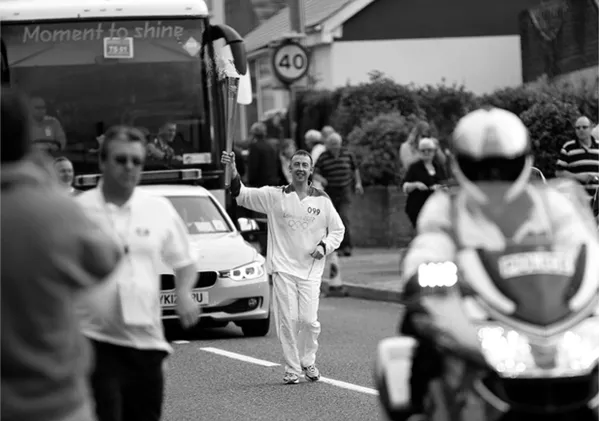
In July 2012, the Olympic flame was carried by 8,000 torchbearers in a relay around Britain and Ireland to herald the start of the Olympic Games in London (Figure 1.1). It passed within 95 per cent of the population, taking in settlements, landscapes and places of interest (London2012 2012a). While some of the torchbearers were international athletes or ‘celebrities’, the vast majority were nominated to carry the torch for their active contributions to local communities. They included people who had coached sports teams, supported disabled people, raised funds for charity, organized community events, managed youth organizations, led Guides and Scouts, served in the emergency services, or lived positively with illness or disability. The torchbearers were enthusiastically encouraged by members of the public who supported the torch as it passed through their localities. Although the 2012 torch relay did not explicitly celebrate the idea of citizenship, it provides an apt starting point for this book as it illustrates many important themes associated with it.
Figure 1.1 The Olympic Torch Relay of 2012 implicitly celebrated and performed ideals of active citizenship. Here the torch is carried by Howard Otton in recognition of his voluntary service with Dartmoor Search and Rescue Team, Plymouth (Photo: Mike Knapman)
Citizenship, like the Olympics, has its origins in Ancient Greece and has been re-discovered and re-invented for the late-modern era. Defined in its broadest sense, it refers to an individual’s membership of a political unit, often the nation-state, and the rights and duties that come with that relationship (Smith 2000; Cheshire and Woods 2009). Originally, the status of citizen was only conferred on certain men but today it is swathed in the language of inclusion and universality. Until the 1950s, Olympic torchbearers were male and usually chosen for their athletic prowess but the carriers of the 2012 flame included men and women of different ages, races, ethnicities, religions, sexualities and abilities/disabilities. All, though, were selected for their ‘inspirational contribution’ (London2012 2012b) to their localities, usually through committed and voluntary participation in community-based activities.
Many politicians have also championed forms of citizenship that emphasize active, voluntary service within local communities. In 2010 the UK’s Prime Minister, David Cameron, stated in a Conservative Party conference speech that:
‘Citizenship is not a transaction – in which you put your taxes in and get your services out. It’s a relationship – you’re part of something bigger than yourself, and it matters what you think and you feel and you do.’
The selection of active and committed volunteers to carry the torch suggests an alignment with these views. Others, by contrast, have argued that rights, rather than duties, should form the cornerstone of contemporary citizenship (Marshall 1950 [1992]) and that governments, rather than individuals, have obligations to provide, promote and safeguard their citizens’ civic, social and political rights.
These rights, however, have not been given away. Instead, they have been achieved and maintained through a spectrum of actions (Short 1993; Parker 1999b; Isin 2009) that range from the conventional use of established political channels to more radical forms of direct action that challenge and disrupt authority (Routledge et al. 2007). Few, if any, torch-bearers were recognized solely for their membership of campaign groups; taking part in direct action protests; striking or being politically active. Indeed, runners were accompanied by police escorts (Figure 1.1) that provided robust security against the torch being appropriated for political protest. In 2008, various attempts were made by demonstrators to seize the Olympic torch as a protest against a lack of human rights within the host nation, China. In 2012, the torch was diverted away from a protest in Northern Ireland which, although not aimed at the torch, detracted from the image of civic harmony that the relay was seeking to portray. Although efforts are often made to portray citizenship as universal, harmonious and inclusive, it can exclude many people who do not benefit from full membership of a state (Smith 1989; Valentine 2001; Lister 2007).
Concepts of citizenship, as well as who is considered a citizen and what this entitles them to, are contested. Although the 2012 relay privileged ideas of ‘active’ citizenship, it culminated in an opening ceremony that celebrated a much wider range of ideals. Using music, humour and performance, the event sought to foreground ideas, people and events that its artistic director, Danny Boyle, associated with the UK. It referenced, amongst many other things: the suffragettes’ campaigns for women’s political rights; the right to universal health care via the National Health Service (NHS); the first lesbian kiss on television; and notable citizens, such as the inventor of the World Wide Web, Tim Berners-Lee. It did not ignore ‘active’ citizenship (it was after all performed by 2,500 volunteers from across the world) or the place of tradition (a cameo appearance by Her Majesty the Queen in one sequence highlighted the significance of the monarchy), but it did offer a diverse, multicultural, fluid and often radical view of UK citizenship.
This emphasized that citizenship is not a static concept (Mullard 2004) but changes over space and time. While citizenship has in the past referred to the relationship between a citizen and his or her state, this connection has been increasingly challenged as private and voluntary actors have started to replace the state in many areas of service and welfare provision (Fyfe and Milligan 2003b; Desforges 2006). Privatization, voluntary actions and new forms of governance (Goodwin 1998, 2009) have made it difficult to determine the boundaries of responsibility (Shaw and MacKinnon 2011).
The torch relay again illustrated this. Runners were nominated by members of the public, including friends, family, co-volunteers, co-workers and employers, and selected by the London Organizing Committee of the Olympic and Paralympic Games (LOCOG), a private company formed to organize the 2012 Olympics in partnership with private and public stake-holders. Three multinational companies, Coca-Cola, Lloyds TSB and Samsung, acted as ‘presenting partners’ (London2012 2012b) for the relay with exclusive advertising rights. The torchbearers’ participation was shaped by this partnership rather than any single organization or government body. The daily running of the relay reflected this heady mix of sectors, including spectators (members of the public), the police (from the state) and sponsored vehicles (from the private sector). Indeed, the supporting caravan was so large that the bearers themselves were sometimes difficult to spot (Figure 1.1; note also Staeheli 2011).
A series of staged events set the Olympic flame against backdrops of local landscapes, streets and people to enable, in the words of the organizers, ‘local communities to shine a light on the best their area has to offer’ (London2012 2012a). These events were spectacular but it is important to remember that they were celebrating the more routine contributions of volunteers to their communities. The torch briefly illuminated the work of a volunteer to the wider public but more mundane, actions are more significant to their everyday role and identity. For example, a Guide leader will be involved in organizing camps, leading weekly meetings, carrying out administration and so on.
In the same way, ideas of citizenship are reproduced through regular performances such as voting, collecting social security or carrying out national service. These everyday actions are probably more important to the idea of citizenship than spectacular events that celebrate it. Lyn Staeheli (2011: 399) argues that: ‘the practices of citizenship – the daily repetitions that are part and parcel of the relationships that construct and disrupt citizenship – are important to the lives of people and to the potential of citizens to act’. If citizenship is to be more than just an ideal, it must be reflected implicitly or explicitly by daily life.
The Olympic relay operated simultaneously at a range of scales: while it celebrated an international sporting festival, the daily events focused on local actors, actions and places. Being a relay, the torch was defined by its mobility rather than an association with any one place. It moved continually between spaces and crossed boundaries, including national borders. Citizenship, like the relay, is multiscalar (Painter 2002) and mobile (Cresswell 2006a, 2009) rather than confined inside particular boundaries or spatial containers (Elden 2010). It has traditionally been coupled with the nation-state but it is increasingly associated with spaces below, across and between state borders (Painter 2002; Desforges et al. 2005; Staeheli 2011; Closs Stephens and Squire 2012a). Citizens are encouraged to act at a local level, perhaps as volunteers, and at the same time to connect to other citizens in other spaces, for example through global campaign groups.
In the following sections, more detailed consideration is given to the reasons why space and place are important to citizenship. Attention is given to the ways in which geography has informed understandings of citizenship and, in turn, how ideas of citizenship have contributed to geographical study. In doing so, the chapter argues there is a reciprocal relationship between geography and citizenship studies and provides a context for this book.
What is Citizenship?
Taken at its broadest level, contemporary citizenship traditionally refers to the relationship between an individual or group of people and a political community such as a nation-state (Smith 2000). This relationship is often expressed through a language of rights and duties. Citizens might be expected to have certain rights, such as the right to vote or speak freely, but, in turn, are also expected to fulfil duties such as military service.
Theories of citizenship are often normative and provide a framework for critiquing the gap between what rights a citizen should expect and what transpires in practice. Consequently, citizenship studies have paid close attention to social policy and the ways in which different institutions, such as schools or hospitals, deliver, deny or challenge human rights (Hill 1994; Mohan 2000, 2003a; Cowen 2005a). Although inclusion is often implied, many people continue to be excluded from full citizenship in de jure (legal) or de facto (actual) terms (Smith 1989; Valentine 2001; Lister 2007). As Turner (1997: 7) states, ‘any bench-mark of citizenship would have to include some notion of egalitarian openness to difference and otherness’.
Citizenship is an important idea because it can be used to challenge and change existing norms in society (Mullard 2004). For example, the language of rights may be to contest racism, exploitation in the workplace, or poor access to services. What is viewed as good or acceptable citizenship is subject to contest and often reflects broader changes that are affecting society (Staeheli 2011). This fluidity means that citizenship eludes definition in any universal or lasting sense. Susan Smith commented:
‘the literature on citizenship often seems confusing because the concept means different things to different people, not least because of the radical (and also conservative) rethinking to which the idea of citizenship has recently been subject’.
(Smith 1995: 190)
Since Smith’s article was published, further meanings have been heaped on to the idea of citizenship. It has been widely appropriated in policy circles to instil particular visions of citizenship that are associated with national identity and duties to the state. Consequently the term has gained a greater purchase in daily life. ‘Citizenship tests’ are used to determine who can or cannot become citizens of a country (Löwenheim and Gazit 2009; Samers 2010); ‘citizen charters’ have been used to prescribe expected levels of service provision from the state (Hill 1994); ‘citizens’ juries’ are used in planning or policy enquiries (Huitema et al. 2010); ‘citizenship’ lessons are taught in schools (Pykett 2009b); voluntary, state and private organizations attempt to instil ‘good’ citizenship (Mills 2013); and ‘active citizens’ are encouraged to contribute voluntary effort to their local communities (Fyfe and Milligan 2003b; North 2011). These initiatives have stressed that citizenship, or at least the rhetoric of citizenship, has become important in the formation and delivery of political policies.
Increasingly citizenship is also being recognized as more than a political contract (Stevenson 2001; Pykett 2010; Isin 2012b). A person’s identity as a citizen is not simply a reflection of national belonging but, rather, is shaped by a whole series of local and global cultural influences (Jackson 2010) that are played out on a daily basis upon a range of scales. Citizenship has often been associated with collectivity (Pykett 2010) and Staeheli (2011) argues that academics have often overlooked individual citizens in favour of studying citizenship. Perspectives from cultural geography have attempted to redress this imbalance by placing greater attention on the different ways in which people negotiate citizenship in their daily lives and practices (Stevenson 2001). The scope of work addressing the cultural geographies of citizenship is broad but has in common a d...