- 477 pages
- English
- ePUB (mobile friendly)
- Available on iOS & Android
eBook - ePub
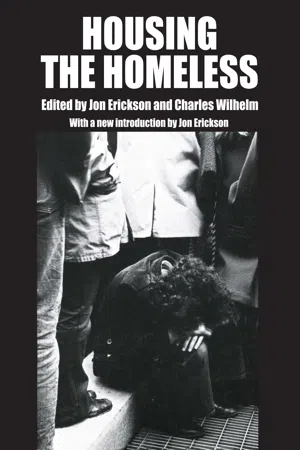
Housing the Homeless
About this book
Homelessness has become a lasting issue of vital social concern. As the number of the homeless has grown, the complexity of the issue has become increasingly clear to researchers and private and public service providers. The plight of the homeless raises many ethical, anthropological, political, sociological, and public health questions. The most serious and perplexing of these questions is what steps private, charitable, and public organizations can take to alleviate and eventually solve the problem. The concept of homelessness is difficult to define and measure. Generally, persons are thought to be homeless if they have no permanent residence and seek security, rest, and protection from the elements. The homeless typically live in areas that are not designed to be shelters (e.g., parks, bus terminals, under bridges, in cars), occupy structures without permission (e.g., squatters), or are provided emergency shelter by a public or private agency. Some definitions of homelessness include persons living on a short-term basis in single-room-occupancy hotels or motels, or temporarily residing in social or health-service facilities without a permanent address. Housing the Homeless is a collection of case studies that bring together a variety of perspectives to help develop a clear understanding of the homelessness problem. The editors include information on the background and politics of the problem and descriptions of the current homeless population. The book concludes with a resource section, which highlights governmental policies and programs established to deal with the problem of homelessness.
Information
IV
Who Are the Homeless and Why?
14
Skid Row as an Urban Neighborhood, 1880-1960
John C. Schneider
RECENT JOURNALISTIC exposes of the “new poor” and homeless, of “street people” and overcrowded city missions, have served to remind us of that perennial urban phenomenon in the United States: skid row. It is more common these days to speak of “skid row types” than to think of skid row as a point in city space. Many cities have deliberately done away with their oldest and most objectionable “wino” areas. Nevertheless, skid row has a long history as a recognizable section of the inner city, dating from at least the last quarter of the nineteenth century.
Except for a few cameo appearances in studies of class and mobility, sub-areas of transient and unattached men have not figured in the work of urban historians. Sociologists have shown a good deal more interest in skid row’s past, but mostly to provide historical background to their investigations of present-day skid row populations and social structures. The results have tended to be superficial glances, especially as far as skid row’s spatial development is concerned. Sociologists might be excused for this, but curiously geographers have also been inattentive to the spatial evolution of skid row. The most ambitious historical study of skid row as an urban neighborhood is Liquor and Poverty: Skid Row as a Human Condition (1978) by a sociologist, Leonard Blumberg, and two associates. A student of Philadelphia’s skid row for twenty years, Blumberg brought to Liquor and Poverty a strong interest in skid row’s historical development. A major segment of the book is devoted to a comparative examination of homeless men’s areas in nineteenth-century Philadelphia, San Francisco, and Detroit. It is clearly the best work to date on the spatial history of skid row in American cities.1
Informative and suggestive, Liquor and Poverty’s historical sections are nonetheless deficient on two counts. First, there is a tendency to assume that transient men’s areas in the past were always decaying neighborhoods housing mainly “skid row-like” persons recognizable to us today. Second, the authors fail to integrate fully the sociological and geographical approaches to skid row. Contemporary investigations of skid row typically have discussed the social community apart from the physical neighborhood. Skid row becomes just an area in which the social problem—homelessness, disaffiliation, alcholism—happens to be concentrated. In fact, sociologists often scold each other for focusing exclusively on skid row populations when the social condition they are most interested in is found in many parts of the city. That very point is one of the principal themes running throughout Liquor and Poverty.
For studies such as Blumberg’s that seek to provide guidelines for welfare and governmental agencies, a concern for the social problem rather than the neighborhood is to be expected, and it is hardly surprising, therefore, that many of their prescriptions for reform make little effort to preserve skid row’s distinctive physical plant.2 Yet there is every reason to believe that the homeless, disaffiliated, or alcoholic people who live on skid row share a quite different social experience than similar persons who live elsewhere. Skid row is a neighborhood in the simplest meaning of that term. Its buildings and spaces contribute to the skid row subculture, however one chooses to describe it. Interestingly, while sociologists such as Claude Fischer have been trying to free the concept of neighborhood from the constraints of place by exploring the complex social networks of modern urbanites, geographers such as David Ley have been rebelling against the economic and quantitative determinists in their own discipline by emphasizing the subjective and the role of imagery in urban geography, and in the process revealing that cities are not only broken into functional and descriptive units, but into perceptual ones as well. Ley’s approach reminds us that neighborhoods and other well-defined urban spaces are important reference points that help to determine the different social experiences of urbanites.3 This is as true for skid rowers as for other urban groups. Ben Reitman, the celebrated “tramp doctor” of early twentieth-century Chicago, certainly thought so. “Whatever the area of the homeless men is in any city,” he once wrote, “it represents the world in which they live. Considering these men as behaving and thinking individuals, we must recognize their surroundings as the sources from which they draw so much that makes them what they are.”4
The sketch that follows is an attempt to put skid row into clearer historical perspective, emphasizing its quality as a functioning neighborhood and as meaningful social space. The focus, consequently, is on several interrelated themes: the size and character of the population, the nature of institutional and associational life, and the extent of spatial cohesiveness. Three stages in the evolution of the modern skid row emerge from the investigation. The first coincided with the great hobo era around the turn of the twentieth century. A second followed in the late 1920s and 1930s when skid row became much less identified with migrant workers and more with the unemployed. And finally, by the post-World War II years skid row had become the familiar world of dropouts and derelicts. In the process of this long transition skid row changed dramatically from a vital and secure neighborhood to a fragmented and vulnerable one.
Skid Row in its Heyday: The “Main Stem,” 1880-1920
The earliest skid rows formed in the context of an active labor marketplace during the second half of the nineteenth century. A male-dominated immigration, the rapid development and exploitation of the trans-Mississippi West, and the general absence of working-class job security were only the most significant of the factors that made the period between the Civil War and World War I an age of transient and seasonal workers.5 Men on the tramp routinely passed through cities because transportation termini, employment agencies, and a good deal of casual work were located there. Transient workers were drawn to the downtown near the docks or railyards, where they established a highly visible subcommunity at a time when differentiated land use characterized American cities.6
The term skid row derives from Seattle’s “skid road” (a lumberjack district of the late nineteenth century) but was not a term commonly used until the 1930s. Between the 1890s and 1920s it was more typical to hear tramping workers speak of the “main stem.” Here a variety of places served the needs of transient and unattached men. In cheap lodging houses a man could spend as little as 7c for a night on a wooden bunk, a dirty hammock, or the bare floor.7 Nearby were cheap restaurants, second-hand clothing stores, employment offices, and most importantly saloons, where tramping workers could eat and drink, socialize, perhaps talk to prospective employers who came there looking for men, and even spend the night.8 At the turn of the century a well-defined homeless men’s area was an established part of every city. New York’s was famous. “From Canal Street to Bayard Street on the west side of the Bowery,” wrote one investigator in 1909, every building is a cheap lodging house, and from Chatham Square to Cooper Square about every other building on each side of the street is a lodging-house, and there are more saloons than lodging houses.”9 No less important in their own right were Chicago’s West Madison Street (the largest homeless men’s area). Seattle’s Yesler Way, San Francisco’s South of Market district, or the Gateway in Minneapolis, a twenty-five-block area that in 1900 had 109 saloons and 113 hotels and lodging houses.10

Exhibit 14-1 Center of the Transient Men’s Area in Omaha, 1887
The city of Omaha was also an important regional center for tramping workers, and the development of its main stem serves as a useful case study. Omaha was situated on major rail lines and was near seasonal farm work and railroad construction jobs. It was first settled in the 1850s, progressed steadily over the next two decades, and then enjoyed spectacular growth in the 1880s as a railroad, commercial, and meatpacking center. A bustling city of around 100,000 people in the late 1880s, Omaha harbored large numbers of transient workers on their way to and from jobs throughout the American West. A scanning of the manuscript schedules of the 1885 Nebraska state census shows that the principal concentration of lodgers and roomers lay between 9th and 15th streets for several blocks above and below Douglas, one of the main east-west streets. Many of the city’s cheapest lodging houses were located in the vicinity. The core of this area was the six blocks along Douglas between 11th and 14th streets. Here clearly was the embryo of a skid row.11 Exhibit 14-1 reveals, however, that as of 1887 the area had not attracted a significant concentration of homeless men’s services.12 In fact, there were not even that many lodging houses and cheap hotels (although it is clear from press reports and the census schedules that many second and third floors above shops and stores were used for lodgings but were not so described in the city directories or Sanborn insurance maps.13 So, while the Douglas Street area housed transient men in these years, it had still not acquired the look and feel of a “main stem.”
This began to change in the 1890s. The nucleus of the central business district was inexorably moving west along Douglas, Farnum, and Harney streets, from 10th street in the early days, to 13th and then 15th by the 1870s, to 16th after the 1880s. As it did so, homeless men and their services rushed into the backwash created in the less attractive older business area. The westward drift of Omaha’s business district probably speeded up the development of the city’s main stem. It was a process not without some friction, for as main stem businesses crowded on to Douglas and the cross streets they created what one Omahan called a “line of respectability” around 14th and 15th streets. Businessmen to the west were determined to hold this line. In 1898 they prodded the police into raiding a gambling den that was operating in the back room of a store just west of 15th, threatening to draw other disreputable businesses to the block.14
Exhibit 14-2 exhibits the considerable change that had taken place in the Douglas Street transient quarter by 1912. Hotels and lodging houses had proliferated and were now joined by a host of supporting businesses: saloons, cafes, secondhand stores, pawnbrokers, employment agencies, even vaudeville theatres. Where only 16% of the addresses in the six blocks supported businesses serving tramping workers in 1887, by 1912 the figure had jumped to 45%. There were other areas around the downtown that catered to these men, but a check of the city directory and real estate surveys shows no area, even a relatively small one, with anything like the concentration of men’s services that Douglas Street had. Douglas was now indeed Omaha’s main stem.
Tramping workers came to this and other stems mostly out of economic necessity, but the areas were also social centers, instrumental in the making and reinforcing of the tramping subculture. They were, in fact, just another manifestation of the male ethic that prevailed in American culture during the latter part of the nineteenth century and early years of the twentieth. Male fraternizing in settings as diverse as the workplace, clubs, lodges, saloons, and sporting events was an acceptable supplement to home life for bachelors as well as for married men.15 This male ethic lent a distinct character to downtown city streets. Gunther Barth has written of the impact of the large department store in bringing women into a downtown world, once the domain of men, but I believe he overstates the democratization of the late-nineteenth century central business district. Despite the increased presence of women downtown much that went on there was still for men only. Hotels, taverns, restaurants, clothing stores, barber shops, tailors, cigar stores, newsstands, and even Turkish baths catered to the needs of business and professional men, male office workers, and shopkeepers. If main stem business failed to enjoy the status of some of their more respectable neighbors, they nonetheless gained a measure of legitimacy as lower-class versions of the same thing.16

Exhibit 14-2 The “Main Stem” in Omaha, 1912
Street life on the main stem therefore had a more positive quality than the often destitute and desperate condition of tramping workers would suggest. The crowded and busy sidewalks—”swarming with migratory workers” as one hobo recalled—offered the men an exhilarating experience. The sociologist Nels Anderson traveled the west as a hobo worker when he was a young man. In 1907 he arrived in Omaha on a freight out of Billings, Montana, and was impressed with the size of the city’s main stem and the variety of its services. He and a companion seemed genuinely excited walking along what was undoubtedly Douglas Street and taking in the view. Anderson’s friend stood on one corner and estimated that from there he could see at least a thousand men on the streets and sidewalks.17 On main stems such as Omaha’s, knots of men were likely to gather outside the employment agencies that displayed large placards announcing farm jobs or railroad section work. The agencies tended to cluster in Omaha (as they did in most cities), mainly on 10th, 11th, and 12th streets just south of Farnum. Men fresh from the freight yards added to the bustle of main stem sidewalks as they moved along in search of a lodging-house, second-hand store, cafe, or saloon. In saloons they took advantage of the free lunch given for the price of a schooner of beer. Jim Tully wrote in his tramp memoir about a large saloon on South Clark Street in Chicago where the “free lunch was always plentiful, and whether a hobo had a five-cent piece or not, he always ate there.” The tramping professor, Walter Wyckoff, found the choices in Chicago overwhelming. He strolled past one saloon after another advertising such treats as “the best free lunch in the city” and “hot sausages with every drink.”18
The main stem, to be sure, was not altogether upbeat. Observers often described scenes that revealed a dark side—the pathetic beggars, the men with black stares and droo...
Table of contents
- Cover Page
- Half Title Page
- Title Page
- Copyright
- Dedication
- Table of Contents
- List of Exhibits
- Acknowledgments
- Introduction Jon Erickson and Charles Wilhelm
- Introduction to the Transaction Edition
- I. Images of the Homeless
- II. Background and Politics
- III. The Importance of Numbers
- IV. Who Are the Homeless and Why?
- V. Solutions to the Problem
- VI. Resources
- Bibliography
- Index
Trusted by 375,005 students
Access to over 1.5 million titles for a fair monthly price.
Study more efficiently using our study tools.
Frequently asked questions
Yes, you can cancel anytime from the Subscription tab in your account settings on the Perlego website. Your subscription will stay active until the end of your current billing period. Learn how to cancel your subscription
No, books cannot be downloaded as external files, such as PDFs, for use outside of Perlego. However, you can download books within the Perlego app for offline reading on mobile or tablet. Learn how to download books offline
Perlego offers two plans: Essential and Complete
- Essential is ideal for learners and professionals who enjoy exploring a wide range of subjects. Access the Essential Library with 800,000+ trusted titles and best-sellers across business, personal growth, and the humanities. Includes unlimited reading time and Standard Read Aloud voice.
- Complete: Perfect for advanced learners and researchers needing full, unrestricted access. Unlock 1.5M+ books across hundreds of subjects, including academic and specialized titles. The Complete Plan also includes advanced features like Premium Read Aloud and Research Assistant.
We are an online textbook subscription service, where you can get access to an entire online library for less than the price of a single book per month. With over 1.5 million books across 990+ topics, we’ve got you covered! Learn about our mission
Look out for the read-aloud symbol on your next book to see if you can listen to it. The read-aloud tool reads text aloud for you, highlighting the text as it is being read. You can pause it, speed it up and slow it down. Learn more about Read Aloud
Yes! You can use the Perlego app on both iOS and Android devices to read anytime, anywhere — even offline. Perfect for commutes or when you’re on the go.
Please note we cannot support devices running on iOS 13 and Android 7 or earlier. Learn more about using the app
Please note we cannot support devices running on iOS 13 and Android 7 or earlier. Learn more about using the app
Yes, you can access Housing the Homeless by Jon Erickson,Charles Wilhelm in PDF and/or ePUB format, as well as other popular books in Social Sciences & Social Policy. We have over 1.5 million books available in our catalogue for you to explore.