Recognizing child maltreatment as a complex phenomenon requiring multifaceted responses, this volume provides a current and comprehensive assessment of the problem, and argues for an expanded conception of helping on the part of those who work with maltreated children, their families, and their communities. Contributions follow a general outline that addresses current theory and models of practice, and empirical knowledge regarding the problem, intervention, and outcomes.
Presenting and up-to- date and encompassing view of how to combat child abuse and neglect, this book discusses the concerns of service providers as well as academics. All the prevalent ways of responding to child maltreatment are addressed, and each is discussed in terms of theory, implementation and evidence for its effectiveness.
For use as an undergraduate or graduate level text for courses in child welfare, sociology, family studies, and community psychology. This text would also be insightful for professionals, academics, and policymakers concerned with child welfare.
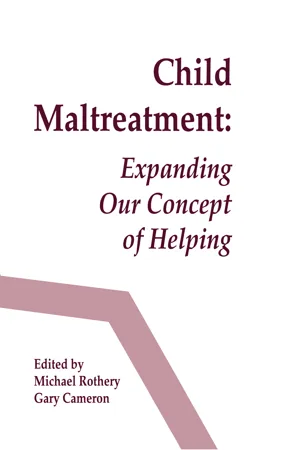
eBook - ePub
Child Maltreatment
Expanding Our Concept of Helping
- 344 pages
- English
- ePUB (mobile friendly)
- Available on iOS & Android
eBook - ePub
Child Maltreatment
Expanding Our Concept of Helping
About this book
Information
1
Child Maltreatment and the Front-Line Worker
One of the more difficult obstacles on the path to a career as a human service worker is dealing with the disillusioning effect of success rates that are less than we would wish, often with clients who are in the greatest need. Faced by situations that test our personal and professional resources and regularly prove them lacking, we may be tempted to blame families for our inability to be helpful (defining them as unmotivated, unworkable, or unreachable, for example). Alternatively, we can decline to treat them, perhaps referring them elsewhere and letting someone else take the responsibility for failing with them. Another defense is to determine that the problems in question are a consequence of such fundamental structural arrangements in our society that anything short of a revolution is inadequate.
This book addresses the needs of a group of families with whom we have frequently failed—families in which children are subject to mistreatment. Happily, it does so without blaming the clients or one another, and without avoiding responsibility for finding ways to succeed more often. It assumes that the proper response to families we have difficulty helping is to keep looking for new ways to serve them, by adding to our repertoire of interventions and continually assessing our beliefs about what helping entails. Hopefully, the result is an expanded view of helping appropriate to the needs of families that we have not always been effective with in the past.
Families in which the parenting function has somehow broken down are not a homogeneous group, and there is no one preferred intervention for helping with the problems they present. Recognizing this, the various chapters of this volume explore what is known about different types of families as well as about a range of interventions that have been developed to serve them. Therefore, it has much to offer professionals who are looking for solutions to the problem of child maltreatment at different levels, from individual counseling through broadly focused efforts at prevention. In this introduction, my purpose is to indicate what is in store for the reader, with a special focus on issues relevant to front-line workers. The book concludes with a similar chapter by Gary Cameron providing a program worker's perspective on the volume and the problems that it addresses.
GENERAL PRINCIPLES OF INTERVENTION
Multiproblem families, rich in stress but poor in resources and able to absorb high levels of service without seeming to improve are a prime example of the hard-to-serve family. They also are the focus of chapter 2, and it is notable that the discussion of their service requirements identifies principles and issues that are echoed in subsequent chapters. For many of us, these principles seem sensible and true to our clinical experience, at the same time as they imply significant deviations from what we have been trained to think and do.
The Need for Coordinated Service Packages. The need for coordinated packages rather than reliance on a single specialized form of help is now a widely accepted principle among people who work with hard-to-serve families, and is supported by the evidence presented in the chapter on multiproblem families. The case is equally strong respecting work with families with adolescents. Fuchs (chapter 4) emphasizes that the problems of teenagers’ families may be a consequence of the vicissitudes of adolescent development, family difficulties, relationships with their communities, peer groups, the schools, sometimes the police, and other factors in combination with one another. Providing effective alternatives to care for teenagers often requires an attention to several of these dimensions, simultaneously or sequentially, in a coordinated fashion. Similarly, Blythe, Hodges and Guterman (chapter 3) describe programs designed to help families with adolescents cope with crises and the debilitating effects of stress through the provision of a range of services appropriate to their specific needs.
A Range of Different Types of Support. The need to think in terms of service packages is an implicit or explicit theme throughout most of this book. So too is the recognition that such packages will normally be constructed out of a range of different types of family supports. Although professional helpers have often learned to value emotional support above all other kinds of help, effective service packages for maltreating families can seldom ignore the need for supplementing instrumental or concrete resources, for educational supports of various kinds, and for efforts to ameliorate social isolation.
As chapter 2 describes, this principle has been recognized for decades as being essential in work with multiproblem families—in chapters 3 and 4 concerning adolescents and in Epstein's exploration of the needs of families headed by young, single mothers (chapter 5), the same point is also made with respect to these populations. There are questions of timing involved; often concrete and instrumental supports have to be the first focus for work. There are also more subtle questions regarding the proper blend of supports that must be present in combination with each other. A traditional structured problem-solving approach might be ineffective offered alone, as might a time-limited program to teach specific parenting skills; the same interventions can offer lasting benefits if they are coordinated with an attention to ways of reducing a family's social isolation and lack of access to meaningful roles.
A Focus on Competence Rather Than Pathology. This focus is both a stimulus for and an effect of an extension of our concept of helping beyond the psychotherapist's traditional focus on the resolution of the emotional and interpersonal conflicts in which dysfunction is presumed to be rooted. The most visible case in point is the extent to which educational supports have emerged as an especially important focus for programs for maltreating families in recent years, emphasizing the building of client competence rather than the treatment of pathology.
In chapter 9 on behavioral approaches, Thomlison argues that one contribution of behavioral theory has been an orientation toward competence rather than pathology: Behavioral approaches view problems as learned rather than as symptomatic . This premise supports a number of other distinctive aspects of behavioral treatment that are explored in detail in a chapter that is a valuable precursor to subsequent chapters describing programs that often draw on behavioral methods, child-management programs being a prime example.
Similarly, in their exploration of the recent growth of various parent-child programs, Susan Wilson and Jeffrey St. Pierre (chapter 6) present as part of the rationale for such programs evidence that efforts to distinguish abusing from nonabusing families by identifying psychopathology or personality problems in the parents have had ambiguous results. Also, efforts to treat the problem by providing the parents with psychotherapy have been unsuccessful. Studies have, however, shown that there are other kinds of variables that discriminate maltreating from nonmaltreating families; these include common interactional behavioral patterns as well as deficiencies in social and economic support. Effective efforts to improve or repair parent-child relationships in maltreating families can appropriately direct educational supports toward different subunits in the family, can have multiple foci, and can take place in multiple settings. Support is also found in Wilson and St. Pierre's review for the arguments made previously, that service packages are preferable to solitary specialized interventions, and these packages will very often have to include attention to environmental stresses and resources.
Coordination of Services. One of the premises underlying this book is obviously that a comprehensive approach to the problem of child maltreatment will draw on the talents and resources of many different helping professionals. For example, pointing out that the traditional focus in intervening with child maltreatment has been on the parents, Kathleen Brophy (chapter 7) argues convincingly that this can profitably be balanced with programs that attend to the needs of children from maltreating families. Specifically, what can preschool and day-care programs do to help very young children from such situations? Brophy reviews a considerable amount of research demonstrating that children this age show significant effects from maltreatment—effects on their functioning that are pervasive and troubling. In response to such children's needs, preschool programs can serve different functions, remediating developmental delays in language, providing general cognitive stimulation, teaching social skills, and promoting personality development. In the service of such goals, preschool programs can be seen as a place to repair damage done to children, and also as a means for supplementing parenting deficiencies in an ongoing way.
Brophy argues for a broad mandate for preschool programs serving maltreating families; their needs are varied and the programs have much to offer. The evidence that such programs offer tangible benefits to the children they serve is clear and Brophy also provides us with the benefits of her own experience in dealing with the critical issue of interagency cooperation when preschool programs are receiving referrals from other social agencies.
In their chapter on in-home services for maltreating families, Bidgood and van de Sande (chapter 8) provide a detailed exploration of in-home programs coordinating different types of helpers working with client families in an effort to bolster their parenting functions. Bidgood and van de Sande identify four common types of in-home program: parent aides, health-care visitors, child-management programs, and multidisciplinary teams. For each of these, usual goals and approaches to service delivery are described along with an exploration of the available research regarding effectiveness.
Professional helpers are part of the formal helping systems with which clients are connected, and as such they are unlikely to get to know a client family's neighbors, peers, friends, colleagues, or extended family unless they deliberately set out to do so. Increasingly, the lack of communication between formal and informal helpers is seen to be unfortunate. Formal helpers have had to recognize that their impact on maltreating families is less than they would wish; at the same time, it is clear that the informal support systems to which a family is connected are very powerful in determining that family's well-being. Therefore, it is not unusual to read that formal and informal helpers need to work together if maltreating families are to be helped in any permanent way. However, this recommendation is difficult to implement without an adequate conceptual basis for assessing what informal help can do for clients and for planning how to utilize it on their behalf. It is for this reason that Gary Cameron's chapter (10) on the potential of social support strategies in child welfare work is so timely and important.
According to Cameron's analysis an adequate understanding of the types of support that different helpers provide reveals that formal and informal helpers help in different ways—they do not serve the same functions in a family's life. The differences have to do with qualities of help such as range of services, boundaries around the helping relationship, the duration of service, availability, technical demands on the helper, and motivational demands on the family. These qualities need to be thought about when planning to intervene with families and it will be clear to most readers that they can tell us much about how help offered by a friend or neighbor differs from that provided by a social worker.
As well as being qualitatively different, the kinds of support offered by different types of helpers serve different functions and are appropriate to different interventive goals. Thus, the overall picture is a complex one, and the unique contribution of Cameron's chapter is that such complexities are explored in detail from the point of view of both theory and research. With these theoretical and empirical foundations in place, the chapter concludes with an exploration of examples of programs that utilize informal helpers on behalf of clients.
PREVENTION
The ultimate goal with respect to any problem as painful as child maltreatment is primary prevention. Not surprisingly, the same complexities that face ameliorative services also confront prevention programs, as is evident in Garbarino's (chapter 11) review of a number of major American studies.
Garbarino points to evidence that successful prevention is possible, but that the success of a specific program or approach is not guaranteed. This is a function of the fact that child maltreatment is a phenomenon that is rooted in a number of different ecological contexts. Maltreating families differ in terms of their structures, in their profiles of problems and needs, and in the social contexts within which they are located. The marked heterogeneity of situations in which children are maltreated requires different programs tailored to the specific problems they are supposed to prevent and the specific social context within which they are supposed to prevent them.
The heterogeneity of maltreating families also has implications for program evaluation. The need for a differentiated view of target problems and their contexts is clear, as is an understanding of history—knowledge of the naturally occurring patterns of target problems over time is essential if we are to be able to detect changes in those patterns resulting from prevention initiatives.
INTERVENTION AND PREVENTION IN CHILD SEXUAL ABUSE
The subject of child sexual abuse is discussed separately in several chapters of this volume because it is a problem that has occupied a special place in the concerns of human service workers for the past decade:
The number of reported cases of… sexual abuse has increased dramatically during the past five years. … As a result, the mental health field is currently being inundated with requests by local preventive service agencies and families themselves for treatment. This condition has put much pressure on the mental health community in general … to develop expertise in a short period of time. (Trepper & Barrett, 1986, p. 5)
Trepper and Barrett go on to point out that although information about treating sexual abuse has been generated in considerable volume as the problem has impressed itself upon us, professional helpers, especially those with a family orientation, lack the support of a firm consensus as to how such cases should be dealt with.
Depression, self-destructiveness and suicidal ideation, profound loss of self-esteem, difficulty in relationships, alcohol and drug abuse—these are but part of the litany of symptoms that are shown to afflict sexual abuse victims with greater frequency than they do nonabused people. The extensive research cited in the chapter contributed by Christopher Bagley and Loretta Young (chapter 12) makes a powerful case supporting what our intuition would predict—that sexual exploitation is among the more damaging traumas that people can inflict on one another.
As with other situations addressed in this book, the sexual abuse problem demands multiple responses. Ultimately we must find ways to prevent it; we also are pressed to find methods of preventing recurrence once abuse is disclosed and of ameliorating the sometimes devastating effects that sexual abuse can have on its victims. Bagley and Young link their evidence regarding the effects of sexual abuse to specific treatment options: cognitive techniques that aim to repair self-esteem, group interventions focused on relationship abilities, and so on. Along with helping victims overcome the trauma of having been abused, and helping to empower them so that they can avoid future victimizations, another important task is finding ways to persuade perpetrators to relinquish their abusive behaviors. Penny Smith's (chapter 13) important contribution to this book is an exhaustive review of extant theories regarding causes of sexually abusive behavior in men, followed by an equally thorough discussion of various treatment options.
As with child maltreatment in general, it has been argued recently in the clinical literature that because sexual abuse is a multifaceted phenomenon, our ability to understand and treat it is going to be constrained unless we are willing to approach it using a combination of perspectives. The victim-perpetrator model (Rosenfeld, 1979), which would direct our attention to the kinds of issues covered by Bagley and Young and Smith, is sometimes seen as incompatible with the systems model that informs most family therapists. In fact, rigid adherence by workers to any one perspective to the exclusion of others may disadvantage our clients, and calls for a theoretically integrated approach to the problem are increasingly common: “incest is a distortion of the sexual dimension of family experience, arising out of a complex combination of mutually influencing variables in each of four … categories: intrapsychic, systemic, developmental, and situational” (Larson & Maddock, 1986, pp. 27–28).
Whether or not family therapy should be offered to families where any form of violence has occurred is a contentious issue. With sexually abusive families, it is especially troubling. On one hand, family therapy historically has operated on the belief that problem beha...
Table of contents
- Front Cover
- Half Title
- Title Page
- Copyright
- Contents
- Preface
- 1 Child Maltreatment and the Front-Line Worker
- PART I CHILD MALTREATMENT
- PART II CHILD SEXUAL ABUSE
- References
- Author Index
- Subject Index
Trusted by 375,005 students
Access to over 1.5 million titles for a fair monthly price.
Study more efficiently using our study tools.
Frequently asked questions
Yes, you can cancel anytime from the Subscription tab in your account settings on the Perlego website. Your subscription will stay active until the end of your current billing period. Learn how to cancel your subscription
No, books cannot be downloaded as external files, such as PDFs, for use outside of Perlego. However, you can download books within the Perlego app for offline reading on mobile or tablet. Learn how to download books offline
Perlego offers two plans: Essential and Complete
- Essential is ideal for learners and professionals who enjoy exploring a wide range of subjects. Access the Essential Library with 800,000+ trusted titles and best-sellers across business, personal growth, and the humanities. Includes unlimited reading time and Standard Read Aloud voice.
- Complete: Perfect for advanced learners and researchers needing full, unrestricted access. Unlock 1.5M+ books across hundreds of subjects, including academic and specialized titles. The Complete Plan also includes advanced features like Premium Read Aloud and Research Assistant.
We are an online textbook subscription service, where you can get access to an entire online library for less than the price of a single book per month. With over 1.5 million books across 990+ topics, we’ve got you covered! Learn about our mission
Look out for the read-aloud symbol on your next book to see if you can listen to it. The read-aloud tool reads text aloud for you, highlighting the text as it is being read. You can pause it, speed it up and slow it down. Learn more about Read Aloud
Yes! You can use the Perlego app on both iOS and Android devices to read anytime, anywhere — even offline. Perfect for commutes or when you’re on the go.
Please note we cannot support devices running on iOS 13 and Android 7 or earlier. Learn more about using the app
Please note we cannot support devices running on iOS 13 and Android 7 or earlier. Learn more about using the app
Yes, you can access Child Maltreatment by Michael Rothery, Gary Cameron, Michael Rothery,Gary Cameron in PDF and/or ePUB format, as well as other popular books in Psychology & Clinical Psychology. We have over 1.5 million books available in our catalogue for you to explore.