- 320 pages
- English
- ePUB (mobile friendly)
- Available on iOS & Android
eBook - ePub
About this book
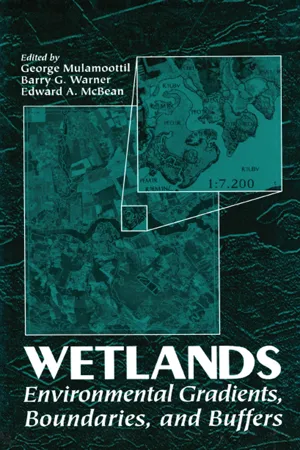
An understanding of environmental gradients (physical, chemical, hydrological, and biological) is a prerequisite to the accurate delineation of wetland boundaries. Presenting the wide-ranging views of academicians, environmentalists, policy makers, consultants, planners, engineers, hydrologists, biologists, geochemists, ecologists, and conservationists, Wetlands: Environmental Gradients, Boundaries, and Buffers focuses on current topics and research related to wetland delineation; summarizes the main issues of concern; and provides recommendations on research needs.
In addition to integrating the most important research and theoretical aspects, this book includes a strong prescriptive component, providing practicing professionals with specific guidance on defining the true dimensions of a wetland area.
Information
1 | INTRODUCTION |
Wetlands are generally thought to be among the most fertile and productive ecosystems of the world. They provide a variety of ecological functions to the landscape. In recent years there has been considerable research activity to generate more scientific documentation on the ecological functions. Much of this activity has resulted from the need to protect wetlands and their functions which is of serious concern in most industrialized countries and, in recent years, in developing countries. The reasons for the protection and conservation of wetlands have been summarized by Greeson et al., (1979) and Williams (1990). Suffice it to say that “civilization began around wetlands; today’s civilization has every reason to leave them wet and wild” (Maltby, 1986).
The values attributed to wetlands vary from one human user to another. Wetlands can be drained and used for agriculture or developed into a subdivision for housing or other land uses. They have been used as receiving areas for waste discharges by some, while some naturalists consider wetlands as unique ecosystems which should be protected. According to Richardson, (1985) the multitude of values ascribed to wetlands dictate that managers must question how the specific objectives of, for example, agriculture, energy production, fishing, hunting and recreation, forestry, and scientific study can all be satisfied within the context of regional ecosystem integrity.
The importance and significance of the functions and values of wetlands within the general scheme of landscape ecology have been receiving increasing attention during the last two decades. The early focus of the research was to establish the extent of the disappearance of wetlands by human use. For example, the wetlands in the Great Lakes region in central North America is estimated to be 67% of the original wetlands that existed prior to the time of settlement (Podniesinski et al., 1995). In Canada, during the last 200 years approximately 14% of the wetlands have been changed to other land uses (Rubec, 1994). In comparison to the wetland loss across Canada, the original wetland area in Ontario has been reduced by 68% south of the Precambrian Shield. Further, the wetland loss has been most severe in southwestern Ontario, where over 90% of the original wetland has been changed to other land uses (Snell, 1987).
The decline in coastal marshes on the Great Lakes has been of particular concern (Lemay and Mulamoottil, 1984; Krieger et al., 1992). In one case study, Lemay and Mulamoottil (1984) estimated that urban and urban-oriented uses were responsible for a 50% decrease in marsh area on the Toronto waterfront. With the ongoing loss of wetlands, it is important to realize that there is a loss of wetland functions. Several animal extinctions have occurred as a result of reduced wetland habitat on the waterfront as determined largely from bird and wildlife census data (Lemay and Mulamoottil, 1984).
The Ramsar Convention of 1971 on wetlands was the first international convention for the protection and conservation of a specific ecosystem or habitat type. Agreement was reached among the different countries to facilitate the conservation of biological diversity. The convention espoused conservation of wetlands of international significance through the principles of wise use. More recently, the Convention on Biological Diversity of 1993 has provided further opportunities for reinforcing the activities of the Ramsar Convention (Ramsar Newsletter, 1994).
A number of wetland features such as the plant and animal communities, size, connection to other wetlands or water bodies, and the amplitude of water level fluctuations are, to varying degrees, essential for the continuing viability of wetlands. However, the most important determinant for the establishment and maintenance of specific types of wetland and wetland processes is hydrology. Indeed, it is the main driving force. Thus, for example, alterations to the hydrological regime as a result of urbanization can have significant physical, chemical, and biological effects on the wetland environment and its ecological processes. Even small changes in surface and ground water hydrology may result in significant changes to the wetland. These changes in turn may have cumulative effects downstream. However, prediction of the changes of wetland as a response to changes in hydrological conditions has been difficult.
Of concern, then, is to improve our understanding of the viability of wetlands to changing environmental conditions. Any wetland is in a continuous state of evolution and flux and should, with time, change into a terrestrial ecosystem. Understanding the propensity for natural ecological change is further compounded by humans, who have changed and continue to change land uses in and around wetlands. Urbanization is probably the most dramatic example of such a change to the natural landscape. Although significant efforts have been directed towards the creation of wetlands in urban areas, it should be noted that many wetlands are not truly viable in an urban environment unless followed by intense management.
More and more suburban land use planning is integrating wetlands and other natural areas as important features of the urban landscape, especially for recreational activities. In certain instances the urban wetlands are used to assist with the control of stormwater runoff prior to discharge into receiving water bodies. It must be borne in mind that suburban landscapes often radically reshape the natural lay of the land and thereby alter the infiltration and runoff characteristics. With the changes in the quantities of surface runoff and infiltration to ground water, there can be changes to the nutrient fluxes into the wetlands. In addition to direct physical and hydrological alterations that result from the construction phase, there are often other physical, chemical, and biological effects that can impact wetlands.
On the positive side, wetlands function as temporary traps of contaminants arising from urban runoff. For example, the impact of highway runoff on water quality often results in changes in turbidity, pH, conductivity, and temperature of water and by adding pollutants such as heavy metals, grease, and oil, contribute to the pollution of the receiving waters. Contaminants such as heavy metals and nutrients, e.g., phosphorus, may be temporarily retained in wetland vegetation or sediments. The vegetation and sediment can be removed, but these activities result in further impacts on the physical and biochemical regime of the wetland. The attenuation capability of wetlands, by removing various chemicals arising from urbanization, explains, in part, their widespread use to protect receiving water bodies. It is important to identify the type of wetland ecotones that are most important for intercepting nutrients and sediments. The degree to which wetlands behave as nutrient and contaminant traps varies with the season. However, to what degree are these attenuative capabilities predictable and to what extent will the viability of a wetland remain in its natural state?
As part of the commitment to protect significant wetlands in Ontario, the provincial government has mandated that an environmental impact assessment of all development activities be completed to assure that the functions and values of wetlands are not reduced. The construction of transportation facilities and other utilities in and around wetlands also requires such an assessment. Although simple in concept, the carrying out of the assessment is a major challenge. For example, the prediction of impacts of bridges or earthfills on the ecology of a wetland is far from an exact science. The placing of fills on wetlands can have physical, chemical, and biological effects on the ecological processes of a wetland. The contaminants from highway runoff entering wetlands may undergo bioaccumulation and even biomagnification, depending on the food chain phenomena. Clearly, detailed predictions in response to changes in these types of inputs are nontrivial.
There are considerable development activities in and around wetlands. In rural situations, the development pressures are related to the intensity of agricultural operations. The demands in the urban context are from the housing, industrial, commercial, and infrastructure sectors. Regulatory jurisdictions and planning agencies are attempting to regulate land use in wetlands and also on lands adjacent to wetlands. However, there is considerable uncertainty, which makes predictions of the impacts of development on wetlands rather nebulous. For example, it is difficult to forecast the impact of a particular land use on the functions of a wetland. Part of the difficulty is a general lack of understanding of wetland science and information gaps in wetland ecosystem dynamics. The practitioners produce environmental planning reports on developments based on the best available literature in wetland science. In fact, most such reports go beyond what can reasonably be said considering the little experience gained to date from wetland-related developments. Here is a situation where the needs of professional practice are ahead of the fundamental scientific knowledge base.
The development decisions related to wetlands are further influenced by policies on wetlands and other regulations. A recent study by Stadel et al., (1995) has demonstrated that there are uncertainties and inconsistencies in the application of policies. An interesting aspect that was pointed out by the authors was the number of inconsistencies in the quality and quantity of information supplied by the witnesses at the Ontario Municipal Board hearings. They attribute this to the lack of scientific knowledge on the ecological functions and processes of wetlands. A significant point to note is the development of public policies on wetlands planning and management without sound scientific knowledge.
The protection of wetlands from land use impacts requires the establishment of buffers. However, the efficacy of the buffers and their long-term viability are only beginning to be investigated. In such a situation, it is difficult for regulatory agencies to accept or reject development proposals involving the use of buffers with different characteristics. Further, it is interesting to note that the width of buffers is stipulated from the boundary of a wetland. With the current problems associated with the boundary delineation issue, it is difficult to agree on a generally acceptable boundary. Such a predicament makes development decisions involving wetlands a vexing issue. The need for this symposium was conceived in the backdrop of such concerns on the protection of wetlands and with an interest to explore the ability of wetlands to function as attenuative features.
The questions and concerns far exceed the range of issues that can be addressed in a symposium. Nevertheless, a number of papers that highlight many interesting issues in relation to gradients, boundaries, and buffers are contained in this volume. Some of the papers are prescriptive, and others are summaries of recent research findings related to specific examples. In dealing with these issues, the papers have been divided into three theme areas, namely: environmental gradients, boundaries, and buffers.
ENVIRONMENTAL GRADIENTS
Issues of environmental gradients relate to the rates of environmental changes with distance or proximity. For example, Phillips in Chapter 14 points out how stream power is reduced by infiltration rates and gentler slope gradients. This has implications in the ability of buffers to remove or treat specific pollutants.
Alternatively, Blom et al., in Chapter 7 describe a study of adaptive mechanisms of wetland plant species occurring along floodplain gradients. These authors examine the diversity of plant communities in relation to the different conditions caused by transient flooding of river floodplains and adaptive responses during periods of submergence. They utilize a “one-species-one-habitat” approach in which various species growing under the same conditions in the field are compared. Life-cycle strategies that have developed in plants to survive the stress conditions during periods of inundation are often dependent on a rapid transition from an active life to a more passive “wait and see” behavior. A part of the strategy can involve the ability to flower and to produce seed immediately after conditions improve; however, the ability to predict when these conditions will exist is difficult.
A quantitative modeling approach developed by McBean et al., in Chapter 5 indicates that attempts to provide pre-urbanization infiltration levels in postdevelopment urbanization scenarios are going to be extremely difficult. There will be significant costs in dollars and space if mitigation of the detrimental changes to the hydrologic balances are planned. It is especially difficult to maintain the gradients for ground water recharge toward wetlands if the historical ratios of surface and ground water gradient inputs to the wetlands are to be maintained. Their findings indicate that measures to enhance infiltration are going to be necessary, if there is an interest to sustain the predevelopment conditions. To achieve environmental sustainability, mitigation measures in the form of small-scale infiltration facilities should be spread throughout the contributing drainage areas.
Chapter 4, by Warner, is a reminder that wetlands, and peatlands specifically, are three-dimensional landforms. Gradients not only occur on the land surface across wetlands but also exist vertically through them. The vertical gradient is essentially a “time gradient” which can change physically, chemically, hydrologically, and biologically with age. By relating these features of the vertical gradient with time, it is possible to determine the condition of the peatland prior to European settlement and the rates and the direction of change as a consequence of surrounding land use activities. This may be an important approach for monitoring change and predicting the future condition of wetlands under specific management strategies. In densely settled regions such as southern Ontario, the peatland condition of 10, 50, or 100 years ago may already represent a humanaltered ecosystem and so management may have to use the peatland condition at the time before European settlement as the datum for gauging the peatland condition today.
BOUNDARIES
The delineation of wetland boundaries is extremely difficult. The statement by Canny (1981) “do not stand on your dignity about the real existence of any boundary; it is in your mind”, captures the uncertainties associated with the determination of boundaries. In the U.S. the delineation is carried out by considering hydrology, soils, and vegetation. Some authors utilize the presence of surface water and interstitial soil water within the major portion of the plant root zone during the growing season as an indicator of wetland hydrology, but this approach is not universal. In Chapter 2 Carter describes the criteria currently in use, the problems associated with the procedures, and the merits of a classification system for identification of wetlands.
Tiner, in Chapter 8, discusses alternative methods for identifying and delineating wetlands, with definitions of boundaries encompassing a wide array of “wetlands” including marshes, bogs, swamps, fens, pocosins, and wet meadows. As he points out, most wetland definitions emphasize the presence and predominance of plants that grow in water or in periodically flooded or saturated soils.
Alternatively, in Chapter 11 Harpley and Milne argue that wetland delineation should consider the faunal component along with the botanical, hydrological, and geomorphological criteria. This broader view of wetland boundaries arises because animals may rely on a wetland for only a portion of their lives. Avian populations associated with wetlands and the mapping of representative wetland species should examine habitats and wildlife disturbance zones. These authors emphasize that attention needs to be paid to the avifauna in the delineation of wetland boundaries.
Pearsell and Mulamoottil utilize hydrologic processes in Chapter 9 to define a wetland boundary. The use of functional boundaries in land use planning is emphasized in their chapter. The delineation of boundaries for different wetland functions is essential in order to incorporate wetlands into new neighborhoods.
Holland describes in Chapter 3 how the boundaries between wetlands and other components of...
Table of contents
- Cover
- Half Title
- Title Page
- Copyright Page
- Table of Contents
- Chapter 1 Introduction
- Chapter 2 Environmental Gradients, Boundaries, and Buffers: An Overview
- Chapter 3 Wetlands and Environmental Gradients
- Chapter 4 Vertical Gradients in Peatlands
- Chapter 5 Urban Intensification and Environmental Sustainability: The Maintenance of Infiltration Gradients
- Chapter 6 Root Zone Moisture Gradients Adjacent to a Cedar Swamp in Southern Ontario
- Chapter 7 Adaptive Mechanisms of Plants Occurring in Wetland Gradients
- Chapter 8 Practical Considerations for Wetland Identification and Boundary Delineation
- Chapter 9 Toward the Integration of Wetland Functional Boundaries Into Suburban Landscapes
- Chapter 10 Management Goals and Functional Boundaries of Riparian Forested Wetlands
- Chapter 11 The Use of Avian Fauna in Delineating Wetlands in the Baldwin Wetland Complex, Southern Ontario
- Chapter 12 Temporal Delineation of Wetlands on Gull Point, Presque Isle, Pennsylvania
- Chapter 13 A Comparison of Wetland Boundaries Delineated in the Field to Those Boundaries on Existing State and Federal Wetlands Maps in Central New York State
- Chapter 14 Wetland Buffers and Runoff Hydrology
- Chapter 15 Effect of Buffer Strips on Controlling Soil Erosion and Nutrient Losses in Southern Finland
- Chapter 16 Hydrogeological Criteria for Buffer Zones Between Wetlands and Aggregate Extraction Sites
- Chapter 17 The CREAMS Model for Evaluating the Effectiveness of Buffer Strips in Reducing Sediment Loads to Wetlands
- Chapter 18 The Use of Vegetative Buffer Strips to Protect Wetlands in Southern Ontario
- Chapter 19 Summary of Final Session
- Index
Trusted by 375,005 students
Access to over 1.5 million titles for a fair monthly price.
Study more efficiently using our study tools.
Frequently asked questions
Yes, you can cancel anytime from the Subscription tab in your account settings on the Perlego website. Your subscription will stay active until the end of your current billing period. Learn how to cancel your subscription
No, books cannot be downloaded as external files, such as PDFs, for use outside of Perlego. However, you can download books within the Perlego app for offline reading on mobile or tablet. Learn how to download books offline
Perlego offers two plans: Essential and Complete
- Essential is ideal for learners and professionals who enjoy exploring a wide range of subjects. Access the Essential Library with 800,000+ trusted titles and best-sellers across business, personal growth, and the humanities. Includes unlimited reading time and Standard Read Aloud voice.
- Complete: Perfect for advanced learners and researchers needing full, unrestricted access. Unlock 1.5M+ books across hundreds of subjects, including academic and specialized titles. The Complete Plan also includes advanced features like Premium Read Aloud and Research Assistant.
We are an online textbook subscription service, where you can get access to an entire online library for less than the price of a single book per month. With over 1.5 million books across 990+ topics, we’ve got you covered! Learn about our mission
Look out for the read-aloud symbol on your next book to see if you can listen to it. The read-aloud tool reads text aloud for you, highlighting the text as it is being read. You can pause it, speed it up and slow it down. Learn more about Read Aloud
Yes! You can use the Perlego app on both iOS and Android devices to read anytime, anywhere — even offline. Perfect for commutes or when you’re on the go.
Please note we cannot support devices running on iOS 13 and Android 7 or earlier. Learn more about using the app
Please note we cannot support devices running on iOS 13 and Android 7 or earlier. Learn more about using the app
Yes, you can access Wetlands by George Mulamoottil in PDF and/or ePUB format, as well as other popular books in Biological Sciences & Ecology. We have over 1.5 million books available in our catalogue for you to explore.