- 395 pages
- English
- ePUB (mobile friendly)
- Available on iOS & Android
eBook - ePub
About this book
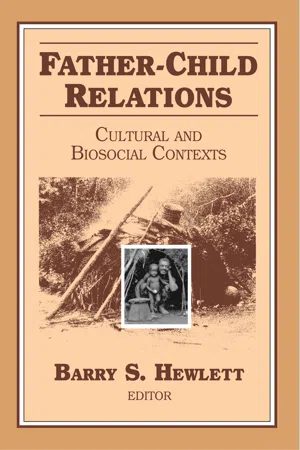
Due to a greater involvement of American fathers in the direct care of their children in recent years, interest in the impact and nature of the father's role in nurturing children has increased. While studies about fathers in the industrialized, literate West have proliferated, little is known about the role of fathers in the preliterate, non-Western world. This collection examines the diversity of paternal roles found in human cultures among various types of societies that are very peaceful and those that actively engage in warfare as a mode of existence.Father-Child Relations recognizes the importance of understanding both biological and cultural aspects of the father's role. Many of the contributors utilize evolutionary or biosocial models, including those of developmental psychology, to examine the father's role, while others rely upon the symbolic analysis of cultural and social anthropology. One chapter is devoted to male-infant relationships in nonhuman primates, a further largely ignored comparative perspective.The anthropologists who have contributed to this collection are field workers who have lived intimately over significant periods of time with the people about whom they are writing. These research reports from the field have been edited to make them wholly accessible to the non-specialist. The contributors of this volume recognize that biology and ideology are intertwined; both together influence the father's behavior and the effects of his behavior.
Information
PART I
Dad and Cad Reproductive Strategies: Biosocial Context of Father’s Role
1
Male-Infant Relationships in Nonhuman Primates: Paternal Investment or Mating Effort?
Since natural selection favors behaviors that promote individual reproductive success, both males and females should be expected to direct caregiving to their own offspring rather than the offspring of other individuals. Because female mammals gestate and give birth, they can normally be certain which offspring are theirs. In contrast, males can never be absolutely certain of paternity, because their mates could have copulated with other males. This has led to the prediction that male care of offspring is most likely to evolve in species in which males can achieve high paternity certainty and thus increase the chances that their investment is directed toward their own young (Alexander et al. 1979; Barash 1982; Kurland and Gaulin 1984).
Although male care of infants is uncommon in mammals in general, it occurs in about 40% of primate genera (Kleiman and Malcolm 1981). High paternity certainty is the most common explanation given for the occurrence of male-infant care in nonhuman primates (Alexander and Noonan 1979; Bales 1980; Busse 1984; Kurland 1977; Redican 1976; but see Snowdon and Suomi 1982 for a different view). In this chapter, we evaluate several predictions derived from the paternity certainty hypothesis by examining differences between nonhuman primate species in the prevalence of male-infant care. As a further test of the paternity certainty hypothesis, we investigate differences between individuals within polygynous species in the extent of male care of young. We argue that the paternity certainty hypothesis does not provide an adequate explanation for patterns of male-infant care in nonhuman primates, and we present an alternative hypothesis to account for these patterns. We conclude with some possible implications for the evolution of male-infant care in humans.
A careful formulation of the paternity certainty hypothesis states that high paternity certainty is a necessary, but not sufficient, condition for the evolution of male parental care; in addition, infants must also benefit from male care. Thus, interspecific variation in the importance of male care to infant survival (and, ultimately, to the infant’s own reproductive success) could in theory account for some of the variation across species in patterns of male care. However, since almost no information is available on the effects of male care on infant survival in the wild, we cannot presently determine the role this variable plays in the evolution of male parental care in primates. In evaluating the paternity certainty hypothesis, therefore, we assume that interspecific variations in the benefits infants derive from male care do not obscure the expected relationships between paternity certainty and male care described below.
Paternity Certainty Hypothesis: Predictions
Several predictions follow from the paternity certainty hypothesis:
- Male care of infants should be more prevalent in monogamous species because a single male typically monopolizes matings, and paternity certainty is therefore high.
- Male care of infants should be more prevalent in species that live in one-male groups because a single male typically monopolizes matings, and paternity certainty is therefore high.
- Male care of infants should be relatively rare in species that live in multimale groups because females typically mate with more than one male, and paternity certainty is therefore low.
- In those multimale groups in which male care is observed, it should involve those infants most likely to be the male caregiver’s offspring.
Below, we first evaluate predictions 1-3, which concern interspecific variation in the prevalence of male-infant care. We then evaluate the fourth prediction, which concerns variation in male care within particular species.
Male Care of Infants: Interspecific Comparisons
We evaluate the first three predictions listed above using data primarily from wild and free-ranging (provisioned) primates. Information from captive groups is included when it is especially relevant. These comparisons are necessarily based on qualitative information, since few studies provide quantitative information on rates of male-infant interactions that can be compared across species.
Male care of infants can be divided into two types: (1) direct care, where the male directs caregiving behaviors (such as carrying, holding, grooming, protection) toward particular infants, and (2) indirect care, where the male performs behaviors that could benefit infants (such as defending the group’s territory or chasing away predators), but these behaviors are not directed toward any particular infant(s) (Kleiman and Malcolm 1981). Although indirect care may sometimes be important, it is in practice difficult to determine when male behavior such as territorial defense is designed to benefit infants and when such potential benefits are simply an incidental byproduct of behavior performed for other reasons, such as to exclude male rivals. Because of this difficulty, we focus our analysis on instances of direct male care.
To simplify comparison between species, we have used a dichotomous classification: presence or absence of male care (see Table 1 for details). We categorize species as male care present when adult males typically show either “intensive caretaking” or “affiliation,” as defined by Whitten (1987). We categorize species as male care absent when males show either no care of infants or only “occasional affiliation” or “tolerance” (Whitten 1987). Male caretaking and affiliative behaviors include carry, protect, share food, co-feed (allow infant to feed in close proximity), groom, hold, and frequent close proximity.
Table 1 lists the presence or absence of male care in monogamous, one-male, and multimale groups of nonhuman primates. Table 1 is not exhaustive but includes all species in which it is known that male care is present, except for some marmosets and tamarins (see below).
Prediction 1: Male Care Is More Prevalent in Monogamous Species
In general, prediction one is supported: most monogamous species show male care of infants (Table 1). In fact, in the monogamous species listed as having male care (such as owl monkeys and titi monkeys), all paired males show infant care, and they provide more extensive care than males in any other primate species except tamarins and marmosets, which are discussed further below. However, the gibbons represent a striking exception to this general pattern; within this family, only siamangs show direct male care. Several gibbon species have been well studied in the wild, and no evidence indicates that paternity certainty is lower for gibbon males than for males of the other monogamous species listed here (Robbins Leighton 1987). Thus, although male care is most common and most intensive among monogamous primates, the paternity certainty hypothesis leaves unexplained some notable exceptions.
Table 1 Presence or Absence of Male-Infant Care in Relation to Mating System in Selected Nonhuman Primatesa


Prediction 2: Male Care Is More Prevalent in Species Living in One-Male Groups
The evidence in Table 1 does not support this prediction. With the exception of mountain gorillas, in none of these species does the breeding male show frequent caregiving or affiliative behavior toward infants, and in some species, males virtually never interact with infants at all (e.g., capped langurs, patas monkeys). Thus, the paternity certainty hypothesis does not explain patterns of male-infant relations in species breeding in one-male groups.
One possible objection to this conclusion is that, despite the one-male group structure, females in these species actually mate frequently with other males and hence paternity certainty is thereby reduced (cf. Alexander and Noonan 1979). In some cases, copulations with outside males do occur (e.g., patas monkeys: Chism and Rowell 1986; Harding and Olson 1986; redtail monkeys: Cords 1984; blue monkeys: Tsingalia and Rowell 1984; hanuman langurs: Hrdy 1977; Sommer 1988). In patas monkeys, for example, multimale influxes during the breeding season occur regularly, females mate promiscuously with several different males, and paternity certainty for the “resident” male is probably consistently quite low (Chism and Rowell 1986; Harding and Olson 1986). The situation for other “one-male” species appears to be more ambiguous. In blue monkeys and redtails, multimale influxes accompanied by promiscuous mating sometimes occur (Cords 1984; Henzi and Lawes 1988; Tsingalia and Rowell 1984), but their likelihood varies from year to year, depending on factors such as the number of females that are simultaneously sexually receptive and the local population density of extra-group males (Butynski 1982; Cords 1987; Henzi and Laws 1988). Observations to date indicate that in both blue monkeys and redtails, several years may pass in which the resident male monopolizes most matings (Butynski 1982; Cords 1987; Rudran 1978; Struhsaker and Le-land 1979). Speaking of blue monkeys, Rowell (1988, p. 192) carefully concludes, “It is quite likely that resident males sire most of the offspring conceived in their group during their tenure, but it is by no means sure.” A similar conclusion may apply to hanuman langur populations characterized by one-male groups. During most of the tenure of a given male, he monopolizes matings with the females in his group, but females do occasionally mate with outside males, especially during takeover attempts when an all-male band may invade the troop (Hrdy 1977; Sommer 1988). It is important to note that, contrary to the paternity certainty hypothesis, male care is consistently absent in the species mentioned above, even during those times when paternity certainty appears to be quite high.
In still other species that live in one-male groups, female copulation with males other than the adult breeding male appears to be extremely rare. For example, observers studying wild hamadryas baboons for several years saw no instances of adulterous mating (Sigg et al. 1982). Similarly, in gelada baboons, mating is usually restricted to a single male (Dunbar 1984b). Yet, in neither of these species does the breeding male show frequent affiliative interactions with his infants.
Until paternity is determined through genetic analysis, the frequency with which infants are fathered by nonresident males cannot be known with certainty, but our current knowledge of mating behavior indicates that, in many species that live in one-male groups, the resident male is usually the father of infants born in those groups. The virtual absence of male-infant care in these species does not support the paternity certainty hypothesis.
Prediction 3: Male Care is Relatively Rare in Species Living in Multimale Groups
The presence of male care/affiliation in a number of species living in multimale groups is inconsistent with this prediction. Table 1 shows that patterns of male-infant relationships vary considerably in primates living in multimale groups characterized by female promiscuity (i.e., females typically mate with more than one male around the time of conception). In some species, such as rhesus macaques or vervet monkeys, males rarely interact with infants, which would appear to conform to the paternity certainty hypothesis. However, other species living in multimale groups, such as Barbary macaques and savanna baboons, show frequent affiliative male-infant interactions, despite low certainty of paternity. The paternity certainty hypothesis might account for instances of male care in these species if only one or two males monopolized matings. There is no evidence that this is the case; f...
Table of contents
- Cover Page
- Title Page
- Copyright Page
- Table of Contents
- List of Contributors
- Acknowledgments
- Introduction
- Part I Dad and Cad Reproductive Strategies: Biosocial Context of Father’s Role
- Part II The Cultural Context of Father’s Role: Perspectives from Cross-Cultural Human Development and Symbolic Anthropology
- Author Index
- Subject Index
Trusted by 375,005 students
Access to over 1.5 million titles for a fair monthly price.
Study more efficiently using our study tools.
Frequently asked questions
Yes, you can cancel anytime from the Subscription tab in your account settings on the Perlego website. Your subscription will stay active until the end of your current billing period. Learn how to cancel your subscription
No, books cannot be downloaded as external files, such as PDFs, for use outside of Perlego. However, you can download books within the Perlego app for offline reading on mobile or tablet. Learn how to download books offline
Perlego offers two plans: Essential and Complete
- Essential is ideal for learners and professionals who enjoy exploring a wide range of subjects. Access the Essential Library with 800,000+ trusted titles and best-sellers across business, personal growth, and the humanities. Includes unlimited reading time and Standard Read Aloud voice.
- Complete: Perfect for advanced learners and researchers needing full, unrestricted access. Unlock 1.5M+ books across hundreds of subjects, including academic and specialized titles. The Complete Plan also includes advanced features like Premium Read Aloud and Research Assistant.
We are an online textbook subscription service, where you can get access to an entire online library for less than the price of a single book per month. With over 1.5 million books across 990+ topics, we’ve got you covered! Learn about our mission
Look out for the read-aloud symbol on your next book to see if you can listen to it. The read-aloud tool reads text aloud for you, highlighting the text as it is being read. You can pause it, speed it up and slow it down. Learn more about Read Aloud
Yes! You can use the Perlego app on both iOS and Android devices to read anytime, anywhere — even offline. Perfect for commutes or when you’re on the go.
Please note we cannot support devices running on iOS 13 and Android 7 or earlier. Learn more about using the app
Please note we cannot support devices running on iOS 13 and Android 7 or earlier. Learn more about using the app
Yes, you can access Father-Child Relations by Barry S. Hewlett in PDF and/or ePUB format, as well as other popular books in Scienze sociali & Antropologia. We have over 1.5 million books available in our catalogue for you to explore.