eBook - ePub
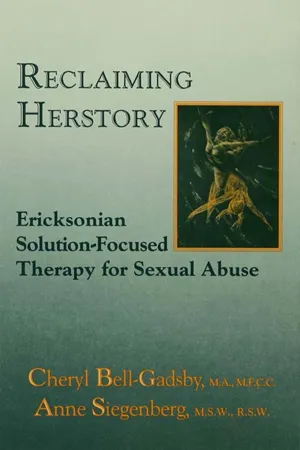
Reclaiming Herstory
Ericksonian Solution-Focused Therapy For Sexual Abuse
- 259 pages
- English
- ePUB (mobile friendly)
- Available on iOS & Android
eBook - ePub
Reclaiming Herstory
Ericksonian Solution-Focused Therapy For Sexual Abuse
About this book
Women who have survived sexual abuse are among the most traumatized individuals who seek therapy. Assisting such clients to reframe transcend their abusive pasts requires enormous sensitivity and therapeutic skill. Reclaiming Herstory: Ericksonian Solution-Focused Therapy for Sexual Abuse will greatly help therapists hone their craft with its solution-focused, Ericksonian approach and highly refined techniques for working with this population. The approach the authors present has evolved through work with hundreds of sexual abuse survivors. The authors have found their techniques to be remarkably effective in helping these clients to regain a sense of freedom and empowerment in their lives. The authors view the healing process as a collaborative partnership in which the therapist co-creates with the client a positive context for healing. This process comprises four distinct stages through which every client must pass in order to achieve their own unique potential. The book clearly describes the primary symptoms and features of the four stages, which are: Breaking the silence and unmasking the secret Becoming visible Reclaiming and reintegration of the self Empowerment and the evolution of the sexual self It also presents, for each stage, a series of detailed metaphorical stories, exercises, and rituals designed to assist a client who is traversing a particular stage. Numerous suggestions, lists, questions, and vivid case studies help the therapist to identify and assess the individual needs of a particular client and then pinpoint those tools that will best facilitate the healing process at a given stage. Recognizing the severe toll that work with sexually abused clients can take on the therapist, Reclaiming Herstory also provides strategies for self-care that can be used during various stages of therapeutic practice. The volume also provides a timely and important discussion of the controversial false memory backlash and its impact on the survivor and implications for the therapist.
Information
PART I
PROCESS AND PRACTICE
CHAPTER 1
Trauma and Memory
Fragments of life pieces…scattered over time…retrieved…then let go…retrieved again…and then let go again…and so the ebb and flow of memory besieged by trauma continues, until the pieces begin to fit together in some cogent way—creating a life-size jigsaw puzzle of human experience. In our clinical practice, persons having undergone such traumas as childhood sexual abuse often do not have clear memories of the event(s) until they are well into their 30s. Conversely, there are some trauma survivors who have a clear memory that spans back to when the abuse first began and before.
The focus of this chapter is to assist the therapist and the therapist-in-training in gaining a clearer understanding of the biological, mental, and emotional effects of trauma on memory. In addition, it seems appropriate to address the phenomenon of “false memory” in order to provide the reader with our particular understanding of the consequences of this phenomenon for both survivors of sexual abuse and the therapists who work with them.
For the purposes of this book, we define memory as a faculty that has the capacity to retain thoughts from the more recent past, all the way back to the past of long ago, that is, the historical past. In addition, we define trauma as a psychic injury caused by emotional shock, which continues to remain unhealed and sometimes dissociated from the conscious memory, often resulting in a behavioral and emotional disorder. Furthermore, we understand dissociation as the vehicle utilized by the brain under severe stress to carry a fragmented form of the trauma, which is often expressed by the survivor through flashbacks, dreams, anxiety, panic attacks, self-mutilation, and/or somatization.
It is our belief, supported by Bessel van der Kolk and Onno van der Hart (1991), that forgotten traumatic memory is not repressed, that is, pushed down and out, but rather it is dissociated, that is, contained in an alternate stream of consciousness where the narrative form of the memory becomes inaccessible and instead, is often expressed on a visceral and emotional level. Therefore, we will be using the term dissociation rather than repression or suppression to describe the impact of trauma on memory. Posttraumatic Stress Disorder is the term used in the Diagnostic and Statistical Manual of Mental Disorders, Fourth Edition to describe the reaction of a human being to such a traumatic event. The DSM-IV (APA, 1994) describes Posttraumatic Stress Disorder as a reaction to a situation that is outside of the realm of usual human experience. Such reactions include fear, terror, and a sense of helplessness, coupled with a behavioral component that is often characterized by emotional numbing, hypervigilance following the trauma, with the traumatic event commonly reexperienced through recurrent and intrusive recollections, distressing dreams, along with the development of dissociative states as a further reaction to the traumatic event.
I. THE BIOLOGICAL, MENTAL, AND EMOTIONAL EFFECTS OF TRAUMA ON MEMORY
When early traumatization occurs, in this case sexual abuse, the memory is often blocked to the extent that only very small fragments of experience are released into the conscious mind by the unconscious mind—creating a sort of protective covering for the person not yet ready to deal with her past abusive experience. Canadian lawyer Susan Vella (1994) speaks of the phenomenon of false memory as a sexual assault defense theory, citing a large study performed by Linda Meyer Williams that supports the belief that traumatic memory is dissociated. In a follow-up study of 200 adults treated as children for sexual abuse, 1 in 3 did not recall the abusive experiences documented in their hospital records 20 years prior.
According to Mary Sykes Wylie (1993), it is only in the last decade that the law and society are acknowledging and giving credence to the premise that traumatic memory is, by its very nature, often dissociated, and, as a result, the statute of limitations has been extended in 21 states in the United States as well as in Canada in order to take this premise into account.
From our experience in working with hundreds of survivors of sexualabuse, the clustering of the following factors tends to create a greater degree of dissociation from the traumatic event(s): the earlier the occurrence of the abuse, the more intense and violent the abuse, the more threatening the abuse, and the more closely related the victim is to the abuser. The extreme expression of dissociated memory can result in multiplicity, also known previously as Multiple Personality Disorder and now referred to as Dissociative Identity Disorder in the DSM-IV. Clients labelled “borderline,” who were previously considered untreatable, are finally being recognized for who they have often been all along—survivors of sexual abuse. In a study conducted by Saxe, van der Kolk, Beckowitz, Chinman, Hall, et al. (1993), 100% of 110 psychiatric inpatients, who were previously diagnosed with schizophrenia, mood disorders, and borderline personality disorder were, in fact, individuals with dissociative disorders. They had not been asked such crucial diagnostic questions as whether they had experienced losing track of time, had partial or complete amnesia for certain events, and/or had experienced feelings of detachment or unrealness, that is, the determinants of dissociation. This is a strong indication that dissociated memory is not always recognized as traumatic—until the dissociated fragments are pieced together to create a full narrative of the event(s).
As therapists, it is of primary importance that we have some understanding of the chemical and biological effects of traumatization on the brain, and hence on memory. The breakthrough work of Pierre Janet (1886–1935) and, more recently, van der Kolk and van der Hart (1984–1993) on the brain and trauma, substantiates what we have learned from our clinical practice and further enhances our understanding of the mechanism of memory under stress. Van der Kolk and van der Hart (1991) discuss the fact that the combination of the arousal and autonomic nervous response, the secretion of neurotransmitters with resultant nerve stimulation, and the patterns and pathways of the nervous system play a vital role in the mechanism of memory retrieval. Although these factors must play an important role in the adolescent and adult survivor of sexual abuse, the mechanism in children is much more complex and less understood. This would stem from the fact that in infants and young children important parts of the nervous system related to memory are not yet myelinized. This constitutes the covering of the nerves with a specialized myelin sheath that protects the nerves, preventing disruption of impulses travelling within them. It is hypothesized that without this sheath, important parts of the brain associated with memory storage and retrieval are vulnerable to disruption. This may explain how most survivors, in our experience, recall sexual abuse from the age of about 5 years and older, with earlier narrative memory of trauma often only available in a more visceral, emotional form.
Janet (1909b) has assisted us in understanding that “the healthy response to stress is mobilization of adaptive action.” However, in the event of severe stress, such as childhood sexual abuse, van der Kolk and van der Hart acknowledge that “actual experiences can be so overwhelming that they cannot be integrated into existing mental frameworks, and instead, are dissociated, later to return intrusively as fragmented sensory or motoric experiences” (1991, p. 447). Traumatic memory gets fixed to resist further change, so that trauma victims continue to relive traumatic experiences in an unmodified, repetitive manner until, as Janet (1909) and more recently van der Kolk and van der Hart (1991) believe, flexibility is introduced in order to lessen the power of the memory. This is where horrific scenarios are unfrozen and replaced by alternative scenarios composed of more positive elements, resulting in the softening of the original experience of the trauma. In the creation of our metaphors, exercises, rituals, and practical techniques, we have attempted to help the survivor reintegrate those fragmented memories and experiences, in order to increase the mobility and flexibility of previously frozen behaviors and maladaptive patterns.
II. THE FALSE MEMORY BACKLASH: IMPACT ON THE SURVIVOR AND IMPLICATIONS FOR SEXUAL ABUSE THERAPISTS
With the recent media attention on False Memory Syndrome, whose premise is based on the belief that therapists can plant traumatic memory into the minds of unsuspecting clients, the very tenet of Posttraumatic Stress Disorder is challenged and brought under fire. Unfortunately, in our experience, recent clients in the process of recovering traumatic memory have begun to question their own newly retrieved fragments—wondering if perhaps they just made it up for some unknown reason: this is a tragic consequence of the false memory backlash.
The medical and legal professions have lent credence to the impact of war and physical trauma on memory, but very little credibility has been afforded the impact of child sexual abuse on memory until more recently. This newly acknowledged awareness was gaining momentum until the False Memory Syndrome Foundation brought forth their beliefs, backed by certain psychiatrists and psychologists who were prepared to state that repressed memory was a fallacy, and that if past trauma occurred, the memory of it in the present would be a clear, full one. As a result, the so-called false memory “experts” have done much to discredit survivors of sexual abuse, who recalled in adulthood traumatic memory that had been blocked from the conscious mind since childhood. The survivor is finally ready to speak out, based on her emerging belief in herself, only to receive the same message from the proponents of False Memory Syndrome that she received from her perpetrators and family members who supported them—”You're making it up,” “It never happened.”
As a result of the increased visibility and recognition in the media afforded victims of sexual abuse, survivors have come to view themselves as credible witnesses to the trauma they suffered, often at the hands of other family members. As the victim of such heinous acts, the survivor has begun to emerge from the shadows of denial and disbelief and find her own voice for the first time. The mighty and powerful voice of the perpetrator has finally been challenged, and the phoenix victim has arisen from the ashes to undergo a dramatic transformation. In order for this transformation to take place, the majority of therapists who work with survivors are a group of professionals dedicated to the healing process and invested in assisting their clients in leading active, healthy, productive lives. The false memory debate has come into the political arena to the extent that therapists who work with survivors of sexual abuse need to take a stand collectively and lobby for the rights of their clients, so that the survivor continues to get the message that she is believed and that she can trust her own memory—that is, she can trust herself.
The False Memory Syndrome Foundation is perpetuating another backlash, that is, the undermining of the therapist's role with survivors of sexual abuse, by suggesting that some therapists plant false memories into the minds of their clients. In order for a therapist to work with sexual abuse survivors, they should be required to meet such criteria as a professional degree in social work, psychiatry, or psychology, membership in a professional association; and specialized training in the area of sexual abuse. The silver lining to the False Memory Syndrome cloud is that it is forcing therapists to reexamine with a critical eye the way they practice, in order to determine how ethical it truly is. It is, therefore, a prudent and ethical practice to go at the client's pace, and if there is dissociated traumatic memory, it will eventually bubble in the conscious mind when the client is ready to reintegrate the memory in a way that is meaningful and healing for her.
Priscilla* was a 37-year-old client who was in therapy for a number of years before she was ready to remember her sexually traumatized past. Until that time, the fragments of memory that had been surfacing were too scattered to allow conclusions to be drawn, and Priscilla was encouraged by the therapist to express those memories through artwork. It was only when the client was ready to piece together in a retrospective therapy session all the artwork she had created over the years that she was able to tell the story of her sexual abuse.
It is our belief that dissociated traumatic memory can not only be retrieved in the therapist's office, but also can surface at different times in the person's life; for example, when facing a stressful situation at work or following the birth of a child, marriage, or divorce—all these milestones can evoke traumatic memory. For a fuller description of the impact of these milestones on the traumatized individual, please refer to Section V, titled “Issues That Often Trigger Memory” in this chapter.
It is becoming more evident that claims made by proponents of the False Memory Syndrome are highly questionable and ac...
Table of contents
- Cover
- Half Title
- Full Title
- Copyright
- Dedication
- Contents
- LIST OF METAPHORS, EXERCISES, AND RITUALS
- FOREWORD
- ACKNOWLEDGMENTS
- INTRODUCTION
- PART I. PROCESS AND PRACTICE
- PART II. THE HEALING STAGES OF SEXUAL ABUSE
- PART III. SELF-CARE FOR THE THERAPIST
- REFERENCES
- NAME INDEX
- SUBJECT INDEX
Trusted by 375,005 students
Access to over 1.5 million titles for a fair monthly price.
Study more efficiently using our study tools.
Frequently asked questions
Yes, you can cancel anytime from the Subscription tab in your account settings on the Perlego website. Your subscription will stay active until the end of your current billing period. Learn how to cancel your subscription
No, books cannot be downloaded as external files, such as PDFs, for use outside of Perlego. However, you can download books within the Perlego app for offline reading on mobile or tablet. Learn how to download books offline
Perlego offers two plans: Essential and Complete
- Essential is ideal for learners and professionals who enjoy exploring a wide range of subjects. Access the Essential Library with 800,000+ trusted titles and best-sellers across business, personal growth, and the humanities. Includes unlimited reading time and Standard Read Aloud voice.
- Complete: Perfect for advanced learners and researchers needing full, unrestricted access. Unlock 1.5M+ books across hundreds of subjects, including academic and specialized titles. The Complete Plan also includes advanced features like Premium Read Aloud and Research Assistant.
We are an online textbook subscription service, where you can get access to an entire online library for less than the price of a single book per month. With over 1.5 million books across 990+ topics, we’ve got you covered! Learn about our mission
Look out for the read-aloud symbol on your next book to see if you can listen to it. The read-aloud tool reads text aloud for you, highlighting the text as it is being read. You can pause it, speed it up and slow it down. Learn more about Read Aloud
Yes! You can use the Perlego app on both iOS and Android devices to read anytime, anywhere — even offline. Perfect for commutes or when you’re on the go.
Please note we cannot support devices running on iOS 13 and Android 7 or earlier. Learn more about using the app
Please note we cannot support devices running on iOS 13 and Android 7 or earlier. Learn more about using the app
Yes, you can access Reclaiming Herstory by Cheryl Bell-Gadsby,Anne Siegenberg in PDF and/or ePUB format, as well as other popular books in Social Sciences & Developmental Psychology. We have over 1.5 million books available in our catalogue for you to explore.