- 321 pages
- English
- ePUB (mobile friendly)
- Available on iOS & Android
eBook - ePub
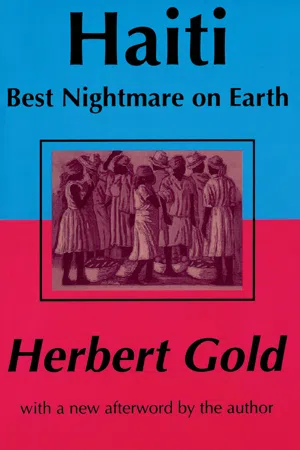
Haiti: Best Nightmare on Earth
About this book
Five decades ago, award-winning author Herbert Gold traveled to Haiti on a Caribbean version of the Fulbright Scholarship. The journey proved to be a turning point in his life. Fifty years later, his attachment to the tiny Caribbean nation-his second home-remains as passionate and powerful as ever. Now, in Best Nightmare on Earth, he explores the secret life of this vibrant, volatile, violent land. -Beautiful...bizarre...dangerous...exotic, a Garden of Eden fallen into despair, a tiny nation of unimaginable misery and unpredictable grace, an island where life is a kind of literature, a world of -unlimited impossibility.- This is Herbert Gold's Haiti, a country of extraordinary paradox and remarkable extremes-of gingerbread dream houses and wretched slums, of brutal repression and explosive creative energy. Where else, he asks, can you run into evil spirits on the back roads, or find the goddess of fertility and orgasm represented by a photo of a tap-dancing Shirley Temple? Where else is there such generosity amid such corruption, such humor in the midst of such desperation? In his many Haitian travels, Gold has dined with Graham Greene and chatted with the hated Duvalier oppressors. He has traded stories with CIA saboteurs, former Nazis, rum-soaked diplomats, and voodoo priests. He has taken in the cockfights and hunted for pirate treasure. He has nearly died of malaria; he has faced machete-wielding gangs of Ton-Ton Macoutes. He followed the traffic in Haitian blood to American hospitals and watched the AIDS epidemic take its toll. He listened to the steady beat of drums rolling down mist-shrouded mountains, and shared in the flirting, drinking, and laughter of the streets. He has captured the essence of this land where tragedy is the music the people dance to. Herbert Gold reflects on the country's history and politics, culture and folklore, but sees much more. He sees Haiti through the eyes of a lover: impassioned, jealous, probing, ever alert, and alive. This book will be of interest to travelers to, and people interested in the problems of, Haiti and the Caribbean; and collectors of Haitian art.
Information
CHAPTER
ONE
1953: The Golden Age of Strange


“It doesn’t have a tin roof,” she said. “My mother’s house does.” And then the inexorable winding down of my G.I. Bill and Fulbright sinecures brought me back to my hometown, Cleveland, the Paris of northeastern Ohio, to await the fame and riches which would surely fall from the heavens (New York) after publication of my first novel. The novel came out; I hurried to the Post Office in the Public Square; my picture failed to appear on the new three-cent stamp.
I had a wife, two babies, no good prospects to support them. I remembered the laughing Haitian singer and dancer. I went to the library to look up scholarships and fellowships and applied for one to take me to the Université d’Haiti. In due course, I was on a ship traveling from New York to Panama, with a stop in Port-au-Prince.
Steaming south along the coast on a white Panama Lines vessel, I watched a tall, imperious Haitian, with an aquiline nose, impeccably dressed, pacing the deck. I admired his self-possession, and as a very young man enraptured by everything different from Cleveland, Ohio, I wondered about his manner of proud exasperation. A quality I had not developed and could only admire from afar was the talent for being elegantly pissed-off.
In the way of travelers, eventually we spoke, and we became friends for the next quarter of a century. As the years went by, his exasperation grew. Haiti gave him plenty to be exasperated about, although he would not leave his country except for brief visits.
This tall black man pacing the deck, Jean Weiner, was an electrical engineer. His family, from the town of Jacmel, had been in the coffee-exporting business. A certain molding of his face and the prominent nose carried on the look of one of his grandfathers, a Jew from—as his name suggested—Vienna. Later I met other good Roman Catholic or voodoo-believing Haitians with ancestors among the wandering Jews who at times had pressing reasons to make their lives in this hidden and unlikely place. Educated in Paris and the United States, an angry and generous soul, Jean was my first friend among the class of Haitians called the elite—African and French and Haitian all at once, and negotiating their lives and their history with unique charm and difficulty.
When the coastal waters began to turn tropical, Jean changed into a white linen suit and began to groan about the island where I was coming to spend the next year—the next year and, as it turned out, a part of every next day and night of my life. “Ah, Herb, go back, go home while you can!” he said, and I laughed, treating this as a joke.
In fact, Haiti was not bad to me. Haiti was mostly bad to Haitians.
The white Panama Lines ship passed the lie de la Gonâve, where uncounted people lived without electricity, machinery, or contact with the larger world of Port-au-Prince and the mainland. I had tried to prepare myself by reading everything I could find in English and French and so I said, “Oh yes, the White King of La Gonâve,” remembering one of the romance-drenched books. These accounts were normally illustrated with woodcuts of drum-beaters or voodoo ceremonies, all staring eyes and licking flames.
“You think you’re ready,” Jean Weiner said. “My dear friend, you are not ready.”
The bay of Port-au-Prince was like a black mirror reflecting the heat. Frantic boys in burned-out log canoes were begging for coins alongside the ship, diving into the murk and coming up gasping for more, another, vite, à moin, vite! Jean extended his long arm to offer me the entire city, spread out in a yellow-gray haze along the wide, wide bay—a low jumble of thick-walled colonial buildings and corrugated tin sheds nearby, and the smoking slum of La Saline, then the irregular slopes with spots of gardens, cloud-shrouded mountains rising into the distance above the town.
I landed with household goods for four; my family would follow by airplane when I found a house. The tropical rush, noise, heat, and harborside dust gave me a dizziness of expectation. I braced myself to sink into clamor as a team of port officials, sweating primly and stubbornly in clothes made for another climate, asked for my papers. “Passport, please!” The startled customs chief looked up, smiling, and waved me through with a welcoming largeness. He was, he declared, an immense and devoted Haitian amateur of my distinguished cousin’s music.
“Who?”
Victor Herbert… evidently a cousin of Gold Herbert.
“Mes-z-amis!” said Jean, shaking his head. “It’s too late now. Welcome to the Land of Unlimited Impossibility.”
Jean’s son, Ti-Jean, delivered my goods in a pickup; and I settled for a while at the Grand Hotel Oloffson, which was then a rundown gingerbread mansion, catchall home for an international collection of wildballs—drunks, criminals, the sexually obsessed, crazies, remittance folks, mistresses and gigolos and bemused adventure-seekers. Over the years it would become my favorite place in the whole wide world, even after it was cleaned up, decorated, prettified, with many of the fat scurrying rats chased from the premises.
I was supposed to give a series of lectures on literature at the Haitian-American Institute. During the first one, someone asked about the place in world literature of Jacques Roumain, Marxist poet and novelist, author of Rulers of the Dew, a book about the conflict over land between the rich and the peasants.
I was new to the politics of Port-au-Prince. Rashly I remarked that Jacques Roumain wasn’t the equal of Dostoyevsky or Tolstoy, and this provoked a crisis in Haitian-American relations. One of my best new friends wrote a front-page editorial in the Nouvelliste, the oldest daily newspaper, denouncing me as a racist for not acknowledging the preeminent sublimity of the Haitian writer. Laughing, he presented me with an advance copy, and then embraced me, saying, “This is tragic but not serious, like so much of our lives.” The American and Haitian authorities jointly decided it would be prudent to cancel the rest of my lectures.
An American cultural affairs officer recommended long siestas. “Build up your strength for the evening,” he crisply advised, and taught me the Creole word “bamboche,” which combines the notions of dancing, drumming, drinking, flirting, and celebrating into a single concept which could be translated as … bamboche.
“Just stay, study, come to know our beautiful country,” said his Haitian counterpart in the cultural affairs office of the Haitian state department. During the rest of my year and a half as a silenced lecturer, he and I exchanged formal dinners and perspectives on the great world. It was not bad work for a writer. My then-wife had a harder time, since at that time women were several centuries behind in elite society. She raged at the Haitian wife’s conversation, which was mostly on the order of: “Est-ce que vous aimez le Brillo, Madame?”
It sounds no more fascinating in English. Do you like Brillo, Madame? The lady believed, as my wife did not, that a woman’s place was to control the keys and discipline the servants.
The cultural official explained that he had the joy of a large family, sixteen children—”cinq de ma femme, onze dans le peuple.” Five by my wife, eleven “in the people.” He denounced my new friend Fortuné Bogat, a Haitian millionaire, and explained that Bogat had grown so rich because he was fair-skinned.
“But he’s much darker than you,” I said, and we argued about that.
I was receiving a lesson in ihe complexities of Haitian racism. Traditionally, mulatto had gotten ahead of black, but a rich black man was seen as mulatto. Therefore, obsessive eyeballing was a never-ending process. The permutations of Haitian pride seemed infinite and too subtle for American taste. The Cercle Bellevue in Bourdon, to which we were frequently invited as guests, did not offer membership to either whites or blacks. The bylaws were strict in protecting mulatto purity. A North American black visitor was called “un blanc noir”—a black white person—because only Haiti really counted. In this feudal world, the triumphant mulattoes, along with a few proud black families, spoke French, lived luxuriously, and ruled over the millions of the poor, uneducated Creole-speakers. Of course, when they made love, joked, grew angry, or commanded servants, the elite also spoke the language of childhood, that rich and spicy Creole. The handsome and graceful Haitian air force officers who courted visiting tourist women (sometimes lined up at the bar of the Oloffson to pick this northern fruit off the tree) as children may have had ti-moune (“little one”) servants to tote their books to school for them. Later, the servants rode in the backseats of their cars to the tennis courts, carried their rackets, chased balls.
The complex injustice of Haitian class, money, and color distinctions gave daily experience a continual quality of incomprehensible parody. In the early fifties, under the reign of the laughing, drinking, womanizing President Paul E. Magloire (a black man ruling under the politics of doublure, doubling, in which black frontmen represented the mulatto power structure behind the scenes), Haitian life seemed impossible, trivial, charming, corrupt, desperate, “tragic but not serious.” It was a tragedy that people could dance to.
The times were not trivial, but rather, as James Joyce said in another context, quadrivial.

MY BABY daughters from Paris and Cleveland did not have an American nursery-school rearing during our year at the little house in the Bourdon district, down a dirt road near a ravine off the Pétionville road from Port-au-Prince. Their favorite friend was a child next door whose mother came to us and said, “You like our daughter?”
“Very much.” She was a lovable little girl, her hair done in braids with an assortment of ribbons.
“Please take her with you when you go. Give her a chance.” We explained that this was not possible, we could not separate her from her family, it was inconceivable to us.
“I love my daughter very much. I am willing to let her go home with you. I give my permission.”
“Please,” we said. “It’s impossible.”
“She will learn to clean your house. She is a good girl. If she does her work well, you could also send her to school.”
“Please.”
Our neighbor gazed at us with grief. She didn’t understand how people who seemed fond of her child could be so cruel, choosing to deny her a chance in life. Puzzled, just wanting information, she asked: “You are racists, Monsieur et Madame?”

OUR FRIEND Felix Morisseau-Leroy, poet, playwright, a “master-of” from Columbia University, a laughing high-liver in the warm-hearted bohemian style, used to drop by for a chat and a rum-soda. He had, still has, the talent for pleasure in life that is also pleasure-giving for others, so he was always welcome. Personally, he wasn’t always happy. Once he came breathless to our door. “Morisseau, what’s wrong?”
“I had a bad dream.”
This made perfect sense. Even in the golden age of the mid-fifties, politics was a bad dream, the conditions of life were bad dreams, the future was a nightmare. A person didn’t have to fall asleep to see demons. But after a rum-soda, he calmed himself and benignly watched my daughters, Ann and Judy, at play with their cats. “Do they speak Creole?” he asked.
“English and French,” I said.
He asked them about their cats and their chicken in Creole and they chattered back happily. My wife and I stared at each other. Our daughters had learned a language behind our backs; from their friends in the neighborhood, of course, and from the servants, who were careful to speak only French with them in our presence but used the natural language of children at other times. We used to hear Gabrielle singing traditional French children’s songs to them, “Bateau” and “Rossignol,” and wondered if they also knew Creole songs. Of course they did. Creole is the medium of the people’s life with each other. Morisseau, who wrote poetry in Creole and adapted Greek tragedy into Creole, proved a point to us. We had better learn the language. Later my wife translated his Creole version of Antigone into English after it was performed before enthralled crowds who had never heard of Greece. (“This is a story which happened a long long time ago…”) In his version, Tiresias was a voodoo priest and Creon a rural police chief and the tragedy became a familiar Haitian tale.

ALAICE FILS-Aimé-de-Dieu was a key member of our new family apparatus. When the children’s pet chicken disappeared or expired due to excessive hugging, he found an identical new one. As the houseboy, he was supposed to perform the car washing, the garden clearing, miscellaneous errands; he was supposed to shine my shoes. Once, astonished to find him handing them to a shoeshine boy in the street, I asked what the devil he was up to. “Ce mon secreteh,” he said—it was his secretary. In office for a year, he had grown to consider shoe-shining beneath him. Out of his own funds he hired one of the boys who patrolled the streets, pounding their shoeshine boxes to attract trade.
Before arriving in Haiti, I had first been a poor student, then a would-be writer, gradually working my way up to lumpen proletariat. Now, like Alaice, I had become a pioneer of the trickle-down theory. At first, my wife and I thought not to have any servants. It turned out that foreigners could not live this way. Then we thought ...
Table of contents
- Cover Page
- Title Page
- Copyright Page
- Contents
- Preface
- Chapter One 1953: The Golden Age of Strange
- Chapter Two Americans in the Port of Princes: The Early Fifties
- Chapter Three Loupgaroud Werewolves Hobgoblind
- Chapter Four The Renaissance of the Fifties
- Chapter Five Combat de Coqs
- Chapter Six Castaways
- Chapter Seven Land Without Jews
- Chapter Eight The Philosopher’s Circle
- Chapter Nine The Darkest Ages
- Chapter Ten ‘Here Is the Youna Leader that I Promised You “
- Chapter Eleven In Haiti, They Run From
- Chapter Twelve Minglers
- Chapter Thirteen The Perfect Dear
- Chapter Fourteen The Uprooting: 1986
- Chapter Fifteen After the Dawn Came Another Night
- Chapter Sixteen Wonder of the World
- Afterword
Trusted by 375,005 students
Access to over 1.5 million titles for a fair monthly price.
Study more efficiently using our study tools.
Frequently asked questions
Yes, you can cancel anytime from the Subscription tab in your account settings on the Perlego website. Your subscription will stay active until the end of your current billing period. Learn how to cancel your subscription
No, books cannot be downloaded as external files, such as PDFs, for use outside of Perlego. However, you can download books within the Perlego app for offline reading on mobile or tablet. Learn how to download books offline
Perlego offers two plans: Essential and Complete
- Essential is ideal for learners and professionals who enjoy exploring a wide range of subjects. Access the Essential Library with 800,000+ trusted titles and best-sellers across business, personal growth, and the humanities. Includes unlimited reading time and Standard Read Aloud voice.
- Complete: Perfect for advanced learners and researchers needing full, unrestricted access. Unlock 1.5M+ books across hundreds of subjects, including academic and specialized titles. The Complete Plan also includes advanced features like Premium Read Aloud and Research Assistant.
We are an online textbook subscription service, where you can get access to an entire online library for less than the price of a single book per month. With over 1.5 million books across 990+ topics, we’ve got you covered! Learn about our mission
Look out for the read-aloud symbol on your next book to see if you can listen to it. The read-aloud tool reads text aloud for you, highlighting the text as it is being read. You can pause it, speed it up and slow it down. Learn more about Read Aloud
Yes! You can use the Perlego app on both iOS and Android devices to read anytime, anywhere — even offline. Perfect for commutes or when you’re on the go.
Please note we cannot support devices running on iOS 13 and Android 7 or earlier. Learn more about using the app
Please note we cannot support devices running on iOS 13 and Android 7 or earlier. Learn more about using the app
Yes, you can access Haiti: Best Nightmare on Earth by Herbert Gold in PDF and/or ePUB format, as well as other popular books in Politics & International Relations & Politics. We have over 1.5 million books available in our catalogue for you to explore.