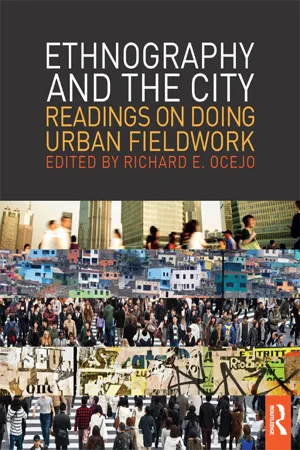
The only collection of its kind on the market, this reader gathers the work of some of the most esteemed urban ethnographers in sociology and anthropology. Broken down into sections that cover key aspects of ethnographic research, Ethnography and the City will expose readers to important works in the field, while also guiding students to the study of method as they embark on their own work.
- 260 pages
- English
- ePUB (mobile friendly)
- Available on iOS & Android
eBook - ePub
About this book
Information
PART I
Data Collection Strategies
SECTION I
Being There, Up Close
The sections in Part I feature readings that deal with two data collection strategies that urban ethnographers choose, specifically strategies that represent being immersed in a field site. The decisions fieldworkers make in designing their projects play a key role in the type and quality of the data they collect and analyze. The theme of this section is the importance of spending long periods of time in the field with participants. It specifically focuses on ethnographers who decide to live in the same neighborhoods and communities as the people they are studying, the benefits to data collection that this decision provides, and the obstacles they face in doing so. Such a theme would sound unusual to anthropologists, since living among participants, traditionally tribes and other indigenous groups in remote villages and rural areas in non-Western societies, has been a common disciplinary requirement in anthropology since its inception. And many anthropologists have used their training to focus on and live within urban environments in Western cities, some of which are featured in this volume (Liebow and Stack, Chapters 13 and 14) and in this section (Bourgois, Chapter 2). Living with the people they are studying is less a decision for anthropologists than it is a foregone conclusion.
But sociologists who use field methods do not necessarily face this disciplinary pressure. Much of sociological research uses quantitative forms of inquiry or other qualitative methods such as interviewing and content analysis. Still, many of sociology’s urban ethnographers have used the data collection strategy of living among participants to great effect, that is, in a manner that turns them into an expert of the setting and its social worlds who can then communicate the experience of “being there” upon leaving the field. The principal idea behind choosing to “be there, up close” for urban ethnographers is to learn details about a population, a place, and a culture that they would not from just being there most of the time or only at times when the “action” takes place. Neighborhoods and communities contain their own hidden rhythms that field researchers must directly observe and experience to fully understand. Behavior in the “backstage” areas (Goffman 1959) of private homes and leisure settings (and even the “backstage” time of night or off hours) often offers deeper insight into the public “front stage” lives people lead. As David Grazian (Chapter 8, this volume) notes in his research on the search for authenticity in the social worlds of blues clubs, it is in private spaces or backstage regions that “we reveal what we imagine to be our most authentic selves to our intimates and confidants” (2003, 11). Ethnographers also regularly seek out the back areas where their participants engage in “real” interactions, or those that reflect deeper meanings beyond their public displays. Embedding themselves in a field site for a sustained amount of time allows ethnographers to focus and narrow their analytical lens to reveal otherwise hidden dimensions of their field site and population. It provides a unique angle for collecting original data.
Many scholars have used being there as a central tenet of ethnographic research. Some have focused on its importance for data collection. In his introduction to a 2004 special journal issue entitled “Being Here and Being There: Fieldwork Encounters and Ethnographic Discoveries,” Robert Emerson points out the theme of discovery, or “‘bring back the news’ from unknown or misknown social worlds” (8), that ethnographers seek to accomplish by being among specific groups of people. As he states, this falls within the Chicago School tradition of fieldwork that places researchers up close to their participants. Andrew Abbott (1997) extols Chicago School scholars’ assertion that “no social fact makes any sense abstracted from its context in social (and often geographic) space and social time” (1152) as a significant intellectual foundation in sociological thought and research. By studying social facts within actual locations, sociologists uncover and develop theoretical explanations for the “constellation of forces” (1160) that influence social life.
Others have examined the importance of being there for analyzing data. Clifford Geertz (1988) entitles the first chapter in his book on anthropological writing “being there,” arguing that an ethnographer’s goal should be to provide readers with the experience of a place and its people. Ethnographic writing for Geertz is more than just reporting from the field. It is where “thick description,” or the researchers’ interpretations and explications of people’s meanings and social contexts, and the scientific endeavor of ethnography take place (see Geertz 1973). Reacting to the critiques of fieldwork within their discipline as a form of power over and domination of objectified groups (see Clifford and Marcus 1986; Marcus and Fischer 1986), anthropologists John Borneman and Abdellah Hammoudi (2009) focus in their volume on the practices of anthropology, rather than issues dealt with by textual analysis. Instead of continuing with or adding to the discursive analyses of the discipline, they instead look at how these critiques have affected experienced-based field research. While in need of self-reflection, Borneman and Hammoudi argue that looking at “being there,” as a set of knowledge- and power-generating practices, yields important insights into understanding such methodological concerns as truth, reflexivity, and objectification.
While being there is a fundamental element of ethnographic research, we should not forget that living among participants is a decision that fieldworkers make, not a requirement for obtaining good data. For some ethnographers doing so may not be possible or even necessary for answering the questions they have about their social problem or population. The nature of the field site and participants often factor into a researcher’s decision. For instance, Jonathan Wynn (Chapter 9, this volume; also see 2011) studies the practices and career paths of walking tour guides by going along on their tours and extensively interviewing them (and by, as we will see later in this volume, becoming a tour guide and leading walking tours himself). While settings are integral to them, walking tours traverse multiple places in the city, and tour guides are obviously not a spatially definable group. Following his intellectual focus, Wynn’s strategy for being there places him squarely in situ, on the actual tours, where he can experience and examine how the guides put their attitudes toward their work into practice on the city streets.
But for urban ethnographers such as those featured in this section, living among participants was a decision that allowed them to understand their subjects’ lives within their social contexts more clearly, to blend into the environment more easily, and to experience life in the place. Each of the following works deals with a specific population living in a neighborhood that is either mostly homogenous or experiencing a transition, such as displacement or gentrification. Among the themes of living with participants that these pieces feature are the benefits of discovering unknown and hidden meanings from experiencing daily life in a neighborhood, becoming too embedded in the lives of those studied such that a researcher’s critical distance and objectivity are compromised, and the potential issues of conducting research in multiple field sites.
This section starts with a piece by Herbert Gans from his classic work The Urban Villagers. Trained in fieldwork at the University of Chicago in the post-World War II “Second Chicago School” (Fine 1995), Gans ultimately received his Ph.D. in city planning. He used his background in ethnographic research to shed new light on what was an important issue in cities at the time. From 1957 to 1958 Gans lived in Boston’s West End neighborhood, which was predominantly first- and second-generation working-class Italian. The city slated it for demolition and redevelopment after declaring it a slum in 1953. An urban renewal strategy, slum clearance was a federally-supported attempt to improve city conditions through the demolition of existing buildings, the relocation of their residents, and the redevelopment of the area with new projects. City planners and policymakers labeled areas slums based on the presence of such physical conditions as substandard housing, which they assumed gave rise to deviant behavior. But Gans noticed that the social conditions of the people in the neighborhood did not factor into their assessments or plans. As he states in the book’s preface:
Contemporary city planning and professions such as education, social work, public recreation, public health, medicine, and psychiatry … use middle-class values to help low-income populations solve their problems and improve their living conditions. As a sociologist and city planner, I wanted to test the validity of this approach. I wanted to know what a slum was like, and how it felt to live in one, because many planners and caretakers believe that it is the source of much of the low-income population’s problem.
(1962, ix–x)1
By experiencing life in the West End, as no city official or developer in a position of power had done, Gans discovers that not only is it not a slum (as the book’s title suggests, he describes it as an “urban village,” or a small community within but separate from the city), but that the Italian residents did not possess deviant forms of middle-class values. Rather, they had their own working-class values that derived in part from a lack of access to the city’s resources. Their urban village situation of a community based on family, peer groups, and social class rather than ethnicity or an ethnic identity contributed to their reaction to urban renewal.
The piece featured in this volume deals with this very issue. Most of The Urban Villagers is a report that Gans made on life in the neighborhood, such as the importance of family and peer groups, not on urban renewal. But the Epilogue, where this piece comes from, focuses on how residents failed to take action against the relocation and redevelopment that loomed over their community throughout the fieldwork period. Gans finds that residents mostly went on with their normal daily lives despite impending displacement. They were confused by the redevelopment process, which bred skepticism that it would ever even take place, and felt socially disconnected from the outsider community leaders who spoke for them against slum clearance.
Being and living there among the working-class Italians at a vulnerable time in their lives affected Gans. Later in the Epilogue he remarks on what living and conducting research in the neighborhood did to change his feelings toward the people and their impending relocation: “I began to develop that identification with the people, and sympathy for their problems which is experienced by many participant-observers” (1962, 305). From living with and learning from the West End’s residents, Gans used the sociological findings in his report to take action and speak informatively on their behalf. Getting “up close” did not just result in an informative monograph on the importance of peer groups and social class in the formation of a conception of community that provides an explanation for their relative inaction in the face of displacement. Gans also used his empirical knowledge to “persuade renewal officials to reverse any still reversible policies to help the West Enders who were about to be displaced” (2007, 232). His example demonstrates the power and potential of this data collection strategy, while also raising the issues of maintaining critical distance and intervening in the lives of participants.
“I was forced into crack against my will,” states Philippe Bourgois in the first sentence of his book on crack dealers in New York City’s mostly Puerto Rican neighborhood of East Harlem, or “El Barrio,” in In Search of Respect. Bourgois moved into a tenement building in El Barrio in 1985 to study poverty and ethnic segregation in the middle of a wealthy city (in fact, the Census tracts immediately south of East Harlem, on the Upper East Side where Bourgois happened to grow up, rank among the nation’s wealthiest). The underground drug economy was one of many themes he wished to explore. It was not long after he moved into the neighborhood and actually lived among the real conditions that statistics of poverty and violence represent that Bourgois realized how important crack dealing and use were in shaping daily life on the street. His opening line is an example of the influence that living in the neighborhoods of the people they are studying has on urban ethnographers.
Highly character-driven, In Search of Respect focuses in particular on two crack dealers named Primo and Caesar. Bourgois used his tape recorder to capture his experiences and conversations with them, on the street, in the Game Room (their crackhouse), and in schoolyards. The narrative regularly pauses as guns fire in the distance and the two men drink and do drugs. Since he makes himself a central character, we learn much about the neighborhood from Bourgois’s retelling of how he gained entry in the crack dealers’ ring. As one of the only white men on the street the dealers assume he is either an undercover cop or a drug addict. After getting introduced through a neighbor, over time he gradually earns the men’s trust and gets close to them and their drug-dealing enterprise.2 He gets so close, in fact, that he sometimes challenges the men’s self-reflections to their faces (e.g. 1995, 116–117). The closeness and familiarity allow him to probe deeper into the hidden meanings they hold about their lives. Bourgois also breaks an ethnographic aim of remaining objective and not making moral judgments about participants’ behavior. In an especially poignant moment, Caesar and Primo brag with their typical macho attitude about how they used to beat special education students in school. Bourgois, whose infant son had just been diagnosed with cerebral palsy, rebukes them for their behavior and fights back tears (1995, 188–189).
This section’s piece focuses on how children and mothers deal with the realities of living in a neighborhood where crack is a way of life. From living in El Barrio Bourgois learns that children are important to its inhabitants’ daily life as well as clear examples of the impact crack has on them. He introduces Angel and Junior, two youths who struggle with the conditions of their segregated neighborhood, and Maria, Primo’s girlfriend, who is overjoyed by her pregnancy despite Primo’s impending court case and lack of legal employment, which will potentially make her and her baby’s lives a struggle from the outset. Bourgois brings his infant son around with him in the neighborhood, and the affection that strangers show heartens him. However, overall the chapter presents a sad, difficult environment for children and mothers to achieve and gain respect.
Urban ethnographers do not just study the conditions and lives of people in poor neighborhoods. They also focus on how neighborhoods are changing and how their residents ...
Table of contents
- Cover Page
- Half-title Page
- Series Page
- Title Page
- Copyright Page
- Table of Contents
- Series Foreword
- Preface
- Introduction: Sociology’s Urban Explorers
- Part I: Data Collection Strategies
- Part II: Relationships with Participants
- References
- Copyright Acknowledgments
- Index
Trusted by 375,005 students
Access to over 1.5 million titles for a fair monthly price.
Study more efficiently using our study tools.
Frequently asked questions
Yes, you can cancel anytime from the Subscription tab in your account settings on the Perlego website. Your subscription will stay active until the end of your current billing period. Learn how to cancel your subscription
No, books cannot be downloaded as external files, such as PDFs, for use outside of Perlego. However, you can download books within the Perlego app for offline reading on mobile or tablet. Learn how to download books offline
Perlego offers two plans: Essential and Complete
- Essential is ideal for learners and professionals who enjoy exploring a wide range of subjects. Access the Essential Library with 800,000+ trusted titles and best-sellers across business, personal growth, and the humanities. Includes unlimited reading time and Standard Read Aloud voice.
- Complete: Perfect for advanced learners and researchers needing full, unrestricted access. Unlock 1.5M+ books across hundreds of subjects, including academic and specialized titles. The Complete Plan also includes advanced features like Premium Read Aloud and Research Assistant.
We are an online textbook subscription service, where you can get access to an entire online library for less than the price of a single book per month. With over 1.5 million books across 990+ topics, we’ve got you covered! Learn about our mission
Look out for the read-aloud symbol on your next book to see if you can listen to it. The read-aloud tool reads text aloud for you, highlighting the text as it is being read. You can pause it, speed it up and slow it down. Learn more about Read Aloud
Yes! You can use the Perlego app on both iOS and Android devices to read anytime, anywhere — even offline. Perfect for commutes or when you’re on the go.
Please note we cannot support devices running on iOS 13 and Android 7 or earlier. Learn more about using the app
Please note we cannot support devices running on iOS 13 and Android 7 or earlier. Learn more about using the app
Yes, you can access Ethnography and the City by Richard E. Ocejo in PDF and/or ePUB format, as well as other popular books in Scienze sociali & Metodologia e ricerca nelle scienze sociali. We have over 1.5 million books available in our catalogue for you to explore.