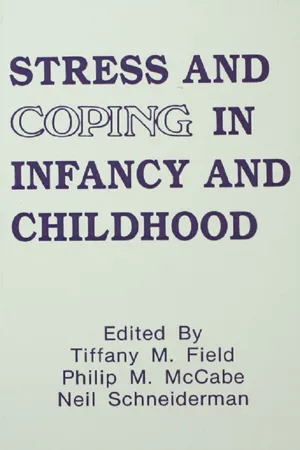
The fourth volume based on the annual University of Miami symposia on stress and coping, this new addition to the series is the first to focus on developmental and clinical stressors during infancy and childhood. While developmental stressors such as early separation and stranger anxiety, novelty stress, and fear-evoked personal distress, arise during normal development, clinical stressors result from certain conditions that are relatively common in infancy and early childhood such as premature birth and respiratory disease.
Various therapies are discussed -- for example, relaxation and massage -- that can alleviate the stress associated with psychiatric conditions in childhood and adolescence, including depression and adjustment disorder. The result is an integration of diverse research and theory on the psychophysiological, developmental, and psychosocial aspects of stress and coping in animals and humans by some of the leading researchers in the field.
eBook - ePub
Stress and Coping in Infancy and Childhood
- 270 pages
- English
- ePUB (mobile friendly)
- Available on iOS & Android
eBook - ePub
Stress and Coping in Infancy and Childhood
About this book
Information
Publisher
Psychology PressYear
2013Print ISBN
9781138996540
9780805809442
Edition
1eBook ISBN
9781134764891
I
Developmental Stressors
1
Infant Stress Reactions to Brief Maternal Separations in Human and Nonhuman Primates
Maternal separation is one of the two most commonly studied psychosocial stressors of infancy. The other one, interaction with strangers, is frequently a component of separation (e.g., Ainsworth & Wittag, 1969). Developmental psychologists have focused on the behavior infants display during separation (e.g., Ainsworth, Blehar, Waters, & Wall, 1978; Schaffer & Emerson, 1964; Weinraub & Lewis, 1977). In contrast, developmental psychobiologists and neuroscientists have focused on the physiological consequences of maternal separation (e.g., Coe, Wiener, Rosenberg, & Levine, 1985; Hofer, 1987; Levine & Wiener, 1988; Reite, Kaemingk, & Boccia, 1989), and on the physiological substrates of separation behavior (e.g., Kalin, Shelton, & Barksdale, 1988; Kehoe & Blass, 1986; Kraemer, Ebert, Lake, & McKinney, 1984).
One conclusion from all of the research is that there are at least two distinct phases in the infant’s response to maternal loss (Bowlby, 1969; Hofer, 1984). The initial minutes and hours of separation are termed the protest phase, during which the infant actively seeks to reestablish maternal contact. This phase may be followed 1 to 2 days later by a despair phase similar to the depression often noted during bereavement in adults. Although Bowlby proposed that both phases were regulated by the emotional response to loss, the data do not support this conclusion. The two phases can be decoupled. In addition, reactions occurring during each phase have different regulators (e.g., Hofer, 1984, 1987).
In this review, we focus on the protest phase, the only phase involved when separations are brief. We have chosen to focus on this phase because (a) most of the behavioral and physiological data on human infants deal with separations of only a few minutes; and (b) reactions to brief separations are of import these days because of concerns about infant day care. Emphasizing the protest phase, we deal with the following questions: What are the physiological changes that occur during this phase of separation? How is the infant’s affective behavior related to these physiological changes? What are the situational factors that make separations more and less stressful? And finally, what do we know about individual differences and developmental change?
Physiological Changes During Brief Separations
Separations of a few minutes to a few hours produce a set of physiological changes indicative of stress in the young of many mammalian species. Dramatic increases in heart rate, Cortisol, and catecholamines have been documented in a number of species (see review by Hofer, 1987). For example, in the rhesus monkey, whose endocrine system is similar to our own, 30 minutes of separation can elicit increases of 40 to 60 μg/dl in circulating levels of Cortisol (Gunnar, Gonzales, Goodlin, & Levine, 1981; Smotherman, Hunt, McGinnis, & Levine, 1979). This corresponds to increases of 100 to 200%. In juvenile squirrel monkeys, separations of 1 and 6 hours produce significant increases in cerebral spinal fluid metabolites of dopamine, serotonin, and norepinephrine that indicates heightened anxiety (Coe et al., 1985). In both macaque and squirrel monkeys, changes in immune functioning have been documented in separations lasting only a few hours, including decreases in white blood cell counts, increases in complement proteins, and decreases in thymic hormone (Friedman, Coe, & Ershler, under review).
There have been very few studies of physiological changes during brief separations in human infants. Nonetheless, the work that has been done suggests that similar physiological changes are produced. Thus, increases in heart rate have been noted during maternal separation, including tachycardia associated with intense crying (Donovan & Leavitt, 1985). Changes in brain activity have also been noted: Fox and Davidson (1988) showed an increase in right frontal activity associated with negative affect during separation in 10-month-olds. Many of these changes have been less dramatic than those produced in monkeys, perhaps because of differences in the quality of the separation environments.
For example, neuroendocrine changes have been more difficult to document. In an early study, Tennes and her colleagues (Tennes, Downey, & Vernadakis, 1977) examined Cortisol excretion rates in year-old infants subjected to a one-hour separation in the home. They found a 22% increase in Cortisol that was not statistically significant. Recently, we (Gunnar, Mangelsdorf, Larson, & Hertsgaard, 1989) examined salivary Cortisol concentrations before and after administration of the Louisville Temperament Assessment to 9-month-old infants. The Louisville assessment involves two separations lasting about 30 minutes each, during which the baby interacts with two different strangers who administer a series of predetermined tasks. Like Tennes et al., we observed a 22% increase in Cortisol that was statistically significant in our sample (see Table 1.1). However, to complicate matters, postassessment Cortisol levels were not significantly different from levels obtained at home under basal conditions. Furthermore, using the same infants at 13 months, we examined responses to the Strange Situation assessment involving only a few minutes of separation. Here we obtained only a 10% increase that was not statistically significant. However, this may have been because we sampled the adrenocortical response too early, before it had reached its peak.
Table 1.1
Salivary Cortisol in μg/dl Means and Standard Errors

Note. Ns ranged from 52 to 61. Values expressed as μg/dl. Numbers in parentheses are standard errors. Adapted from Gunnar et al. (1989).
None of these studies provided unambiguous evidence of a neuroendocrine response to separation in human infants. The only unambiguous evidence comes from a study we (Larson, Gunnar, & Hertsgaard, 1991) recently completed in which the Cortisol response to a 30 minute laboratory separation in 9-month-olds was compared to the response to 30 minutes of play with mother present. These data (see Fig. 1.1) clearly indicate that maternal separation elevates Cortisol at this age over the levels observed when the mother is present. However, they also point to the problem of concluding that the separated infants were in a state of physiological stress. The Cortisol response was small, and postseparation concentrations were not that different from Cortisol levels obtained at home at the same time of day.

Fig. 1.1. Salivary Cortisol at home and in the laboratory during either a 30 minute separation or a 30 minute play period with mother. (Difference between Home Pre and Lab Pre reflects the calming effect of riding in the car.) Reprinted from Larson et al. (1991) Child Development.
Relations Between Physiological and Behavioral Reactions
Brief separations produce a variety of behavioral effects. As noted, all of these effects were once viewed as reflecting a unitary emotional response to maternal loss (Bowlby, 1973). However, the current evidence suggests that, at the very least, during the protest phase we need to distinguish emotional behavior triggered by the enforced separation from emotional behavior reflecting infant reactions to the separation environment (Hofer, 1987). Furthermore, we argue that the emotional arousal produced during the protest phase of separation reflects the interaction among at least four emotion-behavior systems. First there are the attachment behaviors organized around attempts to elicit retrieval and reestablish contact. These include signaling and search behavior. Next there are withdrawal behaviors reflecting fear. These include freezing, inhibition of play and exploration, and sometimes threat gestures to fear-eliciting elements of the environment. Third, there are vocal and gestural reflections of frustration and anger at being blocked from achieving maternal contact. Finally, there are the behaviors organized around affect regulation, including clinging to surrogate caregivers, self-stimulation, and distraction. Only the first two of these, attachment (signaling/calling) and fear-anxiety (behavioral agitation and freezing), have received much attention in the neuroscience literature.
The endogenous opiate system appears to be most intimately involved in regulating the attachment behaviors of searching and signaling. Panksepp (e.g., Herman & Panksepp, 1978) has argued that this system plays a central role in affiliation and attachment. Consistent with this argument, it has now been demonstrated in several species that morphine reduces the number and intensity of the infant’s “calls for mother” during separation, and that naloxone, an opiate antagonist, increases these calls and blocks the morphine effect (Herman & Panksepp, 1978; Kalin et al., 1988). Morphine also reduces the physiological stress of separation, producing significant reductions in the adrenocortical response (Kalin et al., 1988). These reductions can be blocked by prior treatment with naloxone.
Stimulation that triggers endogenous opioid activity reduces separation calls. Endogenous opioids can be triggered by pleasant social interactions (Panksepp, Herman, Vilberg, Bishop, & De Eskinazi, 1978), the consumption of milk, sugars, and fats (Blass, Shide, & Weller, 1989), and by stress (Akil, Madden, Patrick, & Barchas, 1976). As later discussed, stimulation of endogenous opioid system may partly explain why companionship during separation so potently reduces the stress of separation (Panksepp et al., 1978; but see also Blass, Fillion, Weller, & Brunson, in press, for a counterargument). Increases in endogenous opioids also may be one factor influencing the time-course of separation calling. During separation, calling and search behavior decreases. In infants who have been calling from the onset, the decrease in calling typically begins 20 to 30 minutes into separation. This is about the point when increases in endorphins triggered as part of the activation of the hypothalamic-pituitary-adrenocortical responses would be at high or peak concentrations. Anecdotally, this is also the time when, in human infants, one begins to notice the baby rubbing its eyes and acting sleepy. It may be that in a supportive environment, the combined effects of tiredness from increased energy expenditure, and endorphin-related reductions in the acute sense of loss are what allow some babies to quiet down and fall asleep (see Tennes et al., 1977).
Fear and anxiety, the second major emotion-behavior component of the separation response, appear strongly affected by the nature of the separation environment (Kalin & Shelton, 1989). Not surprisingly, manipulations of the neurochemical substrates of fear and anxiety have potent effects on the infant’s fearful and anxious behavior. For example, Kalin et al. (1988) have provided evidence that the endogenous benzodiazepine system plays a role in regulating behavioral inactivity and social withdrawal as well as signaling behavior during brief separations. The major neurotransmittors may also be involved; however, their role in regulating separation vocalizations is still under debate. Kalin and Shelton (1988) have presented evidence that both the alpha and beta adrenergic systems may play a role in regulating behavioral agitation during separation. But, they noted that in order to reduce separation calling, pharmacological manipulations of the norepinephrine system had to be dramatic enough to produce general sedation.
Fear behaviors during separation may be regulated in part by the hypo-thalamic-pituitary-adrenocortical (HPA) system. Kalin, Shelton, and Barksdale (1989) found that intraventricular injections of corticotrophin releasing hormone (CRH) increased freezing and inactivity during a one-hour separation in rhesus infants. Similarly, Levine and his colleagues (Coe et al., 1985) found that pretreatment with metyrapone, which blocks Cortisol production and produces hypersecretion of CRH under stress conditions, resulted in extreme behavioral inhibition in separated infant squirrel monkeys. The levels of CRH required to produce behavioral inhibition, however, are quite high and may naturally occur only with extremely intense activation of the HPA axis. Cortisol (and consequently CRH) levels produced during separation using typical monkey separation paradigms are positively correlated with behavioral agitation, not freezing (Gunnar et al., 1981).
So far, little attention has been paid to anger as a component of the protest response. Nonetheless, anger may be especially important in understanding the human infant’s response. In a recent analysis of discrete facial expressions, Izard and his colleagues (Shiller, Izard, & Hembree, 1986) noted that few infants displayed fear and only a few infants displayed sadness in response to the brief separations in Ainsworth’s Strange Situation. In contrast, anger was frequently noted. Anger is the emotion associated with goal-blocking and loss of anticipated control over desired outcomes. In monkeys, separation situations that should elicit anger are associated with heightened vocalizations, cage shaking, and moderate rather than extreme elevations in Cortisol and cerebral spinal fluid concentrations of norepinephrine metabolites (Bayart, Hayashi, Faull, Barchas, & Levine, 1990). Such conditions have been created by placing a plexiglas barrier between mother and infant during separation: the baby thus can see but not get to the mother. Levine (Levine, Johnson, & Gonzalez, 1985) has argued that these conditions reduce the HPA response to separation because seeing the mother helps sustain the infant’s active attempts to cope with or control the situation.
For ethical reasons, the situations used to study separation in human infants all contain cues that should prevent the baby from feeling helpless. The mother leaves the baby of her own accord (as opposed to being captured and removed); she frequently says goodbye and indicates that she will return soon (a pattern that Western infants should have experienced enough to associate with separations of a finite period); and the infant is rarely left without an alternative caregiver or babysitter. It would make sense, then, that much of the distress observed during brief, laboratory studies of separations in human infants may reflect anger.
This conclusion is consistent with available physiological and neuroendocrine data. Fox and Stifter (1989; Stifter & Fox, in press) have recently described the results of a longitudinal investigation of vagal tone in human infants. Infants with high vagal tone were shown to respond with more intense behavioral distress to limb restraint at ...
Table of contents
- Cover Page
- Half Title page
- Series Page
- Title Page
- Copyright Page
- Contents
- Preface
- PART I Developmental Stressors
- Clinical Stressors
- Author Index
- Subject Index
Trusted by 375,005 students
Access to over 1.5 million titles for a fair monthly price.
Study more efficiently using our study tools.
Frequently asked questions
Yes, you can cancel anytime from the Subscription tab in your account settings on the Perlego website. Your subscription will stay active until the end of your current billing period. Learn how to cancel your subscription
No, books cannot be downloaded as external files, such as PDFs, for use outside of Perlego. However, you can download books within the Perlego app for offline reading on mobile or tablet. Learn how to download books offline
Perlego offers two plans: Essential and Complete
- Essential is ideal for learners and professionals who enjoy exploring a wide range of subjects. Access the Essential Library with 800,000+ trusted titles and best-sellers across business, personal growth, and the humanities. Includes unlimited reading time and Standard Read Aloud voice.
- Complete: Perfect for advanced learners and researchers needing full, unrestricted access. Unlock 1.5M+ books across hundreds of subjects, including academic and specialized titles. The Complete Plan also includes advanced features like Premium Read Aloud and Research Assistant.
We are an online textbook subscription service, where you can get access to an entire online library for less than the price of a single book per month. With over 1.5 million books across 990+ topics, we’ve got you covered! Learn about our mission
Look out for the read-aloud symbol on your next book to see if you can listen to it. The read-aloud tool reads text aloud for you, highlighting the text as it is being read. You can pause it, speed it up and slow it down. Learn more about Read Aloud
Yes! You can use the Perlego app on both iOS and Android devices to read anytime, anywhere — even offline. Perfect for commutes or when you’re on the go.
Please note we cannot support devices running on iOS 13 and Android 7 or earlier. Learn more about using the app
Please note we cannot support devices running on iOS 13 and Android 7 or earlier. Learn more about using the app
Yes, you can access Stress and Coping in Infancy and Childhood by Tiffany M. Field,Philip Mccabe,Neil Schneiderman in PDF and/or ePUB format, as well as other popular books in Psychology & History & Theory in Psychology. We have over 1.5 million books available in our catalogue for you to explore.