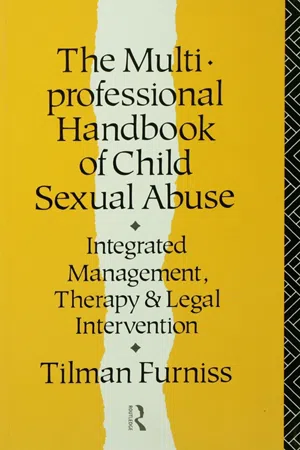
Child sex abuse is a minefield of complexity and confusion for all involved. A genuinely multidisciplinary problem, it requires the close co-operation of a wide range of people with different tasks, from the clinical treatment specialists through to the police and legal system. Tilman Furniss, a leading figure in the field of child sexual abuse, has written a unique, practical handbook designed for all professionals involved in the treatment and care of sexually abused children and their families. Based on fifteen years' innovative work, this book will help professionals develop knowledge and skills to deal with their particular task, and at the same time help them to understand the effects of their actions on the work of other professionals.
eBook - ePub
The Multiprofessional Handbook of Child Sexual Abuse
Integrated Management, Therapy, and Legal Intervention
- 384 pages
- English
- ePUB (mobile friendly)
- Available on iOS & Android
eBook - ePub
The Multiprofessional Handbook of Child Sexual Abuse
Integrated Management, Therapy, and Legal Intervention
About this book
Information
Part One
Principle Ways
Chapter One
From Mad to Bad: Multi-Professional and Metasystemic Starting Point
1.1 Legal Abuse and Psychological Damage
The increasing awareness of child sexual abuse amongst professionals has its origin in two related but very different sources. The first is the growing children’s rights movement which in the historic context of the human rights movement is following the women’s rights movement. The second source is the increasing knowledge and concern about child health and child mental health. Child sexual abuse needs to be seen both as a children’s-rights issue and as a health and mental health problem (Beezley Mrazek, 1981b). Child protective agencies and legal professionals intervene from a normative perspective to protect children from abuse and to punish perpetrators for the crime, whereas mental health workers set up treatment programmes to deal with the psychological sequelae of child sexual abuse. The reasons for intervening may therefore be purely legal or it may be purely therapeutic or a mixture of both, in which case it is absolutely essential to distinguish between the two aspects and clarify the relationship between them.
Traditionally, legal and normative interventions are regarded as being incompatible with therapeutic approaches. The seemingly irreconcilable principles and aims of legal and therapeutic approaches is reflected in a split between the professionals of these two domains. On the one hand we find qualified and competent professionals working in the legal field and in child protective services, who from a legal point of view are highly skilled in dealing with criminal issues and child protective aspects of child sexual abuse. At the same time these professionals are often unable to identify the psychological problems in child sexual abuse as an interlocking sydrome of secrecy and addiction. They are unable to use the therapeutic potential of the individual and family crisis they create when they intervene on the legal level. This does not only mean missing an opportunity of great therapeutic potential. The lack of psychological knowledge in the legal intervention itself may even defeat its own purpose resulting in ‘crime-promoting crime prevention’ or ‘abuse-promoting child protection’. The legal intervention may therefore not only fail in its own aim but may inflict additional secondary psychological damage on the child. (See The interprofessional process in context, 5.2.)
On the other hand we find highly skilled therapists who deal with psychological damage to children and with dysfunctional family relationships. Mental health professionals, however, often do not know how to deal with normative aspects and with the linear and legal tasks of child protection and further crime prevention. Individual and family therapists are often negligent if not dismissive of legal and linear aspects. They positively refuse to treat patients and families when the law is involved because they see any legal involvement as incompatible with a therapeutic stance. If they get involved at all, they do not know how to deal therapeutically with the legal aspects. Usually they try to ignore the legal process.
The result of this dichotomy is that the two sides do not meet, do not understand each other and fail to co-operate. Therapists feel that police and judges ‘put the boot in’ whereas police and child protective services may regard therapists as ‘softies who destroy evidence and fail to protect’. Where legal requirements force therapists to co-operate with statutory agencies this tends to be kept to a formal minimum and is not used to foster an integrated understanding of the overall process.
When professionals get involved in child sexual abuse normative and mental health aspects need to be integrated and differentiated in an overall approach in which therapists may have to rely on the support of legal agencies for their own therapy as much as legal professionals may need to understand the psychological dimension of child sexual abuse as syndrome of secrecy and addiction in order to do their own professional work. Both sides need to change their way of working and both sides need to give up cherished and basic notions of professional independence.
1.1.1 Legal Aspects and Linearity
On the legal level child sexual abuse is defined by implicit or explicit normative statements within the context of specific cultural, social and legal systems. Normative definitions relate to acceptable or unacceptable child rearing practices and to the position of children in different societies. They describe the norms, limits and boundaries of appropriate and acceptable behaviour of adults towards children. Schechter and Roberge (1976: 129) have given one of the best known and most helpful normative definitions: ‘The sexual exploitation of children refers to the involvement of dependent developmentally immature children and adolescents in sexual activities that they do not fully comprehend, are unable to give informed consent to and that violates the social taboos of family roles.’ I would add to this ‘and which aim at the gratification of sexual demands and wishes of the abuser’ in order to include the crucial intentional element of the abuser to abuse. This normative definition highlights the notion of structural dependence of children and the inability to give informed consent to sexual relationships. It points to children’s right to grow up without sexual interference by adults for their own satisfaction. Underlying most normative definitions is the notion that sexual relationships between adults and children constitute child abuse because sexual relationships should only be formed with free will and out of free choice without coercion. In addition both sexual partners need to be able to give full and informed consent to any sexual act in which they get involved.
In differentiating between human rights aspects and mental health issues in child sexual abuse we cannot and must not make the equation that all sexually abused children are automatically psychiatrically disturbed, although all may be confused to some degree by the experience (Baker, 1983) (See Therapy and protection work, 7.2.2). We need to be extremely careful when we interpret figures of incidents and prevalance of child sexual abuse. When Russell (1983), in a study of sexual abuse in San Francisco, describes 38 per cent of women as being sexually abused at least once by the age of 18 then we have to be aware that this figure is formed on the basis of a normative and not a mental health definition. We therefore cannot draw the conclusion that 38 per cent of women in San Francisco are psychiatrically disturbed by their experience of child sexual abuse. But it also means that regardless of how many of the 38 per cent of women are psychologically damaged, the abuse is in normative terms still abuse and should not happen. We need to be very careful not to confuse the two different elements, judging the severity of the violation of legal norms through the outcome of physical or psychological damage. This would mean saying that sexual abuse is only abuse when we find psychological damage, as if bank robbery were only a crime when the bank manager gets a nervous breakdown. Conversely, it is quite inappropriate to use the fact that child sexual abuse in normative terms is so widespread to argue the case that we should not worry about the health or mental health effects of child sexual abuse because the experience is numerically nearly ‘normal’.
The mental health and the legal arguments are related but they have nevertheless quite separate roots. The confusion in child sexual abuse between legal and health definitions arises from the difference in the social attitude in our society towards physical and sexual violation of children’s integrity. In physical abuse ‘a little bit of physical violence’ is regarded as acceptable and only severe forms of physical punishment or violence are identified as abuse. The normative definition of physical abuse is therefore much more equated with an unacceptable degree of physical force or violence rather than with its presence in principle.
In contrast any sexual violation of the child’s integrity is labelled as abuse and the normative definition is much narrower for sexual abuse than for physical abuse. While no parent will be taken to court and no child put into care when parents smack the child’s bottom, a father may well end up in prison and the child may be taken into care for any slight rubbing of the child’s genitals. Whereas ‘a bit of violence’ is acceptable, ‘a bit of sex’ is not. This relates to the fact that socially it is less tolerable to display open sexual behaviour than to act with physical violence. However the more narrow normative definition of child sexual abuse also has a rationale in terms of intervention. The specific problems in dealing with child sexual abuse as an interlocking syndrome of secrecy and addiction makes control, protective intervention and therapy much more difficult and complex than with physical abuse. (See The individual process, Chapter 2.)
The current legal and child protective problems in child sexual abuse are compounded by the fact that in the developing children’s rights movement the child is increasingly becoming a subject before the law in his or her own right. The structural dependence of children as a result of the lack of biological maturation prevents children from exercising their right fully to take their position as independent subjects before the law, which at present is mainly geared to the provision of justice towards adults who are able to take full independent personal responsibility for their actions. The incompatible legal position of the child as a subject before the law without being able fully to realise this role is increasingly leading to changes in legal procedures which have to take the structural dependence of children into account.
The biological lack of maturation on emotional, social and cognitive levels results in a different quality of children’s communications and their way of behaving, relating and thinking. Up to now the qualitative difference between adult and child communication is in the legal system taken as merely a quantitative difference, with the result that in cases of conflict ‘children lie and adults speak the truth’. This basic and fundamental legal concept has to my knowledge never been proven by legal professionals. I as clinician do not see that the concept that adults speak the truth and children lie can be supported by any evidence. The existence of this precarious basic legal concept relies on the inappropriate reduction of the qualitative difference in the child’s communication into a lesser quantitative version of mature adult communication. To refuse to acknowledge the different quality of children’s communication would be like saying that a blind person cannot swear an oath because he or she cannot read a normal Bible.
Primary legal and child protective interventions in child sexual abuse are not related to psychological damage in the child. The legal process and the child protective intervention therefore proceed whether the child is psychologically affected by the abuse or not. Secondary psychological damage may then be easily inflicted in legal or child protective interventions because developmental psychological concepts are not genuinely part of the legal domain and are only taken into account by courts and other legal agencies as far as legal procedures admit.
1.1.2 Mental Health and Circularity
The second group of professionals which got involved in child sexual abuse are workers in the field of child health and child mental health. These professionals are not primarily interested in the notion of the child as a legal subject or in issues of children’s rights. Health and mental health professionals try to identify and to deal with factors which lead to physical and psychological damage of the child.
Mental health definitions of child sexual abuse address themselves to psychological aspects and to developmental factors in the psycho-sexual development of the child. Anna Freud directs her definition of child sexual abuse to the description of factors in the child’s psycho-social and psycho-sexual development which effect normal processes of maturation. She states that in child sexual abuse the child ‘cannot avoid being physically aroused and this experience disastrously disrupts the normal sequence in his sex organisation. He is forced into premature phallic or genital development while legitimate developmental needs and accompanying mental expressions are by-passed and short-circuited’ (Anna Freud, 1981, pp. 33–4). This quotation is part of a longer description. It is not important whether we agree with the content of this mental health definition or the content of the previous normative definition. The important practical difference is that normative definitions as part of the social, cultural and political domain can be defined unconditionally according to opinions and beliefs. Normative definitions can therefore change freely and rapidly through cultural and political changes which are represented in the law. Health and mental health definitions are part of the scientific domain which requires proof through physical and mental health examination. Mental health definitions must be operationalised and have to be supported by data.
Valid and reliable data are still very scarce in child sexual abuse. The work of others and ourselves, however, allows in a very careful and very preliminary conclusion, to state that psychological damage in child sexual abuse may be positively related to the following seven factors (Finkelhor, 1979, 1980; Baker, 1983; Baker and Duncan, 1985; Oppenheimer et al., 1985; Furniss, 1988):
- The age at onset of the abuse.
- The duration of the abuse.
- The degree of violence or threat of violence.
- The age difference between abuser and the abused child.
- How closely abuser and child are related.
- The absence of protective parental figures.
- The degree of secrecy.
1.13 The Interlocking Process
We need to link the legal and the health and mental health domain. In a legal context the abused child may be removed from parents because a law has been broken and the child has the legal right to be protected from further abuse. In terms of mental health, however, this legal protection may be an extemely bad service to the child when the abuse in itself does not lead to significant psychological or developmental damage, while the lawful removal of the child and possible family breakdown as a consequence of the legal process precipitates secondary psychological trauma and psychiatric disturbance in the child. Conversely, in the early years I myself have been involved in preventing child protective services from intervening. I tried to resolve the therapeutic and child protective problem in child sexual abuse purely by traditional forms of individual therapy and family therapy. The metasystemic analysis of this therapy revealed that I as therapist had become part of the family’s system of secrecy. Therapy became ‘anti-therapeutic therapy’ with the effect that the child remained unprotected. The abuse continued under increased threat to the child and under decreased risk of disclosure to the abuser and was worse and more damaging than before.
1.2 Responsibility, Participation, Guilt, Power and Blame
It has been most useful to examine the different concepts of responsibility, participation, guilt, power and blame in a metasystemic framework of linearity and circularity in order to help distinguish between child protective, legal and therapeutic aspects of child sexual abuse. A linear relationship is a relationship which is not open to any form of redefinition through any reinterpretation or punctuation of the interaction. Circularity defines interactional aspects of interpersonal relationships which can be equally attributed to both partners according to the context (Selvini-Palazzoli et al., 1978). The distinction between the linear and legal concept of responsibility and the circular and psychological concept of participation, and the legal and psychological aspects of the concept of guilt, are of great practical and therapeutic importance in child sexual abuse.
1.2.1 Structural Dependence and Responsibility
Biological factors of maturation determine the degree of structural dependence of children on parenting figures starting from total dependence in babyhood and leading to independence and full individual responsibility of adults. In terms of normal childhood development, the child ceases to be a child the moment his physical, cognitive, emotional and social development has reached the stage which allows the child to make independent decisions, take full responsibility for all activities and potentially care for himself, and support himself independently. The legal inequality between parents and children, in which parents are always, and children never, legally responsible for what happens within the interaction between them is based on the biological immaturity of children. Childhood can therefore in simple, but in operationally clear, terms be defined as ‘structural dependence on an adult for physical, emotional, cognitive and social care and protection due to the lack of biological maturation’. Structural dependence of children means that children must be able to trust that whatever a parent does is on the whole good for the child and furthering the child’s development.
1.2.2 Participation
Active participation in sexual abuse constitutes the circular and relationship element. The distinction between the legal concept of responsibility and the psychological concept of participation is often confused. The contention that all children are actively involved in the abuse is then wr...
Table of contents
- Cover
- Half Title
- Title Page
- Copyright
- Dedication
- Contents
- List of figures
- Preface
- Introduction
- Part one: Principle ways
- Part two: Practical problems
- References
- Index
Trusted by 375,005 students
Access to over 1.5 million titles for a fair monthly price.
Study more efficiently using our study tools.
Frequently asked questions
Yes, you can cancel anytime from the Subscription tab in your account settings on the Perlego website. Your subscription will stay active until the end of your current billing period. Learn how to cancel your subscription
No, books cannot be downloaded as external files, such as PDFs, for use outside of Perlego. However, you can download books within the Perlego app for offline reading on mobile or tablet. Learn how to download books offline
Perlego offers two plans: Essential and Complete
- Essential is ideal for learners and professionals who enjoy exploring a wide range of subjects. Access the Essential Library with 800,000+ trusted titles and best-sellers across business, personal growth, and the humanities. Includes unlimited reading time and Standard Read Aloud voice.
- Complete: Perfect for advanced learners and researchers needing full, unrestricted access. Unlock 1.5M+ books across hundreds of subjects, including academic and specialized titles. The Complete Plan also includes advanced features like Premium Read Aloud and Research Assistant.
We are an online textbook subscription service, where you can get access to an entire online library for less than the price of a single book per month. With over 1.5 million books across 990+ topics, we’ve got you covered! Learn about our mission
Look out for the read-aloud symbol on your next book to see if you can listen to it. The read-aloud tool reads text aloud for you, highlighting the text as it is being read. You can pause it, speed it up and slow it down. Learn more about Read Aloud
Yes! You can use the Perlego app on both iOS and Android devices to read anytime, anywhere — even offline. Perfect for commutes or when you’re on the go.
Please note we cannot support devices running on iOS 13 and Android 7 or earlier. Learn more about using the app
Please note we cannot support devices running on iOS 13 and Android 7 or earlier. Learn more about using the app
Yes, you can access The Multiprofessional Handbook of Child Sexual Abuse by Tilman Furniss in PDF and/or ePUB format, as well as other popular books in Psychology & History & Theory in Psychology. We have over 1.5 million books available in our catalogue for you to explore.