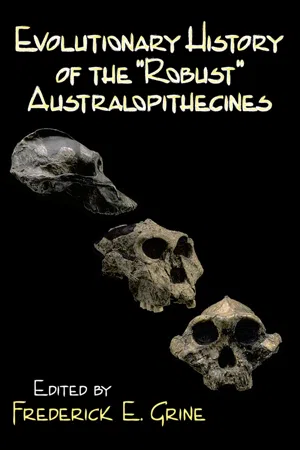
In paleoanthropology the group of hominids known as the "robust" australopithecines has emerged as one of the most interesting. Through them we have the opportunity to examine the origin, natural history, and ultimate extinction of not just a single species, but of an entire branch in the hominid fossil record. It is generally agreed that the human lineage can be traced back to this group of comparatively small-brained, large-toothed creatures. This volume focuses on the evolutionary history of these early hominids with state-of-the-art contributions by leading international authorities in the field. Although a case can be made for a "robust" lineage, the functional and taxonomic implications of the morphological features are subject to vigorous disagreement. An area of lively debate is the possible causal relationship between the presence of early Homo and the origin, evolution, and virtual extinction of "robust" australopithecines.This volume summarizes what has been learned about the evolutionary history of the "robust" australopithecines in the 50 years since Robert Broom first encountered the visage of a new kind of ape-man from Kromdraai. New discoveries from Kromdraai to Lomekwi have served to keep us aware that the paleontological record for hominid evolution is hardly exhausted. Because of such finds no single volume can hope to stand as a summary on the "robust" australopithecines for very long, but this classic volume comes close to achieving this goal. The book sheds new light upon some old questions and also acts to provide new questions. The answers to those questions bring us closer to a fuller understanding and appreciation of the origins, evolution, and ultimate demise of the "robust" australopithecines. Since the "robust" australopithecines most likely stand as our closest relatives, a better understanding of their origin, history, and demise serves to provide heightened appreciation of the course of human evolution itself. This definitive volume addresses the questions and problems surrounding this important lineage.
- 550 pages
- English
- ePUB (mobile friendly)
- Available on iOS & Android
eBook - ePub
Evolutionary History of the Robust Australopithecines
About this book
Information
| Studies of the Craniodental Evidence | I |
| Enamel Thickness and Development in Australopithecus and Paranthropus | 1 |
Frederick E. Grine and Lawrence B. Martin
Teeth comprise a significant portion of the hominid fossil record, and for this reason they have been the subject of numerous morphometric analyses. To date, almost all studies of early hominid dentitions have concentrated on aspects of crown size and morphology, root configurations and occlusal wear. Despite the importance that has been attached to tooth enamel thickness and structure in analyses of Miocene hominoid fossils and interpretations of hominid origins (e.g., Jolly, 1970; Pilbeam, 1972; Simons, 1972, 1976; Simons and Pilbeam, 1972; Szalay, 1972; Gantt, 1977, 1982, 1983, 1986; Gantt et al ., 1977; Kay, 1981; Martin, 1983, 1985), these parameters have received surprisingly little attention in studies of the Plio-Pleistocene hominid fossil record.
Robinson (1956) appears to have been the first and, until quite recently, the only worker to have published measurements of early hominid tooth enamel thickness. He recorded maximum and minimum enamel thickness measurements for six naturally fractured Paranthropus molars that ranged between 1.0 and 3.0 mm with a mean of 2.3 mm (Robinson, 1956: 21). All six specimens measured by him came from the Swartkrans Member 1 “Hanging Remnant” breccia. He noted that “Australopithecus [africanus] does not appear to differ markedly in this respect, though one would expect that the smaller teeth would have slightly thinner enamel” (Robinson, 1956: 21); although he alluded to this later (Robinson, 1963), no measurements were provided. Nevertheless, thick enamelled cheek-teeth have come to be regarded as a characteristic, if not a diagnostic feature of earlier and later hominids, with the australopithecines being regarded as very thick enamelled (e.g., Jolly, 1970; Simons, 1972, 1976; Pilbeam, 1972). This characterization, however, would appear to be related more to observations on tooth wear and the timing of dentine exposure on fossil teeth than to actual measurements of enamel thickness.
Zonneveld and Wind (1985) have recorded a maximum occlusal enamel thickness of 3.3 mm from a CT scan of a worn M2 of Paranthropus robustus (TM 1517) from Kromdraai, and Sperber (1985) has published maximum and minimum measurements obtained from lateral radiographs of unworn upper and lower cheek-teeth of Australopithecus (Taung and Sterkfontein) and Paranthropus (Kromdraai and Swartkrans) specimens. Measurements of enamel thickness via radiographic techniques were evaluated by Gantt (1977), who concluded that such measurements could not be considered accurate because they varied by up to 50% from the true values obtained from thin sections of the same specimens. Sperber (1985), who recognized some of the limitations of accuracy imposed by this indirect method of measurement, concluded that Paranthropus molar enamel was generally thicker than that of A. africanus , which, in turn, outranked the thickness displayed by modern humans. These results, however, are hardly surprising in view of the fact that Swartkrans Paranthropus molars tend to be larger while modern human teeth tend to be smaller than those of A. africanus (Robinson, 1956).
Based upon measurements of broken molar teeth, Gantt (1986: 466) recorded that both A. africanus and southern African Paranthropus specimens possess “significantly” thicker enamel than any known hominoid, including modern humans. However, the sources of Gantt’s data are unclear, for in one paper (1982: 97) he lists that five cheek-teeth from four individuals of Australopithecus (sensu lato) were examined, while in another instance (1983: 278) this sample comprised a lower molar from Swartkrans identified as Australopithecus sp., the Garusi M3 of A. afarensis and a lower molar from Koobi Fora attributed to “A. africanus?“ . Gantt (1982, fig. 8.3; 1983, fig. 26; 1986, fig. 6) has illustrated a thickness value for A. robustus (presumably the Swartkrans lower molar), but as noted by Beynon and Wood (1986), the value of some 2.7 mm read from his graph is at variance with the measurements of 4.0 to 4.5 mm for A. africanus and A. robustus recorded by him (Gantt, 1985, 1986). Although Gantt illustrated a thickness value for A. robustus regressed against an estimated body weight, he (1983, 1986) noted, following the work by Kay (1981) and Martin (1983), that enamel thickness should be compared to tooth size in order to correctly evaluate fossil forms.
The first comparative analysis of enamel thickness in early hominid taxa, undertaken by Beynon and Wood (1986), entailed the linear measurement of occlusal, cuspal apex and lateral thicknesses on a series of naturally fractured cheek-teeth attributable to Paranthropus boisei and “early” Homo (Homo habilis and H. erectus ). That study represents the only instance to date in which any attempt has been made to correct enamel thickness measurements for estimates of tooth size. Beynon and Wood (1986) related linear enamel measurements to the crown base area (a value that includes enamel) and a crude estimate of dentine area.
The absolute enamel thicknesses recorded by Beynon and Wood (1986) for the permament molars of P. boisei were noted by them as being significantly greater than the corresponding means for the “early” Homo sample, and the size corrected values for cuspal apex and occlusal thickness of P. boisei were found to be significantly larger than the corresponding “early” Homo averages. Beynon and Wood (1986), however, noted that the techniques of size correction employed by them are rather crude, and that linear measurements of enamel thickness should be related to the more accurate measures employed by Martin (1983).
Studies of enamel structure in fossil hominids have been restricted to the documentation of enamel prism packing patterns (Vrba and Grine, 1978a,b; Boyde and Martin, 1984), decussation, and developmental rates (Robinson, 1956; Bromage and Dean, 1985; Beynon and Wood, 1986, 1987). Robinson (1956) noted that in southern African specimens of Australopithecus and Paranthropus the perikymata are distinctly more concentrated near the cervical than the occlusal and/or incisal margins, and that the fossils appeared to differ from modern human teeth insofar as the perikymata appeared to be more regular in the areas of highest concentration. Studies of perikymata have been used by Bromage and Dean (1985) to infer age at death for juvenile fossil hominid specimens.
The initial study of early hominid enamel structure by Vrba and Grine (1978a,b) documented the clear predominance of Pattern 3 prism packing in teeth of Paranthropus from Swartkrans and Kromdraai and A. africanus from Sterkfontein. Vrba and Grine also noted fields of subsurface Pattern 1 prisms in regions such as cuspal apices, but concluded that Pattern 3 prisms predominate in australopithecine enamel. Claims that hominids can be differentiated from apes on the basis of the presence of Pattern 3 enamel in the former and Pattern 1 enamel in the latter (Gantt et al ., 1977) were refuted by Vrba and Grine (1978a,b), who observed a predominance of Pattern 3 enamel in all hominoid taxa, and by Boyde and Martin (1982) on the basis of more detailed studies of developing enamel surfaces. Boyde and Martin (1984) have documented enamel prism packing patterns for two lower molars of P. boisei from the Shungura Formation in which Pattern 3 packing was found at all depths sampled deep to the subsurface region. They found the surface region to be composed of from 6 to 10 (Jim of prismless enamel with a thin layer of Pattern 1 enamel deep to this.
Beynon and Wood (1986) have recorded that Hunter-Schreger bands are both straighter and narrower in P. boisei than in “early” Homo , suggestive of a greater degree of prism decussation in the latter. They (1986, 1987) have also argued that molar crown formation time was shorter in P. boisei than in Homo on the basis of differences observed in the disposition of the Brown Striae of Retzius.
The purpose of the present study was to investigate enamel thickness and development in early hominid and modern hominoid taxa as determined from controlled sections through permanent molar crowns, and to attempt to relate these findings to those made by others on the basis of naturally fractured early hominid teeth. The other goal of this study was to relate differences in enamel thickness to modes of enamel accretion in that such data would appear to be of both phylogenetic and functional relevance.
Material
Comparative data relating to tooth enamel thickness derive for the most part from the study by Martin (1983) of sectioned molars of Pan troglodytes, Gorilla gorilla, Pongo pygmaeus and Homo sapiens . These data pertain to measurements of buccolingual (BL) sections through the apices of the mesial cusps of upper and lower molars. The numbers of specimens comprising each of these samples are recorded in Table 1.1; N refers to both number of teeth and number of individuals. In addition, enamel thickness data were recorded for five of the H. sapiens mandibular molars (M1 = 2, M2 = 1, M3 = 2) that had been sectioned along a BL plane through the tips of the entoconid and hypoconid, and for three H. sapiens lower molars (M1 = 1, M2 = 2) not included in the above sample for mesiodistal (MD) sections through the tips of the protoconid and hypoconid for comparison with the values obtained for two of the fossil specimens (see below).
Six specimens representing Australopithecus and Paranthropus formed the basis of the study of enamel thickness (Table 1.2). A. africanus is represented by two unworn permanent maxillary molars, Stw 284 and Stw 402 (Figs. 1.1 and 1.2), obtained recently by A. R. Hughes from excavationsof decalcified Member 4 breccia at Sterkfontein. These specimens have not yet been published. The crown of the Stw 284 M2 measures 15.0 mm MD and 16.9 mm BL; the corresponding diameters of the Stw 402 M1 are 13.8 mm and 14.8 mm. P. robustus is represented by the unworn RM1 of KB 5223 that was obtained from in situ Member 3 breccia of the Kromdraai B East Formation (Vrba, 1981); it has been described in detail elsewhere (Grine, 1982). This crown (Fig. 1.3) measures 14.3 mm MD and 12.5 mm BL across the trigonid cusps. The Swartkrans “robust” australopithecine, ...
Table of contents
- Cover
- Half Title
- Title Page
- Copyright Page
- Dedication
- Table of Contents
- Foreword
- Preface
- Acknowledgments
- List of Contributors
- Part I. Studies of the Craniodental Evidence
- Part II. Studies of the Postcranial Evidence
- Part III. Studies of Variation and Taxonomy
- Part IV. Studies of Evolutionary Relationships
- Part V. Studies of Paleogeography, Paleoecology and Natural History
- Part VI. Summary Comments
- Specimen Index
- Subject Index
Trusted by 375,005 students
Access to over 1.5 million titles for a fair monthly price.
Study more efficiently using our study tools.
Frequently asked questions
Yes, you can cancel anytime from the Subscription tab in your account settings on the Perlego website. Your subscription will stay active until the end of your current billing period. Learn how to cancel your subscription
No, books cannot be downloaded as external files, such as PDFs, for use outside of Perlego. However, you can download books within the Perlego app for offline reading on mobile or tablet. Learn how to download books offline
Perlego offers two plans: Essential and Complete
- Essential is ideal for learners and professionals who enjoy exploring a wide range of subjects. Access the Essential Library with 800,000+ trusted titles and best-sellers across business, personal growth, and the humanities. Includes unlimited reading time and Standard Read Aloud voice.
- Complete: Perfect for advanced learners and researchers needing full, unrestricted access. Unlock 1.5M+ books across hundreds of subjects, including academic and specialized titles. The Complete Plan also includes advanced features like Premium Read Aloud and Research Assistant.
We are an online textbook subscription service, where you can get access to an entire online library for less than the price of a single book per month. With over 1.5 million books across 990+ topics, we’ve got you covered! Learn about our mission
Look out for the read-aloud symbol on your next book to see if you can listen to it. The read-aloud tool reads text aloud for you, highlighting the text as it is being read. You can pause it, speed it up and slow it down. Learn more about Read Aloud
Yes! You can use the Perlego app on both iOS and Android devices to read anytime, anywhere — even offline. Perfect for commutes or when you’re on the go.
Please note we cannot support devices running on iOS 13 and Android 7 or earlier. Learn more about using the app
Please note we cannot support devices running on iOS 13 and Android 7 or earlier. Learn more about using the app
Yes, you can access Evolutionary History of the Robust Australopithecines by Frederick E. Grine in PDF and/or ePUB format, as well as other popular books in Physical Sciences & Evolution. We have over 1.5 million books available in our catalogue for you to explore.