- 187 pages
- English
- ePUB (mobile friendly)
- Available on iOS & Android
eBook - ePub
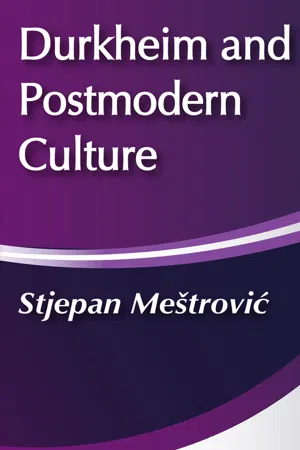
Durkheim and Postmodern Culture
About this book
The present work is an elaboration of the author's previous efforts in Emile Durkheim and the Reformation of Sociology (1988) and The Coming Fin de Sibcle (1991) to demonstrate Durkheim's neglected relevance to the postmodern discourse. The aims include finding affinities between our fin de sibcle and Durkheim's fin de sibcle, and connecting the contemporary themes of rebellion against Enlightenment narratives found in postmodern culture with similar concerns found in Durkheim's sociology as well as in his fin de sibcle culture, contributing to Durkheimian scholarship as well as to the postmodern discourse. The distinctive aspects of the present study flow from the focus on culture, communication, and the feminine voice in culture. Durkheim is approached as a fin de sibcle student of culture, and his insights applied to our fin de sibcle culture. Furthermore, because Durkheim claimed that culture is comprised primarily of collective representations, he was a forerunner of the current, postmodern concerns with communication. Because Durkheim shall be read in the context of his fin de sibcle, this book shall lead to the conclusion that Durkheim was a kind of psychoanalyst such that society is the patient, culture comprises the symptoms, and the sociologist must decipher, decode, and even deconstruct collective representations. Yet, the Durkheimian deconstruction proposed here is unlike the postmodern deconstructions, which criticize and tear apart a text without substituting a better meaning or interpretation. Postmodern discourse has made respectable again the synthesis of multidisciplinary insights that was fashionable in Durkheim's fin de sibcle. In following this postmodern strategy, this book is more than a book about Durkheim. It is also a book about his contemporaries, among them, Carl Justav Jung, Thorstein Veblen, Henry Adams, Georg Simmel, and Max Weber. The author does not follow the postmodern strategy completely, because he f
Information
Chapter 1
Postmodernism as a Cultural Problem
Scholars cannot seem to agree on the meanings of the most recent academic buzzword, postmodernism. Does it imply the dramatic end to modernity, history, even communism—or merely their transformation into something new? Bauman claims that those who celebrate the collapse of communism, “celebrate the end of modernity actually, because what collapsed was the most decisive attempt to make modernity work; and it failed” (1991:222). If Bauman is correct, then one has no good reason to believe that the brand of modernity that took root on this side of the former Iron Curtain will fare any better, in the long run, than the communist version. Yet Fukuyama (1990) and others claim that recently humanity has witnessed the “end of history,” by which he means the end of nationalism, totalitarianism, and wars for territory. For Fukuyama, liberal democracy has triumphed over socialism, while for Lyotard (1984) and other postmodernists, all systems based on the Enlightenment are oppressive (Rosenau 1992).
Some, like Anthony Giddens (1990, 1992), deny the existence of postmodernism, and opt for the term “high modernity” to capture the gist of some of the contradictions that this term signifies. Nevertheless, whatever “it” is, a growing consensus is emerging that the French philosopher, Jean Baudrillard, ought to be regarded as “the high priest” of postmodernism. Baudrillard follows Nietzsche in reducing everyone to gladiators in a world based on anomic, infinite consumption as well as the will to power.1 He portrays a social world of circulating fictions in which nothing is real, true, or grounded in any sort of metaphysical permanence.2
Moreover, Baudrillard is merciless in his attitude toward women, minorities, and all the weak and helpless—all of them “must exit,” Baudrillard writes in his America:
But this easy life knows no pity. Its logic is a pitiless one. If utopia has already been achieved, then unhappiness does not exist, the poor are no longer credible. If America is resuscitated, then the massacre of the Indians did not happen, Vietnam did not happen. ... The have-nots will be condemned to oblivion, to abandonment, to disappearance pure and simple. This is “must exist” logic: “poor people must exit.” The ultimatum issued in the name of wealth and efficiency wipes them off the map. And rightly so, since they show such bad taste as to deviate from the general consensus. (1986:111)
Douglas Kellner writes of Baudrillard’s fin de siècle exhaustion, and concludes that Baudrillard began his career as a Marxist liberal but is ending it with a “capitulation to the hegemony of the Right and a secret complicity with aristocratic conservatism” (1989:215). In Baudrillard: Critical and Fatal Theory, Mike Gane (1991) joins a growing list of critics who find in Baudrillard as well as other postmodernists a proclivity toward cruelty that stems from writing under the sign of Nietzsche (see also Kroker and Cook 1986:171).3 Like all other generalizations, this one could be, and has been, criticized and debated by intellectuals who are engaged in the postmodernist discourse, with nothing like a final resolution on the horizon.
For the sake of discussion, let us assume that Baudrillard can represent well the broad outlines of the postmodernist movement, and that its overall impact includes a rejection of many truths previously held as sacrosanct. These are consequences that one would expect from taking Nietzsche seriously, and there is no doubt that Nietzsche is the most frequently cited author by postmodernists. Where does one go from here?
The present study is a fresh response to the movement that Baudrillard represents. It is a response to the onesidedness and narrow intellectual context exhibited by postmodernists as well as by the traditional rationalists.4 Infinite consumption was not discovered by the postmodernists. On the contrary, it was described as “conspicuous consumption” by the American, turn-of-the century philosopher, economist, and sociologist, Thorstein Veblen (1857–1929) in his 1899 classic, The Theory of the Leisure Class ([1899] 1967). Similarly, it was foreshadowed by the first bona fide professor of sociology in the world, Emile Durkheim (1858–1917) as the anomic “infinity of desires” in his 1897 book, Suicide ([1897] 1951), as well as by other sociologists who wrote in the previous fin de siècle.
The German philosopher, Friedrich Nietzsche (1844–1900), who attacked the idea of compassion, and whose logic is the basis for the pitiless logic promulgated by Baudrillard, was not the only star on the intellectual horizon during the era in which sociology was born. Another German philosopher, Arthur Schopenhauer (1788–1860)—who was Nietzsche’s ([1874] 1965) self-acknowledged master for a time—had reached the zenith of his philosophical fame in Europe in the 1880s. Nietzsche and Schopenhauer were the two philosophical superstars of the previous fin de siècle, and exerted diametrically opposed influences upon intellectuals. Nietzsche stood for the aristocratic hardness based on the will to power, which finds its way in Baudrillard’s account of the postmodern, whereas Schopenhauer stood for compassion and justice, which tend to be neglected by intellectuals as phenomena worthy of study, but illuminate and explain the concerns with human rights in the present era.
Unlike Baudrillard, Durkheim and Veblen ground reality in habits, collective representations, and the collective consciousness, in a word, culture. Culture is the one concept that is missing in the modernist as well as the postmodernist discourses. For example, neither Bauman (1991) nor Brzezinski (1989) raises the cultural question, How and why did communism take root in the lands it ruled up to 1989? To take this question seriously is to seek the cultural antecedents of communism as a modernist system, as well as its possible transformations into a new form of totalitarianism. Similarly, scholars seem to assume routinely that modernity, Enlightenment, and the postmodern circulation of fictions are self-begotten, that they exist a priori, and that they are not rooted in any sort of cultural tradition. In fact, tradition and modernity are assumed to be opposites. This overly tidy, modernist view cannot explain the modern West’s many relapses into traditional nationalism, totalitarianism, and imperialism (see Spengler [1926] 1961), nor the postmodern obsession with history, nostalgia, and sentiment.
Unlike Baudrillard, but in line with Schopenhauer, Durkheim thought of compassion as the “glue” that holds society together. Durkheim offers a “feminine” vision of society that contrasts sharply with Baudrillard’s chauvinistic emphasis on power. Durkheim’s contemporary, Thorstein Veblen, also opposed the pecuniary impulse with matriarchal self-abnegation, which he felt was essential for social life. Unadulterated will to power, force, duty, constraint, and other phenomena usually associated with social order are more likely to lead to the war of all against all than the desired consequence of social stability. Here is another important gap in the contemporary thinking about social systems as non-cultural phenomena.
The German philosopher-sociologist, Georg Simmel (1858–1918), who was Durkheim’s contemporary and one of sociology’s several cofounders, emphasized the importance of this distinction in his neglected study, Schopenhauer and Nietzsche, first published in 1907 but not translated into English until 1986. Nietzsche began his philosophical career as Schopenhauer’s self-acknowledged disciple, but parted with Schopenhauer precisely on the issue of compassion versus the will to power. Schopenhauer taught that compassion or identification with suffering humanity was the right antidote to the egoism and lust for power that had been unleashed by modernity. But Nietzsche mocked compassion as the morality of the weak and powerless—as refracted in Christianity in particular. For the sake of objectivity, we shall stress Schopenhauer’s feminine, compassionate philosophy and its impact on sociology, particularly Durkheim’s sociology, because it has been almost completely obfuscated by the Nietzschean, masculine, power-hungry model of social relations.5 By objectivity, we mean a concern with documenting the lacunae in contemporary analyses of the cultural and philosophical roots of sociology, with filling in gaps, with addressing issues that have been obfuscated due to the one-sided emphasis on Nietzsche.
Our approach is commensurate with the broad outlines of Riane Eisler’s The Chalice and the Blade (1987), in which she distinguishes between the male, dominator model of history versus the female, partnership model. She argues that in prehistory, values symbolized by the chalice—to give and to nurture—reigned supreme, but were replaced by the values symbolized by the blade—violence and domination. Now that the dominator model is purported by many to be reaching its logical limits, she calls for the “transformation of a dominator to a partnership system” (p. xx). I agree overall, but wonder whether a one-sided emphasis on partnership might not be too much of a good thing and pathological in its own right, as is often the case with any excess. And how should one undertake such a transformation without deforming one’s goals? To teach partnership systematically is to engage in domination, and to produce a tainted product, along the lines of Spengler’s ([1926] 1961:361) remark that socialism’s efforts to systematize compassion negate genuine compassion. A sophisticated sociological theory is required to move beyond the simplistic argument that underpins many feminist treatises, namely, that patriarchal power should be replaced with the power of women (Game 1991). Finally, what is the cultural bedrock for both “systems”?
My book seeks to bring Durkheim as one such sophisticated sociological theorist into a cultural discourse and a value system that almost never mentions him, and that overemphasizes Nietzsche as the cultural bedrock for the sociology he established. He has been absorbed into sociology on the false premises that he was a status quo functionalist and defender of modernity, a proponent of social order, consensus, and other masculine-sounding values. All this may be somewhat true, but it is only one side of Durkheim. For the sake of balance, I will emphasize the other side of Emile Durkheim, who conceived of society and culture as also feminine, as a vast partnership that promotes mutual sympathy, integration, and humanity. For example, consider the following description of society from Durkheim’s Moral Education:
On the one hand, it seems to us an authority that constrains us, fixes limits for us, blocks us when we would trespass, and to which we defer with a feeling of religious respect. On the other hand, society is the benevolent and protecting power, the nourishing mother from which we gain the whole of our moral and intellectual substance and toward whom our wills turn in a spirit of love and gratitude. ([1925] 1961:92; emphasis added)
The overall thrust of Durkheim’s sociology is entirely consistent with Eisler’s aims to transform modern society into an entity that is more humane than was and is the case with the onset of modernity. Durkheim’s feminine side has been obfuscated almost completely by the neo-Parsonian and Mertonian functionalists. However, Durkheim’s humanistic program was considerably more complex than replacing one model of social relations with another. His use of the concept society seems to overlap, in significant ways, with the concept of culture. The aim of the present study is to explicate Durkheim’s complexity in this regard. We shall engage in a criticism of Durkheim’s perceived image with an eye toward exposing the one-sidedness of the masculine version of sociology that holds him up as the prince of positivism and regards postmodernism with disdain. Speaking metaphorically, we shall balance the right-handed (left-brain) Durkheim with the neglected, left-handed (right-brain) Durkheim.6 In Jungian terminology, Durkheim’s “shadow” and anima shall be brought to conscious reflection. And the object shall not be a new understanding of Durkheim per se (as if that were possible), but to find an alternative to the nihilistic, right-handed conclusions reached by many postmodernists in their incomplete critiques of the Enlightenment.
Several points need to be clarified before we proceed further. First, Durkheim is certainly not unique relative to his contemporaries with regard to his feminine voice. Among his sociological colleagues, one can point to Ferdinand Tonnies, Georg Simmel, Sigmund Freud, George Herbert Mead, and Thorstein Veblen, who praised empathy, Gemeinschaft, and other derivatives of compassion at the same time that they wrote with considerable ambivalence about Gesellschaft, civilization, and modernity. The more important point is that this emotional, subjective, even feminine aspect to their sociologies was suppressed and distorted along the lines of Max Weber’s “value-free” sociology as it became the basis for Talcott Parsons’s (1937) modernist rereading of their works. Parsons claimed to transform the newly born discipline of sociology into a “detached” and “objective” study of progress and systems theory. Yet, contrary to Parsons, Durkheim was writing in a way that was typical of his fin de siècle culture, and reading him and most of his colleagues in their proper context challenges Parsons’s modernist obfuscation of his import, as well as Parsons’s pretense that he was being objective. Thus, we are not dogmatic about our choice of Durkheim, and shall not hesitate to compare and contrast him with his colleagues when the occasion warrants it. Durkheim is a convenient choice, and a strategic choice as well, for if we can convince the reader that Emile Durkheim, the alleged prince of positivism and functionalism, was actually a feminist of sorts, we will have achieved a significant coup.
Second, our attitude toward Durkheim should not be dismissed as loyalty or hero worship. No doubt, a “detached” reading of Durkheim would and often has yielded trenchant criticisms of his sociology. But one wonders whether any study or point of view can be truly detached, because even such a view presupposes attachment to the dogma of the value-free scientist who works in a pristine, ahistorical, and noncultural context that is difficult to imagine. C. Wright Mills (1959) and others have challenged these assumptions already. Moreover, plenty of such studies exist, and little purpose would be served by adding to the deconstruction of Durkheim. Deconstruction tears a text apart, but its intent is not to improve or offer a better version of a text or author. Far from being neutral, such studies contribute to cynicism, and the disparaging view that sociology has nothing to offer to contemporary times. Our overall aim is not to add to another noncontextual study of Durkheim, and certainly not to tear him down.7 Rather, it is to fill the lacunae left by Durkheim’s modernist interpreters, as well as Baudrillard and the nihilistic version of postmodernism.
Third, the decision not to offer a detached study is made deliberately. Detachment can easily degenerate into sadism, even among scholars, who rarely exhibit kindness or empathetic understanding when reviewing the works of their colleagues. This connection leads us back to the observations with which we began this book, that Baudrillard’s detached critique of the Enlightenment has been criticized for turning into old-fashioned, pitiless cruelty. We are seeking a way out of this impasse by arguing for a need to reconcile masculine objectivity with feminine subjectivity (from Simmel), the barbaric temperament with matriarchal peaceable traits (from Veblen), egoism with altruism (from Durkheim), the mind with the heart (from Schopenhauer), and other versions of homo duplex that characterize Western history. Thus, what some readers might misconstrue as our lack of detachment is based on a self-conscious decision, and is in keeping with the previously stated objectives of the present study: to find a way to reconcile the feminine side of humanity with the masculine, to find a non-nihilistic alternative to the powerful critiques of the Enlightenment offered by postmodernists, and to demonstrate Durkheim’s neglected relevance to these debates.
While we do not follow the method of detached observation—because we are not convinced that it is possible or desirable—this does not detract from the objectivity of our study. On the contrary, the detached observers are biased, because they refuse to consider as legitimate thinkers and theories from the Romantic era that they reject on a priori grounds. Thus, we balance the overwhelming and biased emphasis on Nietzsche’s will to power with an emphasis on his teacher, Arthur Schopenhauer. This is a crucial step in accounting for the lacunae in the contemporary postmodernist discourse, which is dominated by Nietzsche’s philosophy. Similarly, the Parsonian version of Durkheim shall be countered with the original, fin de siècle Durkheim. Durkheim against Baudrillard, the masculine versions of history and language against the appreciators of the feminine versions of history and language—such is our dialectical method. The objectivity stems from appreciating opposing facets of a given phenomenon, not from a ...
Table of contents
- Cover
- Half Title
- Series Page
- Title Page
- About the Author
- Copyright Page
- Dedication
- Table Of Contents
- Preface and Acknowledgments
- Chapter 1. Postmodernism as a Cultural Problem
- Chapter 2. Rediscovering the Romantic Origins of Feminism
- Chapter 3. The Romantic Antecedents of Postmodern Culture and Society
- Chapter 4. The Social World as Will and Idea
- Chapter 5. Postmodern Language as a Social Fact
- Chapter 6. Postmodernism and Religion
- Chapter 7. Suicide and the Will to Life
- Chapter 8. Conclusions
- References
- Additional Readings
- Author Index
- Subject Index
Trusted by 375,005 students
Access to over 1.5 million titles for a fair monthly price.
Study more efficiently using our study tools.
Frequently asked questions
Yes, you can cancel anytime from the Subscription tab in your account settings on the Perlego website. Your subscription will stay active until the end of your current billing period. Learn how to cancel your subscription
No, books cannot be downloaded as external files, such as PDFs, for use outside of Perlego. However, you can download books within the Perlego app for offline reading on mobile or tablet. Learn how to download books offline
Perlego offers two plans: Essential and Complete
- Essential is ideal for learners and professionals who enjoy exploring a wide range of subjects. Access the Essential Library with 800,000+ trusted titles and best-sellers across business, personal growth, and the humanities. Includes unlimited reading time and Standard Read Aloud voice.
- Complete: Perfect for advanced learners and researchers needing full, unrestricted access. Unlock 1.5M+ books across hundreds of subjects, including academic and specialized titles. The Complete Plan also includes advanced features like Premium Read Aloud and Research Assistant.
We are an online textbook subscription service, where you can get access to an entire online library for less than the price of a single book per month. With over 1.5 million books across 990+ topics, we’ve got you covered! Learn about our mission
Look out for the read-aloud symbol on your next book to see if you can listen to it. The read-aloud tool reads text aloud for you, highlighting the text as it is being read. You can pause it, speed it up and slow it down. Learn more about Read Aloud
Yes! You can use the Perlego app on both iOS and Android devices to read anytime, anywhere — even offline. Perfect for commutes or when you’re on the go.
Please note we cannot support devices running on iOS 13 and Android 7 or earlier. Learn more about using the app
Please note we cannot support devices running on iOS 13 and Android 7 or earlier. Learn more about using the app
Yes, you can access Durkheim and Postmodern Culture by Stjepan Mestrovic in PDF and/or ePUB format, as well as other popular books in Social Sciences & Post-Structuralism in Philosophy. We have over 1.5 million books available in our catalogue for you to explore.