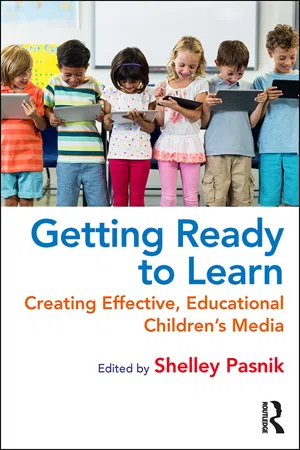
Getting Ready to Learn describes how educational media have and are continuing to play a role in meeting the learning needs of children, parents, and teachers. Based on years of meaningful data from the CPB-PBS Ready To Learn Initiative, chapters explore how to develop engaging, playful, and developmentally appropriate content. From Emmy-Award-winning series to randomized controlled trials, this book covers the media production, scholarly research and technological advances surrounding some of the country's most beloved programming.
- 258 pages
- English
- ePUB (mobile friendly)
- Available on iOS & Android
eBook - ePub
About this book
Information
1
Ready To Learn and Public Media
Improving Early Learning Outcomes for America’s Children
Introduction
There is an often-told story in public media lore about the time in May 1969 when Fred Rogers, creator and host of the beloved and influential children’s television series Mister Rogers’ Neighborhood, testified before the Senate Subcommittee on Communications. The Nixon Administration was eager to cut the appropriation for the newly formed Corporation for Public Broadcasting, and Fred Rogers was asked to talk about how the cut would impact his work (Rogers, 1969). Most people focus on the end of the story when subcommittee chairman Senator John O. Pastore, clearly moved by Rogers’ remarks, said, “Looks like you just earned the 20 million dollars.” While that was a seminal moment in the history of federal funding for public broadcasting, what makes it more remarkable is how Rogers made his case. His persuasive argument was not about the need to produce a daily, half-hour television show. Rather, he talked about the need to provide, what he called, “a meaningful expression of care” that helped very young children deal with “the inner drama of childhood” and taught them that their “feelings are mentionable and manageable.” Fred Rogers’ method for helping young children, especially those most in need, happened to be through a television show, but it was the need he was meeting, not the medium, that carried the day.
The 1991 report, Ready To Learn: A mandate for the nation, written by Ernest Boyer, the president of The Carnegie Foundation for the Advancement of Teaching, was the initial spark that led to the creation of the Ready To Learn Television Act legislation that lives on today. However, like Fred Rogers, Boyer’s interest was in meeting a demonstrated need; in this case the need to improve school readiness for young children after a five-year decline. Boyer was advocating for ways to ensure that all children enter school prepared to succeed. One way was to provide access to resources through what he called “ready to learn television” (Boyer, 1991).
The idea of media not as a goal, but rather a tool to meet needs and achieve goals goes back even further to the founding principles of public broadcasting itself. The Public Broadcasting Act of 1967, the legislation that established the Corporation for Public Broadcasting (CPB), laid out a broad vision for educational media. The intent was to address a gap that commercial media was not filling. In fact, a 1988 amendment to the Act included stronger, more specific language that declared, “It is in the public interest to encourage the development of programming that involves creative risks and that addresses the needs of unserved and underserved audiences, particularly children and minorities.”
Built on this foundation, the work of CPB and PBS aligns with Ready To Learn to meet needs and provide solutions; to serve people and experiment with new ideas. The mission remains evergreen, while the process of fulfilling that mission evolves to meet changes in needs, technology, and media consumption habits. Every five years, the Ready To Learn Television Grant Program, authorized by Congress and administered by the U.S. Department of Education, serves as a catalyst for continual learning, experimentation, improvement, and disruption.
Today, Rogers’ “meaningful expression of care” and Boyer’s “mandate for the nation” lives on in places like the Hilltop neighborhood of Tacoma, Washington, where a mom and her six-year-old daughter take advantage of an innovative rent-subsidy program run by the local housing authority. While the mom attends a mandatory job training program, the girl is in another classroom, her attention fixed on a computer screen, watching a character named Peg and her friend Cat solve problems using math. Later, the young girl will follow Peg and Cat through an adventure in a digital game, only this time the girl will be the one solving the problems. Characters not only drive fictional stories; they also guide children’s learning.
Scenes like this play out every day across the U.S. in child care centers, homes, libraries, health clinics, and other places where young children are. Video content, digital games, and hands-on activities created with Ready To Learn funds, featuring PBS KIDS characters and facilitated by local public media stations support young children and the adults in their lives.
Educational Priorities across Time
With Ready To Learn’s focus on the school readiness needs of young children, the U.S. Department of Education has historically identified particular early learning priorities. Each competitive solicitation of the federal Ready To Learn Television Grant Program has emphasized a particular area of focus. Across time, there has been an enduring emphasis on the reading and language development needs of preschoolers, and these literacy priorities have recently expanded to include an emphasis on early math and science learning (see Figure 1.1).

FIGURE 1.1 Ready To Learn Focus Areas Chart highlighting leading priorities established during the past five-year grant cycles (Courtesy of PBS; The PBS logos and wordmarks are trademarks of the Public Broadcasting Service and used with permission; and CPB)
National Assessment of Educational Progress (NAEP) scores are a useful barometer of America’s educational needs. With scores from NAEP released every two years, education policy leaders are able to review national academic achievement data and trends based on NAEP assessments of the fourth and eighth grades in reading, mathematics, and writing. Recent analysis by the Brookings Institute and Brown Center found that NAEP scores in both reading and math from 2009 to 2015, as well as the preceding period of 1998–2009, have been generally “flat since 2009, not deviating by more than a single scale score point.” The authors point-out that before 2009, reading scores stayed flat, while math scores experienced solid increases. However, these gains in math did not continue into 2009–2015 (Brookings Institute, 2018).
Given this backdrop, it is understandable that Ready To Learn’s initial years featured a broad focus on children’s literacy development, which ultimately crossed two, five-year grant rounds to public media (i.e., 1995–2000 and 2000–2005). These grants enabled PBS and partners to expand existing children’s TV series such as Arthur, Clifford the Big Red Dog, Reading Rainbow, and Sesame Street, while also developing new literacy properties, including Dragon Tales and Between the Lions. To extend the use of this media in communities, local PBS stations delivered awareness and training workshops to childcare providers and parents on the effective use of these literacy series and partnered with First Book to distribute millions of related children’s books for free to families and schools in low-income communities.
However, when it came to the 2005–2010 grant cycle, Ready To Learn’s focus on literacy was significantly heightened by new policy directions and thought-leadership generated by the National Reading Panel. At the request of Congress in 1997, the panel’s charge was to determine the effectiveness of different instructional approaches used to teach children to read. Administered by the National Institute of Child Health and Human Development (NICHD) at the U.S. Department of Health and Human Services, the panel included experts in the field of reading and children’s development. In April 2000, these literacy thought-leaders published the report Teaching children to read, which emphasized research-based practices in fundamental areas of literacy instruction including phonemic awareness, phonics, fluency, vocabulary, comprehension, independent reading, computer-assisted instruction, and teacher professional development (NICHD, 2000). Soon after this effort in 2002, The National Early Literacy Panel was convened to conduct a synthesis of the scientific research on the development of early literacy skills in children ages zero to five, and on home and family influences on early literacy development (National Institute for Literacy, 2008).
These reports played a major role in shaping the No Child Left Behind’s federal literacy policies and initiatives. Education leaders at CPB and PBS were similarly influenced by insights from both panels and used their evidence-based guidance as a springboard for new approaches to children’s television production and outreach. In the 2005–2010 grant cycle, the CPB-PBS Ready To Learn Initiative proposed and then successfully helped to develop an award-winning collection of PBS KIDS properties that leveraged known best practices in early reading education, including Super Why!, Martha Speaks, The Electric Company, Sesame Street, and Between the Lions.
While literacy has remained a major through line for Ready To Learn over the last two decades, the Department of Education expanded the program’s priorities to include math education as part of the 2010–2015 grant cycle. Based on the increased national attention to the role of early math in fortifying children’s long-term academic success, this direction afforded CPB and PBS a first-time opportunity to help develop two new PBS KIDS math properties, Peg + Cat and Odd Squad, which provided local PBS member stations and their partners a strong foundation for providing children with engaging content from their preschool years into the early elementary grades (see Chapter 5 for a detailed description of the production process that led to Peg + Cat).
Fast forward to the current 2015–2020 grant cycle, in which the Department of Education opened new doors for the development of original content to support early science learning. For CPB and PBS, this is creating new pathways for producing multiplatform media that focuses on core science concepts, science inquiry, and engineering practices. The Ruff Ruffman Show, The Cat in the Hat Knows a Lot About That!, Ready Jet Go!, and a new preschool science property aim to help our nation’s youngest learners cultivate a positive mindset toward science, giving them ample opportunities to think and act like scientists (see Figure 1.2). Additionally, CPB and PBS are taking public media’s literacy work to the next level, through an original property called Molly of Denali, which focuses on informational text (see Chapter 12 for a detailed description).

FIGURE 1.2 The Ready To Learn Initiative Timeline outlining the major children’s media and engagement resources developed by the CPB-PBS Ready To Learn Initiative from 1995 to 20151
Ready To Learn as a Catalyst for Innovation
Public media’s commitment to harnessing the power of television and digital media for the public interest has been undergirded by Congress and the U.S. Department of Education for the past 25 years through the Ready To Learn Television Grant Program. The grant has provided the funding and strategic direction that’s enabled public media to innovate with how children’s educational media is produced and delivered, how it’s utilized across learning environments, and how caregivers can use it to support and assess children’s learning.
The Ready To Learn Television Grant Program has fueled public media’s vision to see every new technology as an opportunity for learning. Public media also has utilized the Ready To Learn grant to experiment with various approaches for delivering content and engagement experiences over the years. Early efforts during Ready To Learn grants in 1995–2000 and 2000–2005 focused on making engaging TV episodes of PBS KIDS shows and allowing kids to “play the shows” through related Flash-based learning games on pbskids.org. Efforts during the 2005–2010 grant included new literacy-themed television shows and a curated website, PBS KIDS Island, which featured related digital games, as well as opportunities for kids to participate in hands-on activities at week-long PBS KIDS summer camps organized by PBS member stations and their local community partners.
More recent efforts have taken advantage of new methods for delivering content including tablets, smartphones, and mobile-friendly websites and apps, and new understandings of how to support kids’ media engagement across various learning environments. During the 2015–2020 Ready To Learn Television Grant Program, for example, children are engaging with the characters and stories from their favorite shows through streaming video on the PBS KIDS Video App, through digital games on the PBS KIDS Games App, through related classroom activities that their teachers can access on PBS LearningMedia, through activities that caregivers can find on the PBS KIDS for Parents website, and through month-long workshops at their local public media stations that bring families together weekly to play with the media and engage in joyful learning experiences. All of the content and engagement experiences map to PBS KIDS Learning Frameworks that have been designed by curriculum advisors and provide producers with guidance on the skills, practices, and age-appropriate habits of mind that their content should support for children between the ages of two and eight.
Advances in technology are being utilized in this 2015–2020 round of the grant to not only innovate on how content is delivered, but also to enhance the content itself, providing children with opportunities to personalize their learning experiences and giving PBS KIDS producers the ability to create digital games that adapt to a child’s individual learning and engagement needs (see Chapter 15 for a description of personalized and adaptive learning efforts).
Research findings from past Ready To Learn grants revealed that while an individual television episode, digital game, or hands-on activity can advance learning, children actually learn more when they combine watching a PBS KIDS show, playing related digital games, and engaging in related real-world hands-on activities that extend the learning away from the screen (McCarthy et al., 2013, 2012, 2015; Pasnik & Llorente, 2013; Penuel et al., 2009). This transmedia approach to content and engagement development was the primary goal of Ready To Learn 2010–2015, and research results from this time revealed that not only did PBS KIDS content improve children’s school readiness, but children learned even more when their parents or teachers fully understood what their children were experiencing, had confidence in their ability to support their children’s engagement with the media, and when adults dedicated time to interacting with their kids using the media. These lessons have been a catalyst for new approaches to helping young children learn by supporting and engaging their caregivers. Professional development resources, like the Ready To Learn–funded teaching tips and videos developed in collaboration with the Boston University School of Education, and PBS TeacherLine courses that incorporate the teaching tips described in Chapter 4, provide preservice and in-service early childhood educators with standards-aligned guidance for how to effectively utilize quality media in classroom and childcare settings.
The CPB-PBS Ready To Learn Initiative has endeavored to increase parental involvement in children’s learning through mobile apps designed to foster engagement between children and their caregivers. The PBS KIDS Pl...
Table of contents
- Cover
- Half Title
- Title Page
- Copyright Page
- Table of Contents
- Foreword by Dr. Alice Wilder and Sir Ken Robinson
- Acknowledgments
- List of Contributors
- Introduction
- 1. Ready To Learn and Public Media: Improving Early Learning Outcomes for America’s Children
- 2. From Mission to Screens: The PBS KIDS Approach to Content
- 3. Using Media to Foster Parent Engagement
- 4. Building Learning Pathways and Community for Early Childhood Educators
- 5. When Creativity + Collaboration = Success: The Making of Peg + Cat
- 6. Children’s Mathematical Thinking and Learning: The Importance of Study Design and Aligned Assessments in Promoting and Capturing Learning
- 7. What Early Childhood Educators Need in Order to Use Digital Media Effectively
- 8. Curation and Mediation: Essential Ingredients When Supporting Children’s Learning
- 9. Preschoolers Learn To Think and Act Like Scientists with The Cat in the Hat
- 10. Science Takes Center Stage: Design Principles to Support Young Children’s Science Learning with Media
- 11. Permission to Speak How Educational Media Can Start and Extend Dialogue for Kids and Adults
- 12. Informational Text Adventures with Molly of Denali
- 13. Building Community Partnerships to Support Family Learning
- 14. How Ready To Learn Is Bringing Inclusive Design to PBS KIDS
- 15. Adaptive and Personalized Educational Games for Young Children: A Case Study
- 16. Innovations in Evidence and Analysis: The PBS KIDS Learning Analytics Platform and the Research it Supports
- Index
Trusted by 375,005 students
Access to over 1.5 million titles for a fair monthly price.
Study more efficiently using our study tools.
Frequently asked questions
Yes, you can cancel anytime from the Subscription tab in your account settings on the Perlego website. Your subscription will stay active until the end of your current billing period. Learn how to cancel your subscription
No, books cannot be downloaded as external files, such as PDFs, for use outside of Perlego. However, you can download books within the Perlego app for offline reading on mobile or tablet. Learn how to download books offline
Perlego offers two plans: Essential and Complete
- Essential is ideal for learners and professionals who enjoy exploring a wide range of subjects. Access the Essential Library with 800,000+ trusted titles and best-sellers across business, personal growth, and the humanities. Includes unlimited reading time and Standard Read Aloud voice.
- Complete: Perfect for advanced learners and researchers needing full, unrestricted access. Unlock 1.5M+ books across hundreds of subjects, including academic and specialized titles. The Complete Plan also includes advanced features like Premium Read Aloud and Research Assistant.
We are an online textbook subscription service, where you can get access to an entire online library for less than the price of a single book per month. With over 1.5 million books across 990+ topics, we’ve got you covered! Learn about our mission
Look out for the read-aloud symbol on your next book to see if you can listen to it. The read-aloud tool reads text aloud for you, highlighting the text as it is being read. You can pause it, speed it up and slow it down. Learn more about Read Aloud
Yes! You can use the Perlego app on both iOS and Android devices to read anytime, anywhere — even offline. Perfect for commutes or when you’re on the go.
Please note we cannot support devices running on iOS 13 and Android 7 or earlier. Learn more about using the app
Please note we cannot support devices running on iOS 13 and Android 7 or earlier. Learn more about using the app
Yes, you can access Getting Ready to Learn by Shelley Pasnik in PDF and/or ePUB format, as well as other popular books in Education & Early Childhood Education. We have over 1.5 million books available in our catalogue for you to explore.