- 256 pages
- English
- ePUB (mobile friendly)
- Available on iOS & Android
eBook - ePub
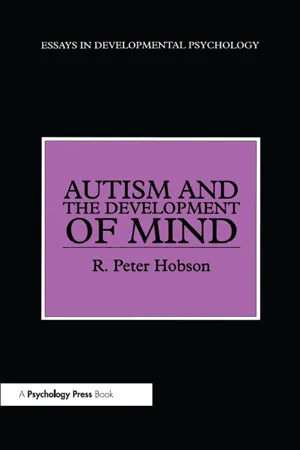
Autism and the Development of Mind
About this book
The purpose of this essay is to illustrate how the phenomenon of early childhood autism may cast light on issues that are central to our Understanding Of Normal Child Development - Issues Such As The Emotional origins of social experience and social understanding, the contribution of interpersonal relations to the genesis of symbolism and creative thought, and the role of intersubjectivity in the development of self. Drawing upon philosophical writings as well as empirical research on autism, the author challenges the individualistic and cognitive bias of much developmental psychology, and argues that early human development is founded upon a normal infant's capacity for distinct forms of "I - Thou" and "I - It" relatedness. To a large degree, autism may represent the psycho-pathological sequelae to biologically-based incapacities for social perception and interpersonal engagement.
Information
CHAPTER ONE
Prolegomena
INTRODUCTION
In writing this book, I have tried to integrate an account of early childhood autism with a perspective on the development of mind in normal young children. In a way, nothing could be more natural than addressing these issues together. It is only by locating the source of autistic children’s “particular mode of existence” (Bosch, 1970: p. 3) and by charting the developmental implications of this abnormality with reference to the normal (non-autistic) course of development, that we shall apprehend the nature of the perplexing and tragic condition we call “autism”.
In another respect, however, the task is far from simple. This is only partly because the issues are too difficult for me to tackle—although too difficult they certainly are. A more technical problem is that I need to move back and forth between descriptions and theories of development in autistic children on the one hand, and accounts of development in normal young children on the other. Too close an integration of these viewpoints would result in an unhelpful muddle, too rigid a compartmentalisation would probably seem sterile and defeat my purpose. I have settled on an uneasy compromise, boxing and coxing as I go. This first chapter is intended to reveal that what follows subsequently is not quite as haphazard as it may seem.
I shall begin by saying something about autistic children.
THE AUTISTIC INDIVIDUAL
It is very difficult to convey what autistic children are like. The reason is that one needs to convey what it is like to relate to an autistic individual, how it feels to try to communicate or otherwise become engaged with the child. In such a situation, it is not uncommon to feel that one is faced with a strangeling who moves on some other plane of existence, a person with whom one cannot connect. This experience of being with an autistic child seems to correspond with something essential that is lacking in the child’s own experience of other people. A central purpose of this essay is to argue that autistic children’s deficient capacity for and experience of personal relatedness is the cardinal feature of their disorder.
On the other hand, it is not simply that autistic children have striking impairments in their interpersonal relations—they also speak and think in unusual ways, they frequently suffer from generalised intellectual deficits, and they commonly engage in stereotyped activities or pursue idiosyncratic preoccupations. In order to illustrate both the consistency and diversity of the clinical picture, as this essay proceeds I shall offer condensed versions of several published accounts of autistic individuals. I hope that the cumulative effect may be to give the reader a sense of how we need to understand and explain a “form of life” that differs fundamentally from our own.
It is fitting to begin with a case vignette from the classic account of autism, a beautiful clinical paper of 1943 in which the American psychiatrist Leo Kanner first described 11 children with “autistic disturbances of affective contact”. Here are some edited excerpts from one of Kanner’s descriptions:
Case 9: Charles was brought to the clinic at the age of four and a half years, his mother complaining how “the thing that upsets me most is that I can’t reach my baby”. As a baby, this child would lie in the crib, just staring. When he was one and a half years old, he began to spend hours spinning toys and the lids of bottles and jars. His mother remarked: “He would pay no attention to me and show no recognition of me if I enter the room … The most impressive thing is his detachment and his inaccessibility. He walks as if he is in a shadow, lives in a world of his own where he cannot be reached. No sense of relationship to persons. He went through a period of quoting another person; never offers anything himself. His entire conversation is a replica of whatever has been said to him. He used to speak of himself in the second person, now he uses the third person at times; he would say, “He wants”—never “I want”…When he is with other people, he doesn’t look up at them. Last July, we had a group of people. When Charles came in, it was just like a foal who’d been let out of an enclosure…He has a wonderful memory for words. Vocabulary is good, except for pronouns. He never initiates conversation, and conversation is limited, extensive only as far as objects go.”
In this moving account by a mother who felt she could not reach her baby, we can register the force of Kanner’s (1943: p. 250) suggestion that autistic children “have come into the world with innate inability to form the usual, biologically provided affective contact with people”. The sense of emotional connectedness that we feel when relating to other people, whether the people are infants, children or adults, seems to have been tragically lacking in this mother’s relationship with her own son. Charles was “inaccessible” to her. For his own part, Charles seemed not to attend to his mother nor to other people, nor even to recognise them as persons with whom he could become emotionally engaged: “…it was just like a foal who’d been let out of an enclosure”. Such unengagement was at the same time physical and mental, and was expressed on a number of levels. On the level of non-verbal communication, there was a virtual absence of co-ordinated, reciprocal bodily expressive exchanges; on the linguistic level there was a dearth of conversational interchange; and on all levels, there was the pervasive sense of the missing intersubjective, personal contact. Where was the meeting of hearts and minds that this mother yearned for with her child? There even seemed to be something lacking in the boy’s sense of his own “me-ness”, in that neither his presence nor his conversation conveyed self-assertion or self-expression: “He walks as if he is in a shadow…He would say, ‘He wants’—never ‘I want’.”
Autistic individuals’ relative incapacity for intersubjective contact with others, what I have just referred to as a meeting of hearts and minds, together with their probably deficient sense of self, are issues to which I shall often return. For now, I want to emphasise what this may mean for the autistic individual’s experience of other people. Perhaps the most succinct and striking account is that provided by an intelligent young autistic adult interviewed by Donald Cohen (1980: p. 388). This man described how the first years of his life were devoid of people:
I really didn’t know there were people until I was seven years old. I then suddenly realised that there were people. But not like you do. I still have to remind myself that there are people… I never could have a friend. I really don’t know what to do with other people, really.
This passage serves to link the earlier account of what a mother called her son’s absent “sense of relationship to persons”, with the autistic individual’s delay in recognising that there are “persons”. Even when such realisation dawns, there remains a difficulty in knowing how to relate to people as people. There appears to be delay and restriction in the autistic person’s acquisition of knowledge about the very nature of persons as a special class of “things” with their own thoughts, beliefs, feelings, and subjective orientations towards the world.
To conclude this preliminary first look at the picture of autism, I need to emphasise how there are additional, regularly occurring features of the disorder that are more “cognitive” in quality. I say “more” cognitive, and I place the word “cognitive” in quotation marks, for two principal reasons: first, because I would not consider that the impairments I have already described are non-cognitive, it is just that they encompass realms of human psychology that are sometimes contrasted with the cognitive domain; second, because the term “cognitive” means quite different things when applied to adult-type psychological function and when applied to infant-level processes and capacities. Be that as it may, autistic children and adults think and speak in ways that are distinctly abnormal, and perhaps abnormal in a manner that is characteristically autistic. They are markedly delayed in developing creative symbolic play, an ability that normally flowers around the middle of a normal child’s second year of life. When representational play does emerge, it is often stereotyped and relatively impoverished in content. Their language is usually delayed to a degree that is out of keeping with their non-verbal cognitive capacities such as visuospatial (jigsaw) pattern recognition. Their social use of language is especially unusual, in that they often fail to adjust what they say to the context in which they say it, and are insensitive to the interests, needs, and knowledge of their listeners. Their thinking is often “concrete” and inflexible, unattuned to contextual subtleties, insensitive to metaphor, and often awkward and one-track in style.
Perhaps this is enough of an inventory to illustrate how any theoretical account of autism will have to explain the co-occurrence of characteristic abnormalities in several seemingly disparate areas of psychological function. I shall oversimplify by drawing an initial, crude distinction between the social and intellectual domains. This is a distinction I create in order to dissolve, or at least reconstitute, at a later stage. For now, I wish to use it as a starting-point for introducing certain themes that will thread their way through my essay.
THE INTERPERSONAL DOMAIN
What does it mean for a human being to have truly interpersonal relations? How is knowledge of the nature of persons with their own mental life acquired? The central thrust of my argument is that knowledge and understanding of persons, or to put this differently, a conceptual grasp of the nature of minds, is acquired through an individual’s experience of affectively patterned, intersubjectively co-ordinated relations with other people. A young child comes to know about people’s psychological states through having subjective experiences that are shared with, opposed to, or otherwise articulated with the experiences (and not merely the “behaviour”) of others. I think that intuitively, this makes far more sense than any other proposal concerning the basis for our knowledge of Other Minds; but beyond this, I draw upon a range of philosophical writings, notably by Ludwig Wittgenstein (1958, 1980), Peter Strawson (1962), and especially David Hamlyn (1974, 1978). I shall leave more detailed argument for subsequent chapters, but I want to convey the gist of this line of thought from “genetic epistemology”. I shall do so by citing a clinical illustration.
About fifteen years ago, when I was a junior psychiatrist on the general wards of the Maudsley Hospital, London, and before I had embarked on psychological investigations of autism, I was involved in caring for a 20-year-old man who was subsequently given the diagnosis of Asperger’s syndrome, a condition with a typical developmental history closely allied to that of autism (Frith, 1991; Wing, 1981a). He was someone with impressive cognitive abilities in certain domains, and had achieved “A” level standard (the English equivalent of American high advanced-placement test scores) in English and German. On the other hand, this man was highly unusual in his bodily co-ordination, for instance walking with the most awkward, almost bizarre, gait. It was especially striking how he seemed unable to achieve any fluency in his interpersonal relations. For example, he would sit unblinking through the hour of our weekly ward group, staring ahead silently. I cannot recall any sense of “affective contact” with him.
Now this individual had a number of preoccupations, but foremost amongst these was his inability to grasp what a “friend” is. He would ask again and again: “Are you a friend?”, “Is he a friend?”, and so on. The ward staff made every effort to teach him the meaning of the word “friend”, they even found someone to act as a “befriender” to accompany him on outings to the local shopping centre. All this was to no avail—he seemed unable to fathom what a “friend” is.
These curious circumstances prompt us to reflect on the question: What is so special, and in this case so elusive, about the concept of “friend”? After all, this patient had little difficulty with other concepts that would have been far more problematic for young normal children. As children, most of us can be taught the meaning of the word “friend” because we experience something of what it is like to engage with others in ways that are fitting between friends. We know what it is to have friends, to be a friend, to enjoy doing with friends those things that are the stuff of friendship. One cannot really know what a friend is, simply by “observing” as one who stands outside and watches behaviour. One needs to participate with others in a “form of life” (Wittgenstein, 1958) in which one experiences the kinds of interpersonal relatedness and relationship that constitute friendship.
I think that this patient with Asperger’s syndrome was severely constrained in the extent to which he could share things with other people, in what one might broadly describe as an emotional way. To an important degree, he seemed to stand outside and observe—and the kind of non-participatory observing of which he was capable seemed insufficient to afford him an understanding of friendship.
I consider that there are important points of similarity between the concept of “friend” and the concept of “persons”. As Hamlyn (1974) argues, we cannot have a proper conception of a possible object of knowledge unless we understand what relations can and cannot exist between the object and ourselves. In order to know what persons are, we need to experience and understand the kinds of relations that can exist between ourselves and others. Amongst other things, truly personal relations involve reciprocally co-ordinated exchanges of feeling, as well as having the potential for a variety of forms of sharing. An individual would not have an adequate conception of a person, if he or she believed that one can only experience or treat people as things.
All this might seem a long way from the issue of what underpins a child’s understanding of minds. I hope to show that, on the contrary, we are close to the heart of the matter. To begin with, minds are properties of embodied people. To ascribe mindfulness is, except in the marginal case of animals, to ascribe “personhood”. More than this, it is from a child’s experience of persons that he or she ultimately derives concepts of “mind”. The claim here is that very young children begin with innately constituted propensities and capacities to relate to and experience other people in special ways and, from this starting point, follow a social-developmental pathway to the time at which they acquire concepts about people’s feelings, intentions, thoughts, beliefs, and so on. The whole process pivots around the child’s experience of personal relatedness, and more specifically, around the qualities of such experience that make knowledge of persons with minds possible.
I think it is very probable that early childhood autism presents us with the negative image of such a developmental progression. In so far as autistic children lack something essential to what is biologically given to effect intersubjective co-ordination with other people, they are deprived of what it takes to acquire knowledge of persons and to understand minds. To return to the words of Cohen’s (1980) autistic patient:
I really didn’t know there were other people until I was seven years old…I never could have a friend. I really don’t know what to do with other people, really.
SELF AND OTHER
The account I have been giving thus far could be reframed from the vantage-point of “self” development. One point of intersection is obvious: to know oneself is to know oneself as a person amongst others. I have my thoughts, feelings, beliefs, and so on, and you have yours; I want to do this, so don’t you do it; that item is mine, not yours; I have these attributes, they matter to me as being descriptive of “me”; and so on. From a less self-centred perspective, we also know what it means to experience and express a sense of community with others, a sense of “we”. In order to acquire a developed concept of self, children need to appreciate the nature of persons and to recognise the existence of other selves with whom they have much in common, but from whom they are distinct.
The story of the development of self is a highly intricate one, however. A preliminary issue is whether there might be more than one developmental line along which the very young child acquires increasingly sophisticated self-awareness. In particular, there seems to be an important distinction between the qualities and structures of what Martin Buber (1958) calls I-Thou and I—It relatedness. As we shall see, the patterning of infants’ observable exchanges with other people appears to be qualitatively different from those manifest in relation to things. This raises the question of whether infants may have different forms of experience in their social and non-social transactions, and correspondingly different senses of self within the different contexts. Alternatively and perhaps more plausibly, there might be some structure to an infant’s sense of self that is applicable to all contexts, but this is augmented by additional potentialities for “selfhood” that are realised primarily within interpersonal settings.
The second major issue concerns the stages through which successively more elaborated senses of self are developed. Major goals are the achievement of self-reflective awareness and the appraisal and assertion of oneself in relation to other selves conceived as such. What are the hurdles to be crossed here, and what conditions foster or hamper developmental progress?
A third issue has to do with the interrelationships among young children’s sense of self, their intuitive or more intellectual understanding of minds, and their capacities to symbolise and to conceptualise. How far are each of these important developmental domains dependent upon, or otherwise co-ordinated with, the others?
The phenomenon of autism may help us to think about these issues, if not to solve them. Autistic children do appear to have specific problems with I-Thou relatedness (Hobson, 1983a, 1989a), and with the development of an “interpersonal self’ (Hobson, 1990a; Neisser, 1988). We have already seen that such disorder may have a direct bearing on deficits in interpersonal understanding. I shall now suggest a connection with the origins of the capacity to symbolise.
THE CAPACITY TO SYMBOLISE
As Charles Morris (1938) emphasised, a sign refers to something for someone. Strictly speaking, we should think not so much of the sign as “referring”, but rather of the someone who attributes or recognises a referring relation between the sign and whatever it signifies. Signs may then be subdivided into symbols and signals. Susanne Langer (1957: pp. 60–61) stressed the contrast thus:
A term which is used symbolically and not signally does not evoke action appropriate to the presence of its object…Symbols are not proxy for their objects, but are vehicles for the conception of objects (Langer’s italics).
To have a conception of an object is to have a particular way of thinking about it. One may conceive of an object in a number of different ways, a fact exemplified by the possibility of applying an infinite number of co-referential linguistic terms to the same thing. One function of symbols is to lift out particular aspects of meaning; or from a complementary perspective, particular meanings can be “carried” by symbols that are embodied in one or another ...
Table of contents
- Cover
- Half Title
- Title Page
- Copyright Page
- Dedication
- Table of Contents
- Preface
- 1. Prolegomena
- 2. The Picture of Autism
- 3. Interpersonal Relatedness I: The Normal Infant
- 4. Interpersonal Relatedness II: The Case of Autism
- 5. The Growth of Interpersonal Understanding
- 6. Conceptual Issues I: On Understanding Minds
- 7. Conceptual Issues II: On Thought and Language
- 8. Thought and Language: The Case of Autism
- 9. The Development of Mind and the Case of Autism
- References
- Author index
- Subject index
Trusted by 375,005 students
Access to over 1.5 million titles for a fair monthly price.
Study more efficiently using our study tools.
Frequently asked questions
Yes, you can cancel anytime from the Subscription tab in your account settings on the Perlego website. Your subscription will stay active until the end of your current billing period. Learn how to cancel your subscription
No, books cannot be downloaded as external files, such as PDFs, for use outside of Perlego. However, you can download books within the Perlego app for offline reading on mobile or tablet. Learn how to download books offline
Perlego offers two plans: Essential and Complete
- Essential is ideal for learners and professionals who enjoy exploring a wide range of subjects. Access the Essential Library with 800,000+ trusted titles and best-sellers across business, personal growth, and the humanities. Includes unlimited reading time and Standard Read Aloud voice.
- Complete: Perfect for advanced learners and researchers needing full, unrestricted access. Unlock 1.5M+ books across hundreds of subjects, including academic and specialized titles. The Complete Plan also includes advanced features like Premium Read Aloud and Research Assistant.
We are an online textbook subscription service, where you can get access to an entire online library for less than the price of a single book per month. With over 1.5 million books across 990+ topics, we’ve got you covered! Learn about our mission
Look out for the read-aloud symbol on your next book to see if you can listen to it. The read-aloud tool reads text aloud for you, highlighting the text as it is being read. You can pause it, speed it up and slow it down. Learn more about Read Aloud
Yes! You can use the Perlego app on both iOS and Android devices to read anytime, anywhere — even offline. Perfect for commutes or when you’re on the go.
Please note we cannot support devices running on iOS 13 and Android 7 or earlier. Learn more about using the app
Please note we cannot support devices running on iOS 13 and Android 7 or earlier. Learn more about using the app
Yes, you can access Autism and the Development of Mind by R. Peter Hobson in PDF and/or ePUB format, as well as other popular books in Psicología & Psicología del desarrollo. We have over 1.5 million books available in our catalogue for you to explore.