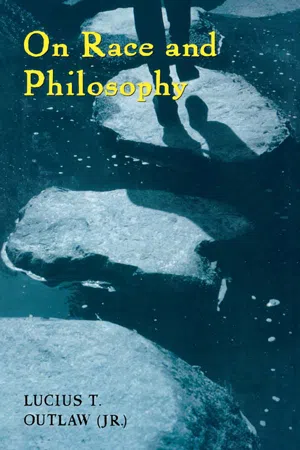
On Race and Philosophy is a collection of essays written and published across the last twenty years, which focus on matters of race, philosophy, and social and political life in the West, in particular in the US. These important writings trace the author's continuing efforts not only to confront racism, especially within philosophy, but, more importantly, to work out viable conceptions of raciality and ethnicity that are empirically sound while avoiding chauvinism and invidious ethnocentrism. The hope is that such conceptions will assist efforts to fashion a nation-state in which racial and ethnic cultures and identities are recognized and nurtured contributions to a more just and stable democracy.
- 256 pages
- English
- ePUB (mobile friendly)
- Available on iOS & Android
eBook - ePub
On Race and Philosophy
About this book
Information
1 Black Folk and the Struggle in “Philosophy”
DOI: 10.4324/9780203760581-1
I
Since the early 1970s, a new generation of young black philosophers has been pressing the case for the articulation and recognition of “black philosophy” and in doing so have sparked heated debates. It is no accident that questions have been raised regarding accomplishments by black folks in the area of intellectual endeavors called “philosophy.” Nor has the form in which the questions have been posed fortuitous — “Is there a ‘Black’ philosophy?” “Can there be a ‘Black’ philosophy?” — or the responses to them. Both the questioning and the responses owe their origins to a discernible complex of historical factors that have come together in a particular way to condition their emergence. For what is revealed in the struggle to confront the issue of “Black philosophy” is the expansion of the continuing history-making struggles of African and African-descended peoples in this country (and elsewhere) to achieve progressively liberated existence as conceived in various ways. Even more concretely, this questioning is one of the impacts of the increased number of black folks entering the ranks of academics with training in the discipline of philosophy on the downturn of yet another wave of resurgent black nationalist consciousness, as many characterize the historical situation.1
This timing is an important factor to be taken into account in understanding the debates regarding black folks and philosophy. Generally, particular historical tendencies and developments do not appear or unfold in all sectors (social, political, economic) of complex societies in the same way and at the same time — in other words, there is often a lag in the rates of change among the different sectors and even within sectors that are internally diverse (for example, professionalized disciplines in higher education). Further, there are specific historical reasons why the absolute number of black folks in academic philosophy has shown a recent marked increase. Both sets of factors have conditioned the emergence of the questioning and the forms of responses. Yet, another factor has more importance: the self-conceptions of those of us involved in “academic” philosophy. That the debate itself has so far (though hopefully not in the future) remained for the most part academic (and meekly so, at that) is revealing with respect to both academic philosophy and black folks who in increasing numbers (though not necessarily with an increase in critical insight of sufficient radicality) are moving into this field of knowledge production and mediation in this country at this time in its historical development. It is with some of the aspects of this complex, yet extremely important historical situation that I wish to deal.
II
Philosophy itself, both as a notion and as various forms of praxis, remains seriously problematic today, again for historical reasons. It has become almost wholly “academic”: the activity of trained “professionals” whose primary function has been reduced to being overseers in museums of the history of ideas. In itself this is a valuable function, for it ensures the preservation of valuable insights and strivings and their perpetuation via the practice of the mediation of tradition. Still, it does not represent a fulfillment of the larger historical and social function of philosophy understood as a dynamic enterprise unifying theory and praxis. As an enterprise, philosophy has suffered from the pervasive historical tendency, which has been intensified with the rapid development of advanced capitalistic-technological society (in this country particularly, in which the highest form of this development has been realized to date), toward increasing specialization and the concomitant development of narrowness, overconcern with methodologies and other discipline-focused matters, and in many cases toward forms of scienticism. Moreover, as a response to prevailing schemes of values of a capitalistic-technological society, the study of philosophy (i.e., participation in studies in the history of some ideas, almost wholly Western) has increasingly suffered from the pervasiveness of the “performance principle,” which would have us judge our primary activities, particularly formal education, in terms of their performance potentials, namely, the accumulation of capital. Thus are philosophy students constantly struggling with the question (and its implied criticism that philosophy is not useful for anything in terms of “making a living”) “What are you/am I going to do with philosophy?” Like most else in our society, the study and practice of philosophy are now often assessed by their market value, and we who “teach” it its market managers: professionals, higher degreed and salaried.
While the enterprise of philosophy has its rightful place in the overall scheme of things, it has nonetheless suffered from its professionalization, and we along with it. To the question “How do philosophers exist in the modern world?” William Barrett answers:
Philosophers today exist in the Academy, as members of departments of philosophy in universities, as professional teachers of a more or less theoretical subject known as philosophy.… The profession of the philosopher in the modern world is to be a professor of philosophy; and the realm of Being which the philosopher inhabits as a living individual is no more recondite than a corner within the University.… The price one pays for having a profession is …professional deformation.… As a human being, functioning professionally within the Academy, the philosopher can hardly be expected to escape his own professional deformation, especially since it had become a law of modern society that man is assimilated more and more completely to his social function. And it is just here that a troublesome and profound ambiguity resides for the philosopher today.2
This deformation reveals itself in other ways as well. It deforms the historical development of philosophical thought, evidenced by the degree to which the “problems” in philosophy continue to be, even in these very problematic times, discipline immanent, thus without foundation beyond the boundaries of the discipline itself. They have not emerged from the practices of life. Prior, therefore, to the resolution of the issue regarding “Black philosophy,” the issue of philosophizing, its possibilities in the West, are in need of clarification.
III
The very debate itself is thus seen to rest on unclarified grounds. We black folks who would involve ourselves in it would be wise to be cognizant of this situation in its fullness: not only its present condition of deformation but the distorted historical development of the West in general. Our rush to uncritical intellectual “integration” in a problematic situation might prove to be our undoing: that is, we might fail to be sufficiently aware of historical tendencies and possibilities that we might struggle with others to realize and, in so doing, help to bring about historical developments that might lead to enhanced conditions of life for all, but for the presently “marginal” peoples in particular.
But isn’t this very debate regarding “Black philosophy,” the struggle on the part of some black (and white) folk (with the sideline support of others, black, white, and otherwise) to define such an enterprise, an attempt that aims at avoiding or correcting the pitfalls of deformation? My response: no, not necessarily. And judging by some of our present endeavors (and our history as a class of educated black folks), again no. The adequacy of our involvement in the debate will depend on how we attend to a number of crucial factors, the awareness of which must be reflected in our philosophizing.
We black folks must, first of all, be clear as to our own being, not only individually but, most importantly, collectively, viewed in its historical sweep and cultural, socio-political, economic complexities, our future possibilities. Our reflections on our future possibilities as a people must be particularly insightful. The achievement of a seemingly integrated position within the ranks of professional academic philosophers and teachers of philosophy must not leave us blind to the general condition of black people in this country and elsewhere and, most importantly, to the realities of the basis of political-economic power in this country in various groupings that are not sufficiently grasped by traditional theory regarding the class structure of capitalistic society. An appropriate grasp of this situation must in turn be reflected in our struggle to come to grips with the activities that constitute philosophizing. Our personal situations as a class of black people characterized as such to a large extent by our levels of formal study must not lead us into a form of philosophizing that would imply that reason has been realized in contemporary history, that reasonableness has come to pervade relations among men and women, among different racial, ethnic, religious groups and economic classes in this society and relations among nations.
We must not be guilty of a premature leap into universal peace and brotherhood without the historical realization of the same for all. Black people are still an oppressed racial group in this society and are still struggling against colonialism and neo-colonialism in other parts of the world. So too are other peoples. And there is ample indication that major powers, particularly the U.S., are neither moving nor are willing or capable of moving, toward a world of peace and increased liberation for all peoples, a movement grounded in a politics and ethics involving political, economic, cultural, and social democracy. The struggle of our people continues to be that of seeking progressive liberation at a level capable of being shared by many given the level of development of the culture as a whole. It is too a continuing struggle for many who are non-black, including many whites. It is, overall, the struggle to harness and direct the capabilities of the society as a whole in the maximum utilization of resources with minimum waste and environmental destruction toward the satisfaction of essential human needs with minimum exploitation and oppression — that is, toward the achievement of forms of life based increasingly on reasonableness democratically envisioned and realized.
Toward this end, however, the concrete realities of the politics of the past, present, and foreseeable future demand that we approach the struggle from the level of a group, i.e., racial and ethnic (or nationalistic, as some would say), position, the only viable position in terms of which to achieve limited goals within the present order of things. In order to realize ends beyond the present order of things, to pursue progressive tendencies and possibilities that might lead to the realization of greater reasonableness and thus to the transformation of the present order of life with greater benefits for greater numbers of people, we must move beyond the limited program of group-centered politics as the only mode of political activity. Still, we cannot be premature even with regard to this.
IV
A very serious phase of our preparation for philosophizing in the interest of black people (and others) includes coming face to face with the history of the relationships of black thinkers to the historical efforts of black people and, most importantly, with where this history leaves us today. We must, in other words, become transparent to ourselves as a class in terms of our history, our responsibilities, our possibilities.
Many very significant insights into the history of black thinkers are to be had in the work by Harold Cruse, The Crisis of the Negro Intellectual. 3 A controversial book, to say the least, still its uneven but very often penetrating analyses and its prescriptive projects harbor a core of truth (both historical and as future possibility) which is, in my judgment, very substantial. On the historical side there emerges from his analyses a picture of essential failure on the part of black intellectuals (i.e., writers, social critics, artists, etc.) in not having forged a collective vision for black people based on an appropriate grasp of social, political, economic, and cultural realities. For Cruse this failure rests fundamentally on the erroneous commitment on the part of many black intellectuals to the ideal of racial integration. Even more the failure of left-looking “radical” black intellectuals, in his judgment, has been/continues to be a uncritical commitment to Marxism-Leninism and to the sufferance of intellectual apprenticeship to white, particularly Jewish, liberal and left-wing intellectuals. The pervasive reality of American life, says Cruse, is that its politics, cultural systems, and economics are group based: power resides in racial-ethnic/national groupings primarily. The struggle for integration on the part of black people without having developed, cultivated, and consolidated our own nationalistic or racial solidarity has resulted in — and will continue to result in — the unsuccessful realization of the struggle for equality and “freedom” within the present scheme of things. The struggle, for the most part, has not been revolutionary either in separatist schemes (which, says Cruse, seek to avoid the problem via escape) or those seeking systemic reform.
The arguments advanced by Cruse call for serious review and critique. Still a number of things are clear. First, our need to be clear as to our grounding as black thinkers. That ground, given present realities and the near and mediate future, is the long history of struggle on the part of our people for an increasingly liberated existence. Out of this grounding emerges our first task: the effort to achieve a critical understanding of our situation: of our real needs and the means by which they might be met. In working to meet these mediate responsibilities we must struggle against the tendencies leading to deformation and particularly we must be prepared to commit “class suicide” in order that our energies be given unequivocally in service to the historical struggles of our people, here and elsewhere. In this regard there is a particular turn that we must make in our development, a turn whose importance is heightened by the debate regarding black folks and philosophy and its context. That turn of development and its ground of necessity is clearly set out by Cruse:
Every other ethnic group in America, a “nation of nations,” has accepted the fact of its separateness and used it to its own social advantage. But the Negro’s conditioning steered him into that perpetual state of suspended tension wherein ninety-five per cent of his time and energy is expended on fighting prejudice in whites. As a result, he has neither the time nor the inclination to realize that all of the effort spent fighting prejudice will not obviate these fundamental things an ethnic group must do for itself. This situation results from a psychology that is rooted in the Negro’s symbiotic “blood-ties” to the white Anglo-Saxon. It is the culmination of that racial drama of love and hate between slave and master, bound together in the purgatory of plantations. Today the African foster-child in the American racial equation must grow to manhood, break the psychological umbilical ties to intellectual paternalism. The American Negro has never yet been able to break entirely free of the ministrations of his white masters to the extent that he is willing to exile himself, in search of wisdom, into the wastelands of the American desert. That is what must be done, if he is to deal with the Anglo-Saxon as the independent political power that he, the Negro, potentially is.4
The insights of Cruse make clear our historically conditioned vocation, which is fixed for us even more specifically by Vincent Harding:
The fact still remains that for the life and work of the black scholar in search of vocation, the primary context is not to be found in the questionable freedom and relative affluence of the American university, nor in the ponderous uncertainties of “the scholarly community,” nor even in the private joys of our highly prized, individual exceptionalisms. Rather, wherever we may happen to be physically based, our essential social, political, and spiritual context is the colonized situation of the masses of the black community in America.5
The vocation of the black intellectual/scholar thusly grounded structures, in Harding’s words, our calling:
To speak truth to our people, to speak truth about our people, to speak truth about our enemy — all in order to free the mind, so that black men, women, and children may build beyond the banal, the dangerous chaos of the American spirit, towards a new time.6
V
Still, the struggle to hear our calling and to respond, in part by taking a pilgrimage through the desert in search of wisdom, in part by speaking the truth, all directed by the concern t...
Table of contents
- Cover
- Halftitle Page
- Title Page
- Copyright Page
- Dedication
- Contents
- Acknowledgments
- Preface
- Introduction: On Race and Philosophy
- 1 Black Folk and the Struggle in “Philosophy”
- 2 Philosophy, African-Americans, and the Unfinished American Revolution
- 3 African “Philosophy”?: De constructive and Reconstructive Challenges
- 4 Africana Philosophy
- 5 Africology: Normative Theory
- 6 Against the Grain of Modernity: The Politics of Difference and the Conservation of “Race”
- 7 Life-Worlds, Modernity, and Philosophical Praxis: Race, Ethnicity, and Critical Social Theory
- 8 The Future of “Philosophy” in America
- Notes
- Index
Trusted by 375,005 students
Access to over 1.5 million titles for a fair monthly price.
Study more efficiently using our study tools.
Frequently asked questions
Yes, you can cancel anytime from the Subscription tab in your account settings on the Perlego website. Your subscription will stay active until the end of your current billing period. Learn how to cancel your subscription
No, books cannot be downloaded as external files, such as PDFs, for use outside of Perlego. However, you can download books within the Perlego app for offline reading on mobile or tablet. Learn how to download books offline
Perlego offers two plans: Essential and Complete
- Essential is ideal for learners and professionals who enjoy exploring a wide range of subjects. Access the Essential Library with 800,000+ trusted titles and best-sellers across business, personal growth, and the humanities. Includes unlimited reading time and Standard Read Aloud voice.
- Complete: Perfect for advanced learners and researchers needing full, unrestricted access. Unlock 1.5M+ books across hundreds of subjects, including academic and specialized titles. The Complete Plan also includes advanced features like Premium Read Aloud and Research Assistant.
We are an online textbook subscription service, where you can get access to an entire online library for less than the price of a single book per month. With over 1.5 million books across 990+ topics, we’ve got you covered! Learn about our mission
Look out for the read-aloud symbol on your next book to see if you can listen to it. The read-aloud tool reads text aloud for you, highlighting the text as it is being read. You can pause it, speed it up and slow it down. Learn more about Read Aloud
Yes! You can use the Perlego app on both iOS and Android devices to read anytime, anywhere — even offline. Perfect for commutes or when you’re on the go.
Please note we cannot support devices running on iOS 13 and Android 7 or earlier. Learn more about using the app
Please note we cannot support devices running on iOS 13 and Android 7 or earlier. Learn more about using the app
Yes, you can access On Race and Philosophy by Lucius Outlaw in PDF and/or ePUB format, as well as other popular books in Philosophy & Philosophy History & Theory. We have over 1.5 million books available in our catalogue for you to explore.