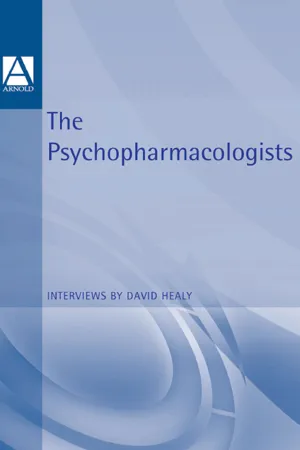
The Psychopharmacologists. An interview-based book about the process of therapeutic innovation in clinical psychiatry. David Healy's method is to interview key individuals involved in the discovery and deployment of drugs that have proved useful to psychiatry, and to draw them together within a model of the mechanism and clinical discovery that he uses as an overall framework.
These are historical accounts but highly relevant to the clinical psychiatrist of today, emphasising the importance of research, and of the marketing strategies of pharmaceutical companies in formulating disease entities as well as treatments for them.
- 668 pages
- English
- ePUB (mobile friendly)
- Available on iOS & Android
eBook - ePub
About this book
Information
1 Pierre Pichot
Psychopharmacology and the history of psychiatry
Could we begin with your recollections of the 1955 Paris meeting, which was effectively the first world-wide meeting on chlorpromazine.
The meeting was organized in Paris by Jean Delay. It was supported by Specia, the pharmaceutical firm which had produced chlorpromazine, which was a branch of the Rhône-Poulenc Group. For the first time people engaged in what was called psychopharmacology came together. They came from many countries, including the United States. Both the efficacy of the drug and the mechanism of action were discussed. However, at that time the biochemistry of the brain, as it exists now, was unknown. It was only at the beginning of the 1960s, that we began to speak of the role of the neurotransmitters in the action of both neuroleptic drugs and antidepressants and of their potential abnormalities in the disease process. So in practice 1955 was only a meeting on therapy with chlorpromazine.
I have always been very much impressed by the fact that chlorpromazine, which had been introduced only three years before, was already used all over the world. Theoretical ideas take usually a very long time to travel from one country to another and sometimes they never make it. I quote always the case of Karl Jaspers’ General Psychopathology, which is considered in the German-speaking world as one of the basic books of psychiatry. This was published in 1913 but appeared in English translation only in 1963, 50 years later and, even then, a paper published in the American Journal of Psychiatry wrote ingenuously that, until this publication, many psychiatrists in the United States had not realized that Jaspers was not only a philosopher, but also a psychiatrist. It takes a very long time for theoretical ideas to travel but in the case of new techniques of obvious practical value, the transmission is very fast. It was the case with ECT and it was even more striking with the neuroleptics because at the time psychoanalysis had an extremely strong influence, especially in the United States, and psychotherapy was considered the appropriate treatment for the mental illnesses.
There was some paradox in the fact that psychodynamically orientated psychiatrists, when confronted with psychotic patients in hospitals, could admit that, after all, drugs were useful. At the beginning of the 1960s I visited Yale University, an extremely well organized Department, in which a young British psychiatrist, psychodynamically orientated, specialized in the psychotherapy of schizophrenics. The programme combined intensive individual and group psychotherapy. At the end of the discussion, I asked my colleague ‘But do you use any drug?’ ‘Of course’, he said ‘we give them chlorpromazine 200 mg a day but just for facilitating the psychotherapy’.
At the 1955 meeting was the issue of who had discovered chlorpromazine an issue?
No. The meeting had been organized by Professor Delay who had published on it. It was certainly not an issue. In the case of chlorpromazine, the problem is extremely complicated. At that time, there was already a great hope about the possibility of psychopharmacology. In order to put the events in perspective, I must return to the life and career of Professor Delay. His father was a well-known surgeon in the South of France and, as fathers are, he wanted his son to become a surgeon. Professor Delay came to Paris to study medicine and, by competitive examination, became a Resident of the Paris Hospitals. At that time, this was a necessary step if you wanted later to attain an academic position. Professor Delay went through the entrance examination brilliantly – he has always been considered as one of the most brilliant physicians of his generation. His father was convinced, by one of Delay’s friends, to let him to give up surgery. So he became a resident in medicine and went to neurology which was – and still is – in France, and possibly in the UK, considered an ‘aristocratic’ speciality, being reserved for the best medical students. At the end of his residency he became ‘Chef de Clinique’, a position more or less similar to that of a Senior Registrar. It’s the first step in an academic career, followed eventually by the assistant professorship, and then by the full professorship. Professor Delay was Chef de Clinique at the Neurology Department of the Salpêtrière, but, at the same time, he studied psychology at the Sorbonne. All his life he had both psychological/literary and biological/scientific medical leanings. During his stay at the Salpêtrière, he was co-author of a book on EEG, an expression of his keen interest in biology and during the same period of his life, he became a PhD with a thesis on memory and its pathology. He was to write other books on psychopathological themes, especially one on mood disturbances which was relevant to his later ideas in psychopharmacology.
After leaving the Salpêtrière, Professor Delay entered psychiatry. This was a tradition in Paris. For a long time, in fact since the creation of a University Department of Psychiatry at the end of the 19th century, the Professor has been originally a neurologist of the Salpetriere who had later specialized in psychiatry. At Sainte-Anne Hospital, the seat of the Department, Delay became assistant Professor and then full Professor and Head of the Department. Because of his dual background he was interested in both psychopathology and in biological psychiatry. His first interest in biological psychiatry was electroconvulsive therapy, ECT, at that time the only really active biological treatment in psychiatry.
In the UK they were also using insulin coma …
Yes, that was also used, but it was technically complicated – there was a special unit at the University Clinic. The efficacy was at best marginal, but at that time we had nothing better for schizophrenic patients. We used a technique which came from the United States and Great Britain during the War: psychotherapy with patients whose state of consciousness had been lowered by a slow intravenous injection of amobarbital. It was called narco-analysis and was considered as combining in some ways psychological and biological components in the treatment. As soon as he became Head of the Department, Delay encouraged his co-workers to develop research in biological psychiatry. At the end of the 1940s, I was personally involved in research on amphetamines. The drug was not known to be addictive and it had been used in England intravenously in combination with amobarbital to produce abreactions, considered to be powerful therapeutic tools. During Delay’s period the general concept of ‘shock’ – an ill-defined term which implied that a rapid change in the state of consciousness could stimulate a recovery – was widespread. One spoke of insulin-shock, cardiazol-shock, electro-shock and of other now forgotten shock-techniques and, for that reason, Delay proposed the term amphetamine-shock.
In 1950 the first World Congress of Psychiatry was held in Paris, Professor Delay being President. As I have said, the main and practically only interest in biological therapy was in shock treatments: the inventors of the three best-known techniques – Sakel, Meduna and Cerletti – presented the main papers. The same year, Professor Delay had collected all his previous publications on biological psychiatry in a book called: ‘Biological Methods in Clinical Psychiatry’. This gives a good idea of his interests and of the situation existing just before the birth of modern psychopharmacology. The book contains, among others, chapters on insulin therapy, electro-shock, narco-analysis, amphetamines and, interestingly, the first mention of drug therapy as we understand it today. Delay had published with Sizaret and Deniker the year before two papers on the action of a dinitrile preparation in depressive states. Dinitriles had been studied previously in Sweden by Caspersson and shown to have allegedly ‘stimulating’ actions in nerve cells. Delay had various types of dinitrile derivatives prepared, and made a clinical trial with one of them. I mention this fact to give a general idea about the atmosphere. The attitude at the Clinic was that, if we tried hard enough, we would find a drug with therapeutic properties.
At that time chlorpromazine appeared. It has been synthesized at the Specia Laboratories. They had already created a series of antihistaminic drugs, some of which, like phenergan, had been used in psychiatry because of their obvious sedative effect. But chlorpromazine had different, and much more complex, properties. After it had been synthesized, its pharmacology was studied by Mrs Courvoisier at Specia Laboratories and it was then put at the disposal of Laborit. He was a navy physician, an anaesthesiologist. On the basis of a theory of the action of drugs in anaesthesiology, he proposed to use it in a combination he called a ‘lytic cocktail’. During his work he discovered and published the fact that chlorpromazine, used alone, had a very specific action. The consciousness remained normal, but the patient showed a complete lack of interest about his surroundings. Laborit suggested that because of that type of action, the drug could play an important role in psychiatric treatment. Others had also received supplies of the drug: Hamon, Paraire and Velluz, the psychiatrists at the Central Military Hospital in Paris, the Val de Grâce, and Pierre Deniker who used it at the Clinic under the direction of Delay.
They also published in 1952 and this is one of the points of discussion. There were three groups involved. There was Laborit, who made the first clinical observations, who did of course not use the drug on mental patients, but who discovered its psychotropic action and suggested that it could have a special interest in psychiatry. There was the group at the Val de Grâce, which used it on mental patients and published the first psychiatric paper, and there was Delay and Deniker whose publication came immediately after. The debate has been very heated. The Lasker prize was given in 1957 to Laborit and Deniker. Delay and Deniker have always considered that they were the real discoverers of the clinical properties of the drug. Their argument is that Hamon, Paraire and Veluz, even if their paper was the first, had used chlorpromazine in conjunction with barbiturates in manic states to potentiate the sedative properties, whereas they had used the drug alone. The American author, Josephine Swazey, a supporter of Laborit, wrote a book on chlorpromazine in which she portrayed him as the real discoverer of the properties of the drug. I have heard – but did not see the documents – that the New York Academy of Sciences made a detailed enquiry in France and concluded that Delay and Deniker were the discoverers of the clinical properties. However, the representative of the Army medical services still claim that their role was decisive.
In September 1993, a ceremony took place for the 200th anniversary of the foundation of the Val de Grâce, an old abbey which became a military hospital in 1794, during the French Revolution. A large scientific meeting was held in the wonderfully restored building and, at the end, a marble plaque was unveiled on which was inscribed: Hommage à Laborit, Lasker prize 1957, and to J. Hamon, J. Paraire and J. Velluz for their discovery, in 1952, of the therapeutic effects of chlorpromazine in psychiatry.
From 1952 on, Delay and Deniker contributed enormously to the subject, whereas Hamon and colleagues did not pursue that direction, and Laborit, not being a psychiatrist, did not work directly in psychopharmacology. The momentum came from Delay and Deniker, who had realized the importance of the new field, and in this respect they were the real discoverers. This is my personal opinion but I believe the discussions about the precise role of the various persons and groups involved have had an unfortunate consequence. I have always thought that the Nobel prize was never given for chlorpromazine, when it should have been, because of this. Only two Nobel prizes have been given for psychiatric discoveries, namely for malaria therapy and lobotomy and chlorpromazine was just as important. My impression – but it is only a guess – is that our Swedish colleagues were afraid of being involved in an argument about the roles and the priorities – they had already had bad experiences in this respect – and preferred to abstain.
Is it possible to tease their respective contributions apart? Was Deniker simply acting under the direction of Delay?
It is very difficult, not to say impossible, to tease the respective contributions of Delay and Deniker apart. As I have said, Professor Delay was deeply interested in the potential possibilities of drug therapy in psychiatry well before chlorpromazine appeared, and he encouraged his assistants in that direction. Deniker was then assistant in charge of the men’s wards, and had under him as resident Harl who is mentioned in the original paper. Of course Deniker was closer to the patients than Delay – and for that matter Harl was even closer – but, just as Harl discussed the results with Deniker, so Deniker discussed them with Delay. It was certainly not a one-man job.
At the 1955 meeting, Linford Rees reported on the evaluation of chlorpromazine using a randomized clinical trial method and he recalls you asking him about the English ‘obsession’ with clinical trials.
I probably meant – and it is still my opinion – that in cases where the changes produced by a treatment are of such a magnitude that they appear obvious to a naive observer, we do not need statistical proof. But it is fairly ironical that Linford Rees mentioned this episode, since I was already considered in France as a strong supporter of statistics. My training had been both in psychiatry at the medical school and in statistical psychology at the Institute of Psychology at the Sorbonne. I had published a book on mental testing and I had close connections with British psychologists and psychiatrists with the same interests. The British tradition in those matters was strong, and from the beginning, I had a leaning towards measurements in controlled trials. I am more or less considered in French psychiatry as the man who has been responsible for the introduction of quantitative assessment methods, both in psychopathology and in psycho-pharmacology. Indeed, I have been much attacked at that time by my colleagues for taking this position.
The French attitude was the result of a serious historical development. Statistical methods were born in France with Laplace and the mathematicians of the ‘Ecole Polytechnique’ such as Fourier, who developed the theoretic basis and the first great medical statistician was in the middle of the 19th century, a French physician, Louis. When the Royal College of Physicians started a section of statistical medicine, about 30 years ago, the first session was, significantly, an outline of Louis’ work. However, statistics later lost any prestige in medicine, probably under the influence of Claude Bernard. Claude Bernard was, of course, a great scientist but in his field, experimental medicine, where a single well-planned experiment was sufficient for a discovery, statistics were of no use. Unfortunately, in some of his writings, he ridiculed statistics. The result was that, because of his considerable influence, the medical profession took a negative view on the method. It was seen as opposed to the traditional and allegedly typically French clinical approach, which rested on the accurate observation of a single case. Statistics were confined to psychology and, in medicine, were looked down on until the Second World War.
It came back mostly through the influence of the medical publications we were receiving after the end of the War from the United States, but its progress was very slow. A few years after the end of the War, Robert Debré, at that time the most influential medical man in France, organized a meeting on clinical trials and invited French colleagues and British statisticians. The lectures of the proceedings are very revealing. Debré’s idea was to promote clinical trials in France but the reactions were, on the whole, not very positive: it was only conceded with some difficulty that statistics had some place in medicine. Debré managed, several years later, to have a mathematician, Daniel Schwartz, nominated in a newly created Chair of Statistics at the Medical School. Although Professor Schwartz was a brilliant statistician of engaging personality, who had a great talent for making complicated concepts understood by people without mathematical training, it took a long time to convince the traditional clinicians of the value of the methods. It was the same in psychiatry as in the rest of medicine: statistics and controlled trials were looked down as alien to the clinical spirit.
Hanns Hippius suggests that when the drugs were first introduced in Germany they weren’t of any great interest to German psychiatrists because therapy was not considered to be part of science. The use of the drugs or the interest in the drugs would have been to see what they revealed about how the mind works rather than in terms of trying to get people well. To some extent, it was a little bit the same within the UK, in the centres of excellence like Oxford and Cambridge and the Maudsley. The idea that it might be a good idea to try to get people well has come from outside the big centres. Is that the same in France?
Not to the same extent, I would say. You must remember that in France, the Paris University Clinic was considered the centre of excellence, and that Head of Department, Professor Delay, had already shown a great interest in drug therapy, as I have mentioned earlier. On the other hand it is true that, in so far as you can speak of German, French or British schools of psychiatry, the German one had always been considered in France as mostly interested in theories. Since Madame de Stael, Germany was seen, especially in the 19th century, as a country of philosophers and thinkers, producing beautiful but sometimes obscure theories. Two years ago I wrote a paper on the history of German psychiatry as seen by the French authors of the same period. The German school had always fascinated the French psychiatrists because of its theoretical points of view, so different from the French attitude prevailing since Pinel, which was basically clinical and descriptive. Of course, the atmosphere in those relations has been influenced by external events. During the First World War, German psychiatry, as represented then by Kraepelin, was attacked violently and considered as fundamentally aggressive, as aiming at imposing its ideas on the world, as the armies of the Kaiser were doing. But, even during this short episode, the main argument used against Kraepelin – of course, wrongly – was that his concepts were of a basically theoretical nature and had allegedly no connection with the clinical facts. Even if one leaves aside the role of national stereotypes which colour the judgements on another country, it can certainly be said, as Hanns Hippius mentioned, that German psychiatry has always shown a great interest in theoretical issues and in psychopathology, whereas the French had a more pragmatic, descriptive and clinical bent. This emphasis on the clinical approach probably favoured an interest in the therapeutic methods, but was at the same time responsible for the antagonism to the controlled trial. It was claimed that a clinician could realize, better tha...
Table of contents
- Cover
- Title Page
- Copyright Page
- Table of Contents
- Contributors
- Preface
- Acknowledgements
- Glossary
- Dramatis personae
- Chronology of interviews
- 1 Pierre Pichot (Paris) The discovery of chlorpromazine and the place of psychopharmacology in the history of psychiatry
- 2 Julius Axelrod (NIMH) The discovery of amine reuptake
- 3 Arvid Carlsson (Gothenburg) The rise of Neuropsychopharmacology: impact on basic and clinical neuroscience
- 4 Frank Ayd (Baltimore) The discovery of antidepressants
- 5 Alan Broadhurst (Cambridge) Before and after imipramine
- 6 Silvio Garattini (Milan) The role of independent science in psychopharmacology
- 7 Heinz Lehmann (Montreal) Psychopharmacotherapy
- 8 Hanns Hippius (Munich) The founding of the CINP and the discovery of clozapine
- 9 Hannah Steinberg (London) Bridging the gap: psychology, pharmacology and after
- 10 Jonathan Cole (Harvard) The evaluation of psychotropic drugs
- 11 Alex Coppen (Epsom) Biological psychiatry in Britain
- 12 Jules Angst (Zurich) The myths of psychopharmacology
- 13 George Beaumont (Cheshire) The place of clomipramine in psychopharmacology
- 14 Donald Klein (New York) Reaction patterns to psychotropic drugs and the discovery of panic disorder
- 15 Herman van Praag (Maastricht) Psychiatry and the march of folly
- 16 Merton Sandler (London) The place of chemical pathology in psychopharmacology
- 17 Floyd Bloom (Scripps) Neurophysiology and the psychopharmacology of the addictions
- 18 Alexandra Delini-Stula (Basle) The changing face of psychotropic drug development – from 1965 to 1995.
- 19 Gordon Claridge (Oxford) The role of individual differences in psychopharmacology
- 20 Malcolm Lader (London) Psychopharmacology: clinical and social
- 21 Herbert Meltzer (Ohio) A career in biological psychiatry
- 22 Brian Leonard (Galway) The role of behavioural pharmacology in drug development
- 23 John Hughes (Cambridge) The discovery of the opioid peptides
- 24 Peter Waldmeier (Basle) From mental illness to neurodegeneration
- 25 Tom Ban (Toronto) They used to call it psychiatry
- Index
Trusted by 375,005 students
Access to over 1.5 million titles for a fair monthly price.
Study more efficiently using our study tools.
Frequently asked questions
Yes, you can cancel anytime from the Subscription tab in your account settings on the Perlego website. Your subscription will stay active until the end of your current billing period. Learn how to cancel your subscription
No, books cannot be downloaded as external files, such as PDFs, for use outside of Perlego. However, you can download books within the Perlego app for offline reading on mobile or tablet. Learn how to download books offline
Perlego offers two plans: Essential and Complete
- Essential is ideal for learners and professionals who enjoy exploring a wide range of subjects. Access the Essential Library with 800,000+ trusted titles and best-sellers across business, personal growth, and the humanities. Includes unlimited reading time and Standard Read Aloud voice.
- Complete: Perfect for advanced learners and researchers needing full, unrestricted access. Unlock 1.5M+ books across hundreds of subjects, including academic and specialized titles. The Complete Plan also includes advanced features like Premium Read Aloud and Research Assistant.
We are an online textbook subscription service, where you can get access to an entire online library for less than the price of a single book per month. With over 1.5 million books across 990+ topics, we’ve got you covered! Learn about our mission
Look out for the read-aloud symbol on your next book to see if you can listen to it. The read-aloud tool reads text aloud for you, highlighting the text as it is being read. You can pause it, speed it up and slow it down. Learn more about Read Aloud
Yes! You can use the Perlego app on both iOS and Android devices to read anytime, anywhere — even offline. Perfect for commutes or when you’re on the go.
Please note we cannot support devices running on iOS 13 and Android 7 or earlier. Learn more about using the app
Please note we cannot support devices running on iOS 13 and Android 7 or earlier. Learn more about using the app
Yes, you can access The Psychopharmacologists by David Healy in PDF and/or ePUB format, as well as other popular books in Medicine & Health Policy. We have over 1.5 million books available in our catalogue for you to explore.