The History of English provides an accessible introduction to the changes that English has undergone from its Indo-European beginnings to the present day. The text looks at the major periods in the history of English, and provides for each a socio-historical context, an overview of the relevant major linguistic changes, and also focuses on an area of current research interest, either in sociolinguistics or in literary studies. Exercises and activities that allow the reader to get 'hands-on' with different stages of the language, as well as with the concepts of language change, are also included.
By explaining language change with close reference to literary and other textual examples and emphasising the integral link between a language and its society, this text is especially useful for students of literature as well as linguistics.
Chapter 3 begins our historical narrative of English in earnest, looking at the language in a series of snapshots which reveal something of the significant linguistic changes, as well as important socio-historical issues, which have characterized its existence at various points in its history. This approach is neither untried nor untested: texts such as Baugh and Cable (2002), Fennell (2001), Barber (1993), Strang (1970), to name but a few, have shown that this kind of historical (re-)construction effectively conveys both a general sense of linguistic change through time and a more specific awareness of significant changes at particular times. It is arguable, however, that this framework, in its inevitable representation of a language's history as a chronological series of discrete, significant ‘linguistic events’, does not wholly capture the dynamic and ongoing nature of linguistic change. For instance, discussions of lexical change which focus on the importance of compounding in Old English (OE), but on borrowing in Middle English (ME) and Early Modern English (EModE), obscure somewhat the continuous importance of both processes throughout all three periods. Similarly, a focus on inflectional change in OE and ME potentially marginalizes its ongoing significance in other periods, as well as creating the impression that it is the only notable dimension of morphosyntactic change. We will therefore attempt here to complement the period-based framework of later chapters by outlining some of the more common changes that have been (and continue to be) significant for English. There are, however, a few provisos to bear in mind before we begin. First, the following sections do not offer a comprehensive discussion of language change. Research in this area covers a great deal of ground: it is approached not only within different theoretical frameworks but also with differing (but related) questions in mind. Studies of language change can (and do) therefore address issues such as the differentiation between internally and externally motivated change (that is, change that occurs and proceeds because of factors either intrinsic to the language system or present in the external social context), or focus on determining the factors that actuate change in the first instance, and facilitate the transmission and retention of some features and the discarding of others. Change can also be measured sociolinguistically, in terms of variables such as age, gender and ethnicity, as well as of attitudes to it. All of these (plus others we have not mentioned) constitute huge areas of research and debate in themselves,1 and it is impossible to do them all justice in the space of this one chapter. We will therefore confine our discussion to major processes of linguistic change, and – given the constraints of space as well as the primary focus of this book – our database deals largely with historical and contemporary examples from English. We begin with processes of sound change.
1.2 Sound Change
As McMahon (1994: 14) points out, sound change can actually be viewed as an umbrella term for a wide variety of changes. Its processes may affect single sound segments (vowels or consonants), combinations of sounds such as consonant clusters and diphthongs, prosodic features such as rhythm, stress and intonation, as well as underlie large-scale sound shifts. This section, however, considers some of the more common segmental sound changes and sound shifts which have affected English and continue to do so.
Sound changes which affect segments can either be conditioned, meaning that they only occur in specific phonetic environments, or unconditioned, meaning that they can affect all occurrences of a particular sound. One regularly occurring type of conditioned change is assimilation, a process through which one sound becomes more like another in its environment. Assimilation can be complete, in that the sounds involved in the process become identical (as in Latin septem > Italian sette), or it can be partial, so that instead they come to share certain features. For example, texts indicate that medial [v] in OE efen/efn ‘even’ was sometimes replaced by nasal [m] through assimilation to final nasal [n], resulting in spellings such as emn. A more recent example of partial assimilation can be heard in the pronunciation [hambæg] (handbag), which results from the replacement of [n] by bilabial nasal [m], because of conditioning bilabial [b]. In all of these examples, assimilation is considered anticipatory or regressive, in that the affected sound precedes the conditioning one. In peseverative or progressive assimilation, however, that order is reversed, as can be seen in the derivation of OE wull ‘wool’ from ancestral Germanic *wulno.2 Finally, assimilation can also be distant, in that the conditioning and affected sounds are separated by intervening segments. In Chapter 3, we will look at a particular instance of such assimilation, namely i-mutation, which affected certain nouns in the Germanic ancestor of English. Words such as feet and goose are descended from forms which marked their respective plurals with a final inflectional –i, as in *fōt/*fōti (‘foot/feet’) and *gōs/*gōsi (‘goose/geese’). Anticipatory but distant assimilation with final –i caused fronting of the stem vowel and by the late OE period, this long ō [o:] had been replaced by long front [e:]. Final conditioning –i had also been obliterated, hence OE spellings such as fēt and gēs. A much later shift from [e:] to [i:] (see Chapter 5) resulted in our modern pronunciations of these words.
Dissimilation, the opposite of assimilation, occurs only sporadically in individual words. Examples include the change in Latin peregrīnus to Old French pelerin (the source of English pilgrim), and Old French purpre to English purpel (‘purple’) (McMahon, 1994: 15). Another type of segmental sound change is epenthesis, a process by which segments are inserted into a phonetic sequence. Epenthetic vowels, for example, typically break up consonant clusters, as in pronunciations such as [fIlIm] (film) and [ar℧m] (arm), which are characteristic of Irish English varieties.
Segments can also be sporadically deleted in pronunciation: through aphaeresis, an initial segment is lost (as in the loss of word-initial [k] and [g] in words such as knee and gnome); and in apocope, a final vowel (as in modern English name [neIm] from ME [na:m
]). In syncope, medial vowels disappear (as in modern English monks from OE munecas) and in haplology, a whole syllable is deleted (as in OE Englalond > modern England). Finally, through metathesis, another sporadic change, adjacent segments are re-ordered, as in OE brid and ācsian > modern English bird and ask. Interestingly, a modern pronunciation aks (which echoes its OE predecessor) also exists and has come to acquire, in some areas and for some speakers, the status of a shibboleth. It is, for instance, taken to be one of the most characteristic, and most denigrated, features of Black English in America (see Lippi-Green, 1997, for a full discussion).
All the changes considered so far affect segments in the particular environments of individual words. Languages do, however, also experience sound change on a much larger scale, as is evidenced by (largely unconditioned) shifts in the pronunciation of sets of vowels or consonants. In general, such shifts involve segments which share qualities that link them in some way. Thus, the First Germanic Consonant Shift (discussed in Chapter 2) affected sets of voiceless and voiced aspirated and unaspirated plosives in the Germanic ancestor of English; and the Great Vowel Shift (discussed in Chapter 5) occurred with the long vowels of Middle English. The same situation obtains with the two modern shifts we will consider briefly here; namely the Southern Vowel Shift and the North California Vowel Shift in American English.
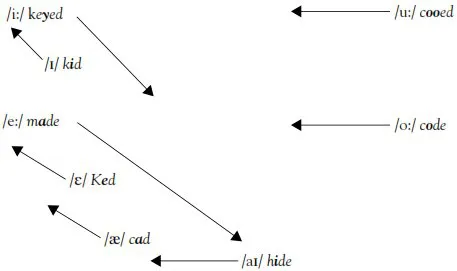
Figure 1.1 The Southern Vowel Shift
The Southern Vowel Shift3 (represented in Figure 1.1), which occurs throughout the Southern States and South Midland areas, essentially involves change in the pronunciation of short front vowels and of long front and back vowels. Labov (1996: 5) locates the beginning of the shift in the changing pronunciation of words with /aI/ such as hide, which becomes increasingly monophthongized and fronted. Words with long /e:/ (such as made) then move downwards to /aI/, and those with /i:/ (as in keyed) follow ‘a parallel path towards mid-center position’ (ibid.). Pronunciation of the short front vowels /I/, /ε/ and /æ/ (as in kid, Ked and cad, respectively) shift forward and upward, taking on something of a glide quality so that a word like bed (/ε/), for example, becomes pronounced like beyd [bɛId] (Wolfram and Schilling-Estes, 1998: 139). In addition, the long back vowels /u:/ and /o:/ (cooed and code, respectively) are becoming increasingly fronted. Interestingly, the Southern Shift appears to be proceeding more rapidly in rural regions, possibly because ‘Southern speakers in metropolitan areas are influenced by the speech of non-Southerners to a greater degree than are Southerners in rural locales’ (ibid.).
The second shift we will illustrate here is the Northern California Vowel Shift, which largely involves the lowering and backing of the short front vowels and the fronting of back vowels. Since this shift has not been diagrammed by its primary researchers (most notably Eckert since the 1990s), I will not attempt to do so here. The description provided in Example 1.1, however, outlines its main movements (note that some changes are in fact conditioned):
Example 1.1 The Northern California Vowel Shift4
/I/ think
> /i:/
before /ŋ/
/I/ did
> /ε/
before other consonants
/ε/ friend
> /æ/
/∧/ fun
>/ε/
/æ/ Brad
> /a/
/æ/ stand
> diphthong, the first element of which is shifting towards /i:/
before nasals
/u:/ dude
> /iw/
/℧/ brook
>/∧/
/o:/ goes
> diphthong, the first element of which is shifting towards /ε/
Eckert (2002) argues that certain adolescent and pre-teen groups (primarily girls) construct social meaning through such pronunciation shifts, particularly in relation to heterosociability.5 Eckert cites as an illustration the ‘performance’ of adolescence by two pre-teens, Trudy and Lillian. Both make use of Shift pronunciations, particularly when talking about defining issues in their developing adolescent persona. Trudy, for example, who appears to be constructing herself as tough Chicana (both behaviourally and linguistically), displays Shift pronunciations such as /∧/> /ε/ in words such as whassup and mud in her narration of a fight for which she was suspended and which she clearly considers a reflection and reinforcement of her persona. Lillian also makes use of Shift pronunciations but this time as part of a construction of ‘(heterosexual) drama princess’. In a conversation with some male peers about her attending a school dance with Brad, Lillian's pronunciation of her su...
Table of contents
Front Cover
Half Title
Title Page
Copyright
Contents
List of Figures
List of Tables
List of Symbols and Conventions
Acknowledgements
Introduction
1. English as a Changing Language
2. Language Families and the Pre-history of English
3. Old English, 500–1100
4. Middle English, 1100–1500
5. Early Modern English, 1500–1700
6. Modern English, 1700 onwards
Bibliography
Index
Trusted by 375,005 students
Access to over 1.5 million titles for a fair monthly price.
Study more efficiently using our study tools.
Frequently asked questions
Yes, you can cancel anytime from the Subscription tab in your account settings on the Perlego website. Your subscription will stay active until the end of your current billing period. Learn how to cancel your subscription
No, books cannot be downloaded as external files, such as PDFs, for use outside of Perlego. However, you can download books within the Perlego app for offline reading on mobile or tablet. Learn how to download books offline
Perlego offers two plans: Essential and Complete
Essential is ideal for learners and professionals who enjoy exploring a wide range of subjects. Access the Essential Library with 800,000+ trusted titles and best-sellers across business, personal growth, and the humanities. Includes unlimited reading time and Standard Read Aloud voice.
Complete: Perfect for advanced learners and researchers needing full, unrestricted access. Unlock 1.5M+ books across hundreds of subjects, including academic and specialized titles. The Complete Plan also includes advanced features like Premium Read Aloud and Research Assistant.
Both plans are available with monthly, semester, or annual billing cycles.
We are an online textbook subscription service, where you can get access to an entire online library for less than the price of a single book per month. With over 1.5 million books across 990+ topics, we’ve got you covered! Learn about our mission
Look out for the read-aloud symbol on your next book to see if you can listen to it. The read-aloud tool reads text aloud for you, highlighting the text as it is being read. You can pause it, speed it up and slow it down. Learn more about Read Aloud
Yes! You can use the Perlego app on both iOS and Android devices to read anytime, anywhere — even offline. Perfect for commutes or when you’re on the go. Please note we cannot support devices running on iOS 13 and Android 7 or earlier. Learn more about using the app
Yes, you can access The History of English by Ishtla Singh,Ishtia Singh in PDF and/or ePUB format, as well as other popular books in Languages & Linguistics & Historical & Comparative Linguistics. We have over 1.5 million books available in our catalogue for you to explore.