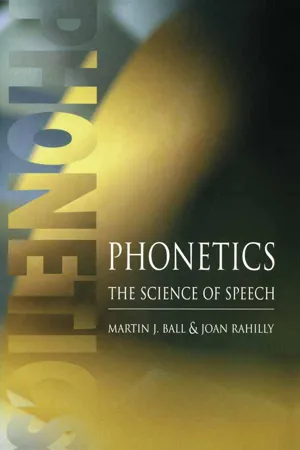
In their comprehensive new introduction to phonetics, Ball and Rahilly offer a detailed explanation of the process of speech production, from the anatomical initiation of sounds and their modification in the larynx, through to the final articulation of vowels and consonants in the oral and nasal tracts. This textbook is one of the few to give a balanced account of segmental and suprasegmental aspects of speech, showing clearly that the communication chain is incomplete without accurate production of both individual speech sounds (segmental features) and aspects such as stress and intonation (suprasegmental features). Throughout the book the authors provide advice on transcription, primarily using the International Phonetic Alphabet (IPA). Students are expertly guided from basic attempts to record speech sounds on paper, to more refined accounts of phonetic detail in speech. The authors go on to explain acoustic phonetics in a manner accessible both to new students in phonetics, and to those who wish to advance their knowledge of key pursuits in the area, including the sound spectrograph. They describe how speech waves can be measured, as well as considering how they are heard and decoded by listeners, discussing both physiological and neurological aspects of hearing and examining the methods of psychoacoustic experimentation. A range of instrumentation for studying speech production is also presented. The next link is acoustic phonetics, the study of speech transmission. Here the authors introduce the basic concepts of sound acoustics and the instrumentation used to analyse the characteristics of speech waves. Finally, the chain is completed by examining auditory phonetics, and providing a fascinating psychoacoustic experimentation, used to determine what parts of the speech signal are most crucial for listener understanding. The book concludes with a comprehensive survey and description of modern phonetic instrumentation, from the sound spectrograph to magnetic resonance imaging (MRI).
- 239 pages
- English
- ePUB (mobile friendly)
- Available on iOS & Android
eBook - ePub
About this book
Information
Table of contents
- Cover
- Half Title
- Title Page
- Copyright Page
- Table of Contents
- Acknowledgments
- Introduction
- 1 The anatomy and physiology of speech
- 2 Initiation of speech
- 3 Speech articulation
- 4 Segments of speech: obstruent consonants
- 5 Segments of speech: sonorant cosonants and vowels
- 6 Suprasegments of speech
- 7 Multiple articulations, co-articulation and the parameters of speech
- 8 Principles and methods of phonetic transcription
- 9 Acoustic characteristics of speech
- 10 The perception of speech
- 11 Perceptual phonetics
- 12 Instrumental phonetics
- Appendix 1: Phonetics charts
- Appendix 2: Languages cited in the text
- References
- Index
Trusted by 375,005 students
Access to over 1.5 million titles for a fair monthly price.
Study more efficiently using our study tools.
Frequently asked questions
Yes, you can cancel anytime from the Subscription tab in your account settings on the Perlego website. Your subscription will stay active until the end of your current billing period. Learn how to cancel your subscription
No, books cannot be downloaded as external files, such as PDFs, for use outside of Perlego. However, you can download books within the Perlego app for offline reading on mobile or tablet. Learn how to download books offline
Perlego offers two plans: Essential and Complete
- Essential is ideal for learners and professionals who enjoy exploring a wide range of subjects. Access the Essential Library with 800,000+ trusted titles and best-sellers across business, personal growth, and the humanities. Includes unlimited reading time and Standard Read Aloud voice.
- Complete: Perfect for advanced learners and researchers needing full, unrestricted access. Unlock 1.5M+ books across hundreds of subjects, including academic and specialized titles. The Complete Plan also includes advanced features like Premium Read Aloud and Research Assistant.
We are an online textbook subscription service, where you can get access to an entire online library for less than the price of a single book per month. With over 1.5 million books across 990+ topics, we’ve got you covered! Learn about our mission
Look out for the read-aloud symbol on your next book to see if you can listen to it. The read-aloud tool reads text aloud for you, highlighting the text as it is being read. You can pause it, speed it up and slow it down. Learn more about Read Aloud
Yes! You can use the Perlego app on both iOS and Android devices to read anytime, anywhere — even offline. Perfect for commutes or when you’re on the go.
Please note we cannot support devices running on iOS 13 and Android 7 or earlier. Learn more about using the app
Please note we cannot support devices running on iOS 13 and Android 7 or earlier. Learn more about using the app
Yes, you can access Phonetics by Martin J Ball,Joan Rahilly in PDF and/or ePUB format, as well as other popular books in Languages & Linguistics & Linguistics. We have over 1.5 million books available in our catalogue for you to explore.