- 328 pages
- English
- ePUB (mobile friendly)
- Available on iOS & Android
eBook - ePub
About this book
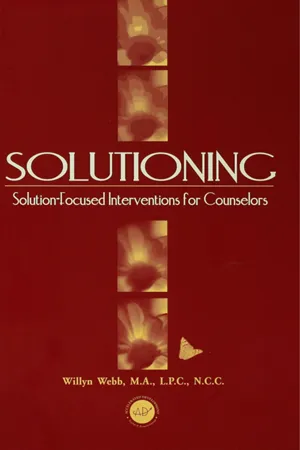
Are you tired of having to compromise your philosophy of counseling to fit the world of managed care? Are you trying to save time while creating a hopeful atmosphere for your clients? Are you looking for more effective ways to encourage responsibility, raise self-esteem and develop life-long abilities in your clients? This book offers a new strategy for any helping professional who answered yes to the above questions. Based on Solution-Focused Brief Therapy, the 4-P Solutioning process provides therapists with key methods to end blaming, encourage responsibility, and empower clients to find and use solutions. Solutioning is not an all-encompassing theory that requires a radical change in philosophy, but a language that promotes growth, change, and flexibility. It encourages the practitioner to blend tried-and-true techniques with the solutioning attitude and supplementary interventions, allowing the efficiency necessary for managed care survival. This book provides therapists with: The language of the 4-Ps, taught using easily accessible practice sheets; skill highlights which focus on pre-existing skills that can be given a solutioning slant; solutioning applications that illustrate how particular interventions apply to common mental health issues; intakes, treatment plans, progress notes, and many other usable tools, along with specific adaptations for family, couple, and play therapy; a complete solutioning group program and the curriculum for teaching the 4-P process with lessons and handouts.
Information
Subtopic
History & Theory in PsychologyIndex
PsychologyChapter 1
Building Blocks
TIMING IS EVERYTHING
“We must use time as a tool, not as a couch.”
—John Fitzgerald Kennedy (Webster, 1992, p. 281)
In this era of managed care and sound-bite attention spans, time has become a big issue in counseling. The age of brief therapy—whether 10 one-hour sessions (Weakland, Fisch, Watzlawick, & Bodin, 1974, p. 142) or one 20-minute session (Huber & Backlund, 1996)—definitely has arrived. The relevance for solutioning is not time, but timing. Regardless of the number or length of sessions, solutioning has a place in any individual’s therapy—it’s only a matter of timing.
The way we practice psychotherapy and interact with our clients expresses our basic beliefs about human nature, problems, and change. Determining your philosophy of counseling was probably a major part of your graduate training. Perhaps looking at some beliefs of solution-focused brief therapy (SFBT) will help you reexamine your own basis while considering where solutioning fits in. As Walter and Peller (1992, pp. 2–5) illustrated, there are three distinct models of therapy, each formed from a different basic question: “What is the cause of the problem? or What maintains the problem? or How do we construct solutions?” They went on to explain, “Solution-focused brief therapy is not a collection of techniques or an elaboration of a technique; rather, it reflects fundamental notions about change, about interaction, and about reaching goals” (Walter & Peller, 1992, p. 28).
Based on my own experiences and those of my adult students, I pose the following questions: Does believing in the fundamental notions of SFBT rule out believing in the relevant and helpful ideas of the other models? Can they be used in conjunction? Are the fundamental notions of SFBT enough? Does talking about the problem undo the benefit of talking about the solution? Are there times when problem talk, insight, understanding, and input are required?
Looking at the needs of clients gives us the answers. Some clients come into therapy heavily burdened with symptoms, which solutioning will readily relieve. This clears the way for them to clearly define their therapeutic purpose, which may require additional use of the 4-P solutioning process or some other model. But some clients need to find the cause of their problems, gain some understanding and insight, or form a relationship with their therapist before they can begin solutioning. Because solutioning is an intervention, it can be used varyingly. This is not an either/or situation. If you can see how the building blocks of humanism, constructivism, causality, systems, and change apply, you can insert solutioning when the time is right.
BUILDING BLOCKS OF BELIEF
Humanism
“Treat people as if they were what they should be, and you help them become what they are capable of becoming.”
—Johann Wolfgang von Goethe (Peter, 1977, p. 393)
Solutioning, like SFBT, sees clients, families, and all individuals as having the abilities and resources they need to flourish, grow, develop, and live satisfying lives; in other words, people can solve their own problems. Additionally, solutioning acknowledges that other models of therapy (or even medication) may be necessary to get the client to the point that he or she can access those abilities and resources. This description of solution-orientated therapy illustrates its nature:
It is a method that focuses on people’s competence rather than their deficits, their strengths rather than their weaknesses, their possibilities rather than their limitations. (O’Hanlon & Weiner-Davis, 1989, p. 1)
At the core of solution-focused therapy is the claim that, wherever a problem is said to exist, there are almost always exceptions—times when the problem occurs less frequently or not at all. Problems do not occur 100% of the time (Metcalf, 1995). No behavior happens all the time. Yet clients often ignore these exceptions or consider them flukes (de Shazer, 1985, 1988). Solutioning aims to help clients focus on and learn from the exceptions.
We all encounter problems in life, yet we all have within us the strengths to face these difficulties and cope with or overcome them. “Counseling is a means of facilitating the time and effort it takes to do so” (Huber & Backlund, 1996, p. 16). Operating from this belief, the therapist can help clients identify the resources they have to resolve their complaints, see their exceptional times, turn those into potential solutions, and act on the information with a plan. In the following case study, a client came into therapy feeling incapable and left knowing she had the abilities required to be the parent she wanted to be.
I Am a Good Parent! The Case of Rhonda
Rhonda brought her 15-year-old daughter, Mary, in for counseling. Mary reported that she was fine with her life, that everything was okay, except when her mother tried to enforce restrictions. Then Mary would become upset, hate her mother, and generally cause an uproar.
Joint sessions illustrated Rhonda’s inconsistencies and lack of confidence as a parent. I requested a session alone with her. She came in feeling like a failure as a parent, aware of her inconsistencies and loss of self-control, and continually expressing her shortcomings. She was on the verge of giving up and sending Mary to live with her father. Believing that every individual has the necessary abilities to cope with life, I set out to codiscover them with Rhonda, using solutioning language as a tool. Rhonda had already established as her purpose of counseling becoming a more effective parent.
Willyn: | You’ve told me about all the shortcomings you feel you have as a parent, and I know you are frustrated. What I’d like to talk about now are the times when are you a good parent. |
Rhonda: | When I say what I’m going to do and stick to it. I just don’t stick to it very often. I get upset or tired and go back on what I’ve said. |
Willyn: | You’ve told me you are a middle-school special education teacher. Are you a good one? Do you have classroom discipline? Do you stick to what you say as a teacher? |
Rhonda: | Oh, yeah. I post the rules and the consequences and stick by them. If I didn’t, my classroom would be in chaos and I’d be a real mess. I really make my students toe the line. |
Willyn: | How do you do that, make your students toe the line? |
Rhonda: | Well, when there’s a problem and they disobey or break a rule, I know exactly what to do because the consequences have already been determined. I don’t get so emotional because I have a plan and follow it. |
At school I’m really good at keeping my cool and being consistent. | |
Willyn: | Wow! That is really impressive, how well-managed your classroom is and how you keep your cool at school! It sounds like having rules and consequences, which everyone understands in advance, is the key. |
Rhonda: | Yeah, those are a lifesaver. I even have them on the walls so we can look at them and be reminded when we need it. |
Willyn: | Having clear rules and consequences that everyone understands really works for you at school, and you are skilled at classroom management. Sounds to me like you have all the capabilities of being a great parent. |
Rhonda: | You know, I never compared the two. I am very capable at school, and most of those kids are a lot worse than my own. I’ve just never done anything at home like rules or consequences. At home, I usually just fly by the seat of my pants and try to ground them or yell or something. |
Willyn: | How about trying at home some of what works at school—rules and consequences—and see what happens? |
Rhonda: | Yeah, I’ll sit down with my girls, just like I do with my students during the first week of school. We’ll talk about what we need for rules and what would be appropriate consequences. I’ll even post them on the refrigerator. You know another thing I do at school when I feel I’m starting to blow is a chill-out. I have the student go to the hall for a minute. Then I go talk to them when I’ve had time to cool off a little. I can’t really send my girls to their room, they’re too big, but I could go to my room for a minute for a chill-out, to remind myself of the rules—like school. |
Willyn: | Great idea. That sounds like it will really work. I can’t wait until next week to hear about all the great changes you make using your school skills at home. |
A couple days after that session, I got a call from Rhonda, reporting that she did have the skills she needed to be a good parent, she just hadn’t used them before.
Reminding herself of her teaching skills whenever she felt incapable as a parent worked for Rhonda. I hadn’t told her she had the skills, but my language assumed it. Rhonda realized it for herself as she answered some solutioning questions. This proved more successful than if I had implied that Rhonda needed a lot of instruction on parenting, which would have fed her self-perception of being incapable.
Simply believing that clients are capable and have resources and abilities affects how we approach, communicate, and assist them in leading satisfactory lives. A humanistic attitude, supported by the language of solutioning, makes all the difference.
Frequently, clients overwhelmed by life’s difficulties lose sight of their problem-solving strengths. They may simply need to be reminded of the tools with which they are equipped to develop long-lasting solutions. At other times, they may have some capabilities that can be added to or honed in order to help them sort out their situations. (O’Hanlon & Weiner-Davis, 1989, p. 34)
Experiences like Rhonda’s are hopeful and motivating for therapists and clients alike. The 4-P process of solutioning is a burnout prevention method for therapists as much as an intervention for clients.
“I always prefer to believe the best of everybody—it saves so much trouble.”
—Rudyard Kipling, (Webster, 1992, p. 93)
Constructivism
Constructivism maintains that the observer can never mirror a reality; instead, the observer constructs a reality that fits with his or her experiences. Duckworth (1987, p. 112) defined constructivism this way: “Meaning is not given to ...
Table of contents
- Cover
- Halftitle
- Title
- Copyright
- Contents
- Acknowledgments
- Introduction
- Chapter 1: Building Blocks
- Chapter 2: Ready, Set, Go: The First P—Purpose
- Chapter 3: Getting There is Half the Fun: The Second P—Potentials
- Chapter 4: Just Do It! The Third P—Plan
- Chapter 5: Forget Me Not: The Final P—Progress
- Chapter 6: Solutioning Reality
- Chapter 7: Adaptable, Usable, Doable
- Chapter 8: Sharing The Wealth
- References
- Index
- About the Author
Trusted by 375,005 students
Access to over 1.5 million titles for a fair monthly price.
Study more efficiently using our study tools.
Frequently asked questions
Yes, you can cancel anytime from the Subscription tab in your account settings on the Perlego website. Your subscription will stay active until the end of your current billing period. Learn how to cancel your subscription
No, books cannot be downloaded as external files, such as PDFs, for use outside of Perlego. However, you can download books within the Perlego app for offline reading on mobile or tablet. Learn how to download books offline
Perlego offers two plans: Essential and Complete
- Essential is ideal for learners and professionals who enjoy exploring a wide range of subjects. Access the Essential Library with 800,000+ trusted titles and best-sellers across business, personal growth, and the humanities. Includes unlimited reading time and Standard Read Aloud voice.
- Complete: Perfect for advanced learners and researchers needing full, unrestricted access. Unlock 1.5M+ books across hundreds of subjects, including academic and specialized titles. The Complete Plan also includes advanced features like Premium Read Aloud and Research Assistant.
We are an online textbook subscription service, where you can get access to an entire online library for less than the price of a single book per month. With over 1.5 million books across 990+ topics, we’ve got you covered! Learn about our mission
Look out for the read-aloud symbol on your next book to see if you can listen to it. The read-aloud tool reads text aloud for you, highlighting the text as it is being read. You can pause it, speed it up and slow it down. Learn more about Read Aloud
Yes! You can use the Perlego app on both iOS and Android devices to read anytime, anywhere — even offline. Perfect for commutes or when you’re on the go.
Please note we cannot support devices running on iOS 13 and Android 7 or earlier. Learn more about using the app
Please note we cannot support devices running on iOS 13 and Android 7 or earlier. Learn more about using the app
Yes, you can access Solutioning. by Willyn Webb in PDF and/or ePUB format, as well as other popular books in Psychology & History & Theory in Psychology. We have over 1.5 million books available in our catalogue for you to explore.