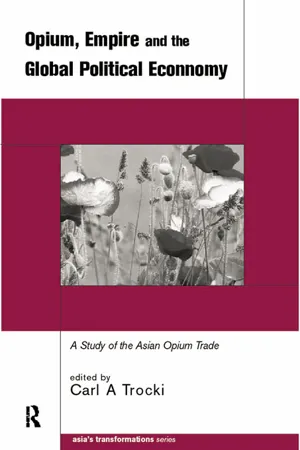
eBook - ePub
Opium, Empire and the Global Political Economy
A Study of the Asian Opium Trade 1750-1950
- 224 pages
- English
- ePUB (mobile friendly)
- Available on iOS & Android
eBook - ePub
Opium, Empire and the Global Political Economy
A Study of the Asian Opium Trade 1750-1950
About this book
Drug epidemics are clearly not just a peculiar feature of modern life; the opium trade in the nineteenth century tells us a great deal about Asian herion traffic today. In an age when we are increasingly aware of large scale drug use, this book takes a long look at the history of our relationship with mind-altering substances. Engagingly written, with lay readers as much as specialists in mind, this book will be fascinating reading for historians, social scientists, as well as those involved in Asian studies, or economic history.
Trusted by 375,005 students
Access to over 1.5 million titles for a fair monthly price.
Study more efficiently using our study tools.
1
The dream of empire
I perceived that the pilgrim ship episode was a good starting-point for a free and wandering tale; that it was an event, too, which could conceivably colour the whole “sentiment of existence” in a simple and sensitive character.
Joseph Conrad, 1917 Introduction to Lord Jim
At the beginning of the twentieth century, Europeans were generally proud of their imperial possessions. There was a consciousness that the peoples of western Europe, in particular, had a natural duty to bring the gifts of civilization to the lesser races of the world. Whether this meant Christianity, law and order, the end of slavery, material progress or merely free trade; whether it was called a mission civilisatrice, or seen as a white man’s burden (every colonial power had its term): there was a sense that they were agents of a higher good.
Joseph Conrad, however, the great novelist of that era, saw no virtue in empire. His greatest novels are all, in one way or another, attacks on imperialism, and contain within them a thorough and systematic critique of Europe’s, particularly Britain’s, imperial adventure. He was one of the few, at that early date, who understood that imperial rule was not only a crime against the captive peoples, but also destroyed and corrupted even the best of the imperial peoples. It polluted everything it touched. I believe he saw opium as a metaphor for those pollutants, and it may be useful to probe his critique of Britain’s “dream of empire.”
In Lord Jim, the young Jim abandoned a ship full of Muslim pilgrims. This moral lapse set in motion the chain of events that makes up the plot. It was Jim’s great crime. He was a ship’s officer and in a time of danger he literally jumped ship, abandoning eight hundred people to what seemed certain death. Ironically, the ship did not sink, but drifted along until rescued by a passing French naval vessel. Later, in an effort to redeem himself, Jim isolated himself from European society in the fictitious Malay community of Patusan and gave up his life, heroically, but almost senselessly it seems, rather than betray his word.
The Patna episode, for that was the ship’s name, introduces the novel. Conrad intended the episode to “colour the whole ‘sentiment of existence.’” As such, we should expect to find there most of his main themes. This part of the story has thus attracted the attention of a number of Conrad scholars and there is a significant critical literature on it. I was ultimately drawn to this literature, because I wondered why Conrad chose the name Patna, and I wanted to see what the experts had to say on the subject of the Patna. As a historian of nineteenth-century Asia, I had my own ideas about the significance of the term.
Patna is one of India’s most ancient cities. Formerly the site of Pataliputra, the Mauryan capital in the third century BC, by the nineteenth century Patna had long been an integral part of British holdings in the territories of Bihar/Bengal. These circumstances alone would have made it a likely choice for an exotic sounding name, but in the nineteenth century Patna meant something more. The word had a special status in the British Empire. Its significance was in its connection to the Englishman’s other great contribution to Asia, the opium trade. In fact, we might look upon Patna as the unofficial capital of the opium empire that the British had created.
For nearly 150 years, Patna had been virtually synonymous with the opium trade. “Patna” was literally a brand name for one of the major types of British– Indian opium that was traded at Calcutta, Singapore, Hong Kong, Canton, and in every major port of Asia. Wherever one went east of Suez, on any day he could pick up the local English language newspaper to discover the daily quotations for the prices of “Patna” or “Benares” opium;1 whether in the market at Singapore, or at the monthly auctions in Calcutta, or at any of the major ports of South and Southeast Asia or the China coast. Patna opium was as much a part of the everyday environment of maritime commerce in the region as tea, pepper, gambier, copra or tin. Almost without exception, Patna opium was carried on virtually every vessel that traded at Singapore, Hong Kong and Shanghai. Whether packed in chests as it came from Calcutta; or whether in individual balls, as taken from the chests; or whether as smokeable chandu packed in tubes or “pots”; Patna opium was as omnipresent as silver dollars and “native” coolies in the white man’s empire.
The American merchant William C. Hunter repeats a bit of doggerel penned by one of his countrymen in Canton during the 1830s as a parody of the Byron poem, “Know’st thou the Land”:
Know’st thou the land where the drug in its glory
With cotton and betel nut govern the day
Where Patna or Malwa’s the theme of each story
The life of each anecdote, solemn or gay?
With cotton and betel nut govern the day
Where Patna or Malwa’s the theme of each story
The life of each anecdote, solemn or gay?
(Hunter 1882, pp. 111–12)
It seems fitting, if Conrad wished to make an ironic statement about the morality of imperialism, that he would make Jim the mate of a ship named for an addictive drug that deprived people of their sense of duty and morality. A drug that offered pipe dreams in exchange for dismal reality. It seems likely that a person of Conrad’s background, one conversant with the day-to-day language and usage of Asian maritime commerce, would immediately associate the word “Patna” with opium. Most of the critics agree that the book has a strong antiimperialist message, and Conrad scholars such as Jan Verleun see significance in the “dreamlike” quality of the Patna episode. It is a message that signals moral lapse and false consciousness about the grim and dirty work of empire which had been cloaked in light adventure novels and smug dreams of peace and order. It only seems sensible to link those themes to the very source of dreamlike delusion itself, opium; however, I admit that neither Conrad nor other Conrad scholars have made such a link.
I would thus suggest that for Conrad the Patna episode was a sort of parable of European imperialism. Like the empire the tale is filled with ironies and ambiguities. As the first mate aboard the floating death trap that was the Patna, Jim may be seen as the representative of the Good. He was, as Marlow, Conrad’s narrator, describes him, the best kind of Englishman: “one of us.” But, even here there is something ironic about this characterization.
All the time I had before me these blue, boyish eyes looking straight into mine, this young face, these capable shoulders, the open bronzed forehead with a white line under the roots of clustering fair hair, this appearance appealing at sight to all my sympathies; this frank aspect the artless smile, the youthful seriousness. He was of the right sort; he was one of us. He talked soberly, with a sort of composed unreserve, and with a quiet bearing that might have been the outcome of manly self-control, of impudence, of callousness, of a colossal unconsciousness, of a gigantic deception. Who can tell!
(Conrad 1986 [henceforth LJ], p. 100)
The passage ends with an interesting twist. Was Jim a sincere, open and appealing individual, or was he simply a clever liar, or even more troubling, was his quiet bearing and manliness the result of a “colossal unconsciousness?” Conrad seems to be playing with the reader here and he gives us several possible interpretations of Jim’s character. In the final analysis, his intention seems to have been for us to choose “unconsciousness” as the fundamental problem. Jim is the English everyman, and like the rest of us, he is confused and misled in his own mind. Perhaps that delusion was shared by most of his contemporaries.
The romantic adventure of the Patna’s voyage nearly turns into a tragedy and emerges as humiliation. Jim’s dream is the source of the problem. He is shown as if in some kind of trance, or dream, or torpor; like a man who has taken a puff of opium. On the voyage aboard the Patna, the weather, the very universe seemed pervaded by a vast and profound calm. To speak of Jim being “penetrated by the great certitude of unbounded safety and peace” (LJ, p. 17) conjures up the image of someone under the influence of that most soporific of drugs:
his joints cracked with a leisurely twist of the body, in the very excess of well-being; and, as if made audacious by the invincible aspect of the peace, he felt he cared for nothing that could happen to him to the end of his days.
(LJ, pp. 19–20)
In those peaceful days, he dreamed
his thoughts would be full of valorous deeds: he loved these dreams and the success of his imaginary achievements. They were the best parts of life, its secret truth, its hidden reality. They had a gorgeous virility, the charm of vagueness, they passed before him with a heroic tread; they carried his soul away with them and made it drunk with the divine philtre of an unbounded confidence in itself. There was nothing he could not face.
(LJ, p. 20)
Jan Verleun remarks on Jim’s psychic state, “Jim’s sensibilities before the Patna incident are atrophied; he is too pleasurably languid and too intoxicated with imaginary successes to dislike actively his fellow officers, that is to perceive them even with any vividness” (Verleun 1979, p. 199, n. 6). The vile and corrupt captain, the opium-soaked chief engineer and whimpering second engineer were sad company for a “gentleman” of his quality. Nevertheless, Jim could pretend he did not share the same space with them.
those men did not belong to the world of heroic adventure; they weren’t bad chaps though. Even the skipper himself … His gorge rose at the mass of panting flesh from which issued gurgling mutters, a cloudy trickle of filthy expressions; but he was too pleasurably languid to dislike actively this or any other thing. The quality of these men did not matter; he rubbed shoulders with them, but they could not touch him; he shared the air they breathed but he was different.
(LJ, pp. 24–5)
Jim’s moral senses were anesthetized. Fundamental to Jim’s delusion was his failure to recognize the evil around him. If Conrad placed such stress upon delusion and corruption, and if he took pains to associate these themes with the Patna, it seems sensible to look more closely as the word itself.
Jim’s delusion is very much like that of someone like Thomas Stamford Raffles (the founder of Singapore) and other high-minded English liberals who attempted to establish systems of order and purity, to remake the world according to the rational principles of the Enlightenment and the best impulses of European civilization. They brought the gifts of free trade, economic and personal freedom, adherence to the rule of law, personal integrity and duty. They opposed slavery, feudalism, superstition, piracy and oppression. And yet, as we know, the European empires were exploitative, racist, violent and fundamentally pernicious. This reality made the “dream” a dangerous delusion, both for the English as well as their subjects.
Conrad was not a prisoner of the British rhetoric that justified their empire. Despite his debt to Britain and to the empire, which took him in, gave him a living, gave him a life, and recognized his genius, Conrad could never forget that he was also Teodor Josef Korzeniowski, the child of a country which had literally ceased to exist under imperial rule. To Conrad, an outcast, orphaned Pole, whose father had died in a Russian prison, whose uncles had been executed by the Czar, there were no “good” imperialists. Just as there were no good rapists. The evil was in the act itself, and the ends did not justify the means. Many of Conrad’s most profound tales carry this message.
This was Conrad’s paradox. According to Cedric Watts:
The novel offers a general verdict on imperialism by showing that even those Europeans who, like him [Jim], attempt to be benevolently paternalistic to their subject peoples may, in the long term, do more harm than good, and it offers a general verdict on the romantic conception of personal honour by showing that the more it resembles exalted egoism, the higher may be the price that others have to pay for it.
(LJ, p. 23)
The European adventure in Asia was as ethically confused as was Jim’s experience aboard the Patna. Deeply involved, as it was, in one of the most pernicious, yet well-organized and profitable drug trades that has ever existed, the empire was rotten at its heart. Moreover, by the beginning of the twentieth century, it was like the Patna, rusted, decrepit and ready to collapse in the smallest crisis. How could a system based on the trade in this product, acknowledged even then as an evil, be morally squared with the ideals of the “best” of the empire builders? If I may give my own meaning to Conrad’s metaphor, Jim in abandoning the Patna, and leaving a shipload of Asians to their doom, was the same as the European traders and colonial governments that left millions of their subjects, as well as Chinese non-subjects, to be carried to ruin by the opium habit, while they reaped a profit from the sale of the drug.
Like their subjects, Europeans were caught in the sense-dulling inducements of the drug. They too, were lost on their own Lethe of moral forgetfulness. For many of them, greed for profit and power were their own drugs. Conrad claimed that unlike Kipling, whom he said, wrote about the English, he himself wrote for the English.2 His aim was to enlighten them about themselves, and the nature of their empire. He aimed to penetrate the false consciousness of high imperial complacency. He may also have had another audience in mind when he styled Jim as “one of us.” The timing of the book is significant, Lord Jim was written between September 1899 and July 1900, this was not long after the American intervention in the Philippines (August 1898). It was published soon after Rudyard Kipling’s “White Man’s Burden” which was addressed to the “The United States and the Philippine Islands.” Kipling wished to encourage Britain’s American cousins to assume their place in the great work of European imperialism in Asia:
Take up the white man’s burden –
Send forth the best ye breed –
Go, bind your sons to exile
To serve the captives’ need;
To wait in heavy harness
On fluttered folk and wild –
Your new-caught sullen peoples,
Half-devil and half-child.
Rudyard Kipling,
“The White Man’s Burden” 1898
Send forth the best ye breed –
Go, bind your sons to exile
To serve the captives’ need;
To wait in heavy harness
On fluttered folk and wild –
Your new-caught sullen peoples,
Half-devil and half-child.
Rudyard Kipling,
“The White Man’s Burden” 1898
This sounds a lot like Jim’s “dream” of his mission in Patusan. It is possible that Conrad’s purpose was to warn off the Americans from imperial adventures in Asia.
Opium had been the partner of British colonialism since the days when Robert Clive defeated the Nawab of Bengal at Plassey in 1757, and it remained so in the days when Mohandas K. Gandhi was raising the standard of revolt against the Raj under Lord Curzon. Oddly enough, by 1900, opium was generally not seen as a British, or European problem. It was an Asian problem. Even David Edward Owen, whose pioneering study first laid bare the trail that the British opium trade had cut through Asia, still saw opium as the “Orient’s distinctive vice” (Owen 1934, p. 2). In some ways this was true. When European merchants and conquerors first came to Asia, the drug was already an item of commerce. It had first been brought to India by Arabs and was taken on to China where reports of its use date from the eighth century. When Albuquerque arrived in India in 1509, the trade was well-established, with Arab and Indian merchants selling it in Burma, the Malay Peninsula and China. He recommended to his ruler that Portugal begin producing it:
If your Highness would believe me, I would order poppies … to be sown in all the fields of Portugal and command afyam to be made, which is the best merchandise that obtains in these places … the people of India are lost without it, if they do not eat it …
(Owen 1934, p. 2)
By the end of the seventeenth century, however, Europeans had changed the nature of the trade. Opium was no longer only a medicinal drug or a buffer against stress, but had become a drug used primarily for pleasure. This shift came as Chinese and Southeast Asian users began to smoke it. This manner of use remained more or less restricted to Asian users until the twentieth century and gave it a peculiarly Asian association.
The dream of total control over the opium trade seemed to come true as hundreds of avid Englishmen fell upon the wealth of Bengal in the aftermath of Plassey. By 1760 the free-lancing “servants” of the English East India Company had arrogated to themselves the profits from most of the productive enterprises of Bengal. Among these, the most lucrative proved to be opium, which was so profitable that the Company itself eventually appropriated the monopoly on its cultivation. Government control continued throughout the nineteenth century. Owen takes at face value the somewhat bemused attitude with which many Victorian Englishmen seemed to regard the trade. It was really an aberration:
That roughly one-seventh of the revenue of British India should have been drawn from the subjects of another state as payment for a habit forming drug is, in the...
Table of contents
- Cover
- Title
- Copyright
- Contents
- List of figures
- List of tables
- Acknowledgments
- Weights and measures
- Introduction
- 1 The dream of empire
- 2 All the drowsy syrups of the world
- 3 Cleverer than alchemists
- 4 In compassion to mankind
- 5 The most gentlemanlike speculation
- 6 In the hands of Jews and Armenians
- 7 A matter of considerably greater solicitude
- 8 The most long-continued and systematic international crime
- Appendix 1 The literature of the opium trade
- Appendix 2 A comment on the Jardine Matheson “Opium Circulars”
- Appendix 3 Englebert Kaempfer’s comments on opium from his “Amoenitatum Exoticarum”
- Appendix 4 The economics of Malwa opium cultivation
- Glossary
- Notes
- Bibliography
- Index
Frequently asked questions
Yes, you can cancel anytime from the Subscription tab in your account settings on the Perlego website. Your subscription will stay active until the end of your current billing period. Learn how to cancel your subscription
No, books cannot be downloaded as external files, such as PDFs, for use outside of Perlego. However, you can download books within the Perlego app for offline reading on mobile or tablet. Learn how to download books offline
Perlego offers two plans: Essential and Complete
- Essential is ideal for learners and professionals who enjoy exploring a wide range of subjects. Access the Essential Library with 800,000+ trusted titles and best-sellers across business, personal growth, and the humanities. Includes unlimited reading time and Standard Read Aloud voice.
- Complete: Perfect for advanced learners and researchers needing full, unrestricted access. Unlock 1.5M+ books across hundreds of subjects, including academic and specialized titles. The Complete Plan also includes advanced features like Premium Read Aloud and Research Assistant.
We are an online textbook subscription service, where you can get access to an entire online library for less than the price of a single book per month. With over 1.5 million books across 990+ topics, we’ve got you covered! Learn about our mission
Look out for the read-aloud symbol on your next book to see if you can listen to it. The read-aloud tool reads text aloud for you, highlighting the text as it is being read. You can pause it, speed it up and slow it down. Learn more about Read Aloud
Yes! You can use the Perlego app on both iOS and Android devices to read anytime, anywhere — even offline. Perfect for commutes or when you’re on the go.
Please note we cannot support devices running on iOS 13 and Android 7 or earlier. Learn more about using the app
Please note we cannot support devices running on iOS 13 and Android 7 or earlier. Learn more about using the app
Yes, you can access Opium, Empire and the Global Political Economy by Carl Trocki in PDF and/or ePUB format, as well as other popular books in History & Economic History. We have over 1.5 million books available in our catalogue for you to explore.