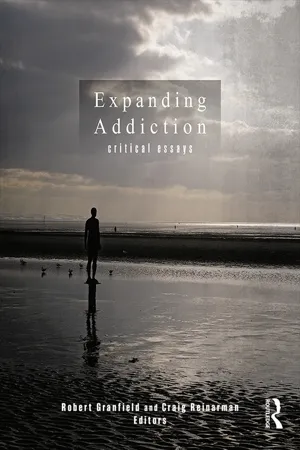
The study of addiction is dominated by a narrow disease ideology that leads to biological reductionism. In this short volume, editors Granfield and Reinarman make clear the importance of a more balanced contextual approach to addiction by bringing to light critical perspectives that expose the historical and cultural interstices in which the disease concept of addiction is constructed and deployed. The readings selected for this anthology include both classic foundational pieces and cutting-edge contemporary works that constitute critical addiction studies. This book is a welcome addition to drugs or addiction courses in sociology, criminal justice, mental health, clinical psychology, social work, and counseling.
eBook - ePub
Expanding Addiction: Critical Essays
- 334 pages
- English
- ePUB (mobile friendly)
- Available on iOS & Android
eBook - ePub
Expanding Addiction: Critical Essays
About this book
Information
Historicizing Addiction
Chapter 2
Discovering Addiction
Enduring Conceptions of Habitual Drunkenness in America1
Levine’s classic history shows that the core features of the modern disease concept of alcoholism—its progressive character, loss of control over drinking, the necessity for abstinence—are all rooted in the ideology of the 19th-century temperance movement.
Introduction
In the last years of the eighteenth century, European culture outlined a structure that has not yet been unraveled; we are only just beginning to disentangle a few of the threads, which are still so unknown to us that we immediately assume them to be either marvelously new or absolutely archaic, whereas for two hundred years (not less, yet not much more) they have constituted the dark, but firm web of our experience.
–Michel Foucault2
The essentials of the contemporary understanding of alcoholism actually first emerged in American popular and medical thought at the end of the 18th century and beginning of the 19th century. At that time a new paradigm or model first defined addiction as a central problem in drug use and diagnosed it as a disease or as disease-like condition. The idea that alcoholism is a progressive disease—the chief symptom of which is loss of control over drinking behavior, and whose only remedy is abstinence from all alcoholic beverages—is now about 200 years old, but no older.
This new paradigm constituted a radical break with traditional ideas about habitual drunkenness. During the 17th century and for most of the 18th century, the assumption was that people drank and got drunk because they wanted to and not because they “had” to. In colonial-era thought, alcoholic drinks did not permanently disable the will, they were not addicting, and habitual drunkenness was not regarded as a disease. With very few exceptions, 17th- and 18th-century Americans did not use a vocabulary of compulsion with regard to alcoholic beverages.
At the end of the 18th century and in the early years of the l9th century, some Americans began to report that they were addicted to alcoholic drinks: They said they experienced overwhelming and irresistible desires for liquor. Laymen and physicians associated with newly created temperance (or anti-alcohol) organizations developed theories about addiction and brought the experience of it to public attention. Throughout the l9th century, people associated with the temperance movement argued that intemperance, inebriety, or habitual drunkenness (they used all three terms) was a disease and a natural consequence of the moderate use of alcoholic beverages. The idea that drugs are inherently addicting was first systematically worked out for alcohol and then extended to other substances. Long before opium was popularly accepted as addicting, alcohol was so regarded.3
Contrary to what many have believed,4 I am suggesting that present-day American medical, scientific, and popular thought about alcoholism is of a piece with a major strand of 19th-century thought, the ideology of the temperance movement. Both temperance thought and modern conceptions of alcoholism agree about the progressive character of addiction, the alcoholic’s experience of loss of control, and the necessity for total abstinence by addicts.
The most important difference between tem perance conceptions of addiction and 20th-century alcoholism thought is the location of the source of addiction.5 The temperance movement found the source of addiction in the drug itself; alcohol was viewed as an inherently addicting substance, much as heroin commonly is today. Contemporary medical, scientific, and popular understandings locate the source of alcohol addiction in the individual body; only some people, it is argued, for reasons still unknown, become addicted to alcohol. Although that change represents a major development in thought about addiction, the contemporary ideas are still well within the paradigm first established by the temperance movement. Insofar as Alcoholics Anonymous and temperance advocates share the concept of addiction and recommend abstinence as the only solution, their differences remain in-house or intra-paradigmatic.6
This chapter traces the history of American thought about habitual drunkenness and alcohol addiction. Traditional 17th- and 18th-century (colonial-era) ideas are contrasted with the new conceptions that emerged in the 19th century and developed further in the 20th century. Finally, there is a brief discussion of the social and historical context in which the concept of addiction came to be an acceptable and intelligible way to define problems associated with drinking alcohol.
Traditional Views: The World without Addiction
In the 17th-century and especially 18th-century America was notable for the amount of alcoholic beverages consumed, the universality of their use, and the high esteem they were accorded. Alcoholic drink was food, medicine, and social lubricant. Even a Puritan divine such as Cotton Mather called it the “good creature of God.” It flowed freely at weddings, christenings, and funerals, at the building of churches, the installation of pews, and the ordination of ministers. For example, in 1678 at the funeral of a Boston minister’s wife, mourners consumed 51 1/2 gallons of wine;7 at the ordination of Reverend Edwin Jackson of Woburn, Massachusetts, the guests drank 6 1/2 barrels of cider, along with 25 gallons of wine, 2 gallons of brandy, and 4 gallons of rum.8 Heavy drinking was also part of special occasions like corn huskings, barn raisings, court and meeting days, and especially militia training days. Workers received a daily allotment of rum, and certain days were set aside for drunken bouts; in some cases, employers paid for the liquor. The tavern was a key institution in every town, the center of social and political life, and all varieties of drink were available. Americans drank wine, beer, hard cider, and distilled spirits, especially rum. They drank at home, at work, and while traveling; they drank morning, noon, and night. And they got drunk.9
During the 17th and 18th centuries, most people were not concerned with drunkenness; it was neither especially troublesome nor stigma-tized behavior. Even the prominent physician Benjamin Rush,10 when still urging moderation in 1772, noted how common and acceptable drunkenness was. “Why all this noise about wine and strong drink?” he wrote, anticipating his readers’ complaints. “Have we not seen hundreds who have made it a constant practice to get drunk almost everyday for thirty or forty years, who, not withstanding, arrived to a great age and enjoyed the same good health as those who have followed the strictest rules of temperance?” Dr. Rush was willing to grant that there were indeed “some instances of this kind.” In his rich and thorough study of early American drinking practices, Rorabaugh concluded that “to most colonial Americans inebriation was of no particular importance. William Byrd, for example, noted with equal indifference intoxication among members of the Governor’s Council and his own servants.” Rorabaugh found that Byrd’s attitude was typical and that for most Americans in the period “drunkenness was a natural, harmless consequence of drinking.”11
From time to time, however, some wealthy and powerful individuals complained about excessive drinking and drunkenness. In 1637 there was concern about “much drunkenness, waste of the good creatures of God, mispense of time, and other disorders, which took place at taverns.”12 In 1673 the Puritan minister Increase Mather published his sermon, “Wo to Drunkards,” deploring the frequency of excessive drinking in the colonies.13 By 1712 things had gotten even worse and he reissued his pamphlet. Around the same time, his son, Cotton Mather, worried about drunkenness among members of his own congregation.14 By the 1760s John Adams was so concerned about the level of drunkenness that he proposed limiting the number of taverns, and Benjamin Franklin labeled taverns “a Pest to Society.” Despite such complaints, and despite regulations on the amount of time one could spend in a tavern, how much one could drink there, and penalties for drunkenness including public whippings and the stocks, Americans continued to drink and get drunk.15
Ministers and political leaders sometimes singled out individuals who were periodically or frequently drunk; they called such people drunkards, common drunkards, or habitual drunkards. Occasionally they described drunkards as addicted to drunkenness or intemperance, as in Danforth’s statement in 1709 that “God sends many sore judgments on a people that addict themselves to intemperance in Drinking.”16
In the 17th and 18th centuries, “addicted” meant habituated, and one was habituated to drunkenness, not to liquor. Almost everyone “habitually” drank moderate amounts of alcoholic beverages; only some people habitually drank to the point of drunkenness. Towns circulated lists of common drunkards, and landlords who sold liquor to them could be fined or have their licenses revoked.17 Some drunkards were punished severely, others were treated quite kindly, and some did reform.
In general, however, drunkards as a group or class of deviants were not especially problematic for colonial Americans. If they had property or were able to support themselves, they were treated much like anyone else of their class. And those who could not support themselves were grouped among the dependents in every community. As Rothman has shown, colonial Americans did not make major distinctions among the poor and deviant: The fact of need was the important issue, not why someone happened to be needy. Further, colonials did not expect society to be free from crime, poverty, insanity, drunkenness, or other deviance. According to Rothman “they did not interpret its presence as symptomatic of a basic flaw in community structure or expect to eliminate it. They would combat the evil, warn, chastise, correct, banish, flog, or execute the offender. But they saw no prospect of eliminating deviancy from their midst.”18
The clergy, especially the educated and scholarly Puritans, did most of the warning and chastising about habitual drunkenness—about what they called the “Sin of Drunkenness” and the “Vice of Drunkenness.” In the writings of men like Increase and Cotton Mather, Thomas Foxcroft, Samuel Danforth, and Jonathan Edwards, we can see the seeds of a modern view of habitual drunkenness, as well as the absolute limits to which colonial and Puritan thought could go on the question. With the Bible as their guide, ministers warned of the eternal suffering awaiting drunkards. Puritans also argued that drunkards tended to commit “all those Sins to which they are either by Nature or Custom inclined.” Cotton Mather called drunkenness “this engine of the Devil.” Some ministers noted the difficulty of getting drunkards to give up their habit. “It is a Sin that is rarely truly repented of and turned from,” wrote Increase Mather. Finally, Puritans observed that drunkards suffered in this world as well; they frequently became sick or injured, and they tended to ignore their economic, religious, and family responsibilities. “Those that follow after Strong Drink have not the Art of getting or keeping Estates lawfully,” Danforth warned in 1710. “They cannot be diligent in their Callings, nor careful to improve all fitting Opportunities of providing for themselves and for their families.”19
In terms of external behavior, there is little to distinguish the contemporary idea of alcoholism or inebriety from the traditional, colonial view of the drunkard. The modern reader translates the behavioral description of the habitual drunkard into modern terms—into the alcoholic. But the understanding we have of the drunkard is not the understanding of the 17th and 18th centuries. The main differences lie not so much in the external form as in the assumptions made about the inner experiences and inner condition of the drunkard.20
Beginning in the 19th century, terms like “overwhelming,” “overpowering,” and “irresistible” were used to describe the drunkard’s desire for liquor. In the colonial period, however, these words were almost never used. Instead, the most commonly used words were “love” and “affection,” terms seldom used in the 19th and 20th centuries. In the modern definition of alcoholism, the problem is not that alcoholics love to get drunk, but that they cannot help it—they cannot control themselves. They may actually hate getting drunk, wishing only to drink moderately or “socially.” In the traditional view, however, the drunkard’s sin was the love of “excess” drink to the point of drunkenness. Thus did Increase Mather distinguish between one who is “merely drunken” and a drunkard: “He that abhors the sin of Drunkenness, yet may be overtaken with it, and so drunken; but that one Act is not enough to denominate him a Drunkard. And he that loveth to drink Wine to Excess, though he should seldom be overcome thereby, is one of those Drunkards.”21
This is one important characteristic of 17thand 18th-century thought that radically separates it from modern ideas. Insofar as the traditional view raised the question of the drunkard’s experience or feelings, it described the drunkard as one who loved to drink to excess, who loved to drink and get drunk: “Solomon’s description of a Drunkard is that he is...
Table of contents
- Cover Page
- Half Title Page
- Title Page
- Copyright Page
- Contents
- Preface
- Acknowledgments
- Introduction
- Part I Historicizing Addiction
- Part II Locating Addiction
- Part III Treating Addiction
- Part IV Expanding Addiction
- Credit Lines
- Contributor Biographies
- Index
Trusted by 375,005 students
Access to over 1.5 million titles for a fair monthly price.
Study more efficiently using our study tools.
Frequently asked questions
Yes, you can cancel anytime from the Subscription tab in your account settings on the Perlego website. Your subscription will stay active until the end of your current billing period. Learn how to cancel your subscription
No, books cannot be downloaded as external files, such as PDFs, for use outside of Perlego. However, you can download books within the Perlego app for offline reading on mobile or tablet. Learn how to download books offline
Perlego offers two plans: Essential and Complete
- Essential is ideal for learners and professionals who enjoy exploring a wide range of subjects. Access the Essential Library with 800,000+ trusted titles and best-sellers across business, personal growth, and the humanities. Includes unlimited reading time and Standard Read Aloud voice.
- Complete: Perfect for advanced learners and researchers needing full, unrestricted access. Unlock 1.5M+ books across hundreds of subjects, including academic and specialized titles. The Complete Plan also includes advanced features like Premium Read Aloud and Research Assistant.
We are an online textbook subscription service, where you can get access to an entire online library for less than the price of a single book per month. With over 1.5 million books across 990+ topics, we’ve got you covered! Learn about our mission
Look out for the read-aloud symbol on your next book to see if you can listen to it. The read-aloud tool reads text aloud for you, highlighting the text as it is being read. You can pause it, speed it up and slow it down. Learn more about Read Aloud
Yes! You can use the Perlego app on both iOS and Android devices to read anytime, anywhere — even offline. Perfect for commutes or when you’re on the go.
Please note we cannot support devices running on iOS 13 and Android 7 or earlier. Learn more about using the app
Please note we cannot support devices running on iOS 13 and Android 7 or earlier. Learn more about using the app
Yes, you can access Expanding Addiction: Critical Essays by Robert Granfield, Craig Reinarman, Robert Granfield,Craig Reinarman in PDF and/or ePUB format, as well as other popular books in Psychology & Addiction in Psychology. We have over 1.5 million books available in our catalogue for you to explore.