eBook - ePub
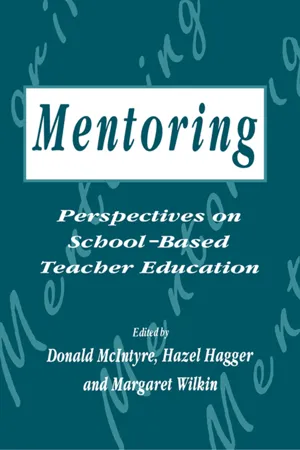
Mentoring: Perspectives on School-based Teacher Education
- 240 pages
- English
- ePUB (mobile friendly)
- Available on iOS & Android
eBook - ePub
Mentoring: Perspectives on School-based Teacher Education
About this book
A series of essays on mentoring issues in education, which includes discussion of the political and historical aspects of mentoring, the mentor-student relationship and the generic skills approach to mentoring.
Information
Part 1 Contexts of Mentoring
1 The Early History of School-based Teacher Training
The part of the field which we are to examine has long been a battleground for the expert, and many questions call for discussion. What, for example, should be the purpose of professional training? – its character and duration? Where should it be given, and by whom?… At what age should it commence? – and is a system of apprenticeship desirable? (Lance Jones The Training of Teachers in England and Wales, 1923)
The principle of systematic initial training for teachers was a new one in the early nineteenth century. It was an idea whose currency widened with the inception of mass elementary schooling and which was not thereafter seriously challenged.1 The form and content, and more fundamentally, the purpose of such training have, however, been extensively debated from the early blueprints of Lancaster, Bell, Stow, Kay-Shuttleworth and Coleridge through to the more familiar models of our own day.
These debates might be interpreted in two ways. On the one hand, there is the perspective of the contemporary educationist, concerned principally with the application and development of training policy. From this point of view, the business of teacher training constitutes a search for the most effective arrangements for the preparation of classroom teachers. To the extent that this perspective has a dimension of change, it is of periodic reform attended by implicit assumptions that the search has been, or is about to be, more or less successfully resolved.2 Indeed, the notion of progress must be a central one in any account of the development of the teacher training process. Yet beneath the changing policies for professional preparation for the classroom, there lie the deep continuities of classroom life itself. Any reading of the classroom logs of today’s trainee teachers alongside the recollections of, say, Phillip Ballard or FH Spencer or Abel Jones, from the turn of the century demonstrates this in a particularly vivid way.3 Even more telling are the columns of the teachers’ press from the late nineteenth century onwards. No modern teacher could fail to browse through these sources, with their endless, familiar stories of stress, fatigue, injustice and conflict over recurring issues, without feeling that he or she is treading in professional footsteps already worn deep by earlier generations.4 Teacher training itself forms part of this continuing repertoire, with reforms characteristically consisting of the rearrangement or redistribution of a number of key elements which have, to one degree or another, been present from the earliest days of teacher training. Of these, perhaps the most important has been the relation between the place of training which is based in the classroom, and that which is based in the training institution. History records how the balance between the two sites has shifted over the last century and a half, with each shift leaving an image in professional and political consciousness which could be raised in support of further change in one direction or another. Thus for example, the attacks on institutional training as variously remote, limited or overly-theoretical which, in differing contexts, were raised in the 1890s, in the 1960s and in the early 1990s; and, on the other hand, the dangers of a school-based apprenticeship model – the spectre of the pupil-teacher–adverted to by many in the 1880s, the 1920s, by some in the 1970s, and by others today.5
In broad terms, it might be said that until the final decade of the nineteenth century, training based within the school enjoyed an effective practical hegemony. By the end of the 1920s however, a new college-based primacy was firmly in place. The intervening years, as we shall see, have a particular significance as a period of tension and transition between the sites of school and training institution which in some respects mirrors that of our own age.
The history of the teaching profession and its concerns – as opposed to the history of education itself – has, to date, been but poorly explored. It offers us a rich resource of collective experience which needs to be attended to more respectfully and exploited more thoughtfully. That is why present-oriented perspectives on the significance of training debates in the past cannot stand alone. They have to be informed by a second understanding; that of the historian. The historical perspective has no interest in rummaging through the past for idealized or timeless policy models. Instead, it seeks to understand changes and continuities in teacher training contingently, as expressions of particular moments in time. Thus, for example, whilst it may be useful to conceptualize school-based ‘apprenticeship’ as one broad model of training, it is considerably less helpful to invoke a ‘return to the pupil teacher system’. The characteristics of that essentially nineteenth century system belong to a particular time, which has passed.6 Moreover, the historical approach understands that, whatever the apparent familiarity of this or that aspect of training in the past, the meanings ascribed to it, and to training as a totality, change over time. Such changes cannot be understood simply as responses to purely educational pressures. Reform of teacher training needs also to be set within the context of much broader social, political and religious debates over the direction and purpose of educational change.
In seeking to address these wider problems, policy formulators have always been faced with a simple but intractable truth. The classroom, recognized as the critical productive site of all educational enterprise was – and remains – beyond the continuous control of church or state. Only the teachers were – and are – continuously there. For the interest of church and increasingly of state, an enduring problem, therefore, has been to ensure that the teachers operated as effective agents of a higher authority. This was a central purpose behind the state’s entry into the sponsorship and certification of teacher training in 1846. From that moment, effective forms of training, together with regular inspection by the recently-formed HMI, were envisaged not simply as mechanisms to improve the quality of schooling, but also to regulate and direct the daily activity of the teacher in the classroom. Since 1846, this is a capacity which the state has utilized in varying degrees according to perceived need and which it has never relinquished.
State-sponsored training, however, had a reverse side. It did not only promise to lever up the quality and effectiveness of schooling and to offer closer control over the teachers. Paradoxically, it also carried the potential to exercise an independent effect upon those who were trained. It conveyed new knowledge and skills and, perhaps more important, a shared sense of professional identity. From very early on, it was clear that the concerns of the newly-trained profession were unlikely to remain those simply of humble and trusty servants of the classroom. The experience of being trained might do something more than simply to inculcate approved behaviour. In particular, training exposed the ambivalent class position of the elementary teacher.7 Over time, it released new collective concerns for higher social status, for better material reward, for enhanced professional autonomy and for the satisfaction of personal ambition. In short, the trained teachers began to produce their own tunes to march to. This was a danger of which Kay-Shuttleworth, the architect of the pupil-teacher system, was aware. The safeguard he advocated was the encouragement of humility and self-sacrifice in the form of a sub-professional missionary ideology for teachers.8 This was to be built into the structure of the training process through the new teacher training colleges founded, mainly from the 1840s, under the auspices chiefly of the established church and organized as semi-monastic total institutions. Such closely organized insitutional training was to be the guarantor not of particular standards of personal competence and classroom practice, but of moral commitment. Official support for institutional training – though there were never sufficient college places – was unwavering. The contrast with the scepticism for institutional training of the 1990s is instructive. Today, official perceptions of institution-based training have long since ceased to be of professional quietism, and the prospect of training delivered in schools and by teachers is seen no more as educationally or socially damaging.
In the short term, the reasons for these changes can be seen to have been accelerated by the implications of the contractual and curricular constraints placed upon the profession at work in the second half of the 1980s, but there is a much longer perspective within which change needs to be set.
At the start of the nineteenth century, any form of specific preparation for teaching was virtually unknown. Schools were either controlled by the churches or were private in character and could therefore be established by any individual. In the latter case, qualifications to teach depended not on formal certification but on the de facto recognition of proficiency accorded by paying customers. In essence, this depended upon the demonstration by the teacher of appropriate teaching skills. These consisted in a particular level of academic knowledge – gained from an elementary schooling in the case of teachers of ‘inferior’ private schools and from a university education in the case of most middle- and upper-class private schools – and the ability to manage effectively a classroom to ensure the transmission of this knowledge. This latter quality was acquired, or not, by trial and error. Some succeeded, others did not.
The first attempts to produce trained teachers did not concern themselves with the middle- and upper-class echelons; these would not figure substantially until well into the twentieth century. The most pressing early concerns for formalized training were seen to attach to those who, in the words of Derwent Coleridge, were to become ‘the teachers of the people’.9
Initially, such training was typically based not in purpose-built colleges, but in schools. These were the schools organized from the earliest years of the nineteenth century upon the innovatory and voguish monitorial principles associated with Lancaster and Bell. The form of such training was normally very short, often lasting no longer than a month or two. The majority of the adult trainees were already serving teachers who were sent to be trained in the principles of the system. This is a centrally important point, the residual significance of which was to mark the course of training for the rest of the century and beyond. Trainees came to the monitorial schools not to learn to teach in any reflective, still less theoretical, sense. They came instead to learn a mechanical system and to pick up tips for its practical implementation; to internalize a closely prescribed form of knowledge transmission and schoolroom organization. In the oft-quoted words of Bell,
It is by attending the school, seeing what is going on there, and taking a share in the office of tuition, that teachers are to be formed, and not by lectures and abstract instruction.10
So, alongside the ranks of pupils who were learning through the system, sat the trainees observing its operation and learning to replicate it. This notion of effective teaching as the replication of set principles was to be a very powerful one, finding many echoes, for example, in the professional memories of the last generation of pupil teachers, trained in the first three decades of the twentieth century.11 In these memories, the description ‘a good teacher’ is habitually used in a rather precise sense, to denote a constellation of fixed attributes and shared meanings in a way which would make little sense to practitioners at this end of the century.
The central problem for this early form of monitorial school-based training lay in the paucity and generally poor quality of trainees. Those who were prepared to undergo training, however brief, as mature students were always going to be few. In 1838, for example, JC Wigram, the Secretary of the Anglican National Society calculated that at the society’s 46 ‘training schools’, other than its larger metropolitan central schools at Baldwin’s Gardens, there were not more than 100 trainees in attendance at any one time.12 Where could a more constant supply of recruits be found? Despite the ambivalent social status later attached to it, elementary school teaching was perceived to be an occupation which was fundamentally appropriate to those of working-class origin. But how could bright working-class children, leaving school at the very latest before the onset of their ‘teens, be attracted to a profession which could not offer training or employment until they had reached early adulthood? How, in other words, could clever working-class children – prospective teachers of the future – be identified, corralled and preserved from other more immediately lucrative occupations whilst they waited to attain the age of 18?
The solution, of course, came with the introduction of Kay-Shuttleworth’s pupil-teacher scheme, announced in the Committee of Council on Education’s Minutes of 1846.13 Their Lordships were aware of
the very early age at which the children acting as assistants to schoolmasters are withdrawn from school to manual labour and the advantages which would arise if such scholars…were apprenticed to skilful masters, to be instructed and trained, so as to be prepared to complete their education in a normal school.14
Here was a system which was to be the backbone of teacher supply and training for the rest of the century.15 The system was in part borrowed from schemes already operating on the Continent, and in part a development of the role of the monitorial system’s monitors – the squads of juvenile helpers who, as agents of the solitary teacher, supervised a mechanical or catechetical process of learning.
It is very important to recognize that, as the 1846 Minutes make clear, the pupil-teacher system was not intended to comprise in itself a complete system of professional preparation. It was above all a supply mechanism, designed to bridge the gap between the age of 13, when a pupil-teacher signed his or her indentures, and the age of 18, when he or she was old enough t...
Table of contents
- Cover Page
- Contents
- Preface to the Paperback Edition
- Notes on Contributors
- Introduction
- Part I Contexts of Mentoring
- Part II Conceptions of Mentoring
- Part III Realities of Mentoring
- Index
Trusted by 375,005 students
Access to over 1.5 million titles for a fair monthly price.
Study more efficiently using our study tools.
Frequently asked questions
Yes, you can cancel anytime from the Subscription tab in your account settings on the Perlego website. Your subscription will stay active until the end of your current billing period. Learn how to cancel your subscription
No, books cannot be downloaded as external files, such as PDFs, for use outside of Perlego. However, you can download books within the Perlego app for offline reading on mobile or tablet. Learn how to download books offline
Perlego offers two plans: Essential and Complete
- Essential is ideal for learners and professionals who enjoy exploring a wide range of subjects. Access the Essential Library with 800,000+ trusted titles and best-sellers across business, personal growth, and the humanities. Includes unlimited reading time and Standard Read Aloud voice.
- Complete: Perfect for advanced learners and researchers needing full, unrestricted access. Unlock 1.5M+ books across hundreds of subjects, including academic and specialized titles. The Complete Plan also includes advanced features like Premium Read Aloud and Research Assistant.
We are an online textbook subscription service, where you can get access to an entire online library for less than the price of a single book per month. With over 1.5 million books across 990+ topics, we’ve got you covered! Learn about our mission
Look out for the read-aloud symbol on your next book to see if you can listen to it. The read-aloud tool reads text aloud for you, highlighting the text as it is being read. You can pause it, speed it up and slow it down. Learn more about Read Aloud
Yes! You can use the Perlego app on both iOS and Android devices to read anytime, anywhere — even offline. Perfect for commutes or when you’re on the go.
Please note we cannot support devices running on iOS 13 and Android 7 or earlier. Learn more about using the app
Please note we cannot support devices running on iOS 13 and Android 7 or earlier. Learn more about using the app
Yes, you can access Mentoring: Perspectives on School-based Teacher Education by H. Hagger,D. Mcintyre,Margaret (Lecturer in Education Wilkin,Hagger, H.,Mcintyre, D.,Wilkin, Margaret (Lecturer in Education, University of Cambridge) in PDF and/or ePUB format, as well as other popular books in Pedagogía & Educación general. We have over 1.5 million books available in our catalogue for you to explore.