orna Wing discusses the stresses on the autistic child's family, services that are available and the outlook for the future. This revised updated edition explains how an autistic child views his world and how to cope with the difficult behaviour and emotional problems that are expected from him.
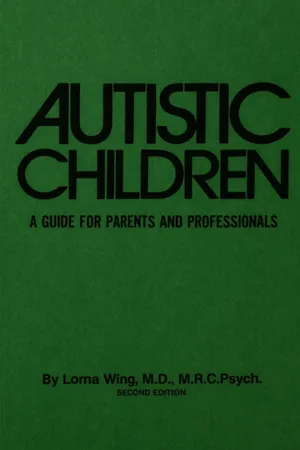
- 176 pages
- English
- ePUB (mobile friendly)
- Available on iOS & Android
eBook - ePub
About this book
Information
Part I
Description of the children
I
Introduction
The mental and physical development of children can go wrong in many different ways, and sometimes this leads to difficult behaviour. Autism is one of the ways in which disturbed development may be shown. Autistic children appear at first sight to be strikingly different from normal children, and from children with the commoner kinds of childhood disabilities. However, each of the problems they show can be found in other handicapped children, especially in those who have one or more of the impairments affecting perception and language development. It is easier for parents to deal with the situation if they can see their child as handicapped, sharing problems with other handicapped children, but also remembering that he is first and foremost a child, with the same need as every other child for a home and family, love, security, guidance and a chance to develop his skills and positive assets to the full. Each autistic child has his own personality which determines the way he reacts to his handicaps and which makes him a unique individual. For these reasons, parents and others who work with these children do not like to hear them referred to as ‘autistics’, which suggests that the handicap is the only thing that matters. They are children who happen to be suffering from the condition known as early childhood autism.
DEFINITIONS
One of the biggest problems in writing about autistic children is that doctors and other professional people tend to differ in the words they use to describe and name the condition. The cause, or causes, of autism in children are, as yet, unknown, and there are no neat tests which can be used to make the diagnosis. Blood tests, X-rays, electroencephalograms (that is, records of the electrical waves from the brain), and other physical examinations which are helpful in general medicine, cannot give a positive answer to the question ‘Is this child autistic?’, although they are sometimes necessary to detect or exclude other conditions which might be present. The only way to make a positive diagnosis is for the doctor to ask about the child’s behaviour, in minute detail, from birth up to the time of examination, because the decision depends upon the presence or absence of a special pattern of behaviour.
In this situation, people look for theories to explain the children’s odd behaviour, and the different names that are used are linked with some of the ideas that have been put forward. Professor Kanner suggested the name ‘early infantile autism’ because he believed that the aloofness and social withdrawal shown in the early years were the most important features. (‘Autism’, used in psychiatry to mean withdrawn and self-absorbed, comes from the Greek word ‘autos’, meaning ‘self’.) Other workers refer to the condition as ‘childhood schizophrenia’, because they believe that it is a special form of the adult illness. *Others again have used very general terms, such as ‘childhood psychosis’, ‘severe emotional disturbance’, ‘non-communicating children’ or ‘exceptional children’, but these labels can cover so many different behaviour patterns that they cause more problems than they solve.
In this book I shall try to avoid confusion over names by defining terms in simple concrete ways, and in some detail. There are many different ideas as to what a ‘psychosis’ is, but I shall use the label ‘childhood psychosis’ to cover all those conditions in which a child behaves most or all of the time in ways which are extremely strange and unpredictable, even considering his age and his level of intelligence. Many children who are backward act in a way which is strange for their physical age, but which is understandable if you know that they are mentally retarded. They are therefore not called psychotic. On the other hand, some children have patterns of behaviour which are unusual whatever their level of mental development and when this odd behaviour is continuous the children can be said to be psychotic. The term is a description and not an explanation of behaviour. Sometimes the cause of a childhood psychosis is known. It may be, for example, a brain tumour, some brain injury, or an infection in early childhood. More often, however, it is not possible to find any definite reason for the behaviour because, as yet, methods of examining the function of the brain are limited.
The term ‘childhood psychosis’ covers many different patterns of behaviour of which early childhood autism is one, and perhaps the commonest, example. The behaviour shown by autistic children will be described in detail in Chapter 4 below.
* This theory is being discarded nowadays, for several reasons. Firstly, the symptoms of autism are different from those of schizophrenia. For example, delusions and hallucinations are important in the latter and never seen in the former, and the speech problems of autism are not at all the same as those found in some schizophrenic patients. Secondly, when autistic children grow up, they do not become schizophrenic adults. Thirdly, schizophrenic patients are more likely than average to have relatives who are also schizophrenic. Autistic children, on the other hand, have only the same chance of having a schizophrenic relative as the average (and some say the chance is less than average). The only similarity is that both schizophrenic adults and autistic children are very vulnerable to the effects of bad institutions, but this goes for other kinds of handicaps too.
2
History
It seems likely that there have always been autistic children, although it is only since Kanner’s paper in 1943 that they have been named as a group and thought of separately from other severely mentally handicapped children. Perhaps they were the reason for the legends of ‘fairy changeling’ children, in which the fairies were believed to steal away a human baby and leave a fairy child in its place. In some versions of the story the changeling was remarkably beautiful, but strange and remote from human kind.
In 1799 a French doctor, J. M. G. Itard, was given charge of a boy about twelve years old, known as Victor the ‘Wild boy of Aveyron’, who had been found wandering and living wild in the woods. The child’s behaviour was very abnormal. Itard thought that he was handicapped because he had been isolated from humans from an early age. Pinel, another eminent doctor of the time, disagreed with Itard over this, and believed that the boy was severely mentally retarded from birth. Reading the story now, it is possible to see that Victor behaved like an autistic child. Some people have suggested that he was autistic because he was abandoned in infancy. It seems much more likely that he was separated from, or abandoned by, his parents in the troubled times following the French Revolution because he was autistic and difficult to manage, and not the other way round. Itard’s story is most interesting and moving, and worth reading because of the way in which he set about teaching the boy.
Over a century later, in 1919, an American psychologist, Lightner Witmer, wrote an article about Don, a boy of two years and seven months, who also behaved like an autistic child, and who was accepted at Witmer’s special school. Individual teaching over a long period helped this child to compensate for his handicaps.
Professor Kanner, in 1943, was the first person to describe these children as a special group. Since then interest has grown steadily. Many different theories of causes have been put forward, and the actual behaviour of the children has been observed in more detail. As a result of such studies, many workers now feel that Kanner’s early childhood autism is not a specific and separate condition. Although the classically autistic child is easy to recognise, there are many more children with autistic features who do not show the full syndrome. The wider group of children has the same needs for a special type of education and management as the typically autistic child. This finding has implications for the estimation of numbers and the provision of services, as will be discussed in the next chapter.
In 1962, the first society for parents and interested professional workers was set up in the United Kingdom. Subsequently, such associations have been formed in many different countries. They have worked for wider recognition of the problem, earlier diagnosis, better services, and for more and better opportunities for special education. After some years of effort on behalf of the children, it became clear that most would need to live and work in a sheltered setting all their lives, so the voluntary societies are now concerned to develop day and residential centres for adults with autism and related conditions. Some progress has been made in all these fields, but there is still a long way to go.
3
How many children are autistic?
TYPICAL AUTISM
The first special study designed to answer this question was carried out in 1964 in the English county of Middlesex. Every child aged eight, nine or ten years whose home address was in the county was considered, whether or not he was known to have any mental or physical handicap. The results showed that between four and five children in every 10,000 in the age range studied had autistic behaviour. About half had the full classic behaviour pattern described by Kanner. This means that their behavioural abnormalities included the two features Kanner considered to be fundamental. These are social aloofness and indifference to others, especially other children, in the early years of childhood (though this may become much less marked with increasing age), and elaborate repetitive routines instead of the imaginative, flexible, pretend play of normal children. The other half had the syndrome in less marked form but still with enough of the typical picture to be diagnosed as autistic.
Two more studies, one in Aarhus county, Denmark, and one in the Camberwell area of London, England, used similar definitions of early childhood autism to those in the Middlesex research, and gave the same result. The important point about all three surveys is that the workers made their own diagnoses and did not count only those children seen and diagnosed as autistic by psychiatric clinics.
CHILDREN WITH AUTISTIC FEATURES
The Camberwell study also included a wider range of children. Every child in the area aged under 15 years who had any difficulty in taking part in two-way social interactions or who had repetitive, stereotyped activities, whether these were simple or elaborate, or who had impairment of comprehension and use of non-verbal and verbal communication was examined. This definition included the autistic children but also covered many who had ‘autistic features’. For example, there were very severely handicapped children who were markedly aloof and rejected all approaches from other children and who had no pretend play at all, but whose repetitive behaviour consisted of such simple activities as rocking, teeth grinding, or gazing at bright lights. Another group included those who had never been socially aloof, but whose social interactions were odd, naive and one-sided and whose social behaviour was not affected by the responses or interests of the people they approached. These children also had repetitive activities, sometimes consisting of a fascination with a particular topic such as astronomy, railway time-tables, plumbing, or monsters from outer space. A few children were found who lacked genuine two-way social interaction, but who did develop a kind of pretend play. However, this was limited to one or two themes, and was repeated endlessly without variation.
The problem of social interaction arises from a lack, or a very limited grasp of the highly complex and subtle rules governing human communication. It is different from that seen in emotionally disturbed or delinquent children, who understand these rules but respond to other people in neurotic or anti-social ways.
From the available evidence, it appears that the number of children with typical or nearly typical autism is fairly predictable, at least in industrialised societies, but that the number with autistic features varies from one area to another, for reasons that need to be investigated. The range for the latter is approximately seven to fifteen in every 10,000 children. Adding those with typical autism and those with autistic features gives a total of twelve to twenty per 10,000 children aged below fifteen years.
AGE OF ONSET
Kanner at first believed that classic autism was always present from birth, and he therefore named it early infantile autism. Later he observed the same syndrome in children who appeared to have had a year or two of normal development before becoming autistic, and later writers have extended this to three or even four years. For this reason, the term early childhood autism seems more appropriate and will be used in this book.
The wider range of children with autistic features studied in the Camberwell survey were all abnormal from birth or within the first five years of life, the great majority having an onset before three years of age. The whole range of these behaviour patterns, including typical autism, is sometimes referred to, collectively, as the ‘early childhood psychoses’.
PSYCHOSES IN LATER CHILDHOOD
Children can develop psychoses after the age of five, but these are different from those seen in early childhood. In most cases they are the psychiatric conditions seen far more often in adult life, such as schizophrenia, mania or psychotic depression. Such problems are extremely rare in childhood. The early childhood psychoses are, by comparison, more common.
SEX RATIO IN AUTISM
Boys are affected more often than girls. Kanner found four times as many boys among children with the classic autistic syndrome, but in the Middlesex study the ratio was a little less than three boys to one girl. There are also more boys among children with autistic features; though, overall, this difference is not as marked as in classic autism.
ASSOCIATED MEDICAL CONDITIONS
More than a third of all children with autism or autistic behaviour have a history of some medical condition that affects the brain, either inherited, or occurring before, during, or after birth (see Chapter 5). Approximately one-third have had at least one epileptic fit by the time they reach adult life. The more severely handicapped the child, the more likely it is that some medical condition will be found to account for the handicaps.
Kanner thought that children who seemed to have abnormalities of the brain produced by a physical cause should not be put into the same group as those with classic early childhood autism. The problem in accepting this idea is that better methods of examining the central nervous system have been developed since Kanner first defined the autistic syndrome. Some children with very characteristic autistic behaviour can now be shown to have organic brain damage. If the children are followed up into adult life, signs of such damage may become clear, although unsuspected in early childhood. A few post-mortem examinations have also shown abnormalities of the brain undiagnosed in life.
Sometimes children with autism or autistic features have additional handicaps such as deafness, blindness or, rarely, cerebral palsy (spasticity). It is even possible to find autistic behaviour in a child with Down’s syndrome (once known as mongolism), although most such children are very sociable, communicative and have pretend play.
USEFUL SKILLS
All children with autism and related conditions are mentally handicapped because they lack the essential quality needed for normal intelligence and adaptability to the demands of life – that is, sufficient imagination to think about the past and present and to make some appropriate plans for the future. However, they do vary greatly in the number of useful skills they possess.
These skills can be measured by using certain psychological tests which explore non-verbal, practical abilities and rote memory. From the results it is possible to classify the children on a rough scale of severity. Nearly four-fifths of the total group of children with early childhood psychosis function in the severely retarded range, and only a tiny prop...
Table of contents
- Cover Page
- Title Page
- Copyright Page
- Preface to Second Edition
- Foreword
- Contents
- Part I Description of the children
- Part II Education and management
- Book List
- Index
Trusted by 375,005 students
Access to over 1.5 million titles for a fair monthly price.
Study more efficiently using our study tools.
Frequently asked questions
Yes, you can cancel anytime from the Subscription tab in your account settings on the Perlego website. Your subscription will stay active until the end of your current billing period. Learn how to cancel your subscription
No, books cannot be downloaded as external files, such as PDFs, for use outside of Perlego. However, you can download books within the Perlego app for offline reading on mobile or tablet. Learn how to download books offline
Perlego offers two plans: Essential and Complete
- Essential is ideal for learners and professionals who enjoy exploring a wide range of subjects. Access the Essential Library with 800,000+ trusted titles and best-sellers across business, personal growth, and the humanities. Includes unlimited reading time and Standard Read Aloud voice.
- Complete: Perfect for advanced learners and researchers needing full, unrestricted access. Unlock 1.5M+ books across hundreds of subjects, including academic and specialized titles. The Complete Plan also includes advanced features like Premium Read Aloud and Research Assistant.
We are an online textbook subscription service, where you can get access to an entire online library for less than the price of a single book per month. With over 1.5 million books across 990+ topics, we’ve got you covered! Learn about our mission
Look out for the read-aloud symbol on your next book to see if you can listen to it. The read-aloud tool reads text aloud for you, highlighting the text as it is being read. You can pause it, speed it up and slow it down. Learn more about Read Aloud
Yes! You can use the Perlego app on both iOS and Android devices to read anytime, anywhere — even offline. Perfect for commutes or when you’re on the go.
Please note we cannot support devices running on iOS 13 and Android 7 or earlier. Learn more about using the app
Please note we cannot support devices running on iOS 13 and Android 7 or earlier. Learn more about using the app
Yes, you can access Autistic Children by Lorna Wing in PDF and/or ePUB format, as well as other popular books in Psychology & Clinical Psychology. We have over 1.5 million books available in our catalogue for you to explore.